
Reviewed · TOULOUSE
Toulouse: City Sightseeing Tour by Bus with Audio Guide
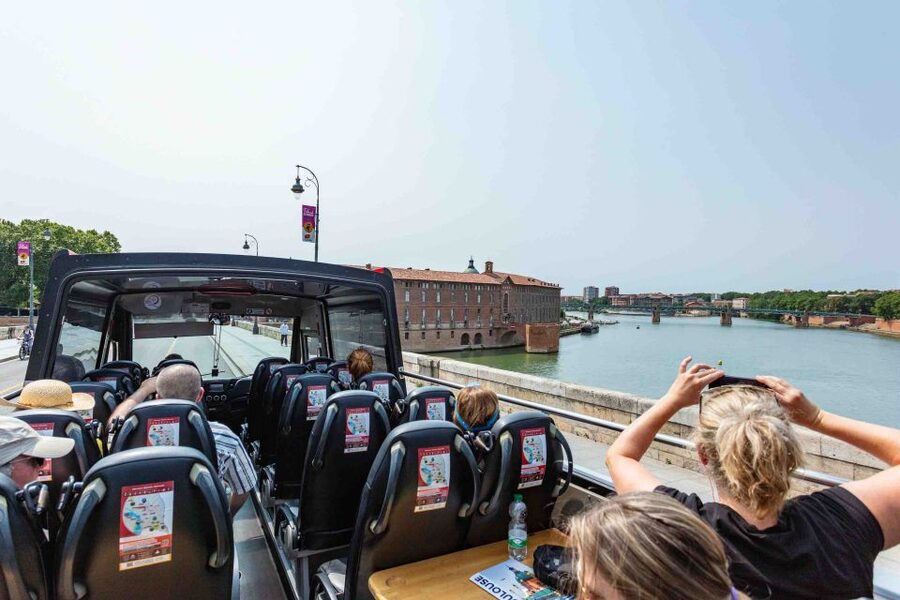
Toulouse reveals itself quickly from the top of a small open-air minibus. In about an hour, you’ll pass rose-colored brick streets, grand churches, the Capitol, the Garonne, and the Canal du Midi, getting a useful map of the city before you explore on foot. I like the easy view from the raised seats and the fact that the route slips through streets you might skip on a walking tour.
I also like the clear multilingual audio, with options including English, French, Spanish, Italian, German, Russian, Chinese, and Japanese. Drivers can add a friendly human touch, too. The main caution is that this is an overview, not a stop-and-explore tour. The recorded commentary can sometimes fall out of sync, and some passengers find the low seats or music make certain sights harder to follow.
Key points to know before you book
- A fast introduction to the Ville Rose: See Toulouse’s rose-colored brick center, major churches, riverfront, and canal in roughly one hour.
- The best seats are worth claiming early: The open top gives you better views, but low seating and other passengers can affect what you see.
- The commentary is mainly recorded: Audio is offered in eight languages, while the driver handles the route and may add extra remarks.
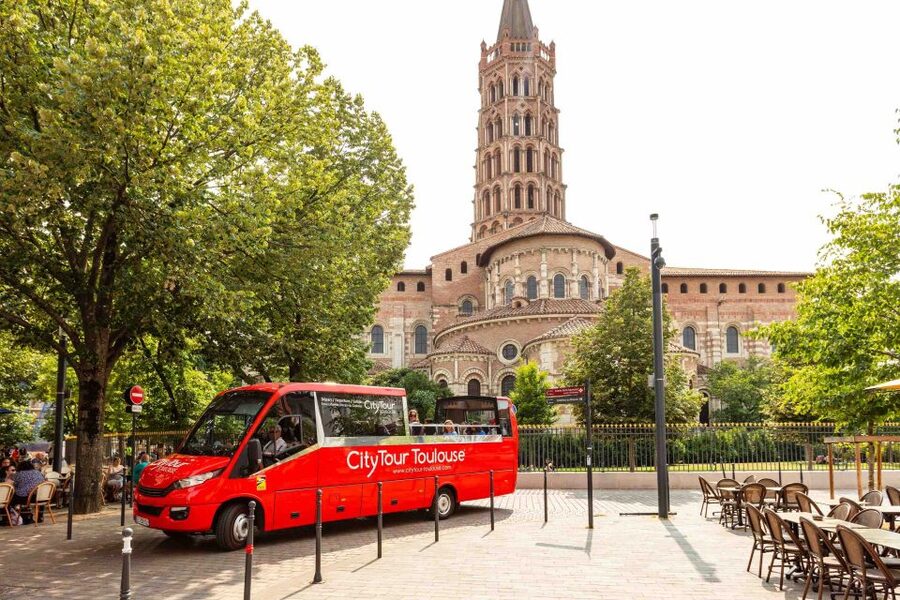
- The route covers major landmarks without stops: Expect to view Saint-Sernin, Toulouse Cathedral, Hôtel d’Assézat, the Capitol area, the Garonne, and Canal du Midi from the bus.
- Good value for a short stay: At $19 per person, it costs little compared with a private tour and helps you decide where to return later.
- Check the departure time carefully: The bus needs at least four passengers, and the advertised duration may vary from about 50 minutes to 75 minutes.
A quick ride through Toulouse’s pink-brick center
Toulouse is known as the Ville Rose, or Pink City, because much of its older architecture uses warm terracotta brick. From an open-top vehicle, that color is easy to notice. Sunlight brings out the soft pink and orange tones, while the compact streets give you a close look at façades, church towers, and busy squares.
The tour begins at Toulouse Welcome, at 2 rue du Poids de l’Huile, near the Donjon du Capitole. The bus departs from the corner of Rue du Poids de l’Huile and Rue de la Pomme, directly opposite the Capitol building. That location is central and easy to combine with a walk around the Capitol afterward.
You should think of this trip as a moving orientation rather than a sightseeing bus with regular stops. The minibus loops through Toulouse and returns to the same area. You stay aboard for the full ride, so bring your camera and keep your attention outside the windows.
The published duration is one hour, with the route also described as lasting about 75 minutes. One past departure took around 50 minutes. That variation matters if you have a train, museum reservation, or lunch booking immediately afterward. Give yourself a little breathing room.
More Bus Audio Tours in France
- Paris: Tootbus Panoramic by Night Bus Tour with Audioguide
★ 4.3 · 1,126 reviews - Paris: Openair Double Decker Bus Audio-Guided City Tour
★ 3.5 · 938 reviews - Toulouse: Carcassonne Day Trip by Coach with Audioguide
★ 4.4 · 580 reviews
What you see near the Capitol and old town
The Capitol is the natural starting point. Toulouse’s central square is one of the city’s main reference points, and beginning opposite it makes the meeting point simple to find. The building itself is one of the sights you’ll want to revisit on foot, since a bus view cannot show every architectural detail.
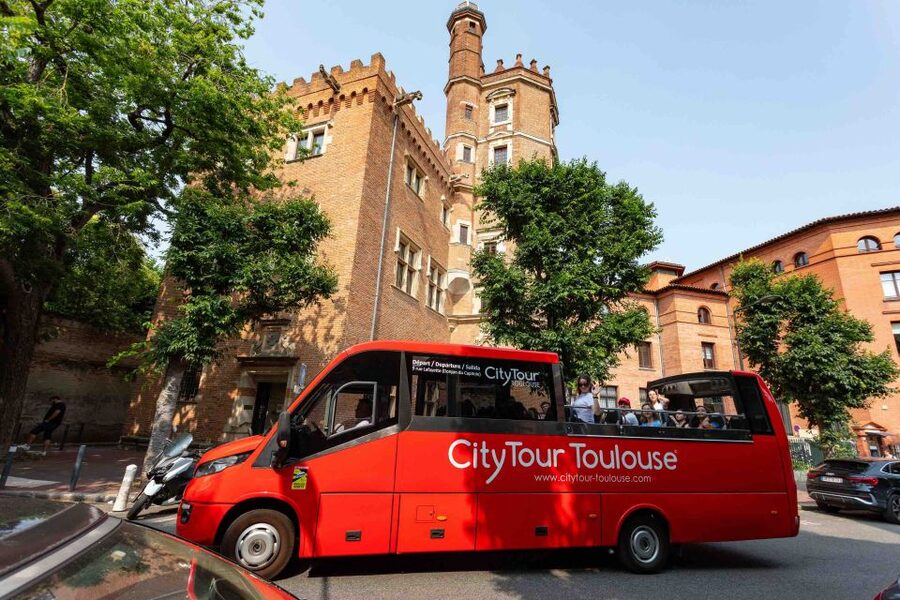
From here, the route moves into the old town and its narrow streets. A small minibus is useful in this setting. It can reach areas that would feel too tight for a full-size sightseeing coach, and you get a sense of how the historic center fits together.
The audio guide provides facts and anecdotes about Toulouse, its culture, food, and sporting life. The English recording has been described as having a pleasant British voice and a touch of humor. Some people find the accent personal and enjoyable, while others find a few words harder to catch. If English is not the right fit for you, you can select French, Spanish, Italian, German, Russian, Chinese, or Japanese.
The main limitation is orientation. At times, the recording may begin discussing a building just before or just after the bus passes it. If you want exact architectural detail, take a quick photo and note the street or nearby landmark so you can return later.
Saint-Sernin and Toulouse Cathedral from the road
Two of the most important church buildings on the route are the Basilica of Saint-Sernin and the Cathédrale Saint-Étienne de Toulouse. Both deserve a proper visit, but the bus gives you a useful first look and helps you understand where they sit within the city.
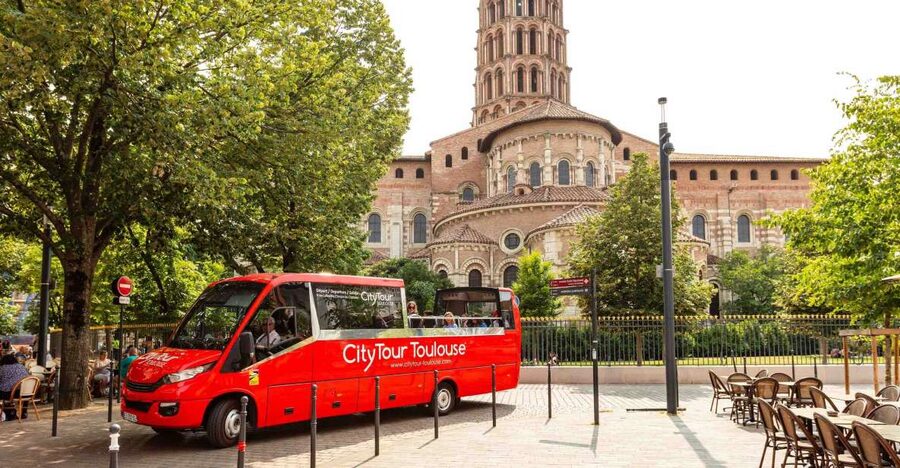
The Basilica of Saint-Sernin is especially important to Toulouse’s identity. From the vehicle, you can appreciate its scale and distinctive exterior, even though you will not have time to study the interior or walk around every side. The bus view is best treated as an introduction. If the church interests you, return later when you can enter at your own pace.
Toulouse Cathedral offers a different architectural impression. The route lets you see its main exterior and place it within the old town. Again, the audio guide supplies context, but this is not a church tour. You will not stop for a detailed explanation or a quiet interior visit.
This is where the experience works best as part of a larger day. Use the ride to mark the churches you want to see, then walk back after the bus tour. One advantage of starting near the Capitol is that you can continue on foot through the center without losing time finding your bearings.
Hôtel d’Assézat and the city’s grand façades
The route passes the Renaissance façade of Hôtel d’Assézat, one of Toulouse’s more elegant private mansions. Its architecture reflects the wealth created by the city’s historic trade in pastel dye. You’ll see the exterior from the bus, while the Bemberg Foundation art collection is housed inside.
The Fondation Bemberg contains French paintings from the 19th and 20th centuries. The bus cannot substitute for the gallery visit, but it can help you decide if the building and collection belong on your list. If you are interested in art, note the location as the minibus passes, then return with more time.
The value here is not a long stop. It is the chance to connect Toulouse’s streets with the city’s culture and past wealth. The commentary also broadens the ride beyond a simple list of buildings by touching on food, art, sport, and local life.
You may find the open roof particularly helpful on this part of the route. Tall façades can be difficult to photograph through side windows, and an unobstructed view makes it easier to look up. On the other hand, bright sun, wind, or rain can affect your comfort. The roof is a pleasure in good weather, but less useful if the day turns wet or cold.
More City Audio Tours in France
- Rouen: Audio Guided City Tour
★ 3.9 · 79 reviews - Paris Luxury Minivan City Tour with Audio Guide
★ 5.0 · 2 reviews - Private Auto Paris City Tour with Audio Guide
★ 5.0 · 2 reviews - Rome: City Sightseeing Hop-on Hop-off Bus with Audioguide
★ 4.0 · 16,045 reviews
The Garonne and Canal du Midi
The ride also reaches the banks of the River Garonne and the Canal du Midi. These waterways explain an important part of Toulouse’s character and its place between the Atlantic and Mediterranean worlds.
The Garonne gives the tour a welcome change from the close streets of the old center. You get wider views and a sense of the city’s setting. The Canal du Midi adds another layer, showing the engineered water route that links Toulouse toward the Mediterranean.
This part of the ride is valuable because it connects individual sights into a bigger picture. Instead of seeing only churches and façades, you see the waterways that shaped movement, trade, and daily life. The audio guide explains the connection between the Atlantic Ocean and Mediterranean Sea, giving the route more context than a silent drive-by.
Do not expect a long riverside stop. The minibus continues along its route and returns to the central meeting point. If you want a slow walk beside the water, treat this section as a preview and plan time afterward.
How the audio guide works in practice
The audio guide is included, and the language list is unusually broad for a short city ride. You can choose English, French, Spanish, Italian, German, Russian, Chinese, or Japanese. The live guide language information also includes Traditional Chinese, alongside English, French, German, Italian, and Spanish.
The recorded narration is easy to follow for much of the route, with short sections that cover monuments and local details. Some departures have had a driver who added extra information, humor, or a personal touch. Guides named Gabriel and Ray have been praised for being attentive hosts, though the person on your departure may be different.
I would not book this expecting a full live walking tour. The driver’s main job is to operate the vehicle and keep the route moving. The audio recording does most of the explaining. That makes the experience consistent and convenient, but it also means you cannot stop the narration to ask about a particular building.
There are a few practical sound issues to keep in mind. The recording may occasionally be out of sync with the view, and one passenger found the music louder than the speech. If you miss a sentence, do not worry. The route is short, and you can focus on the next clearly identified sight.
Comfort, views, and the open-top setup
The vehicle is described as comfortable, and the open top gives you a strong view of the streets. A retractable roof has also been used, which helps when the weather changes. The arrangement is more intimate than a large double-decker bus, but it also means that seating capacity and sightlines matter.
Try to arrive early if having a particular view is important to you. One issue raised by passengers is that a group arriving together may take the best seats. The upper or most open seats give you the clearest view, while low seats can make it harder to see over people or frame buildings.
The vehicle’s size is an advantage in Toulouse’s older streets. You get closer to the architecture, and the route can cover more ground than you would on foot in the same time. The tradeoff is that the bus may not pause long enough for you to study a monument.
Smoking is not allowed. The minimum operating requirement is four passengers, so it is sensible to confirm the departure is running if your plans are very tight. Booking can be canceled up to 24 hours before departure for a full refund, and a reserve-now, pay-later option is available.
Is $19 good value for one hour?
At $19 per person, this is a fair price for a compact orientation ride. You are paying for a central departure, an open-top minibus, a multilingual audio system, and access to a route that covers several separate parts of Toulouse.
The value is strongest if you have only a few hours in the city. You can see the main churches, central streets, Hôtel d’Assézat, the Garonne, and the Canal du Midi without using your limited energy on a long walk. Afterward, you can choose two or three places to visit properly.
It is less compelling if you already know Toulouse well or prefer detailed, slow sightseeing. A self-guided walk costs less and lets you enter buildings, pause for photographs, and change direction whenever you like. This ride earns its price by saving time and showing you the shape of the city quickly.
For older passengers or anyone who finds long walks difficult, the bus can be a practical choice. One booking suited an 82-year-old passenger and a 66-year-old companion particularly well. Still, the low seating and occasional difficulty seeing over other passengers are worth considering.
Who will enjoy this Toulouse tour most?
I would choose this trip for a first visit, a short stop between trains, or the first morning of a longer stay. It helps you identify the Capitol, Saint-Sernin, the cathedral, the river, and the canal before you commit to a walking route.
It also suits families and mixed-age groups because you cover a lot without asking everyone to walk for an hour. The audio options make it useful for international groups, and the driver can sometimes add light humor or extra local comments.
You may want something else if your priority is detailed history, interior visits, or questions answered in real time. The narration is informative but brief. The bus does not replace a specialist guide or a careful walking tour of Toulouse’s churches and Renaissance mansions.
My practical verdict
I would book this tour if I had limited time and wanted a clear first impression of Toulouse. The strongest features are the small open-top vehicle, the central meeting point, the broad route, and the language choices. The driver’s friendly manner can make the ride feel more personal than a fully automated bus.
I would not book it as my only sightseeing activity. Use the hour to get oriented, then return to Saint-Sernin, Toulouse Cathedral, Hôtel d’Assézat, or the riverfront on foot. Arrive early for better seats, allow more than the advertised hour, and keep expectations focused on an overview.
FAQ
How long does the Toulouse city tour last?
The listed duration is one hour, while the route is also described as lasting 75 minutes. One past departure took about 50 minutes, so allow some flexibility.
Where does the tour begin?
It begins at Toulouse Welcome, 2 rue du Poids de l’Huile, near the Donjon du Capitole.
How do I find the exact departure point?
The bus departs from the corner of Rue du Poids de l’Huile and Rue de la Pomme, directly opposite the Capitol building.
Is the tour conducted in an open-top vehicle?
Yes. The experience uses an open-top minibus, and a retractable roof may be used when needed.
Which sights can I see?
The route passes the Capitol area, Toulouse Cathedral, the Basilica of Saint-Sernin, Hôtel d’Assézat, the River Garonne, and the Canal du Midi.
Is the commentary live or recorded?
The main commentary is provided by an audio guide. The driver may also add information during the ride.
Which audio guide languages are available?
The audio guide is available in Chinese, English, French, German, Italian, Japanese, Russian, and Spanish.
Which languages are listed for the live tour guide?
The live tour guide language information includes English, French, German, Italian, Spanish, and Traditional Chinese.
Does the bus stop so I can visit the sights?
The tour is a stay-on-the-bus sightseeing ride. It returns to the starting point rather than providing regular sightseeing stops.
Can I cancel the booking?
Yes. You can cancel up to 24 hours in advance for a full refund. A reserve-now, pay-later option is also available.
Latest audio tours in France
- Rouen audio guided tour★ 4.0 · 19 reviews
- Rouen Cathedral Self Guided Audio Tour★ 4.0 · 2 reviews
- Rouen: Audio Guided City and Joan of Arc Tour★ 4.0 · 2 reviews
- The Hardest City to Invade: Saint Malo’s Secrets Audio Guide★ 4.5 · 9 reviews
- The Tuileries Garden’s Classic Sights: A Self-Guided Audio Tour★ 4.0 · 3 reviews
- The French Revolution: Self Guided Audio Tour of Paris★ 4.5 · 3 reviews
- Audioguide – The Eiffel Tower and its secrets★ 4.0 · 4 reviews
- A Self-Guided Audio Tour Around Parc Montsouris★ 3.5 · 6 reviews
Bus Audio Tours, compared.
City Sightseeing Hop-on Hop-off Bus with Audioguide
Read our review →
City Sightseeing Hop-On Hop-Off Bus with Audio Guide
Read our review →


City Bus Tour with Audio Guide and Lake Cruise
Read our review →
Tootbus Panoramic by Night Bus Tour with Audioguide
Read our review →
City Sightseeing Hop-On Hop-Off Bus Tour with Audio Guide
Read our review →
Trakai Tour with Audio Guide and Minibus Transfers
Read our review →Browse the lists this tour appears in