
Reviewed · ROME
Rome: City Sightseeing Hop-on Hop-off Bus with Audioguide
Rome is easiest to understand from above street level, and this open-top bus gives you a useful first look at the city’s scattered monuments. You can ride the full 100-minute loop, hop off near major sights, then continue when you are ready. I especially like the flexible ticket choices and the fact that the fare includes the Jubilee Line, a useful extra route connected with Vatican and Rome Open. The main caution is simple: this bus shows you Rome better than it reaches every attraction. Traffic can slow the ride, stops can change during special events, and the commentary may occasionally cut out before a segment finishes.
I also like the easy starting point at Via Marsala, near Roma Termini, and the choice of eight audio languages. You can use the bus to get your bearings on arrival, or treat it as sightseeing in its own right. Just remember that a one-loop ticket is not a hop-on, hop-off pass, and attraction entry is not included.
Key points to know before you board

- A full loop takes about 100 minutes, making it a practical introduction to Rome when you have limited time.
- The route passes the Colosseum, Vatican City, Trevi Fountain, Spanish Steps, Piazza Navona, and more, but you must arrange attraction tickets separately.
- The 1-day, 24-hour, 48-hour, and 72-hour choices suit different plans, while the one-loop option is for riding without getting off.
- The Jubilee Line is included, giving you an extra route beyond the main City Sightseeing circuit.
- Audio commentary is offered in eight languages, with headphones and Wi-Fi available on the open bus.
- The route is useful but not fixed in stone, since special events can change or close some stops.
Seeing Rome from an open-top bus

Rome is a city of grand monuments separated by ordinary streets, busy junctions, and several of the famous Seven Hills. Walking is rewarding, but the distances add up quickly. The bus gives you a broad view before you decide where to spend your limited time on foot.
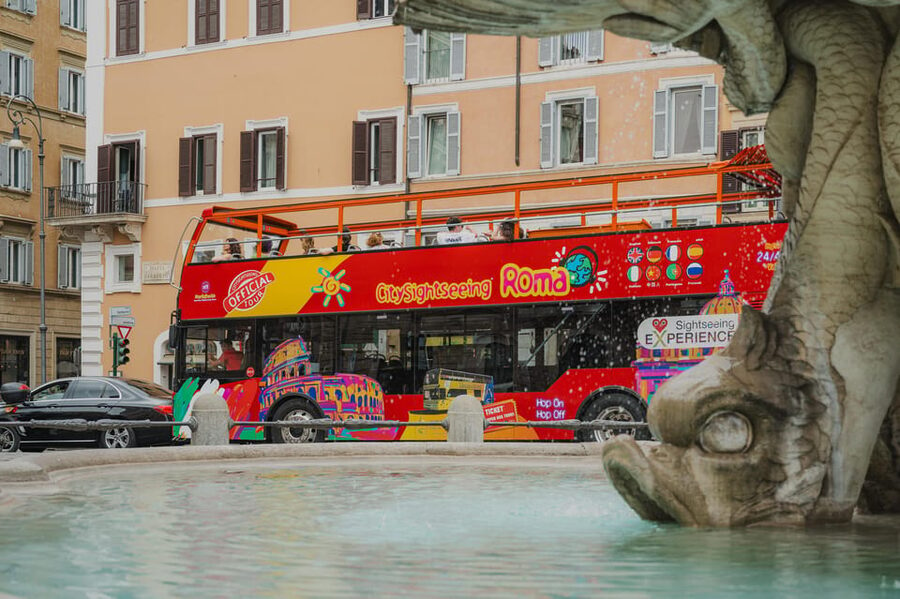
The open upper deck is the main appeal. You can see churches, piazzas, ruins, fountains, and domes without constantly checking a street map. The lower deck provides shelter, though the open-air view is the reason to choose this service.
You may ride the entire loop without getting off. That works well on your first afternoon, especially if you arrive at Roma Termini with only a few hours available. A complete circuit takes about 100 minutes, although Rome’s traffic and special events can affect the timing.
The audio guide adds context as you pass each area. English, Italian, French, German, Spanish, Portuguese, Russian, and Chinese are available. Headphones are supplied on the open bus, and Wi-Fi is included there as well. The commentary is generally clear and informative, though you may find that some sections are interrupted or finish early. I would treat the audio as a helpful layer, not a replacement for a guided walking tour.
More Hop-On Hop-Off Audio Tours in Rome
- Rome: Hop-on Hop-off Sightseeing Bus Tour with Audioguide
★ 4.1 · 4,801 reviews - Rome: Colosseum, Forum Audio Tour with Hop-on Hop-off Bus
★ 3.9 · 6 reviews - Hop-on Hop-off and Saint Mary Major with Audio Guide Option
★ 4.0 · 5 reviews
Starting near Roma Termini
The listed starting point is Via Marsala, 7, close to Roma Termini. You can also begin at any stop on City Sightseeing Rome Line A. This is handy because you do not need to cross the city just to reach the bus.
Roma Termini is a practical base for many visitors arriving by train or airport connection. From here, you can settle into the route and see how Rome fits together. The first part of the ride takes you past Santa Maria Maggiore and toward San Giovanni in Laterano, two major churches that deserve more attention than a quick glance from the upper deck.
If you are using a one-day or longer ticket, I suggest riding part of the loop first and getting off at the area that interests you most. The route is more useful when you combine it with walking, rather than expecting it to replace Rome’s buses, metro, or your own feet.
Santa Maria Maggiore and San Giovanni in Laterano
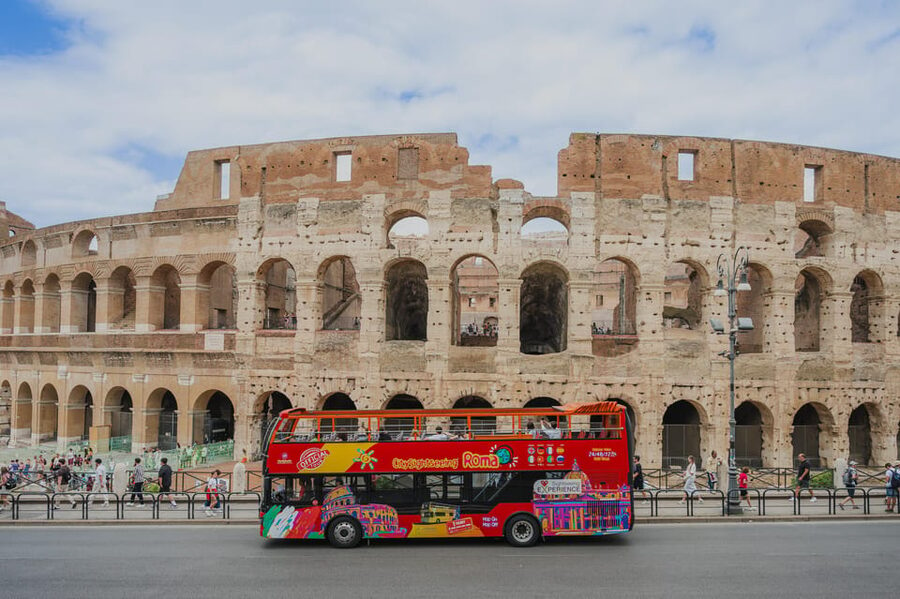
Santa Maria Maggiore is one of Rome’s great basilicas. From the bus, you get a quick look at its position near Termini and the broad streets around it. It is a good reminder that Rome’s famous sights are not limited to the Colosseum and Vatican.
The bus then passes Basilica di San Giovanni in Laterano. This church is the cathedral of Rome, and its importance can be easy to miss if you focus only on the central historic district. The stop is useful for anyone interested in Rome’s major religious buildings, though the published route describes these churches as pass-by points rather than guaranteed places to leave the bus.
That distinction matters. You can see a great deal from the bus, but you should not assume every passing landmark has a convenient hop-off point directly outside it.
The Colosseum and Circus Maximus
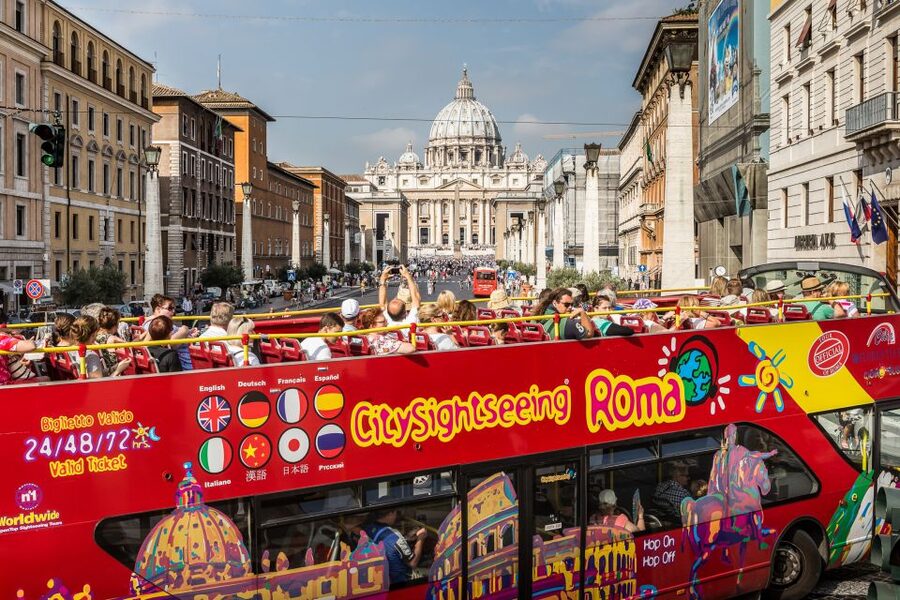
The Colosseum is the visual star of the route. The bus gives you a raised view of its enormous outer walls and places the amphitheater beside the rest of ancient Rome. Even if you already know the building from photographs, seeing its scale in relation to modern streets is useful.
The Colosseum stop is listed among the route’s points, but service can be affected by traffic, restrictions, or special events. You may also find that the bus passes close enough for excellent photographs while getting off is not possible at that moment. If entering the Colosseum is important to you, buy a separate attraction ticket and allow plenty of time for walking and admission. The bus fare does not include entry.
Nearby Circus Maximus offers a different view of ancient Rome. It is a long open space rather than a complete monument, so the bus gives you a good sense of its size. This is one of the route’s better contrasts: the Colosseum is compact and dramatic, while Circus Maximus is broad and understated.
The combination works well for first-time visitors. You see the famous structure, then pass the much larger setting where public spectacles once took place. The audio commentary can help connect the two.
More Bus Audio Tours in Rome
- Colosseum, Forum, Palatine Hill with audio guide and Arena or Bus option
★ 4.0 · 193 reviews - Rome Panoramic Bus Tour & Colosseum Arena Visit with Audio Guide
★ 4.5 · 31 reviews - Rome: Panoramic sightseeing Bus Tour + City Highlights Audioguide
★ 3.0 · 11 reviews - Pontifical Villa Gardens at Castel Gandolfo Audio-Guided Minibus Tour
★ 4.0 · 10 reviews
Piazza Venezia, Largo Argentina, and Piazza Navona
Piazza Venezia is one of Rome’s key traffic centers, marked by the large white monument to Victor Emmanuel II. From the bus, you can take in the monument, the surrounding avenues, and the city’s habit of placing grand buildings right beside ordinary urban life.
The next notable point is Largo di Torre Argentina. Its exposed ancient ruins sit below street level, and the site is visually different from the Colosseum. A pass-by view will not give you much time to study the remains, but it adds another layer to the ride.
Piazza Navona is one of the most rewarding places to leave the bus. Its long oval shape follows the outline of an ancient stadium, and its fountains, church facade, cafés, and street life make it a natural place to wander. The route gives you a convenient way to reach this part of central Rome without committing to a long walk from Termini.
I would plan time here rather than simply taking a photograph from the bus. The square is best experienced at street level, where you can see the fountains and surrounding architecture from different angles. Food and drinks are not included, so any café stop is at your own expense.
Vatican City and Castel Sant’Angelo
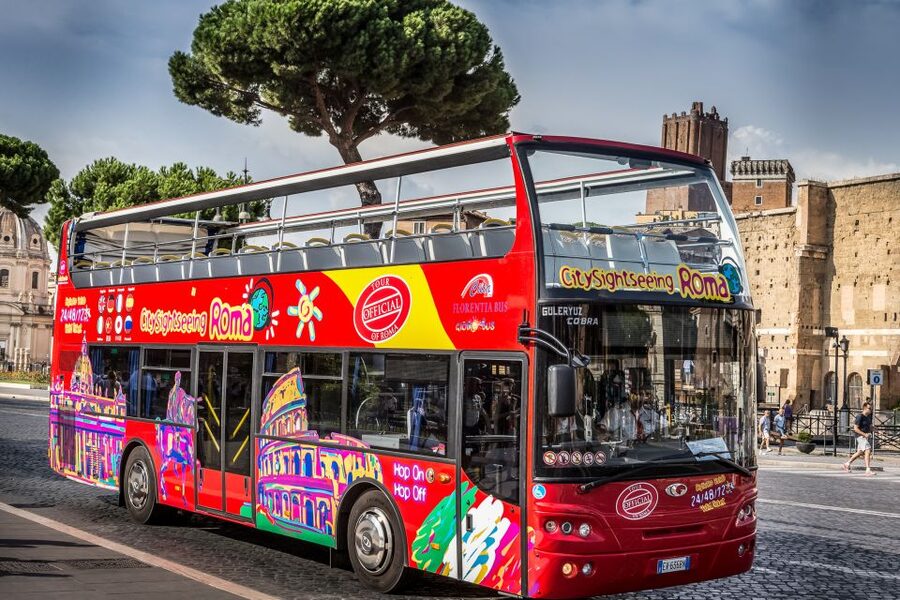
The Vatican section passes near Vatican City and Castel Sant’Angelo. This is one of the most useful parts of the circuit for orientation because the area contains several major sights close together, yet the streets can be confusing on foot.
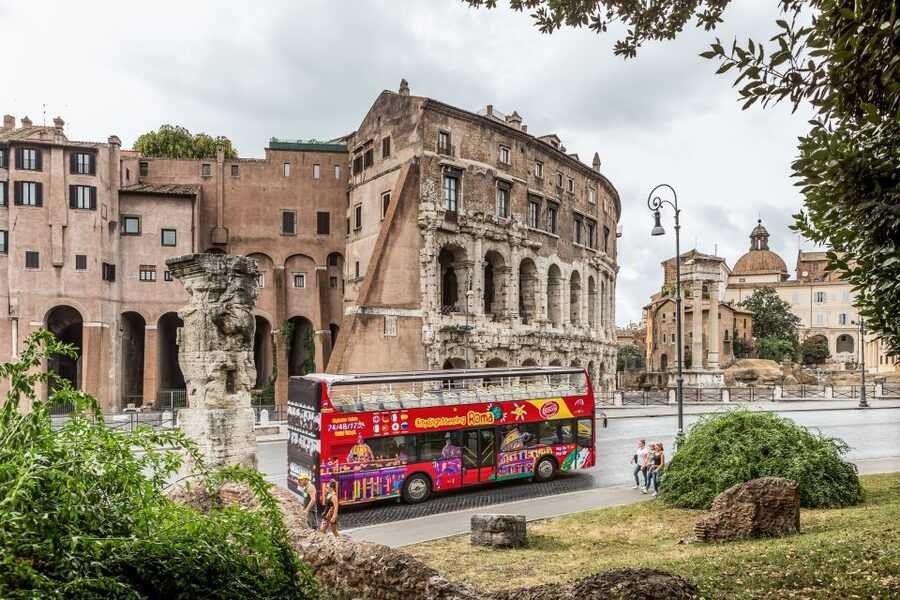
The Basilica di San Pietro dominates the Vatican approach. The route gives you a sense of the vast scale of the church and the open space around it. Castel Sant’Angelo, originally built as a mausoleum and later used as a fortress, provides a strong visual marker beside the river.
The bus is a good way to see these landmarks in one sweep, but it does not include Vatican Museums or St. Peter’s entry arrangements. If you plan to visit either, treat the bus as transportation between sightseeing periods, not as your admission plan.
The included Jubilee Line is especially useful here. It is operated by Vatican and Rome Open and is exclusive to the City Sightseeing ticket. The supplied information does not give a separate timetable or complete stop list for this line, so check the current operating details when you board. Its inclusion adds value for anyone planning to spend time around the Vatican.
Spanish Steps, Trevi Fountain, and Piazza Barberini
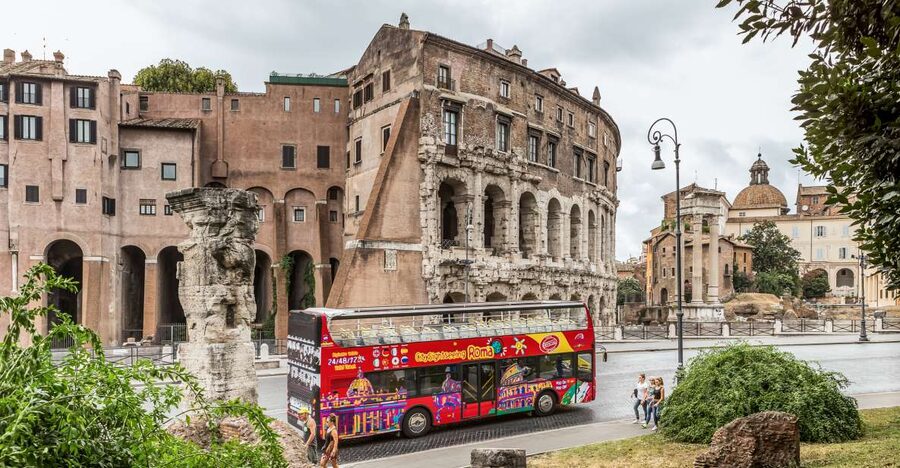
The route continues toward Piazza di Spagna and the Trevi Fountain. These are among Rome’s most popular stops, and they are also among the areas where crowds, traffic, and temporary closures can affect the bus.
The Spanish Steps connect Piazza di Spagna with the upper streets near Trinità dei Monti. From the bus, you get the location and a quick view, but the steps themselves are best appreciated on foot. The nearby Trevi Fountain is also a walk-down sight. The bus can get you into the area, but do not expect to pull up to the fountain itself.
Piazza Barberini provides another useful central point. It is known for Bernini’s Triton Fountain and for its position between the historic center and the streets leading toward Villa Borghese. This part of the route can help you connect several major areas without repeatedly returning to Termini.
Because the Spanish Steps and Trevi Fountain are popular, a flexible pass is more useful than a rushed single ride. You can get off, walk between nearby sights, and pick up a later bus. Exact waiting times are not provided, so allow extra time rather than building a tight schedule around the next departure.
Villa Borghese and the return to Termini
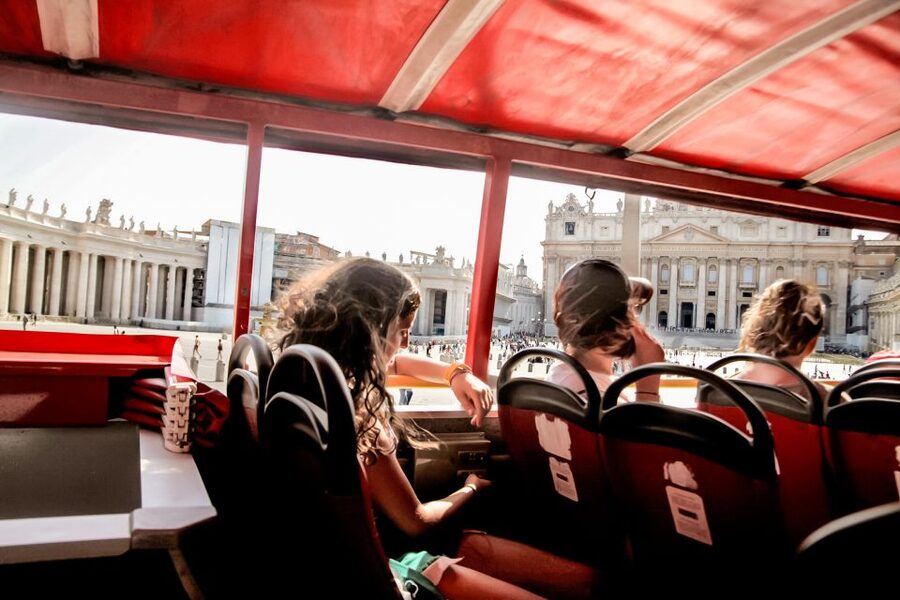
Villa Borghese appears on the route as a pass-by point. The park offers a quieter change from Rome’s stone-heavy central streets, and the bus gives you a quick sense of its wooded setting and location above Piazza del Popolo.
If your plan includes the Borghese Gallery, remember that the gallery requires its own ticket and booking arrangements. The hop-on, hop-off fare does not include attraction entry. The route is still useful for reaching the park area, but you should confirm the current stop position before committing to a timed visit.
From Villa Borghese, the bus continues toward Piazza Barberini and Roma Termini before returning to Via Marsala. The full circuit works best as a visual map of Rome. After riding it once, you may find that later walking routes feel less confusing because you understand how the major districts relate to each other.
Choosing between one loop and 1 to 3 days
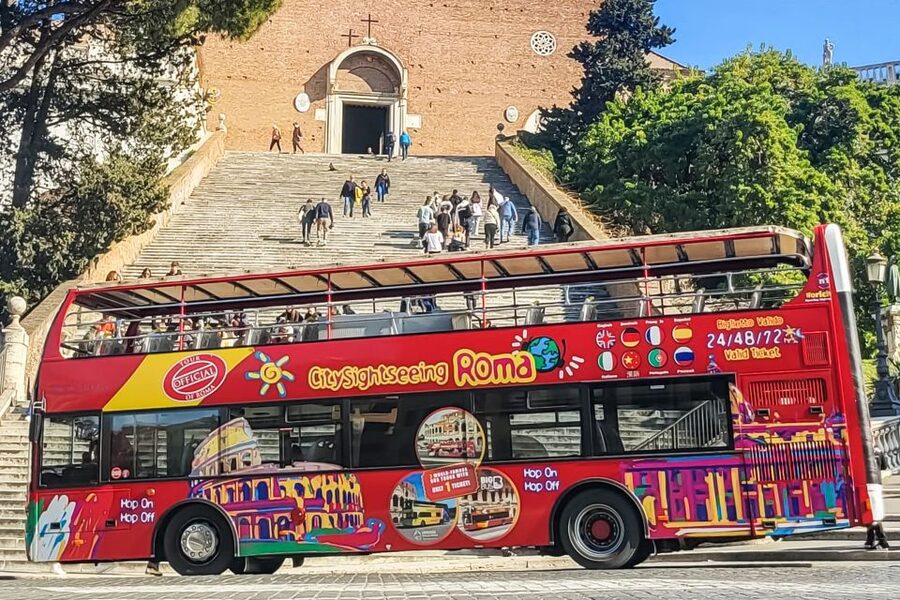
The one-loop option is the simplest choice if you want a seated overview and do not plan to get off. It is also the option most likely to disappoint anyone expecting a true hop-on, hop-off pass. The information specifically states that one loop is not a hop-on, hop-off tour.
For more freedom, choose the 1-day, 24-hour, 48-hour, or 72-hour ticket shown at booking. The difference between a calendar day and a 24-hour period can matter, so check the exact product name and validity before paying.
I see the best value in the 48-hour ticket if you want to use the bus for both sightseeing and orientation. One day can feel rushed when you include the Colosseum, Vatican area, Trevi Fountain, and Spanish Steps. A longer ticket lets you ride the full circuit once, then use selected sections on another day.
At the stated price of $15 per person, the service can be good value if you use it for more than a single transfer. It is less compelling if you only want transportation between two points, since the route is designed for sightseeing and may take longer than a direct public transport connection.
What the bus does well, and where it falls short
The strongest feature is freedom. You can stay seated for the whole loop, get off for a long visit, or use the bus for only part of the route. The different ticket lengths make it easier to match the service to your schedule.
The route also covers the landmarks most people want to place on a first Rome visit. Colosseum, Vatican City, Spanish Steps, Trevi Fountain, Piazza Navona, Circus Maximus, and Piazza Venezia all appear in one circuit. That is a lot of visual information in less than two hours.
The weak points are just as clear. Rome’s traffic can slow the ride, and special events may alter the route or make some stops unavailable. You should also expect a pass-by view of several places rather than a guaranteed stop beside every monument.
The audio guide is useful, but technical interruptions are possible. If the commentary matters greatly to you, bring your own basic sense of the route from the app and treat the spoken narration as an extra.
Who will get the most from this Rome bus tour?
I would recommend it to first-time visitors, families, older visitors, and anyone with limited time. It is also helpful if you want to see the city without committing to a long walking day.
It suits you particularly well if you want to get your bearings fast, photograph major landmarks, and decide which areas deserve a longer visit. The open-top view makes the ride feel like sightseeing rather than a plain transfer.
I would be more cautious if you already know Rome well, dislike traffic, or need precise point-to-point transport. You may find walking and public transport faster for individual journeys. The bus works best as a city overview with flexible stops, not as a guaranteed schedule.
Cancellation is available up to 24 hours before the experience for a full refund, and you can reserve now and pay later. Those terms help if your Rome plans are still moving, but you should still check the current start times and route conditions before setting out.
Should you book it?
Book this tour if you want an easy first look at Rome and value the ability to sit, photograph, and get off when a district catches your attention. The 48-hour option is the strongest choice for a relaxed visit, while the one-loop ticket suits a short overview only.
Skip it if your priority is entering monuments or reaching one attraction as quickly as possible. You will need separate tickets for the Colosseum, Vatican attractions, and other paid sites. For most first visits, though, the open-top circuit and included Jubilee Line offer a practical way to see how Rome’s major sights fit together.
FAQ
Where does the Rome hop-on, hop-off bus start?
The listed starting point is Via Marsala, 7, near Roma Termini. You can also begin at any stop on City Sightseeing Rome Line A.
How long does the full bus loop take?
The full loop takes about 100 minutes.
Can I get off and board again?
Yes, if you purchase a hop-on, hop-off ticket valid for 1 day, 24 hours, 48 hours, or 72 hours. The one-loop option is not a hop-on, hop-off ticket.
Which major sights does the route pass?
The route passes Santa Maria Maggiore, San Giovanni in Laterano, the Colosseum, Circus Maximus, Piazza Venezia, Largo di Torre Argentina, Piazza Navona, Vatican City, Villa Borghese, Piazza di Spagna, Piazza Barberini, and Roma Termini.
Is the Colosseum entrance included?
No. Attraction tickets are not included in the bus experience.
Is the Vatican entrance included?
No. The bus passes Vatican City, but attraction tickets are not included.
What languages are available for the audio guide?
Audio commentary is available in Spanish, Chinese, English, French, German, Italian, Russian, and Portuguese.
Are headphones included?
Yes. Headphones are included on the open bus.
Is Wi-Fi available onboard?
Yes. Wi-Fi is included on the open bus.
What is the Jubilee Line?
The Jubilee Line is an additional route operated by Vatican and Rome Open. It is included with the City Sightseeing ticket.
Can the route change?
Yes. Special events can change the route, and some stops may not be guaranteed.
More City Audio Tours in Rome
- Milan: City Sightseeing Hop-On Hop-Off Bus with Audio Guide
★ 4.0 · 6,256 reviews - Riga: Canal Boat Sightseeing Tour With Audio guide
★ 4.5 · 1,827 reviews - Florence: Eco-Friendly Golf Cart City Tour with Audio Guide
★ 4.6 · 1,094 reviews - City Sightseeing Hop-On Hop-Off Bus Tour with Audio Guide
★ 3.0 · 1,083 reviews
Latest audio tours in Rome
- Pantheon Skip the Line Entry Tickets with Digital Audio Guide★ 3.5 · 52 reviews
- St. Peter’s Basilica: Dome Climb with Lift & Audioguide★ 4.5 · 13 reviews
- Audio guide in Vatican Museums and Sistine Chapel★ 4.5 · 12 reviews
- The Roman Jewish Ghetto: A Self-Guided Audio Tour★ 4.0 · 8 reviews
- Experience: The Pantheon Audio Tour★ 4.5 · 4 reviews
- Trastevere: A Self-guided Audio Tour of Rome’s Medieval Village★ 4.5 · 3 reviews
- Navova square underground with audioguide★ 4.5 · 17 reviews
- The Colosseum’s Attic with 3rd, 4th & 5th Levels with Audio Guide★ 4.5 · 20 reviews
Hop-On Hop-Off Audio Tours, compared.
City Sightseeing Hop-On Hop-Off Bus with Audio Guide
Read our review →

City Sightseeing Hop-On Hop-Off Bus Tour with Audio Guide
Read our review →
Hop-On-Hop-Off with Optional Audio Tour or Cruise
Read our review →
Golden Tours York Hop-on Hop-off Open Top Bus Tour with Audio Guide
Read our review →
Doha: 24-Hour Hop-On Hop-Off Bus Ticket with Audio Guide
Read our review →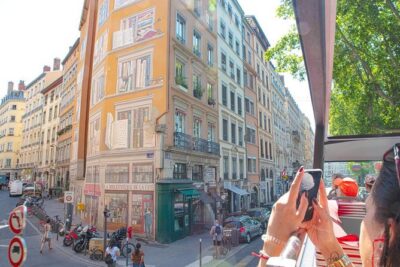
Browse the lists this tour appears in