
Reviewed · FRANCE
The Hardest City to Invade: Saint Malo’s Secrets Audio Guide
Saint-Malo’s best story is written in stone: a fortified port that faced the sea, defended itself with gates and bastions, and sent sailors toward Canada. This self-guided GPS walk links those clues in about an hour, from the tourist office to the Big Gate.
I like the precise navigation and the freedom to stop for photos, coffee, or a second look at a rampart view. I also like the offline access and lifetime use, which make this a useful orientation walk even if your schedule changes. The main drawback is that the audio moves a little quickly, and some French names would be easier to follow with French pronunciation.
Key points to know before you go
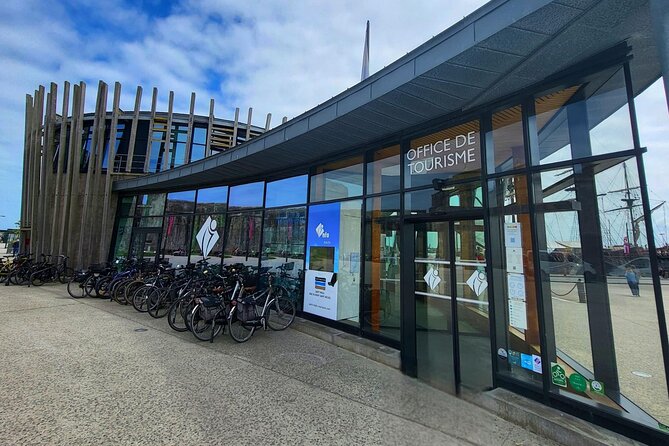
- Start at the Saint-Malo Tourist Office: The meeting point is on Esplanade Saint-Vincent, not in central Rennes, despite Rennes being listed as the wider location.
- Walk the city’s defensive spine: The route visits Saint-Malo Castle, several gates, bastions, towers, and sections of the famous ramparts.
- Hear the Canada connection: Jacques Cartier, Quebec Square, and House Quebec give the walk an Atlantic focus beyond the city walls.
- Plan on 60 to 75 minutes: The route ends at the Big Gate, with entry fees not included for any museums or attractions along the way.
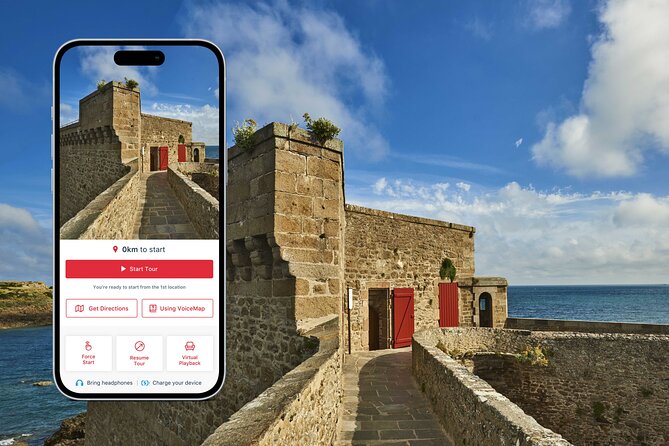
- Use your own equipment: You need a smartphone and headphones. Audio, maps, and route data can be used offline.
- Expect an audio guide, not a live escort: VoiceMap provides the English narration, GPS directions, and written information for your private group.
Saint-Malo’s walls tell the story

This walk is less about checking off isolated sights and more about understanding how Saint-Malo worked as a fortified port. The route takes you from the modern tourist office toward the sea, then around the old city’s defensive points and historic entrances.
You’ll hear about corsairs, military engineers, explorers, writers, and merchants. That range gives the tour a useful shape. Saint-Malo is not presented only as a pretty seaside town. You get a sense of why its gates mattered, why its walls were strengthened, and how the city’s maritime links reached as far as Quebec.
The tour is offered in English and lasts roughly one hour to one hour and 15 minutes. The GPS format means you do not need to keep checking a printed route. As you approach a stop, the audio should guide you toward the next point. Offline maps and geodata are included, which matters if your phone connection is weak around the old fortifications.
One practical note deserves attention. The experience is listed under Rennes, but the actual start is the Office de Tourisme de Saint-Malo at Esplanade Saint-Vincent. If you are planning transport from Rennes, check your timing carefully. This is a Saint-Malo walking tour, not a guided transfer from Rennes.
More Audio Tours in France
- Paris: Illuminations River Cruise with Audio Commentary
★ 4.3 · 12,340 reviews - Paris: Louvre Museum Hosted Entry and Mona Lisa Audioguide
★ 4.6 · 5,235 reviews - Paris: Orsay Museum Entry Ticket and Digital Audio Guide App
★ 4.4 · 3,170 reviews
Begin at the tourist office and the sea
The route starts outside the Office de Tourisme de Saint-Malo. That is a sensible meeting point because you can get your bearings before setting off, check what else is open, and make sure your phone and headphones are working.
From there, you walk toward Chaussée du Sillon. This boulevard gives you broad views of the sea and coastline, helping you read Saint-Malo as a maritime city before you enter the denser old town. It is a good early pause for photographs, especially if you want to connect the later fortress walls with the open water they were built to watch.
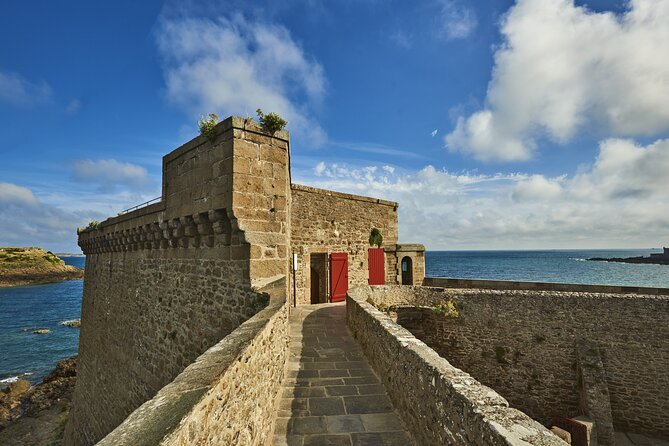
The walk then turns toward Saint-Malo Castle. The castle brings together the main themes of the tour: defense, local power, corsairs, and the threat of attack from the sea. The audio explains the castle’s role in protecting the city, so you are not simply looking at a large stone structure without context.
Because this is a walking route rather than a castle admission tour, do not expect entry to every attraction mentioned. Entry fees are not included. The main value here is the explanation you hear while moving through the city streets and defensive areas.
Gates, ermine, and the city’s changing defenses

Saint Vincent Gate is one of the first important entrances on the route. The guide points out the ermine symbol, a useful detail because it appears throughout Saint-Malo. Symbols like this can be easy to miss when you are walking independently. The audio gives you a reason to look closely at the stonework and local signs.
Next comes Porte Saint-Thomas, with its unusual connection to the city’s three Saint Thomas gates. The explanation covers different stages of Saint-Malo’s fortifications, helping you see that the walls were not created in one single campaign. They changed as the city grew and as military needs changed.
This is where the GPS format earns its keep. Old towns can be confusing, particularly when a route moves between gates, squares, and rampart entrances. The directions were praised for being easy to follow, while the narration itself was considered a little fast. I would keep the app controls ready so you can pause or replay a passage when a name or date goes by too quickly.
The route also passes the birthplace of Chateaubriand. He was a major French writer, politician, and diplomat. His presence adds a literary and political note to a tour otherwise shaped by fortifications and seafaring.
Place Vauban and the engineering of war

Place Vauban is the large square in front of the castle. It is named for Vauban, the celebrated military engineer associated with French fortifications. The guide explains his influence on Saint-Malo’s defenses, giving you a clearer idea of how military planning shaped the city’s appearance.
I like this stop because it turns a broad square into a lesson in strategy. You can begin to think about angles, gates, walls, and the movement of troops rather than seeing the fortifications as scenery alone. The square also helps you understand the relationship between the castle and the wider defensive system.
From here, the route continues through Poterne Aux Normands, a historic gateway that offers a glimpse of the medieval city. It is a smaller, more enclosed part of the route, and it contrasts with the open views along Chaussée du Sillon.
The Bastion de la Reine follows. This strong defensive point was important to the city’s protection, and the audio explains its strategic role. Bastions are easier to understand when you hear how they fit into a larger wall system. Look outward as you walk, but also pay attention to how the bastion connects with nearby sections of the ramparts.
Another self-paced route in France:
- From Paris: Giverny Day Trip with Audio Guide or Live Guide
★ 4.3 · 2,372 reviews - Paris: Eiffel Tower Access w/ Audioguide and Optional Cruise
★ 4.0 · 1,630 reviews - Giverny and Monet’s House Half Day Trip from Paris Guide or Audio
★ 4.0 · 1,319 reviews - Paris: Catacombs Entry & Seine River Cruise with Audio Guide
★ 4.4 · 1,150 reviews
Towers, odd street names, and sea views
At Bidouane Tower, you hear the story behind the name of the dancing cat street. It is one of the tour’s more unusual details, the sort of small local clue that can make a walk feel more personal. Not every stop is a major monument, and that is a strength here. A strange street name can reveal as much character as a grand gate.
The route then reaches Champs-Vauvert Cavalier, a section of the defensive works with strong views and more military context. The word cavalier refers to a raised defensive position, and the stop gives you another chance to see how Saint-Malo used height and stone to guard the city.
The audio tour does not take you all around the walls. That limitation matters if your main goal is a complete rampart circuit. You will see and walk along notable sections, but this is a focused historical route rather than a full perimeter walk. If you want to cover every stretch of the walls, allow extra time after the audio ends.
Quebec Square and Saint-Malo’s Atlantic reach
Place du Quebec shifts the story from local defense to overseas connections. At House Quebec, the guide explains the relationship between Saint-Malo and Quebec. The connection feels natural in a port city whose sailors and explorers looked beyond Brittany.
This is also where Jacques Cartier enters the route. At Holland Bastion, you see a statue of Cartier, the explorer linked to the exploration of Canada. The guide explains his voyages and his connection with the country.
A second Jacques Cartier stop is included later, so the subject receives more than one mention. That may feel slightly repetitive if you are listening without pausing, but it also reinforces the importance of Cartier to Saint-Malo’s identity. I would treat the two points as separate chances to connect the statue, the bastion, and the wider Atlantic story.
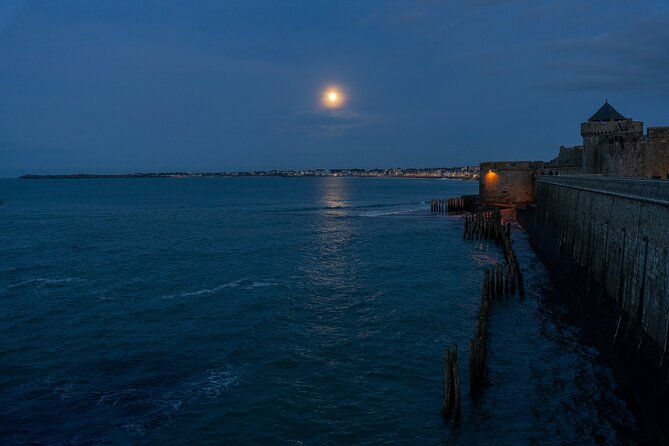
The views from the walls are part of the appeal. You can look out toward the sea and then back toward the dense old city, seeing why Saint-Malo developed as both a port and a fortress. Bring headphones that let you remain aware of your surroundings, especially on sections where you may want to stop for a photograph.
The ramparts, cathedral, and the final gate
The walk continues along Les Remparts de Saint-Malo, the city’s famous ramparts. Here the audio explains the surprising history of the defenses and how they shaped the city. The route does not simply tell you that the walls are old. It gives you a reason to notice their scale, access points, and position above the water.
You then pass through Porte Saint-Pierre and reach Place du Guet. The gate offers another view of the fortification system, while the square provides a quieter look at the city’s past and its strategic importance.
Saint Vincent Cathedral of Saint-Malo brings together religion, local memory, and maritime history. Important figures, including Jacques Cartier, are buried there. The guide covers the cathedral’s history and architectural features, so you can decide how much time you want to spend looking inside or around it.
The route ends at the Big Gate, also called Grand Porte, on Grand Prte. Ending at a major entrance makes sense: you finish with one last reminder that Saint-Malo was built to control movement in and out of the old city.
Since the tour ends at a fixed point, you can then continue exploring on your own. The supplied information does not promise a return to the tourist office, so plan your next move from the Big Gate rather than assuming the route loops back.
Is $8.99 a fair price?
At $8.99 per person, this is a low-cost way to get an organized introduction to Saint-Malo. You are paying for English narration, GPS directions, offline maps, and access that does not expire after one use. The lifetime feature is especially useful if you return to the city or want to replay sections later from another location.
The value depends on what you want. If you need a live guide to answer questions, adjust the pace, or explain local pronunciation, this will feel limited. You receive an audio program, not personal conversation.
If you want a private walk without joining a scheduled group, the price is easier to justify. Your group can move at its own speed, pause when the sea views catch your eye, and replay sections without holding anyone else up. Museums and other attraction entry fees are extra, so the $8.99 covers the audio experience rather than a complete sightseeing pass.
The average booking time is eight days ahead. That is useful for planning, but the tour itself is available daily from midnight to 11:59 p.m. according to the stated opening hours. The broad time window fits a port call or a day when you are fitting Saint-Malo around other plans.
Who will enjoy this audio walk?
I would choose this tour if you like walking with a clear sense of direction but do not want to follow a guide’s fixed pace. It suits couples, families with older children, and small private groups who want a short historical introduction before exploring further.
It is also a good match if you are visiting Saint-Malo for the first time and want to understand the old city quickly. The route connects major defensive points, sea views, literary figures, and Canadian links in a compact circuit.
You may want something else if you prefer a full tour of every rampart section, detailed museum visits, or live discussion. The audio narration is in English, and a written English version is included, but the French pronunciation issue remains. Names such as Saint-Thomas, Chateaubriand, and Jacques Cartier may require a replay if you want to hear them clearly.
Most people can participate, service animals are allowed, and the route is near public transportation. You still need to manage your own walking pace and bring suitable personal equipment, since the phone and headphones are not supplied.
Booking, cancellation, and practical preparation
Confirmation is provided at booking. Bring a charged smartphone and your own headphones, then download or prepare the audio, map, and route data for offline use.
Free cancellation is available if you cancel at least 24 hours before the local start time. Cancellations or changes made within 24 hours are not refunded or accepted, so do not leave the decision until the last moment.
Before starting, I would do three things:
- Confirm that your map shows the Office de Tourisme de Saint-Malo, not a meeting point in Rennes.
- Allow up to 75 minutes rather than planning the route down to the last minute.
- Keep the audio controls easy to reach so you can pause the faster narration and replay unfamiliar place names.
Should you book Saint-Malo’s Secrets?
Book it if you want an affordable, flexible introduction to Saint-Malo’s gates, ramparts, castle, sea views, and links with Quebec. The excellent GPS guidance and offline access make it practical, while the lifetime use gives the low price extra value.
Skip it if you want a live guide, French-language narration, or a complete walk around every section of the walls. For most independent visitors, though, it is a useful first pass through the old city. Use the audio for its planned hour, then keep exploring from the Big Gate at your own pace.
FAQ
Where does the Saint-Malo audio tour start?
It starts outside the Office de Tourisme de Saint-Malo at Esplanade Saint-Vincent, 35400 Saint-Malo, France.
Where does the tour end?
The tour ends at the Big Gate, listed as Grand Prte, 35400 Saint-Malo.
How long does the audio tour take?
The tour takes approximately one hour to one hour and 15 minutes.
What language is the tour offered in?
The audio and written guide are available in English.
Do I need to bring my own phone and headphones?
Yes. A smartphone and headphones are not included, so you need to bring your own.
Are attraction entry fees included?
No. Entry fees for museums or attractions mentioned along the route are not included.
Can I cancel for a full refund?
Yes, if you cancel at least 24 hours before the experience start time. Cancellations made within 24 hours are not refunded.
Latest audio tours in France
- Rouen audio guided tour★ 4.0 · 19 reviews
- Rouen Cathedral Self Guided Audio Tour★ 4.0 · 2 reviews
- Rouen: Audio Guided City and Joan of Arc Tour★ 4.0 · 2 reviews
- The Tuileries Garden’s Classic Sights: A Self-Guided Audio Tour★ 4.0 · 3 reviews
- Audioguide – The Eiffel Tower and its secrets★ 4.0 · 4 reviews
- A Self-Guided Audio Tour Around Parc Montsouris★ 3.5 · 6 reviews
- The French Revolution: Self Guided Audio Tour of Paris★ 4.5 · 3 reviews
- Summit Eiffel Tower Audio Guide Tour with Unlimited Time Access★ 4.5 · 58 reviews
France Audio Tours, compared.

Illuminations River Cruise with Audio Commentary
Read our review →
Louvre Museum Hosted Entry and Mona Lisa Audioguide
Read our review →
Orsay Museum Entry Ticket and Digital Audio Guide App
Read our review →
Giverny Day Trip with Audio Guide or Live Guide
Read our review →
Eiffel Tower Access w/ Audioguide and Optional Cruise
Read our review →
Giverny and Monet’s House Half Day Trip from Paris Guide or Audio
Read our review →
Catacombs Entry & Seine River Cruise with Audio Guide
Read our review →
Tootbus Panoramic by Night Bus Tour with Audioguide
Read our review →Browse the lists this tour appears in