
Reviewed · ITALY
Florence: Michelangelo’s David Priority Ticket & Audio App
Michelangelo’s David is the reason most people come to Florence’s Accademia Gallery, and seeing the original in person is far more powerful than seeing another photograph. The sculpture’s scale, marble surface, and changing expression reward a slow walk around it.
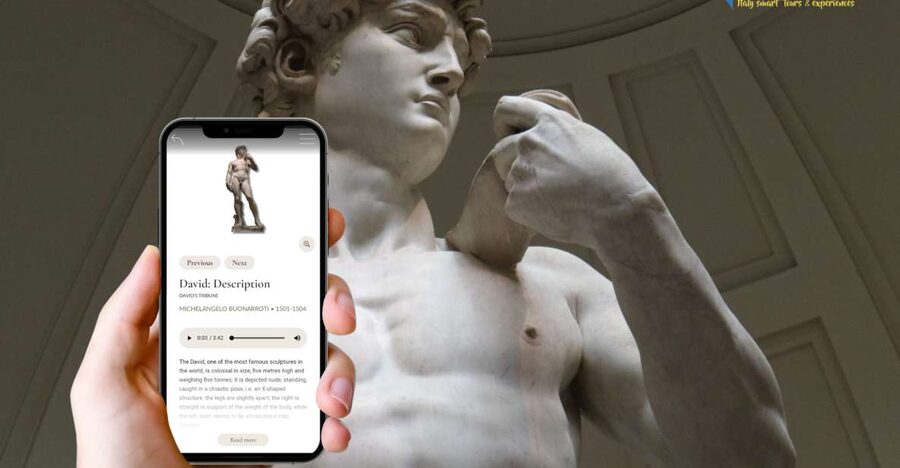
I like the timed priority entry, which cuts out the ticket-buying queue, and I like having an audio app instead of a fixed group tour. You can stop when you wish and spend more time with David or move quickly through the smaller rooms.
The main catch is preparation. You need a charged phone, headphones, the downloaded app, and a good internet connection before you arrive. The host provides entry help, but this is not a live guided tour, and the security queue remains.
Key points to know before you book
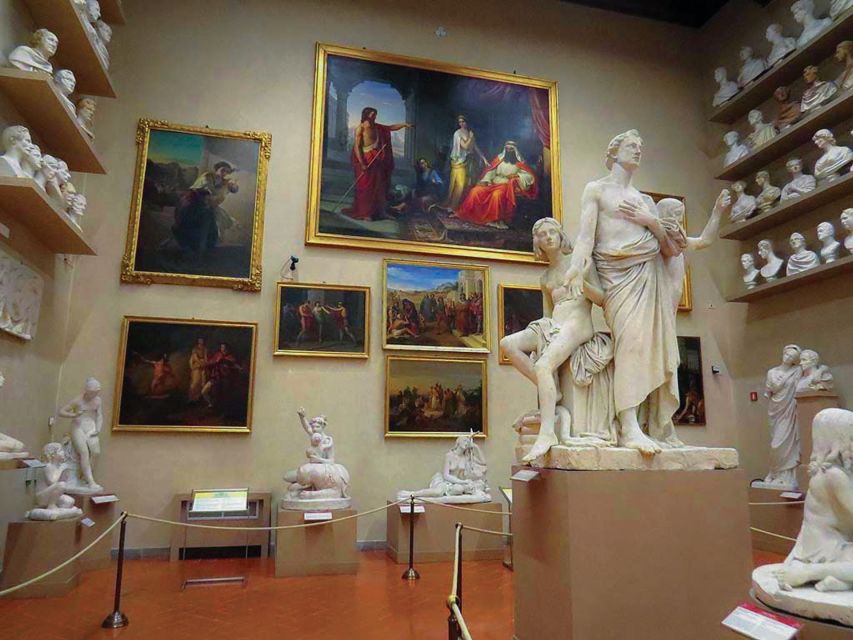
- David is the star, but not the only reason to enter: Michelangelo’s Prisoners and St. Matthew give you a fuller view of his unfinished and finished sculpture.
- The meeting point is just outside the museum: Find the assistant in a yellow vest with an ACCORD ID badge near Via Ricasoli 57, opposite Carrefour Express.
- Priority entry saves the most time at busy hours: You skip the ticket-buyers line and ticket-pickup line, though everyone still passes through museum security.
- The audio app works at your own pace: It is offered in 18 languages, including English, Italian, Spanish, French, German, Chinese, Japanese, and Portuguese.
- You need your own listening gear: Earphones are not included, and the app should be installed over Wi-Fi before you leave your hotel.
- A small bonus adds a local-food angle: The package includes a selection of Tuscan tastings, such as extra-virgin olive oil, truffle products, schiacciata, and cantuccini.
Why David deserves more than a quick photograph
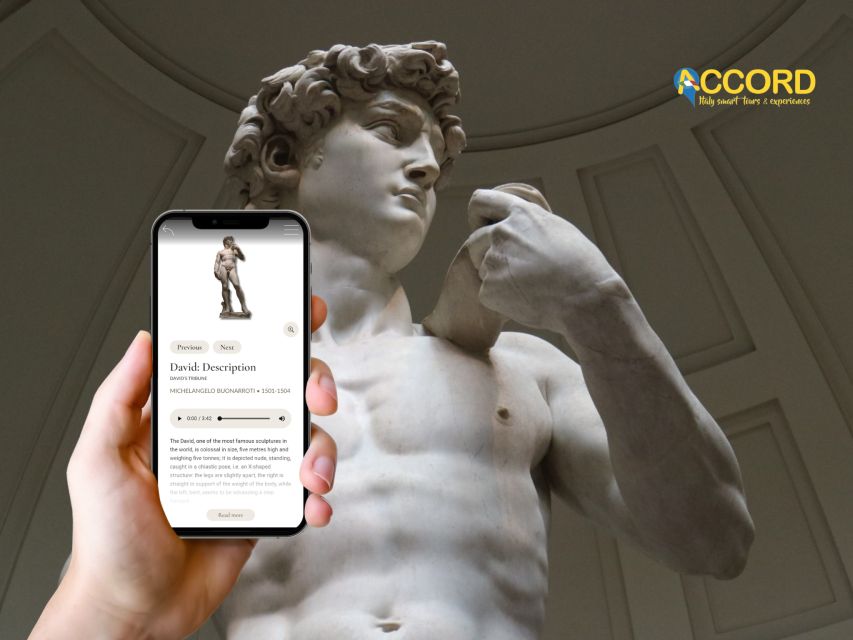
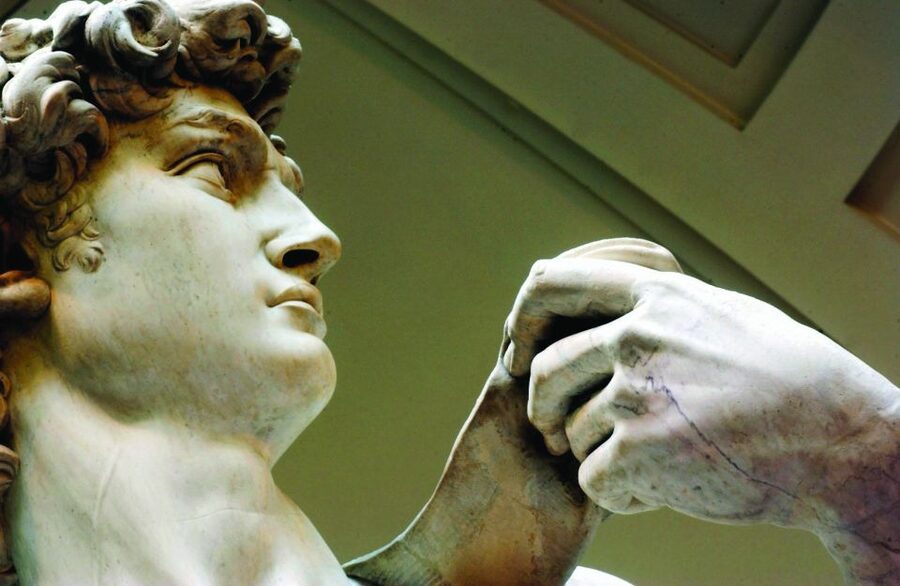
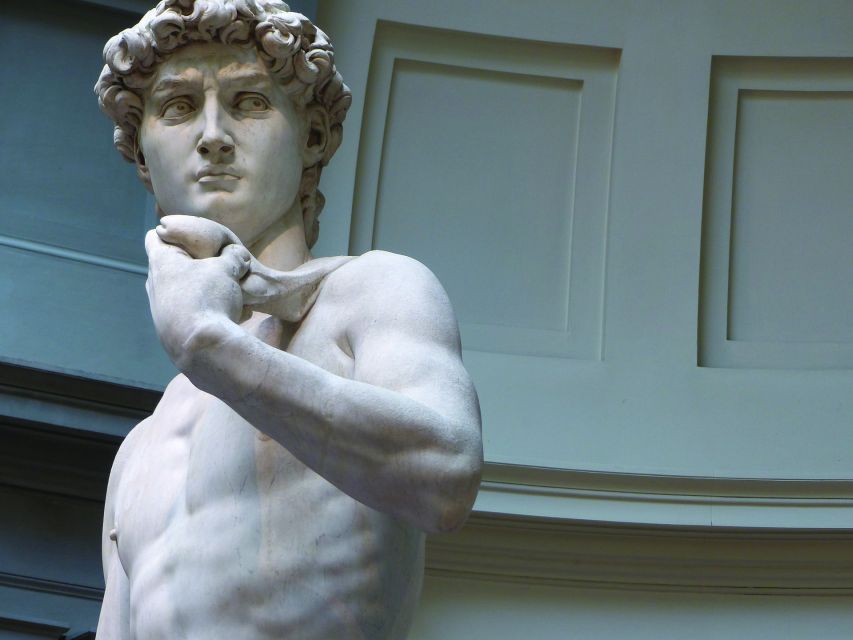
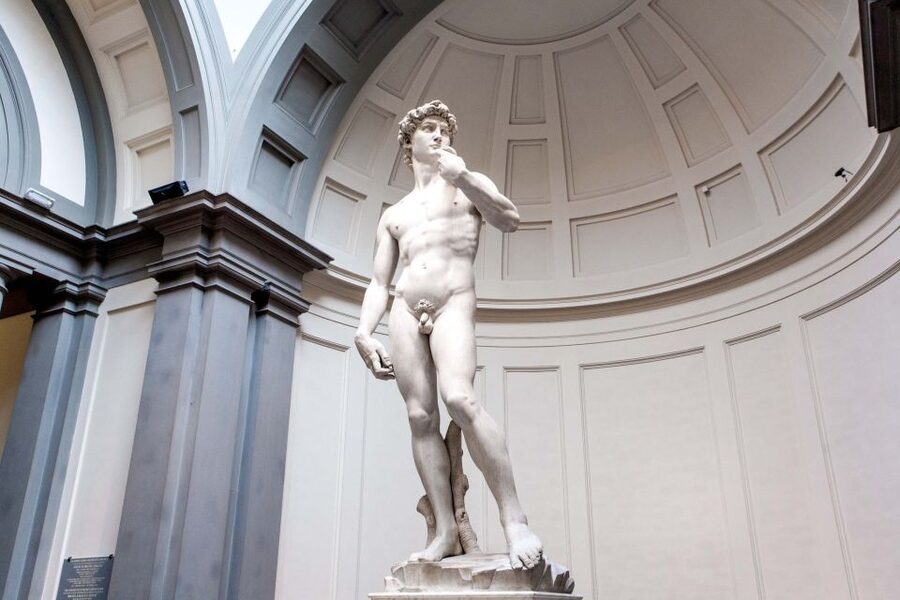
The Accademia Gallery is compact compared with Florence’s Uffizi, but its main room has enormous visual force. At the center is Michelangelo’s David, carved from a single block of marble and originally completed in 1504.
Michelangelo shows David before the fight with Goliath, not after it. His tense face, alert eyes, and powerful posture suggest a young man measuring the danger ahead. Florence adopted the image as a symbol of civic strength and the city’s defense of its independence.
You can walk around the statue and watch the expression change as your angle changes. From one side, David looks watchful. From another, he seems almost calm. The details are startling: the veins in the hands, the tendons, the curls of hair, and the careful balance of the body.
The sculpture is larger than many first-time visitors expect. Give yourself a few minutes before reaching for your phone. Look first, then use the audio app to add context. The room can be busy, but the timed entry helps control the number of people inside at one time.
A priority ticket does not give you a private viewing. You will share the gallery with other people, and the room can feel crowded during popular periods. Still, entering at a chosen time is much better than arriving without a plan and finding a long outdoor queue.
More Smartphone Audio Tours in Italy
- Rome: Colosseum & Forum with Audio Guide App -Optional Arena
★ 4.2 · 24,770 reviews - Florence: Timed Entry to Michelangelo’s David + Audio App
★ 4.6 · 19,496 reviews - Florence: Cathedral & Brunelleschi’s Dome Ticket & Audio App
★ 4.4 · 6,973 reviews
Meeting the host at Via Ricasoli 57
The meeting point is at the Accademia entrance area, a few steps from the museum at Via Ricasoli 57. Look for the assistant in a yellow vest carrying an ACCORD ID badge, directly in front of the Carrefour Express supermarket.
Arrive 15 minutes before your scheduled time. The staff member will have your reserved ticket and direct you to the correct entrance route. This small handoff matters because the Accademia has separate lines and it is easy to waste time standing in the wrong one.
The host speaks English and Italian. The service is mainly practical rather than interpretive. You receive your ticket, get pointed toward the security entrance, and enter on your own.
That arrangement suits me. You are not tied to a guide’s pace or a group’s schedule. It also means you should not expect a personal explanation of every artwork at the door. The value comes from the reserved entry and the independent visit.
The day before your visit, you should receive a WhatsApp reminder with the meeting instructions and details for downloading the audio application. Do not leave this task until you reach the museum. Some people have had trouble downloading the app because of weak phone service, while others found the staff helpful when installation caused problems.
What priority entry really saves
The phrase skip the line needs a little explanation. This ticket lets you bypass the line to buy an admission ticket and the separate ticket-pickup process. It does not let you ignore the museum’s security screening.
At busy times, security can take around 10 to 15 minutes. That is still a manageable wait, especially when the regular ticket line outside is long. The greatest benefit comes during high-demand periods, when David draws a steady stream of people from across Florence.
Timed entry also gives you a firmer plan for the day. You can arrange breakfast, the Duomo, lunch, or another museum around your Accademia appointment rather than guessing how long the ticket queue might take.
Earlier time slots are a sensible choice if your schedule allows. Morning entry can help you use your saved time elsewhere, though the gallery’s crowd level can change from day to day. The ticket is valid for your selected date and time, so watch the meeting instructions closely.
Using the mobile audio guide without losing your independence
The audio app is designed for self-guided sightseeing. You use your own phone and headphones, then move through the museum at your chosen speed.
The app is available in English, Italian, Spanish, German, French, Russian, Chinese, Japanese, Polish, Turkish, Portuguese, Dutch, Korean, Hungarian, Greek, Croatian, and Romanian. That range is useful for mixed-language families or couples who prefer different listening options.
I like the format for the Accademia because the gallery is not enormous. You can listen to a section on David, pause it while you look, and then continue without blocking the flow of your visit. You can also skip an item that does not interest you and return to it later.
The audio content focuses on the major works and the story behind them. It helps explain why David mattered to Florence and gives you a way to read the other sculptures and paintings rather than treating them as decoration around the main attraction.
Do not expect the depth of a private art historian. Some users find the explanations useful but brief, and the app can be less detailed than they hoped. That is the tradeoff for a low-cost self-guided format.
Download the app before arriving, preferably on Wi-Fi. Bring your own earphones, since none are included. Charge your phone fully, and remember that you may need to handle the device while looking at the artwork. If you travel with a family, consider sharing one audio device only if everyone is happy with the same pace.
Another self-paced route in Italy:
- Rome: Pantheon Fast-Track Ticket and Official Audioguide
★ 4.5 · 27,353 reviews - Rome: City Sightseeing Hop-on Hop-off Bus with Audioguide
★ 4.0 · 16,045 reviews - Pompeii: Entry Ticket with Audio Guide
★ 4.1 · 13,491 reviews - Venice: La Fenice Opera House Entry Ticket with Audio Guide
★ 4.6 · 11,742 reviews
Michelangelo’s Prisoners and St. Matthew
After David, focus on the other Michelangelo sculptures. The Prisoners, also called the Slaves, were intended for the tomb of Pope Julius II. The tomb was never completed, and these figures remain partly trapped in the marble.
Their unfinished state is the point. Bodies appear to push, twist, or struggle toward freedom, while sections remain rough and attached to the stone. You can see Michelangelo’s working process in a way that a polished statue does not reveal.
St. Matthew also helps you think about unfinished sculpture. These works are not merely leftovers from a failed project. They offer a direct look at how Michelangelo’s figures seem to emerge from the block.
The audio guide can give you the background, but take time to study the surfaces yourself. Look at the difference between the smooth areas and the roughly worked marble. The contrast makes the room feel like a workshop as much as a museum.
Renaissance paintings beyond the famous statue
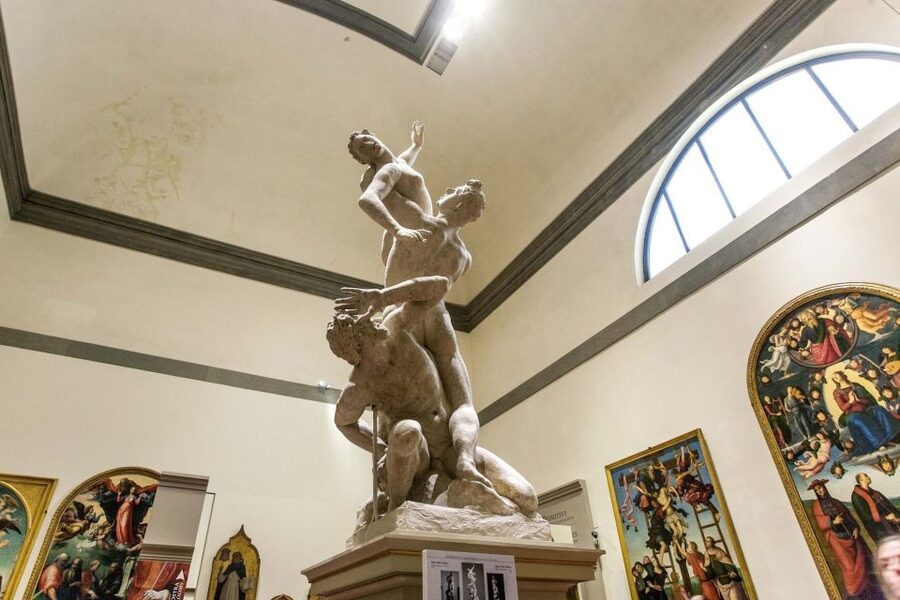
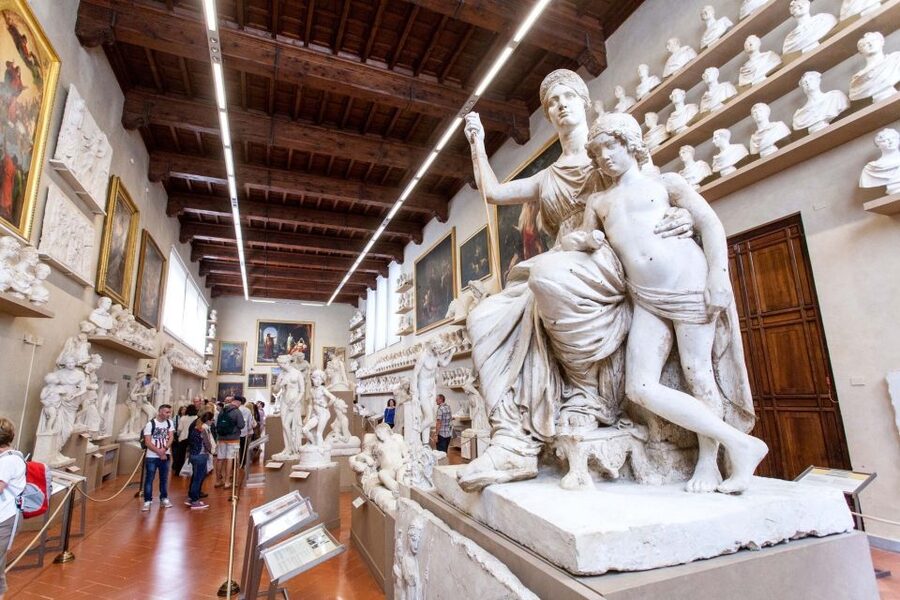
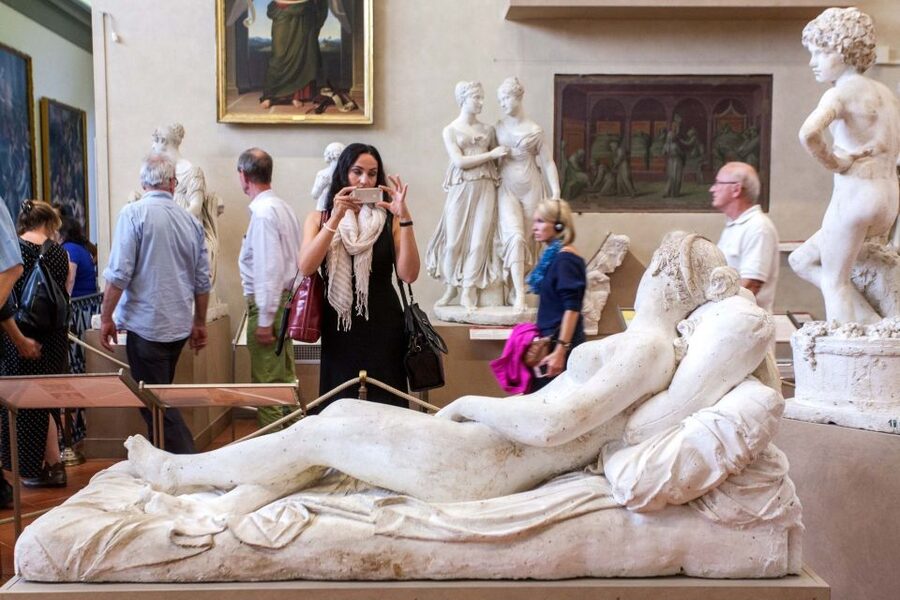
The Accademia is not only a Michelangelo stop. Its rooms contain paintings and sculptures by important Italian artists, including Sandro Botticelli, Domenico Ghirlandaio, Taddeo Gaddi, Filippino Lippi, Andrea Orcagna, and other Florentine masters.
These works may not command the same crowd as David, but they give you a better sense of the art world Michelangelo inherited. Look for the changes in faces, gestures, architectural settings, and the treatment of religious scenes.
Botticelli and Ghirlandaio are particularly useful names to keep in mind as you move through the collection. The gallery allows you to place Michelangelo within a much larger Florentine tradition rather than treating him as an isolated genius.
The museum is small enough for a focused visit. If you have limited time, you can see the essential rooms in roughly an hour, then stay longer if a painting or sculpture catches your attention. The ticket does not impose a guided route, so you control the pace.
The Medicean Stradivarius and old instruments
One of the more easily missed parts of the visit is the collection of historic musical instruments connected with the Cherubini Conservatory. It includes an Antonio Stradivarius violin belonging to the Medicean Quintet.
This room adds a different note to the museum. After marble figures and Renaissance paintings, the instruments remind you that Florence’s cultural life included music, court collections, and technical craft as well as visual art.
The Stradivarius is not a performance, and the collection will not replace a full music museum visit. Still, it is a worthwhile stop because it broadens the experience beyond the David-focused route.
If you have come with someone who is less interested in sculpture, this room may give them another reason to slow down. Use the audio app if you want context, but make time to look closely at the instruments themselves.
The Tuscan tasting bonus
The package includes a selection of Tuscan food tastings. The offerings can include extra-virgin olive oil, truffle specialties, schiacciata, and cantuccini.
Think of this as a bonus, not the central reason to buy the ticket. The real value is the reserved museum entry. The tasting adds a local-food touch, but the exact presentation and timing are not described as a separate guided food experience.
Schiacciata is a traditional Tuscan flatbread, while cantuccini are the crisp almond biscuits often served with a sweet drink. The olive oil and truffle products offer a quick introduction to flavors associated with the region.
If food is a major priority for your day, plan a separate market visit or meal as well. The tasting included here should be treated as an extra alongside the gallery, not as a substitute for a full food tour.
Price, value, and who should buy it
At $23 per person, this is a sensible purchase if you care about saving time and want some help understanding the art without paying for a live private guide.
The cost is easiest to justify when the official ticket supply is difficult to find or when you are visiting during a busy period. Paying a little more than a basic admission ticket can protect a valuable morning or afternoon in Florence.
The value is weaker if you are comfortable waiting in line, already have a timed ticket, or plan to use your own art guidebook. The audio app is useful, but it is not the main reason to book this option.
I would choose it for a first visit, a short stay, or a family that wants independence with a little structure. It also suits people who dislike being moved through a museum in a fixed group.
I would think twice if your phone is unreliable, you do not want to use headphones, or you want a live expert to answer questions. In those cases, a different format may serve you better.
The overall rating for this experience is 4.4 from 6,812 ratings, which matches the pattern I would expect: strong satisfaction with the entry process, friendly assistance, and the freedom to explore, with some frustration around app installation and the audio content’s limited depth.
Practical details that can make or break the visit
Bring your passport or ID card. Children also need identification. Large bags and luggage are not allowed, and pets cannot enter.
You may bring one bottle of water per person, with a maximum size of 500 milliliters. Keep the visit light and simple, since the museum’s entry process includes security screening.
The gallery is wheelchair accessible. You still need to follow the same timed-entry and security procedures, so allow a little extra time before the appointment.
Cancellation is free up to 24 hours before the visit, and you can reserve now and pay later. These terms are useful if your Florence schedule is still shifting, but your selected entry time remains important once the booking is set.
Should you book this Accademia experience?
Book it if you want to see the original David without gambling on a long ticket queue. The priority entry is the strongest feature, and the audio app gives you enough context to make the visit more meaningful than a quick photograph and exit.
Arrive early, find the yellow-vested ACCORD host, and install the app before you leave your accommodation. Bring headphones, charge your phone, and remember that security still takes time.
Skip it if you already have a timed Accademia ticket or want a full live art tour. For most first-time visitors with limited time, though, $23 is a fair price for reliable entry, an independent visit, and access to one of Florence’s unforgettable works.
FAQ
Where is the meeting point?
Meet near the Accademia Gallery entrance at Via Ricasoli 57, directly in front of the Carrefour Express supermarket. Look for an assistant wearing a yellow vest and an ACCORD ID badge.
How early should I arrive?
Arrive 15 minutes before your scheduled activity time so the host can provide your ticket and direct you to the correct entrance line.
Does the ticket skip the security check?
No. All visitors must pass through museum security. At busy times, the security wait can take approximately 10 to 15 minutes.
Is this a live guided tour?
No. An English or Italian speaking host helps you collect your ticket and enter. Inside, you explore independently with the mobile audio guide app.
What languages are available in the audio app?
The app is available in English, Italian, Spanish, German, French, Russian, Chinese, Japanese, Polish, Turkish, Portuguese, Dutch, Korean, Hungarian, Greek, Croatian, and Romanian.
Do I need to bring headphones?
Yes. Earphones are not included, so bring your own headphones or earbuds.
Should I download the app before arriving?
Yes. The instructions are provided with your voucher, and downloading the app over Wi-Fi before your visit is recommended.
Can I bring luggage into the Accademia?
No. Luggage and large bags are not allowed.
Can I bring water inside?
Yes. Each person may bring one bottle of water, up to 500 milliliters.
Is the Accademia Gallery wheelchair accessible?
Yes, the activity information states that the museum is wheelchair accessible.
Can I cancel for a refund?
Yes. You can cancel up to 24 hours before the activity for a full refund.
Latest audio tours in Italy
- Orgosolo Multilingual Audioguide★ 4.5 · 42 reviews
- Pantheon Skip the Line Entry Tickets with Digital Audio Guide★ 3.5 · 52 reviews
- St. Peter’s Basilica: Dome Climb with Lift & Audioguide★ 4.5 · 13 reviews
- Audio guide in Vatican Museums and Sistine Chapel★ 4.5 · 12 reviews
- The Roman Jewish Ghetto: A Self-Guided Audio Tour★ 4.0 · 8 reviews
- Experience: The Pantheon Audio Tour★ 4.5 · 4 reviews
- Trastevere: A Self-guided Audio Tour of Rome’s Medieval Village★ 4.5 · 3 reviews
- Navova square underground with audioguide★ 4.5 · 17 reviews
Smartphone Audio Tours, compared.
Colosseum & Forum with Audio Guide App -Optional Arena
Read our review →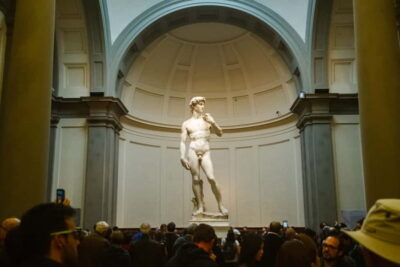
Timed Entry to Michelangelo’s David + Audio App
Read our review →
Cathedral & Brunelleschi’s Dome Ticket & Audio App
Read our review →
Uffizi Priority Ticket & Masterpieces Audio App
Read our review →
Castel Sant’Angelo Entry Ticket & Digital Audioguide
Read our review →
Pantheon Priority Entry Ticket & Audio Guide App
Read our review →
Orsay Museum Entry Ticket and Digital Audio Guide App
Read our review →Browse the lists this tour appears in