
Reviewed · ROME
The Roman Jewish Ghetto: A Self-Guided Audio Tour
Rome’s Jewish Ghetto is small enough to explore on foot, yet its streets hold layers of Jewish and Roman history. This 30-minute audio walk links the former Five Scole, Rome’s Great Synagogue, and the ancient Portico d’Ottavia without tying you to a guide’s schedule.
I like the low price and the freedom to pause whenever you want. I also like the offline maps and GPS playback, which can make a short visit more focused. The main concern is technical: you need to download every file before setting out, and the route can become confusing if you start in the wrong place or use manual playback.
Key points at a glance
- Three sharply different stops: Follow the story from the former synagogue complex at Piazza delle Cinque Scole to the 1904 Great Synagogue and then the Roman-era Portico d’Ottavia.
- About 30 minutes on foot: This is a compact introduction, not a full-day historical tour.
- GPS-guided audio: The VoiceMap app can start and stop narration based on your position when used in its intended tour mode.
- Works offline after download: Audio, maps, and location data are available without mobile reception.
- Excellent value at $8.99: You receive lifetime access rather than a one-time listen during a fixed departure.
- Best with a quick setup check: Download the complete tour on a dependable connection and begin at Via di S. Maria del Pianto, 22.
Why this short walk works in Rome’s Jewish Ghetto
I find self-guided audio walks most useful in compact historic districts, and this is a good match for that format. The Jewish Ghetto does not require a coach, complicated transport, or a long block of your day. You can arrive near the start, open the app, and let the narration give meaning to buildings and names you might otherwise pass without noticing.
The route is short, but the subject is not. You move between the memory of the old Jewish community, the synagogue built after emancipation, and a much older Roman monument. That contrast gives the walk its shape. You are not simply looking at attractive streets. You are hearing how religious life, political restrictions, rebuilding, and ancient Roman architecture meet in one small part of the city.
The audio format also gives you room to look around. You can pause for a photograph, stop to orient yourself, or take a break for food. One especially useful feature is location-based playback: when the app is set up properly, it uses your position to trigger the next section. That means you do not have to keep checking a printed route every few steps.
Still, do not treat it like a completely hands-off experience. The app depends on correct setup. Start at the listed beginning, use the Start Tour button, and allow the tour to use your location. A past technical problem left one customer with only the first ten minutes, while another person found the route hard to follow after starting incorrectly. Those problems may be avoidable, but they are worth planning for.
More Self-Guided Audio Tours in Italy
- Self Guided Audio Tour-Coliseum & the Gladiator’s Legends
★ 3.5 · 49 reviews - Self Guided Audio Tour with 100 Captivating Stories in Rome
★ 4.5 · 7 reviews - Self-Guided Audio Tour – The gods of the Palatine
★ 3.5 · 5 reviews
Starting at Via di S. Maria del Pianto
The tour begins at Via di S. Maria del Pianto, 22, in the 00186 postal area of Rome. This is an urban starting point, not a transport service, so you arrange your own way there. The experience includes no vehicle, food, drinks, museum admission, or other entrance fees.
Give yourself a few minutes before pressing play. Open the VoiceMap application, confirm that the route has loaded, and check that the full audio package is on your phone. Download the audio, maps, and geodata while you have a reliable connection. An eSim, hotspot, or shared network may not complete the download properly, so do not assume that seeing the first section means the whole tour is ready.
The instructions are meant to work for a solo visitor, a couple, or a family. The activity is private in the practical sense that only your group participates, but it is not a live private guide. You hear recorded narration rather than asking questions along the way.
Piazza delle Cinque Scole and five lost synagogues

One of the most meaningful stops is Piazza delle Cinque Scole. The word scola means synagogue, and the square took its name from five houses of worship: the Temple, New, Castilian, Catalan, and Sicilian Scole.
The important point is that this name survives even though the synagogue complex itself was demolished after the emancipation of the Ghetto. The square therefore works as a memory marker. You may not see five preserved synagogues, but the name points back to the community that once organized religious life here.
I like this stop because it asks you to read Rome in two ways. First, look at the physical street in front of you. Then listen for the vanished buildings behind the name. An audio guide can explain that kind of absence better than a quick photograph or a standard sightseeing checklist.
This is also where the tour’s limits become clear. The stop is mainly about context, and the former complex is no longer intact. If you expect a preserved synagogue interior or a museum-style display, you may find the visit more reflective than visual. The value comes from the story attached to the place.
The Great Synagogue and Rome’s post-emancipation change
The route then turns to Rome’s main synagogue, built after the Jewish community commissioned architects Osvaldo Armanni and Vincenzo Costa in 1901. The new temple opened in 1904 and has served as the principal place of worship in Rome ever since.
This gives the walk a clear change of mood. At Piazza delle Cinque Scole, you hear about a lost complex and a name that endured. At the Great Synagogue, you reach a building created for a new period in Jewish life after emancipation.
The audio stop helps you place the synagogue in the wider story of the neighborhood. You are not simply seeing a major religious building. You are hearing why a new temple was commissioned and when it opened. That date, 1904, gives you a firm point in the city’s modern history.
Do keep your expectations practical. The tour does not include tickets or entrance fees to museums or attractions along the way. The provided route describes the synagogue as a stop, but it does not promise an interior visit. Plan on hearing the explanation from the route itself unless you separately arrange entry.
For me, this is one of the strongest parts of the walk because it connects architecture with community life. The stop is especially useful if you have already seen ancient Roman monuments but want a clearer sense of the Jewish community’s place in modern Rome.
More Self-Guided Audio Tours in Rome
- Trastevere: A Self-guided Audio Tour of Rome’s Medieval Village
★ 4.5 · 3 reviews - Discover Marvellous Rome: Self-Guided Audio Tour
★ 5.0 · 2 reviews - Athens: Acropolis Ticket & Optional Self-Guided Audio Tours
★ 4.1 · 2,542 reviews - Gettysburg Battlefield Self-Guided Driving Audio Tour
★ 4.5 · 910 reviews
Portico d’Ottavia, where Roman and Jewish history meet
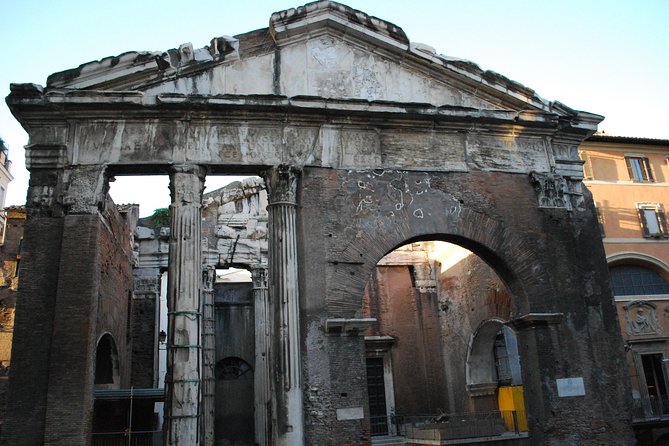
The final destination is Via del Portico d’Ottavia, 39. Here you reach the Portico d’Ottavia, an ancient structure built by Augustus, Rome’s first emperor, in honor of his sister Octavia.
The monument included a grand arch and facade, followed by an inner portico that originally held two temples. That Roman setting gives the last part of the walk a different visual and historical weight. The route has moved from remembered synagogues to a functioning modern place of worship, then back to the imperial city.
This stop is a good reason to take the audio walk instead of simply wandering through the neighborhood. A Roman ruin can be impressive but hard to place. The narration gives you the basic structure: who built it, whom it honored, and what it contained.
The finish also leaves you in a useful part of the Jewish Ghetto rather than at an isolated endpoint. The supplied information points to restaurants in the area, and the neighborhood is known for its food. You are not buying a meal with the tour, but you can easily treat the walk as a short history lesson before stopping for lunch or dinner.
How the VoiceMap app handles the route
The app is designed around GPS and your location. With the intended setup, the narration can begin and stop as you move between points. This is more convenient than manually searching through a long recording, especially in streets where you may want to keep your phone in your pocket.
The app also includes maps and geodata. That matters because the main route problem is not the length. It is knowing where to begin and how to follow the intended sequence. Start at the stated meeting point and use Start Tour rather than virtual mode or manual playback.
You can pause the experience at any time and restart it later. That makes the walk easy to fit between other Rome plans. If you stop for food or decide to spend extra time at the synagogue area, you are not losing a scheduled departure.
The system is not foolproof. GPS can be less clear around dense city buildings, and a partially downloaded tour can leave you without later recordings. Before leaving, check that all sections appear downloaded. Keep your phone charged, and avoid deleting the app or files until you finish.
What $8.99 buys you
At $8.99 per person, this is inexpensive for Rome. You are paying less than the cost of many guided visits, and the access does not end when the 30-minute route is over. The package includes lifetime access to the Roman Jewish Ghetto tour through the VoiceMap application.
That lifetime access improves the value in two ways. You can pause the walk and return to it later, and you can use the content again if you revisit Rome. You are also not paying for a group departure that starts at a fixed time.
The trade-off is the lack of a live guide. Nobody is there to answer a question, adjust the route for your interests, or solve a navigation issue on the street. If you want personal conversation and a flexible explanation, a guided tour may suit you better.
For a short introduction, I think the price is fair. The three stops have a clear connection, and the offline function makes the purchase more useful than a simple online article. The value drops if you do not complete the download or if you expect admission to the synagogue or museums to be included.
Who should choose this audio tour?
I would recommend it to you if you want a compact introduction to the Jewish Ghetto and prefer to move independently. It suits solo visitors, couples, and families who do not want to follow a group flag or keep a strict appointment.
It also works well for repeat visitors to Rome. You can use it to add a focused neighborhood walk to a day that already includes larger sights. The short length means it does not demand the same energy as a long walking tour.
History-minded visitors will get the most from the links between the stops. The former Five Scole explains what has disappeared. The Great Synagogue shows the community’s later rebuilding. Portico d’Ottavia places the neighborhood in the much older Roman city.
I would be more cautious if you dislike phone-based navigation or want a highly detailed tour. The walk gives you a focused introduction, not an exhaustive account of every street, restaurant, or historical period in the Ghetto. You also need to manage the technology yourself.
The experience is offered in English. The practical details say most people can participate, service animals are allowed, and the start is near public transportation. The advertised operating window runs from July 8, 2019, through July 2, 2027, with access listed every day at all hours. Those hours describe the digital activity, not opening hours for a particular building.
Should you book it?
Book this audio walk if you want a low-cost, self-paced way to connect three important points in Rome’s Jewish Ghetto. Its best qualities are the clear historical arc, the short route, the location-triggered narration, and lifetime offline access.
Skip it if you want a live historian, guaranteed indoor visits, or a tour that needs no technical preparation. Before you go, download every file on a stable connection, begin at Via di S. Maria del Pianto, 22, and use the app’s Start Tour function. With that preparation, $8.99 buys a useful half-hour of history and the freedom to explore at your own rhythm.
FAQ
How long does the Roman Jewish Ghetto audio tour take?
The tour takes approximately 30 minutes.
What language is the tour offered in?
The tour is offered in English.
Where does the tour start?
The starting point is Via di S. Maria del Pianto, 22, 00186 Roma RM, Italy.
Where does the tour finish?
The tour ends at Via del Portico d’Ottavia, 39, 00186 Roma RM, Italy.
Does the tour work without mobile reception?
Yes. After you download the tour, the audio, maps, and geodata can be used offline.
What does the price include?
The $8.99 price includes lifetime access to the Roman Jewish Ghetto tour, the VoiceMap application, and offline access to the audio, maps, and geodata.
Are entrance fees or transport included?
No. You need to arrange your own transportation, and the tour does not include food, drinks, museum tickets, or entrance fees to other attractions along the route.
Latest audio tours in Rome
- Pantheon Skip the Line Entry Tickets with Digital Audio Guide★ 3.5 · 52 reviews
- St. Peter’s Basilica: Dome Climb with Lift & Audioguide★ 4.5 · 13 reviews
- Audio guide in Vatican Museums and Sistine Chapel★ 4.5 · 12 reviews
- Trastevere: A Self-guided Audio Tour of Rome’s Medieval Village★ 4.5 · 3 reviews
- Experience: The Pantheon Audio Tour★ 4.5 · 4 reviews
- Navova square underground with audioguide★ 4.5 · 17 reviews
- The Colosseum’s Attic with 3rd, 4th & 5th Levels with Audio Guide★ 4.5 · 20 reviews
- Self-Guided Audio Tour – The gods of the Palatine★ 3.5 · 5 reviews
Self-Guided Audio Tours, compared.

Acropolis Ticket & Optional Self-Guided Audio Tours
Read our review →


Ultimate Acadia National Park Self-Guided Driving Audio Tour
Read our review →

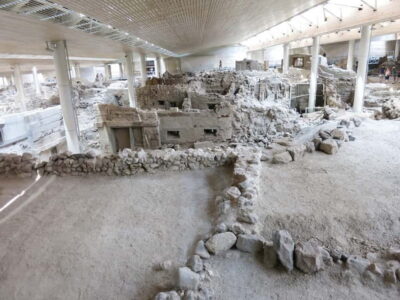
Akrotiri Ticket with Optional Self-Guided Audios
Read our review →
Browse the lists this tour appears in