
Reviewed · PARIS
Scandalous Paris, audioguided smartphone tour
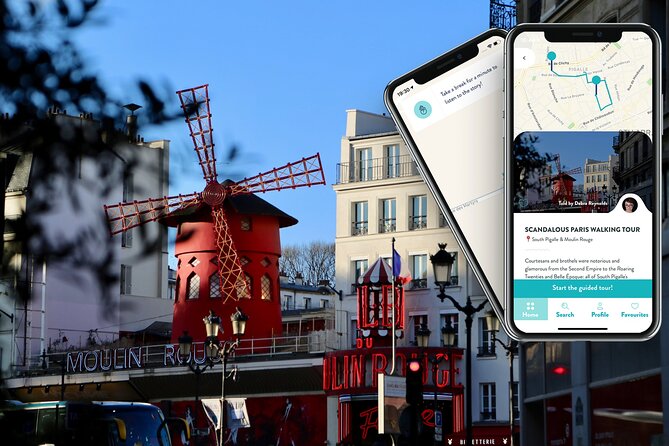
Paris has its polished postcard face, but South Pigalle tells a much racier story. This self-guided smartphone walk follows courtesans, brothels, artists, and cabaret dancers from Place Saint Georges to the Moulin Rouge, with audio commentary triggered by your location.
I like two things right away: the route gives you a focused way to explore a neighborhood instead of sending you across the whole city, and the app lets you pause for a coffee, a shop, or a wrong turn without losing your place. The main drawback is that you are on your own, so anyone hoping for live questions, group energy, or a guide pointing out details in person should choose a traditional walking tour.
Key points before you book
- South Pigalle’s scandalous past: Learn how courtesans, brothels, and cabarets shaped the area from the 18th century through the 1950s.
- Eight compact stops: The walk runs from Place Saint Georges through Rue Saint-Georges, Rue Saint-Lazare, Rue des Martyrs, Rue de Navarin, Rue Frochot, Rue Victor Massé, and the Moulin Rouge.
- Automatic audio commentary: Stories begin at the places connected to them, with directions and a live map built into the app.
- Flexible timing: The stated duration is about 1 to 1.5 hours, but you can pause and resume when you like.
- Good low-cost value: At $11.55 per person, the walk costs far less than most private guided tours, though you give up a live guide.
- Adult subject matter: The tour is not recommended for anyone under 16, and some stories are described as explicit.
Why South Pigalle makes a good walking-tour subject

South Pigalle is not just a backdrop for stories about vice. The streets reflect several layers of Parisian life: elegant 18th-century townhouses, theaters, artists’ studios, nightlife, and the old trade in paid companionship. This tour uses those layers to explain how a respectable neighborhood gained a reputation for pleasure.
The focus is especially useful if you have already seen the major monuments and want a different side of Paris. You are not being led from one famous landmark to another. Instead, the interest comes from connecting ordinary streets and squares with the people who once lived, worked, painted, or entertained there.
The period covered is broad. The stories reach back to the transformation of the New Athens district in the 18th century, then move through the courtesans and brothels of the 19th century, the artistic nightlife around Montmartre, and the cabaret culture that continued into the 20th century. That gives the walk a clear arc, even though each stop focuses on a separate place.
The tone is playful rather than academic. One description of the tour promises a dose of humor, and that matters here. The subject can become grim or moralizing if presented too solemnly. A lighter delivery helps you understand the social contradictions of the period: public respectability on one side, private appetite on the other.
More Smartphone Audio Tours in France
- Paris: Orsay Museum Entry Ticket and Digital Audio Guide App
★ 4.4 · 3,170 reviews - Paris Orsay Museum Entry Ticket with Digital Audio Guide
★ 3.5 · 93 reviews - Paris: Rodin Museum Ticket & Optional Digital AudioGuide App
★ 4.7 · 56 reviews
Starting at Place Saint Georges and the New Athens district
The tour begins at 28 Place Saint Georges, in the small square known as Place Saint Georges. This is a practical starting point because it puts you near the southern edge of Pigalle, away from the loudest stretch around the Moulin Rouge.
The first story introduces the New Athens district and its transformation into what the tour describes as a paradise of pleasure. Allow about 15 minutes here. You will get the broad setting before the route turns to specific women, streets, and businesses.
This opening is important because it shows that the area did not begin as a single-purpose red-light quarter. Its identity developed over time. The contrast between elegant surroundings and scandalous activity is one of the tour’s main themes.
Use this stop to get comfortable with the app. The map shows where to go next, while the location feature helps guide you if you take a wrong turn. Since the experience depends on your smartphone, make sure you have received the activation code before setting out and have enough battery for the walk.
Rue Saint-Georges and the courtesans who challenged convention
The next stop, Rue Saint-Georges, takes about 10 minutes and focuses on courtesans who turned social expectations upside down. The material is described as rather explicit, so you should expect adult subject matter rather than a polished, family-friendly account of old Paris.
The value here is not simply learning the names of famous women. The stories show how courtesans could occupy an unusual position in society. They were tied to wealthy men and strict social rules, yet they could also exercise money, style, influence, and personal freedom in ways respectable women often could not.
That tension gives this section more substance than a string of gossip. You hear about a society that judged women harshly while also rewarding the men and institutions that supported the trade. The tour’s humor may make these contradictions easier to absorb.
Rue Saint-Georges is also an early test of the self-guided format. A live guide could answer questions or add context if one story catches your attention. Here, you follow the recorded commentary and move along when the app directs you.
Rue Saint-Lazare and the world of the lorettes

At Rue Saint-Lazare, the subject turns to the lorettes, a term used for courtesans with a reputation for light morals. This stop is planned for about 10 minutes.
The word itself helps show how Paris created labels for women who lived outside the accepted rules. The tour uses these figures to explain the social world around courtesans, rather than treating them as isolated characters. Their lives were linked to fashion, money, public appearance, and the constant tension between independence and dependence.
This is a good section for anyone interested in how language shapes social attitudes. The commentary gives you a closer look at the way Parisian society classified women and turned personal lives into public entertainment.
The route also keeps the subject tied to real streets. You are not sitting in a museum hearing a general lecture. You are standing in the neighborhood where these stories belong, moving through the same basic street pattern that made the area useful for homes, entertainment, and discreet meetings.
More Smartphone Audio Tours in Paris
- Paris: Musee De L’Armee Ticket With Digital Audio Guide
★ 4.2 · 39 reviews - Paris Audioguide – TravelMate app for your smartphone
★ 4.1 · 27 reviews - Louvre Paris Tour with Audioguide on Your Smartphone (no ticket)
★ 3.5 · 20 reviews - Montmartre Paris Walking Tour with Audioguide on Your Smartphone
★ 4.5 · 17 reviews
Rue des Martyrs and Paris’s hundreds of brothels

Rue des Martyrs brings the tour to one of its broadest claims about old Paris: the city had more than 700 brothels, operating into the 20th century. Allow around 15 minutes for this stop.
The most useful point is the connection between money and social status. Brothels were expensive, and visiting one regularly could signal wealth and importance. The comparison to driving a Ferrari today is blunt, but it makes the point quickly. The establishments were not only places of private pleasure. They could also serve as public markers of status.
This section helps you see prostitution as part of the city’s commercial and social structure, not as a minor side story. It also explains why certain neighborhoods gained a reputation that lasted long after individual businesses disappeared.
The drawback is that street-level remains may be limited. The appeal comes mainly from the audio account and the setting, not from entering preserved brothels or viewing a major collection of objects. If you need interiors and physical exhibits, this walk may feel thin. If you enjoy connecting present-day streets to vanished places, it works better.
Rue de Navarin and the clients behind the stories
Rue de Navarin continues the brothel theme, with attention to historic establishments and their famous clients. Plan on another 10 minutes.
This stop shifts the focus from the women who worked in the trade to the men who paid for it and helped maintain its social power. That change matters. It prevents the story from becoming only a collection of glamorous courtesans and scandalous anecdotes.
You also get a sense of how reputation worked. Famous clients gave certain places prestige, while the places themselves helped clients display wealth and access. The connection between private behavior and public status appears again here.
Because the tour is on a public street, you should expect a walking lesson rather than a staged recreation. There is no promise of entering historical brothels, and personal expenses are not included. Wear comfortable shoes and treat the route as an outdoor neighborhood walk.
Rue Frochot, Toulouse-Lautrec, Degas, and Pissarro
At Rue Frochot, the focus turns toward art. Painters including Toulouse-Lautrec, Edgar Degas, and Pissarro lived in the neighborhood and painted its libertine nightlife. The stop takes about 10 minutes.
This is one of the strongest changes of pace in the route. The district was not only a place for courtesans and brothels. It also attracted artists who found its theaters, dancers, and nightlife useful subjects. Their work helped carry the area’s image far beyond its streets.
The comparison to early paparazzi is playful, but it points to a real idea: artists recorded people and places that fascinated the public. Their pictures helped turn nightlife into a visual product, much as photographs and entertainment reporting do today.
I like this stop because it connects social history with art without requiring a museum ticket. You are still outside, but the audio gives the neighborhood another layer. If you already know the paintings, you may appreciate the setting more. If you do not, the stories still explain why this part of Paris attracted artists.
Rue Victor Massé and the French Cancan

Rue Victor Massé brings the route back to performance, with a short section on the French Cancan. The dance is presented as an erotic spectacle from its period, rather than as a harmless postcard image.
This stop is useful because it explains how cabaret entertainment built its own kind of scandal. The French Cancan was not simply dancing. It was movement, costume, provocation, and audience expectation packaged for nightlife.
The commentary also helps connect the smaller streets to the major destination at the end of the route. South Pigalle’s reputation grew through many forms of entertainment, from private rooms to public stages. Courtesans, artists, dancers, and cabaret owners all belonged to the same wider culture of spectacle.
Allow about 10 minutes. The route is short enough that you can keep moving, but the app also allows you to stop if you want to look around or take a break. That flexibility is one of the better reasons to choose this format.
Finishing at the Moulin Rouge
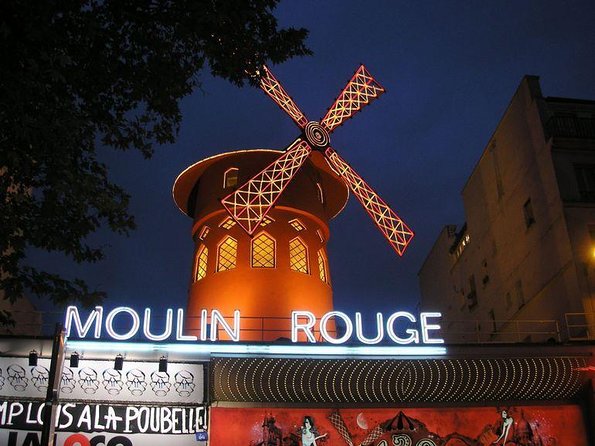
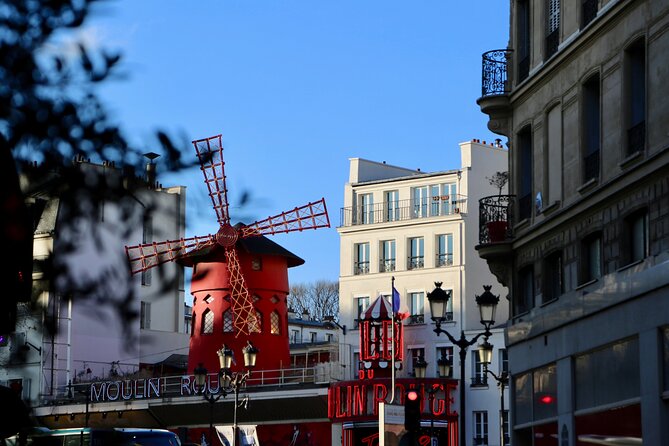
The final stop is the Moulin Rouge, at 46 Rue Pierre Fontaine. Allow about 15 minutes. The tour ends near this world-famous cabaret, giving the walk a clear and recognizable finish.
The Moulin Rouge works well as the closing point because it gathers many of the tour’s themes in one place: nightlife, dance, public scandal, artistic fascination, and the commercial power of Parisian pleasure. You finish with a landmark rather than a vague endpoint.
Keep your expectations in check. The experience is an exterior neighborhood tour with audio commentary. The information provided does not include admission to the Moulin Rouge, a performance ticket, or a backstage visit. You are learning about the venue and its place in Parisian nightlife, not attending a show.
The end location also makes the tour easy to pair with other plans in the Pigalle area. Since the walk begins at Place Saint Georges and ends near the Moulin Rouge, you can plan your day around this northward route instead of backtracking to the starting point.
How the smartphone format works on the street
The audio commentaries are designed to trigger automatically when you reach the right locations. A map shows the route, and the built-in geolocation feature helps correct you if you take a wrong turn.
This is simpler than following a long written guide, especially in streets where you may be watching traffic and checking addresses. The directions are meant to keep you moving without constant map reading.
The best feature is the ability to pause and resume at the same spot. You can stop at a terrace, browse a shop, or take a short break when you want. You are not tied to a group’s pace or a guide’s schedule.
The trade-off is equally clear. No live person is present to answer questions, adjust the pace, or add extra detail. This format suits you if you like independence. It is less suitable if you want conversation or a personal introduction to the neighborhood.
The tour is described as private, meaning only your own group participates. In practice, that means you can set your own pace without strangers around you, but the experience remains self-guided rather than privately led.
Price, timing, and who gets the best value
At $11.55 per person, this is an inexpensive way to add a themed walk to a Paris itinerary. The price covers the smartphone audio experience and activation code. Transport, food, drinks, shopping, and other personal costs are not included.
The advertised duration is about one hour to one hour and 30 minutes. The individual stop estimates add up to roughly 95 minutes, so you should allow closer to the longer end if you listen fully and walk at an easy pace.
I see the strongest value for people who want a specific subject without paying for a private guide. It is also a good choice for repeat visitors who have already seen central Paris monuments and want a neighborhood walk with a clear theme.
You should be comfortable managing your own phone and following directions. The experience is near public transportation, and service animals are allowed. Most people can participate, but the subject matter is not recommended for anyone under 16.
The booking terms are forgiving if your plans change early. You can cancel for a full refund at least 24 hours before the local start time. Cancellations or changes made inside that 24-hour window are not refunded or accepted.
Should you book the South Pigalle audio walk?
Book it if you want an affordable, flexible introduction to the less respectable side of Paris. The route offers a good mix of courtesans, brothels, artists, the French Cancan, and the Moulin Rouge, with enough humor to keep the material moving.
Skip it if you need a live guide, detailed access to interiors, or a tour suitable for children. The strongest experience comes from pairing the audio with curiosity about the streets themselves. At $11.55, it is a sensible choice for an independent afternoon walk, especially if the history of Parisian nightlife interests you more than another standard monument tour.
FAQ
Where does the tour begin?
It begins at 28 Place Saint Georges, 75009 Paris, France.
Where does the tour end?
It ends at 46 Rue Pierre Fontaine, near the Moulin Rouge.
How long does the tour take?
The approximate duration is one hour to one hour and 30 minutes.
How many stops are included?
The route includes eight stops, beginning at Place Saint Georges and ending at the Moulin Rouge.
Is this a guided group tour?
No. It is a self-guided experience on your own smartphone, with only your group participating.
How does the audio guide work?
Audio commentary triggers automatically at the relevant locations. The app also provides directions, a map, and geolocation support if you take a wrong turn.
Is the tour suitable for children?
It is not recommended for anyone under 16 because some of the subject matter is explicit.
Can I cancel for a refund?
Yes. You can receive a full refund if you cancel at least 24 hours before the experience’s local start time. Cancellations made less than 24 hours before the start are not refunded.
Latest audio tours in Paris
- The Tuileries Garden’s Classic Sights: A Self-Guided Audio Tour★ 4.0 · 3 reviews
- The French Revolution: Self Guided Audio Tour of Paris★ 4.5 · 3 reviews
- Audioguide – The Eiffel Tower and its secrets★ 4.0 · 4 reviews
- A Self-Guided Audio Tour Around Parc Montsouris★ 3.5 · 6 reviews
- Summit Eiffel Tower Audio Guide Tour with Unlimited Time Access★ 4.5 · 58 reviews
- Self-Guided Audio Tour -The Eiffel Tower, Exterior★ 4.0 · 9 reviews
- Trendy Marais, smartphone audioguided walking tour★ 5.0 · 6 reviews
- Self Guided Tours in Paris with 100 Captivating Audio Stories★ 3.5 · 3 reviews
Smartphone Audio Tours, compared.
Colosseum & Forum with Audio Guide App -Optional Arena
Read our review →
Timed Entry to Michelangelo’s David + Audio App
Read our review →
Cathedral & Brunelleschi’s Dome Ticket & Audio App
Read our review →
Michelangelo’s David Priority Ticket & Audio App
Read our review →
Uffizi Priority Ticket & Masterpieces Audio App
Read our review →
Castel Sant’Angelo Entry Ticket & Digital Audioguide
Read our review →
Pantheon Priority Entry Ticket & Audio Guide App
Read our review →Browse the lists this tour appears in