
Reviewed · ROME
Rome by Golf Cart Private Tour and Colosseum with Audio Guide
Rome is easiest to grasp when you can cover a lot of ground without wearing out your feet. This private golf cart tour links the Colosseum, Aventine Hill, Circus Maximus, ancient temples, and Tiber Island, then gives you time inside the Colosseum with a self-guided audio tour. The big draw is the mix of moving sightseeing and independent exploring.
I like the private format, since only your group rides together and you can agree on an end point in Rome’s historic center. I also like the Orange Garden and Capitoline Hill viewpoints, which add quiet, wide views to the famous ruins. The main catch is that the cart portion is brief at about two hours, and many sights are viewed from the vehicle rather than visited inside.
Key points
- A private golf cart covers 16 stops, including the Colosseum, Circus Maximus, Aventine Hill, ancient temples, and Tiber Island.
- The Orange Garden provides a peaceful pause with views toward St. Peter’s Basilica and the Tiber River.
- Piazza del Campidoglio offers a strong Roman Forum viewpoint without requiring a long archaeological walk.
- One hour inside the Colosseum is self-guided, with entry and reservation fees included.
- Drivers speak English, Italian, Spanish, or French, but a live tour guide is not included.
- You must bring an original valid ID, arrive early, and leave large bags and prohibited items behind.
Why the Golf Cart Works Well in Rome
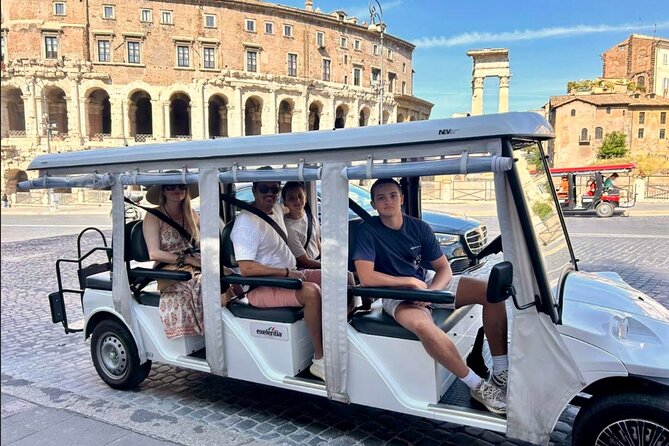
Rome’s historic center is compact on a map but tiring underfoot. The streets rise sharply toward the Aventine Hill, traffic can slow crossings, and the major ancient sites are spread across several neighborhoods. A golf cart gives you a practical overview in a short time.
This is a private activity, so you are not joining a large coach group. That matters in Rome, where narrow streets and crowded squares can make big-group sightseeing awkward. You ride with your own party, with a driver who speaks English, Italian, Spanish, or French.
The cart portion lasts about two hours. The complete experience takes about four hours, with roughly one hour set aside for the Colosseum audio visit. The remaining time includes moving between stops and short pauses. Do not expect a four-hour walking tour with extended visits at every monument.
The format suits you best if you want orientation, photos, and historical context before choosing which parts of Rome to explore more deeply on foot. It is also useful at the beginning of a Rome stay, when you are still trying to understand how the ancient center, river, hills, and grand squares fit together.
More private tours in Rome
- Exclusive Capuchin Crypts Tour: Audio, Small Group or Private
★ 4.5 · 42 reviews - Private Florence Tour by Golf Cart ETukTuk with Audio Guide
★ 4.0 · 256 reviews - Alberobello: Private Tuk Tuk Tour with Audio Guide
★ 4.8 · 172 reviews
Starting Near the Colosseum
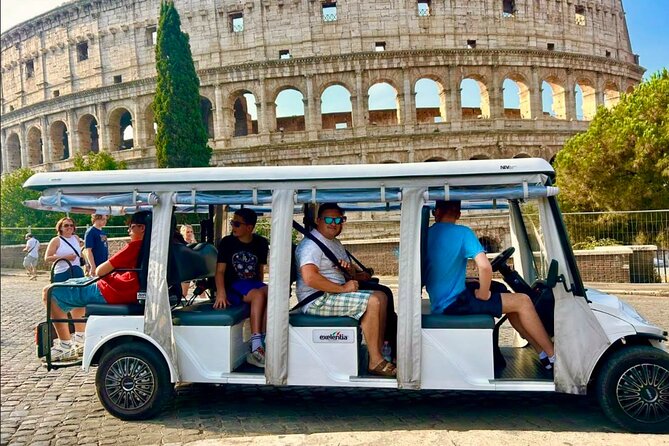
The meeting point is at Via delle Terme di Tito 72, close to the Colosseum. The location is useful because you can take photographs of the amphitheater before the cart sets off.
Arrive at least 20 minutes before departure. The early arrival is required for organizational reasons, not just a polite suggestion. Punctuality matters here, and a delay of more than 20 minutes can result in cancellation of the service.
The first stop is listed as the Colosseum, but this opening point is mainly for meeting your driver and getting photographs. The admission ticket is used later for the separate self-guided visit. Keep that distinction clear so you do not expect the first ten minutes to be an interior tour.
The Colosseum and Arch of Constantine
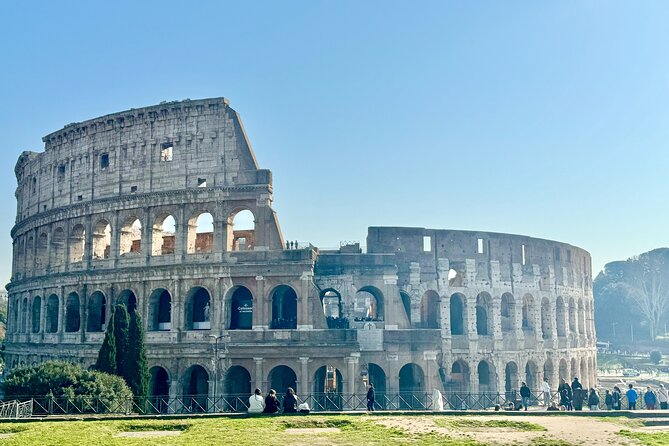
The cart begins beside two of Rome’s most recognizable monuments. The Colosseum needs little introduction, but seeing it from the road gives you a useful sense of scale before you enter.
The nearby Arch of Constantine dates to AD 315 and commemorates Constantine’s victory over Maxentius. Its carvings include pieces taken from earlier monuments, a detail that helps explain how Roman emperors reused older symbols to support their own public image.
You will pass the arch rather than receive a long stop inside the monument. The value is visual and introductory. Your driver can point out the relationship between the Colosseum, the arch, and the ancient ceremonial area around them.
Circus Maximus and the Climb to Aventine Hill
The cart then moves past Circus Maximus, the enormous valley once used for chariot races and public spectacles. Today it is an open public space, so the challenge is to picture the crowds and construction that once filled it.
A short stop is planned here, but you should expect a view rather than an archaeological visit. The open ground makes the site’s scale easier to understand, even though few standing structures remain.
From there, the route climbs Aventine Hill. The mood changes quickly. Instead of the dense traffic and crowds around the Colosseum, you see a quieter area with villas, gardens, and churches. The hill was linked historically with Rome’s plebeians, giving the route a social as well as architectural angle.
This is one of the places where a golf cart earns its keep. You avoid spending energy on the uphill walk and reach one of Rome’s best viewing areas without turning the outing into a demanding hike.
More Audio Tours in Rome
- Rome: Colosseum & Forum with Audio Guide App -Optional Arena
★ 4.2 · 24,770 reviews - Rome: City Sightseeing Hop-on Hop-off Bus with Audioguide
★ 4.0 · 16,045 reviews - Rome: St. Peter’s Basilica & Dome Entry Ticket & Audio Tour
★ 4.2 · 7,537 reviews - Colosseum, Roman Forum & Palatine Hill with Audioguide App
★ 4.4 · 6,291 reviews
Orange Garden: The Best Pause for Views
Giardino degli Aranci, or the Orange Garden, is one of the most appealing stops on the route. The park is known for its orange trees and broad views across Rome. You get about 15 minutes here, enough for photographs and a short pause.
From the garden, you can see toward St. Peter’s Basilica and the Tiber River. The view is not a substitute for visiting the Vatican, but it helps you place St. Peter’s within the wider city.
I especially like this stop because it breaks up the ancient ruins with greenery and open space. The drawback is simple: 15 minutes goes quickly. If you want a long walk through the garden or time to sit and linger, this itinerary will feel rushed.
Bocca della Verità and the Ancient Riverfront
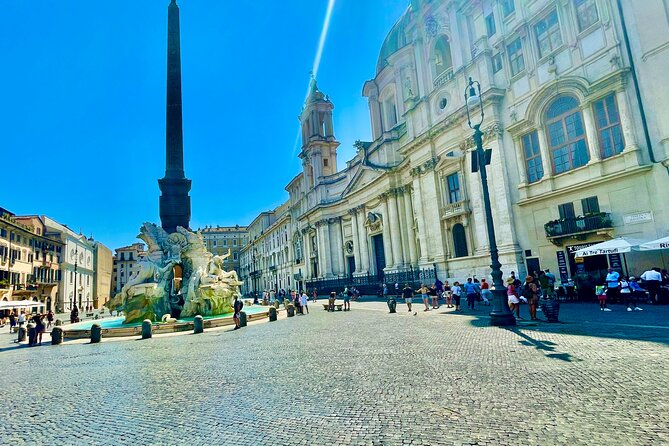
The cart passes the Bocca della Verità, the famous marble face associated with the old truth-telling legend. The planned viewing is short, about five minutes, so you should not expect an extended visit.
The route then reaches the old riverfront zone, where several important Roman structures sit close together. You pass the Temple of Hercules Victor, a round building dating to the late second century BC. Its circular form makes it easy to distinguish from the rectangular temple designs nearby.
The Temple of Portunus follows. Its raised podium and columns show the standard Roman temple arrangement, with engaged columns along the sides and freestanding columns at the front. These are quick views, but together they give you a useful lesson in Roman architecture.
Next comes the Arch of Janus, a fourth-century structure whose exact purpose remains debated. It may have served a commercial function or provided cover for a marketplace, though the tour presents those ideas as possibilities rather than settled fact.
The Theatre of Marcellus is another strong roadside sight. Two levels of its original facade remain, with Doric columns below and Ionic columns above. Its construction was tied to Augustus and dedicated to his nephew Marcellus, linking architecture with imperial family politics.
Capitoline Hill and the Roman Forum View
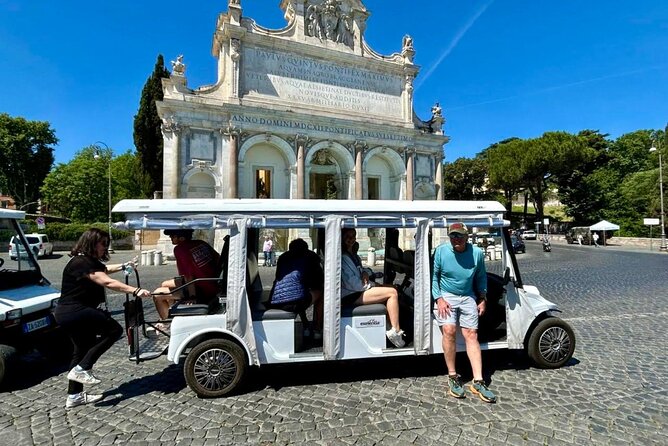
Piazza del Campidoglio is one of the most rewarding stops because the square itself and the view beyond it are both important. Michelangelo designed the square with a carefully balanced layout, and the bronze statue of Marcus Aurelius occupies its center.
From the elevated edge, you look across the Roman Forum. The ruins spread below with temples, basilicas, and fragments of public buildings. This viewpoint helps you understand the Forum as a connected civic center rather than a collection of isolated stones.
The stop lasts about 15 minutes. That is enough to take in the view and hear an explanation, but not enough for a full visit to the Capitoline Museums or a detailed walk through the square. If the Forum is a major priority, plan a separate visit.
Piazza Venezia and the Vittoriano
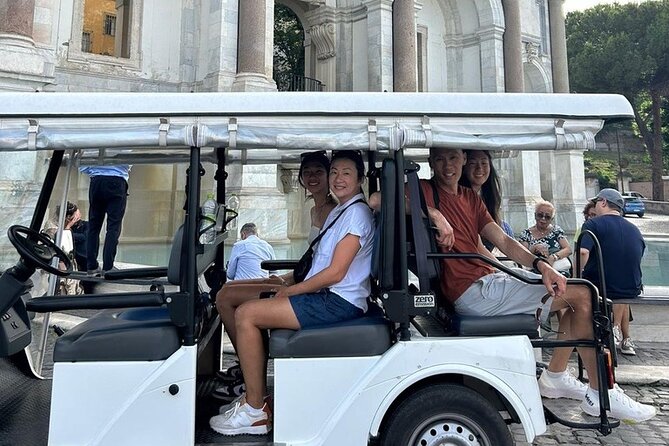
The cart continues toward Piazza Venezia, one of central Rome’s major traffic hubs. The enormous white Vittoriano, also called the Altar of the Fatherland, dominates the area.
The monument honors Victor Emmanuel II, the first king of unified Italy. Its size, statues, and bright marble make it impossible to miss. Some visitors find it grand, others find it overpowering, but it is important for understanding modern Italian national identity.
Traffic affects this part of the route. The plan is to pass through or near the square if conditions allow, so you should treat the stop as a moving view rather than a guaranteed long pause. That flexibility is sensible in Rome, where road conditions can change quickly.
Tiber Island, Ponte Fabricio, and Portico d’Ottavia
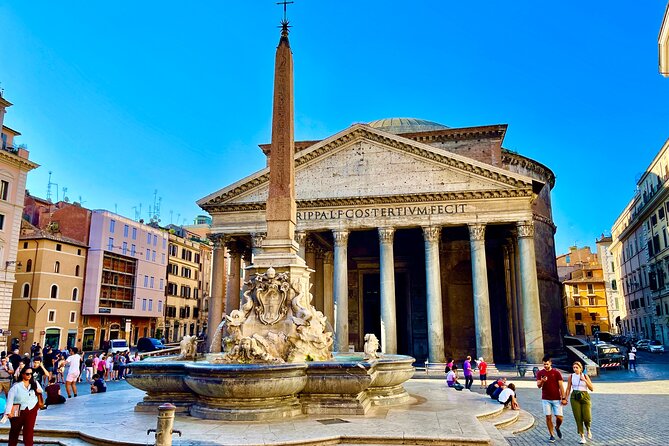
The final stretch visits several landmarks beside the Tiber. Isola Tiberina, or Tiber Island, has long been linked with healing. The route points out its connection with medicine and the Fatebenefratelli Hospital.
You also pass Ponte Fabricio, dating to 62 BC and connecting the island with the mainland. Its arches have carried people across the Tiber for centuries. From the cart, you get a quick look at the bridge’s structure, though not a dedicated walking inspection.
The route finishes near the Portico d’Ottavia, once a large complex of columns and enclosed spaces used for public activity. This stop is another reminder that ancient Rome was not only temples and arenas. It also had areas for business, leisure, and daily civic life.
The itinerary may change because of traffic or other events. Unused time is generally spent traveling between stops, so do not count on every site receiving the same amount of attention.
Entering the Colosseum With an Audio Guide
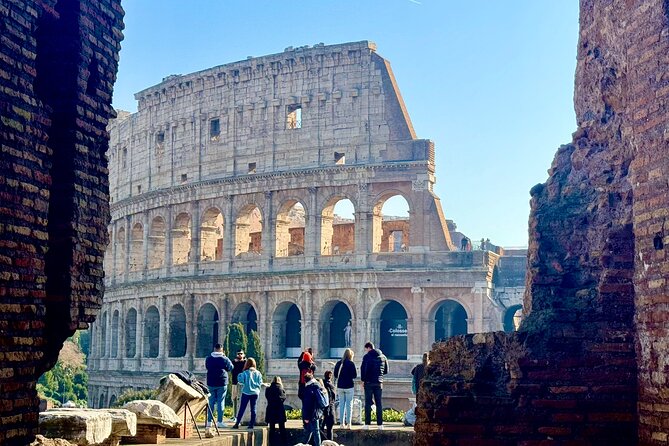
The Colosseum portion is separate from the golf cart sightseeing. You receive an entry ticket valued at €18, along with the €2 reservation fee, and about one hour with a self-guided audio tour.
I like this arrangement because you can move at your own pace instead of following a live guide’s fixed rhythm. If you want to pause at a particular section, replay an explanation, or simply take in the interior, the audio format gives you that control.
The tradeoff is that no live tour guide is included. Your driver may explain sights during the cart ride, but you should not book this expecting a specialist-led Colosseum lecture. The audio guide is a practical option for independent visitors, not a replacement for a longer guided archaeological tour.
Bring a valid original ID for every participant. Copies are not accepted for Colosseum entry. Large backpacks, bulky bags, luggage, trolleys, bottles and glass containers, alcoholic drinks, and aerosols are forbidden inside. Plan to carry only what you need for the visit.
Price, Timing, and Overall Value
At $270.88 per person, this is not a budget sightseeing ride. The value depends on how much you care about privacy, convenience, and covering several parts of Rome in one outing.
The price includes the private two-hour cart tour, the one-hour Colosseum audio visit, the entry ticket, and the reservation fee. It does not include gratuities, baby seats, or a live guide. Group discounts are available, which may improve the per-person cost for a larger private party.
You are paying mainly for the private vehicle and the efficient route. If you are comfortable walking, using public transportation, and arranging the Colosseum on your own, you can spend less. If you have limited time, prefer not to navigate Rome’s hills, or are traveling with family members who tire easily, the convenience has real value.
The tour is offered in English, and the driver may also speak Italian, Spanish, or French. Confirm the language you need when booking. Since only three published ratings are available, I would treat the perfect rating as encouraging but not enough to ignore the practical details.
One particularly useful service detail concerns Stephano. He received praise for helping resolve a serious problem involving an original Colosseum provider and finding a workable remedy. That suggests a strong effort to help when plans go wrong, though you should not assume Stephano will be your assigned driver.
Who Should Book This Experience?
I would recommend this to first-time Rome visitors who want a broad introduction without spending the whole day walking. It is also a good fit for families, small private groups, and anyone who wants to combine transport with major photo stops.
It works less well if you want long interior visits, detailed archaeology, or a slow food-and-neighborhood experience. Most stops are brief, and several monuments are viewed from the cart.
The non-refundable policy also deserves attention. Once booked, the experience cannot be changed or refunded for any reason, so check your dates carefully before paying.
Should You Book It?
Book this tour if you value a private ride, want to see many ancient landmarks in four hours, and prefer exploring the Colosseum with an audio guide at your own speed. The Orange Garden and Capitoline viewpoint add variety that a basic Colosseum visit misses.
Skip it if your priority is a full guided visit at each monument or if the price feels high for a route with many drive-by views. For the right visitor, this is a comfortable way to get your bearings, save your legs, and see Rome’s ancient center from several useful angles.
FAQ
How long does the complete experience last?
The experience lasts approximately four hours. About two hours are devoted to the private golf cart tour and about one hour to the self-guided Colosseum visit, with additional time used for travel between stops.
Where does the golf cart tour start?
The golf cart tour starts at Via delle Terme di Tito 72 in Rome, near the Colosseum.
Where does the tour end?
It can end at the starting location or at another place in Rome’s historic center if you agree on the location with the driver before departure.
Is a live tour guide included?
No. The package includes a driver for the private golf cart tour and a self-guided audio tour for the Colosseum. Drivers may speak English, Italian, Spanish, or French.
What must I bring to enter the Colosseum?
Each participant must bring a valid original ID. Copies are not accepted.
Can I bring a backpack or luggage into the Colosseum?
No. Backpacks, bulky bags, luggage, trolleys, bottles and glass containers, alcoholic drinks, and aerosols are forbidden inside.
Can I cancel or change the booking?
No. The experience is non-refundable and cannot be changed after booking.
Latest audio tours in Rome
- Pantheon Skip the Line Entry Tickets with Digital Audio Guide★ 3.5 · 52 reviews
- St. Peter’s Basilica: Dome Climb with Lift & Audioguide★ 4.5 · 13 reviews
- Audio guide in Vatican Museums and Sistine Chapel★ 4.5 · 12 reviews
- The Roman Jewish Ghetto: A Self-Guided Audio Tour★ 4.0 · 8 reviews
- Experience: The Pantheon Audio Tour★ 4.5 · 4 reviews
- Trastevere: A Self-guided Audio Tour of Rome’s Medieval Village★ 4.5 · 3 reviews
- Navova square underground with audioguide★ 4.5 · 17 reviews
- The Colosseum’s Attic with 3rd, 4th & 5th Levels with Audio Guide★ 4.5 · 20 reviews
Private, compared.
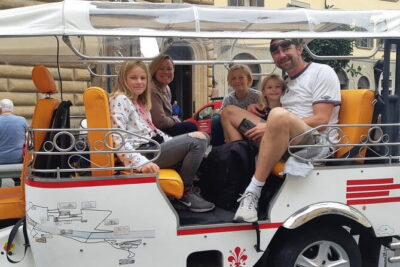
Private Florence Tour by Golf Cart ETukTuk with Audio Guide
Read our review →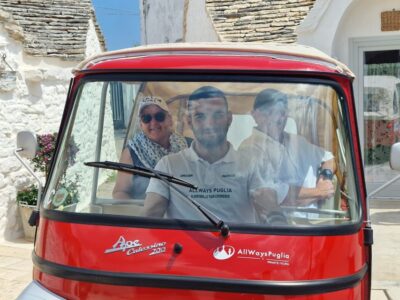
Alberobello: Private Tuk Tuk Tour with Audio Guide
Read our review →
Chiva Private Cultural Tour with Audio Guide in Buga
Read our review →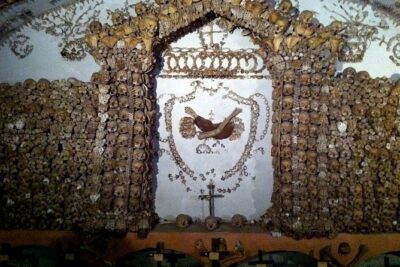
Exclusive Capuchin Crypts Tour: Audio, Small Group or Private
Read our review →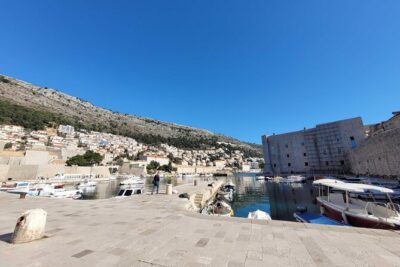
Private Self-Guided Audio Walking Tour in Dubrovnik Old Town
Read our review →
Half Day Self-Guided Audio Walking Private Tour in Copenhagen
Read our review →
Private Half Day Versailles with Audio Guide Tour from Paris
Read our review →Browse the lists this tour appears in