
Reviewed · CROATIA
Private Self-Guided Audio Walking Tour in Dubrovnik Old Town
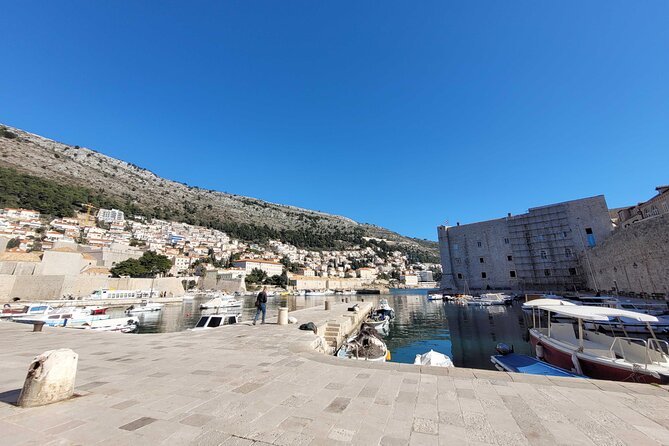
Dubrovnik’s Old Town is compact, but its stone streets are packed with stories. This self-guided GPS audio tour lets you explore without keeping pace with a group, moving from St. Blaise Church and the Rector’s Palace to Pile Gate, Sponza Palace, and the old city center.
I like the freedom to pause for photos, coffee, or a closer look at a carved doorway. I also like the offline content, which helps you avoid roaming charges once the tour is downloaded. The main drawback is technical: some users have dealt with clumsy activation, repeated audio, overlapping tracks, or a flat computer voice.
Key points to know before you book
- GPS-triggered narration: The app is designed to begin each explanation as you reach a point of interest.
- A flexible one-to-three-hour walk: You can move quickly through the route or stop longer at major buildings.
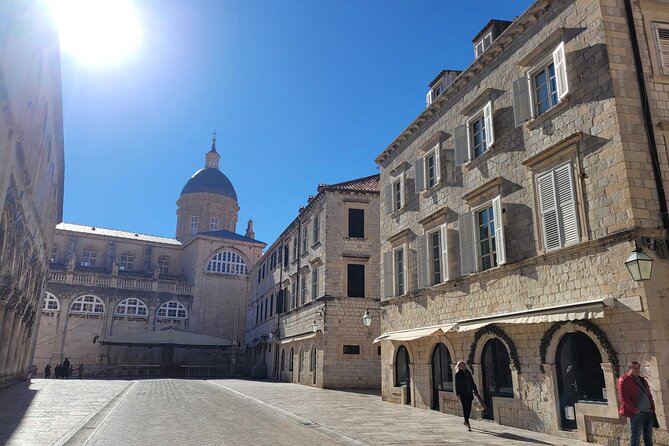
- Seven useful Old Town landmarks: The route covers St. Blaise Church, the Rector’s Palace, Amerling Fountain, Gundulić Monument, Pile Gate, the Luža Square tower, and Sponza Palace.
- Offline access after download: Download the map and audio while you have an internet connection, then use the tour without mobile data.
- No live guide or entrance tickets: You explore privately, but museum admission, headphones, food, transport, and your smartphone are your responsibility.
- A low-cost option with some app risk: At $9.61 per person, it can be good value, but only if the technology works properly on your phone.
What this Dubrovnik audio walk is really like
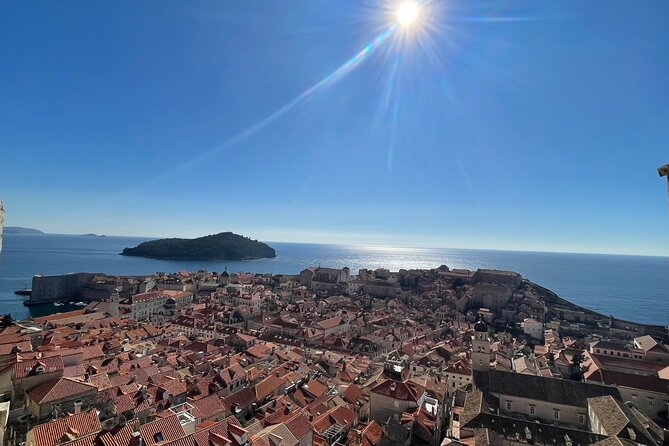
This is not a walking tour with a person leading you through the streets. It is a private digital route for your own group, delivered through the Navicup application in English. The route is open all day, with listed operating hours from midnight to midnight, so you can fit it around a cruise arrival, a hot afternoon, or an evening stroll.
The advertised walking time is about one to three hours. That range matters. You can follow the core stops in roughly an hour if you keep moving, but Dubrovnik rewards a slower pace. You may want extra time at the Rector’s Palace, Sponza Palace, and Pile Gate, and you will probably pause often in the narrow streets.
The strongest part of the concept is the GPS-based start to each recording. When it works as intended, you do not need to keep checking a printed route or manually search for every building. The app should recognize your position and begin the related narration.
That convenience comes with a condition: download everything before you arrive. An internet connection is needed to download the Navicup app and activate the audio tour. After that, the offline content is meant to help you avoid roaming charges.
More History Audio Tours in the world
- Colosseum, Roman Forum & Palatine Hill with Audioguide App
★ 4.4 · 6,291 reviews - Venice: St. Mark Basilica Ticket, Audioguide+History Gallery
★ 3.9 · 4,780 reviews - Rome: Colosseum, Ancient Rome Tour or AudioGuided Tour
★ 4.4 · 2,879 reviews
Starting at Svetog Đurđa 1
The stated meeting point is EXCELSA NEKRETNINE D.D. at Ul. Svetog Đurđa 1 in Dubrovnik. This is a meeting point for the digital experience, not a place where a live guide waits with a flag. Once activated, the route returns to the same meeting point at the end.
You need your own smartphone and headphones. Neither is included. That sounds obvious, but it is the sort of small detail that can spoil a low-cost tour if you arrive with a nearly empty phone battery or no comfortable way to listen.
The tour is private in the simple sense that only your group participates. You are not sharing a pace with strangers, and you can stop the audio when you like. This works well for couples, families, and friends who prefer to look around without making small talk with a group.
The app may also display more points than the main route. One technical complaint involved extra listings such as the Hard Rock Cafe and nightclubs, which made the map feel crowded. You can filter out irrelevant objects, so take a moment to simplify the map before setting off.
St. Blaise Church and the first taste of Dubrovnik Baroque
The first named stop is the Church of Saint Blaise, one of Dubrovnik’s most important sacred buildings. The current church was built in 1715 in a luxurious Venetian Baroque style.
The stop is listed at about five minutes, with admission not included. That short timing tells you how to use the audio: listen to the main explanation, then decide if the facade or interior deserves more of your own time.
St. Blaise is a useful opening stop because it places Dubrovnik within the wider Adriatic world. The Venetian Baroque style connects the city to a period of strong artistic exchange across the region. You get a quick architectural lesson before moving into the political heart of the old republic.
If you want a quiet, thoughtful start, this is one of the better parts of the route. The limitation is that the listed stop time is brief, so the audio may not give you the depth of a live specialist who can answer questions about the church.
The Rector’s Palace and the machinery of Ragusa

The Rector’s Palace is the most substantial historical stop on the route. From the 14th century until 1808, it served as the seat of the Rector of the Republic of Ragusa. It also housed the smaller council and the state government.
This was not simply a grand residence. The building included an armory, powder magazine, guard house, and prison. That mixture gives you a clearer sense of how Dubrovnik governed itself. Political work, military storage, security, and punishment were gathered in one important complex.
The tour details do not give a precise duration for this stop or include entrance admission. If you want to go inside, treat any museum or attraction ticket as an extra cost. The audio route can explain the building from the outside, but the full value of the palace may come from seeing its rooms and collections in person.
I would give this stop more time than the five-minute entries on the route. The Rector’s Palace is where the walk shifts from pretty architecture to the practical workings of a small maritime republic.
More Self-Guided Audio Tours in the world
- Athens: Acropolis Ticket & Optional Self-Guided Audio Tours
★ 4.1 · 2,542 reviews - Gettysburg Battlefield Self-Guided Driving Audio Tour
★ 4.5 · 910 reviews - Joshua Tree National Park Self-Guided Driving Audio Tour
★ 4.5 · 762 reviews - Ultimate Acadia National Park Self-Guided Driving Audio Tour
★ 4.0 · 521 reviews
Amerling Fountain and a small sculptural pause

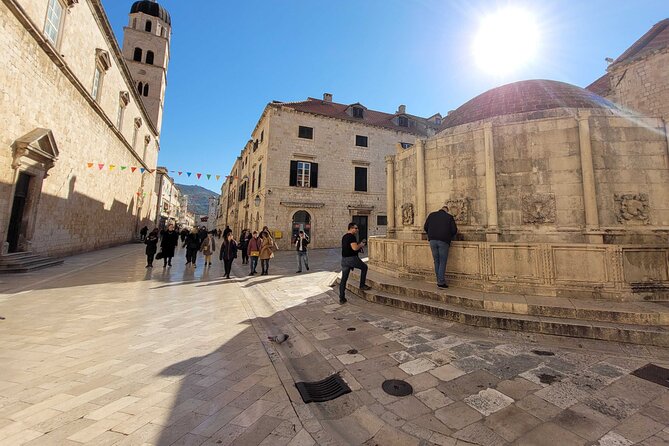
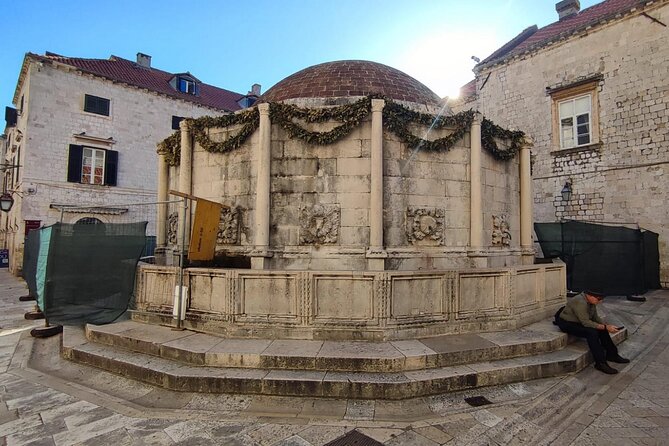
The Amerling Fountain is a much shorter stop, listed at about two minutes. It was created by Croatian sculptor Ivan Renditchi and installed in 1900 as a gift to the Amerling brothers’ hometown.
This is the kind of detail you can easily miss when walking quickly toward the main monuments. The fountain adds a later layer to the Old Town, showing that Dubrovnik’s story did not end with medieval walls or Renaissance palaces.
Admission is free. You do not need to plan a separate ticket or a long visit. Let the audio provide the context, look closely at the sculpture, and continue at your own pace.
The drawback is that a two-minute explanation cannot do much more than identify the work and its creator. Still, short stops are part of the route’s appeal. You get a string of small discoveries rather than one long lecture.
Gundulić Monument and Dubrovnik’s literary side
The Monument of Poet Ivan Gundulić is another brief stop, listed at about one minute. Gundulić was born in 1589 into an old and respected aristocratic family.
The four low-relief panels at the base of the monument show main episodes from Osman, his most important epic. This gives the walk a welcome literary turn. Dubrovnik is not presented only as a city of rulers, churches, and defensive buildings. Its public memory also honors poetry and local culture.
One minute is enough to understand what you are looking at, but not enough for a full discussion of Gundulić’s work. If poetry interests you, use the audio as a prompt and spend a little longer examining the relief panels.
This is also a good example of why a self-guided route can work well. You are free to linger at a small monument that a large group might pass in silence, or move on if literary history is not your priority.
Pile Gate, the practical entrance to the Old Town
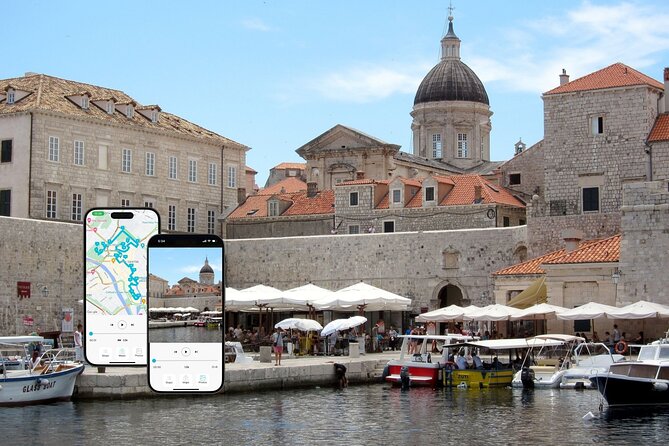
Pile Gate is described as the natural starting point for a visit to Dubrovnik. Built in 1537, it was once the main entrance, at a time when the Old Town had only two entrances.
The gate is an important orientation point. It helps you understand that Dubrovnik was designed as a controlled urban space, not an open collection of pretty streets. Entry, movement, and defense mattered.
The stop itself is listed at about three minutes and does not require an admission ticket. You can expect a quick explanation of the gate’s role, followed by a chance to look at the structure and the flow of the street beyond it.
Because the route begins at a separate address and includes Pile Gate as a stop, pay attention to the app’s directions. The GPS function is meant to guide you, but it is still wise to check that the map has downloaded correctly before you start.
Luža Square and the 31-meter tower
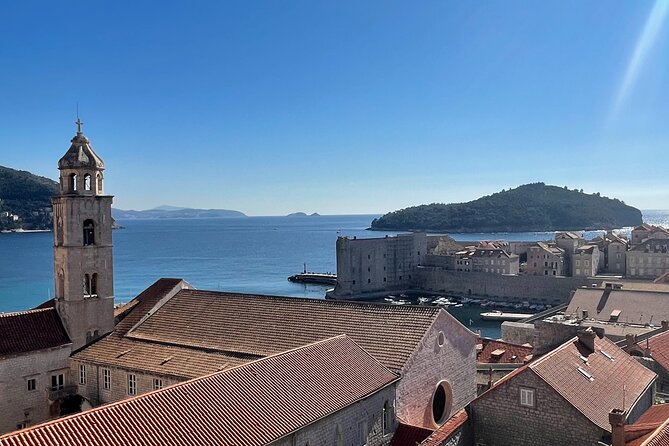
Another stop takes you to the tower at Luža Square, at the end of Stradun. The tower is 31 meters high and forms part of the visual focus of this central area.
The supplied route information does not name the tower or provide a separate duration or admission detail, so I would treat it as a short orientation stop. The important point is its position at the end of Stradun, Dubrovnik’s main street, and its role in the shape of the central square.
This is where GPS audio can be especially useful. In a dense old city, a brief explanation can help you connect a tower, a square, a main street, and the surrounding public buildings. Without that context, you may simply see another stone structure among many.
Sponza Palace and the city before the earthquake
Sponza Palace is one of the best stops on the route. Built between 1516 and 1522, it has kept its original form and offers a strong idea of what many Dubrovnik palaces looked like before the earthquake of 1667.
Its design combines a serious public facade with the elegance expected of a major city palace. The name comes from the word for the place where rainwater was collected, reflecting the former use of the site.
The stop is listed at about five minutes, with free admission. That does not necessarily mean every part of the building or any nearby attraction is free, so check the entrance situation on the day if you plan to go inside.
I like Sponza because it connects architecture with everyday city systems. The name points to water collection, while the building itself shows how Dubrovnik’s elite shaped public space. It is not just a pretty facade. It gives you a glimpse of how the city worked and how it looked before a major disaster changed so much of the Old Town.
Audio quality, voices, and the app’s weak point
The biggest question is not the route. It is the software.
The app is supposed to start narration automatically and avoid restarting a location once you have passed it. One positive experience praised exactly this GPS behavior, saying the audio began as the user reached each point. That is the best version of the tour: hands-free, private, and easy to follow.
But you should be prepared for possible glitches. Problems reported include audio repeating several times, the next building’s narration starting over the current track, and some locations failing to play. There were also activation delays in at least one case because the booking notification did not reach the support team automatically.
Voice quality may vary. The provider explains that some tours use professional human voices while others use high-quality computer voices. The English experience may therefore feel polished to one person and stiff to another. One account found the information dry, with a computer voice reading short descriptions and errors in the text.
There is also a positive account connected with a guide named Branko, described as excellent for history, culture, and architecture. Since this product is self-guided and does not promise a live guide, check the exact audio version you receive rather than assuming a named person will lead you in person.
My practical advice is simple: activate the tour before you need it, test one audio point, and keep the support contact available. If the audio starts repeating or overlapping, stop the tour rather than letting several tracks play together. The provider says the map can be filtered, which is useful when unrelated businesses and nightlife locations appear.
Is $9.61 good value?
At $9.61 per person, the price is low for a private Old Town orientation. If the GPS and audio work properly, the tour can cost less than a live group walk while giving you control over the pace.
The value is strongest if you want a basic introduction to the main sights. You receive a downloadable map, an activation link, and offline content in English. You do not pay for transportation, and the activity ends back at its meeting point.
The value is weaker if you expect a polished historical performance, detailed answers, or guaranteed human narration. Entrance tickets are not included, and neither are headphones or a phone. You also need an internet connection for the initial download, so the low price does not remove all preparation.
For a family or private group, the group discount option could improve the deal, though the exact discount is not stated. For one person who wants a lively storyteller, a more expensive live tour may be a better use of money.
Who should book this walk?
I would choose this tour if you like to move independently and want a light layer of context over your sightseeing. It suits people who already plan to walk Dubrovnik Old Town and want help noticing details such as the Amerling Fountain, the Gundulić reliefs, and the practical history of Pile Gate.
It also suits couples and small groups who dislike being hurried. You can pause the audio, take photos, or spend longer at Sponza Palace without holding up anyone else.
I would be cautious if you dislike apps, have limited phone battery, or want a warm human voice throughout. The mixed reports on activation, audio overlap, and computer narration mean you should see this as an inexpensive tool, not a fully supported private guide.
The route is accessible to most people according to the supplied information, and service animals are allowed. It is also near public transportation. No special transportation is provided, so you need to reach the starting point yourself.
You can cancel for a full refund up to 24 hours before the scheduled start time. Cancellations or changes within 24 hours are not refunded or accepted, and the cut-off follows Dubrovnik local time.
Should you book the Dubrovnik audio tour?
Book it if you want an affordable, private introduction to Dubrovnik’s central landmarks and you are comfortable managing a smartphone app. The strongest features are the GPS-triggered narration, offline access, flexible timing, and a route that includes both major buildings and smaller cultural details.
Skip it if you need reliable live commentary or polished storytelling with no technical risk. For the best chance of a smooth walk, download the app and audio early, test the activation, bring headphones, and filter the map before you begin.
At $9.61, this is a reasonable add-on to your Old Town visit. Just keep your expectations in the right place: it is a self-guided audio aid, not a substitute for a live historian.
FAQ
How long does the Dubrovnik audio tour take?
The walking experience takes approximately one to three hours. Your timing depends on how quickly you move and how long you spend at the landmarks.
What language is the audio tour offered in?
The experience is offered in English.
Do I need internet access to use the tour?
You need an internet connection to download the Navicup application and audio tour. The content is then available offline to help avoid roaming charges.
Is a live guide included?
No. The tour is self-guided through a smartphone application, and no live guide is included.
Are entrance tickets included?
No. Entrance tickets to museums or attractions along the route are not included. The listed stops include several free outdoor points, but any paid attraction admission is your responsibility.
What do I need to bring?
You need your own smartphone and headphones. Transportation, food, and drinks are not included.
More Audio Walking Tours in the world
- Sofia: City Monuments Guided Walking Tour with Audio Guide
★ 4.5 · 825 reviews - Florence: 2.5 hour Audio Guided Walking Tour led by Host
★ 4.6 · 293 reviews - Self Guided Classic Freedom Trail Location Aware (GPS) Walking Audio Tour
★ 4.5 · 258 reviews - Valletta: Self-Guided Historical Walking Tour (Audio Guide)
★ 3.7 · 251 reviews
Latest audio tours in the world
- Seville Maestranza Bullring Tour with Audio Guide★ 3.5 · 6 reviews
- Seville Scavenger Hunt and Highlights Self Guided Audio Tour★ 5.0 · 5 reviews
- Seville Audio guided walking tour 3h20 and 28 audio commentaries★ 5.0 · 2 reviews
- Royal Alcazar of Seville Entry Ticket with Audio Guide★ 4.0 · 42 reviews
- Seville Cathedral and La Giralda Entry Ticket with Audio Guide★ 3.0 · 9 reviews
- Seville Cathedral and Giralda Entry Tickets with Audio Guide★ 4.0 · 56 reviews
- Essential Seville’s Ancient History: An Audio Tour★ 5.0 · 9 reviews
- Sequoia National Park Self-Guided Audio Tour★ 4.5 · 9 reviews
Audio Walking Tours, compared.

City Monuments Guided Walking Tour with Audio Guide
Read our review →

Self Guided Classic Freedom Trail Location Aware (GPS) Walking Audio Tour
Read our review →
Self-Guided Historical Walking Tour (Audio Guide)
Read our review →
Cape Cod & Provincetown Self-Guided Driving & Walking Audio Tour
Read our review →
Verona Walking Tour with Audio and Written Guide by a Local
Read our review →
Royal Walking Tour and Buckingham Palace Audio Tour
Read our review →
Bologna Walking Tour with Audio and Written Guide
Read our review →Browse the lists this tour appears in