
Reviewed · FLORENCE
Florence: Accademia Gallery Entry Ticket with Audio Guide
Michelangelo’s David is the reason most people come to Florence’s Accademia Gallery, and it earns the attention. The 17-foot marble figure is far more powerful in person than in a photograph, with tiny details in the hands, face, and posture that reward a slow look.
I like two things here: prebooked entry helps you avoid the regular ticket line, and the optional audio guide gives you more context than a quick walk past the art. The gallery also offers a useful look at Michelangelo’s unfinished Prisoners, not just his one famous statue.
The main catch is the meeting process. You must first check in at the Italy Pass office on Via dei Pucci, then make your way to the museum, and the audio app requires a code and your own earbuds. Build in extra time, and do not expect a personal guide inside.
Key points at a glance
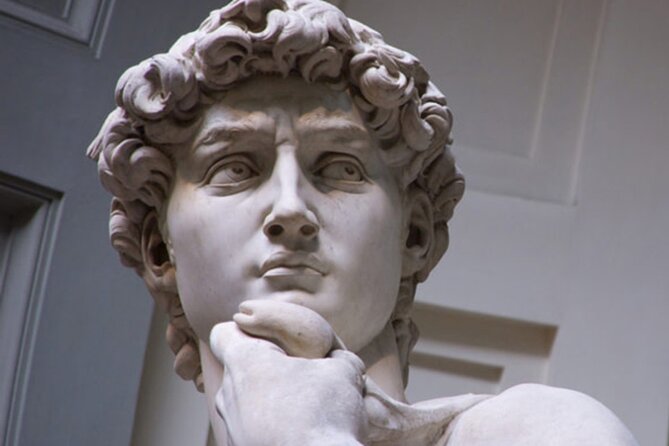
- David under the skylight: See Michelangelo’s most famous sculpture from close range, including details that disappear in photographs.
- The unfinished Prisoners: Study four rough-hewn figures that show Michelangelo’s sculpting process before the marble was fully released.
- More than one masterpiece: Find Florentine religious paintings, plaster casts, Medici instruments, and a Stradivarius violin.
- A ticket with practical help: A host assists with entry, but the service is not the same as a guided museum tour.
- Audio guide choice: Select a multilingual in-app guide, or explore independently at your own pace.
- Bring your own earbuds: Disposable earphones are available, but they may not work well with every device.
Why David deserves your full attention
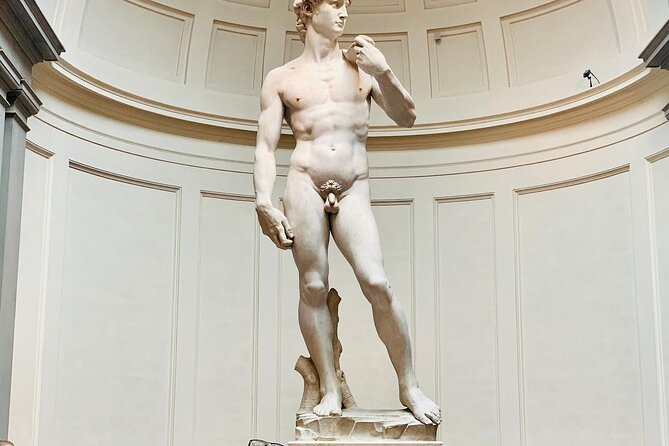
Florence has no shortage of famous art, but David is different from most museum highlights because of its scale and directness. The statue is over 17 feet tall, yet Michelangelo gave it details that invite close inspection. Look at the veins in the hands, the set of the mouth, and the alert expression in the eyes.
David is shown before his encounter with Goliath, tense and watchful rather than triumphant. That choice gives the sculpture its force. You are not looking at a relaxed hero posing for a victory portrait. You are looking at a young man preparing for danger.
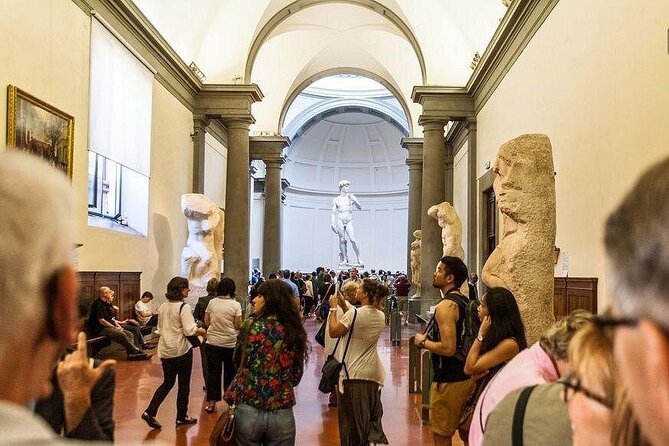
The statue is displayed at the end of the long Tribune, beneath a natural skylight. That placement gives you a gradual approach. You first move through the gallery, then see David framed at the far end. Take a moment before walking close. The first view from a distance helps you understand the whole composition.
At $42 per person, the ticket is not cheap for a single museum visit. Its value rests mainly in avoiding the standard ticket queue and securing access to one of Florence’s busiest attractions. If David is high on your list, that convenience can matter more than saving a few dollars.
More Museum Audio Tours in Florence
- Florence: Uffizi Priority Ticket & Masterpieces Audio App
★ 4.2 · 6,402 reviews - Florence: Uffizi Gallery Timed Entry Ticket & Audio Guide
★ 4.2 · 2,794 reviews - Florence: Uffizi & Accademia Priority Tickets with Audio App
★ 4.4 · 1,253 reviews
The Hall of the Prisoners and Michelangelo’s working method
The Hall of the Prisoners comes before David and is one of the most revealing parts of the visit. Four unfinished marble figures appear to struggle out of their blocks. They are often called the Slaves or Prisoners.
These sculptures show Michelangelo’s non-finito approach, meaning the work was left incomplete. You can see bodies beginning to emerge from rough stone, with some sections shaped clearly and others still trapped in the block.
I find this room valuable because it changes how you look at David. Instead of seeing Michelangelo only as a master who produced perfect finished figures, you see the physical act of carving. The unfinished surfaces preserve the tension between raw marble and human form.
Do not rush through this hall just because the famous statue is waiting ahead. The Prisoners are less polished, but they offer a more intimate view of the artist’s hand. The rough stone also makes the finished David seem even more controlled.
Beyond David: paintings, plaster, and royal instruments
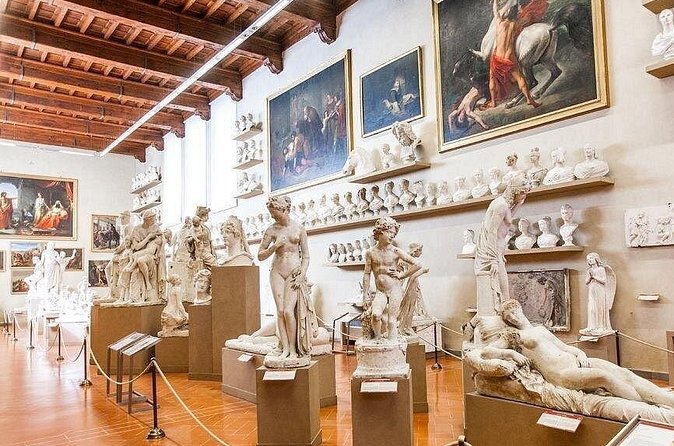
The Accademia is not a one-statue museum. David gets the largest share of attention, but the other collections give you a fuller picture of Florentine art and craft.
The gallery’s religious collection includes gold-ground paintings from the 13th through the 16th centuries. These works belong to an earlier style of Italian painting, when sacred figures were often shown against shining gold backgrounds.
You may find these paintings quieter than the Michelangelo rooms. Their value comes from comparison. They show the artistic world that preceded the Renaissance and help explain how Florentine painting changed over time.
The Gipsoteca Bartolini, or Hall of Models, contains 19th-century plaster casts. The room can feel like a sculptor’s workroom, with pale figures arranged as studies and models. It offers a useful contrast with David. Here, you see the planning and copying stages of sculpture rather than one celebrated final work.
The Museum of Musical Instruments adds another change of pace. Its collection includes objects connected with the Medici and Lorraine families, along with a Stradivarius violin. If you enjoy decorative arts, court life, or music, allow time for this section instead of treating it as an afterthought.
The description of the experience also refers to a unique church and handmade medieval stained-glass windows by famous artists. Because the main route centers on the Accademia Gallery, check the precise arrangement of this part when you receive your entry information. Do not assume that every church feature is part of the standard museum visit.
How the ticket and meeting process work
Your meeting point is the Italy Pass store at Via dei Pucci 37/39 red. You do not go directly to the Accademia first. This is the most important practical detail to understand before booking.
A host or greeter helps you with entry, with assistance offered in English, French, Italian, or Spanish. The service is designed to get you through the admission process, not to lead a full art-history tour. Once inside, you explore independently unless you choose the audio guide.
Allow time to find the office, check in, and continue to the museum. A cramped waiting area can make the start less comfortable, especially if you arrive with luggage or need to sit. The process may also involve meeting another representative near the Accademia, so keep your phone available and follow the instructions given at check-in.
This setup can feel less direct than a simple ticket delivered to your phone. In exchange, you receive prebooked admission and on-site assistance. That tradeoff makes the option most useful for people who value help with a busy museum entrance and do not mind an extra check-in step.
More Museum Audio Tours in Italy
- Florence: Uffizi Gallery Reserved Entry Ticket & Audioguide
★ 4.5 · 970 reviews - Florence Duomo, Baptistery & Opera Museum Audioguided Tour
★ 4.2 · 607 reviews - Florence: Accademia Gallery Reserved Entry & Audio Guide
★ 4.3 · 600 reviews - Florence: Uffizi Gallery Tickets with Optional Audio Guide
★ 4.1 · 503 reviews
The audio guide: useful, but prepare before you arrive
The audio guide is optional. You can choose a basic prebooked entry ticket and move through the rooms on your own, or select the ticket with a multilingual in-app guide.
The audio guide is offered in English, Spanish, French, German, and Italian. It can add background to David, the Prisoners, the paintings, and the other collections. For a first visit, that extra explanation may help you connect the rooms instead of seeing them as a series of unrelated displays.
The technology needs preparation. You receive a code for the app, and the app must be downloaded before you can listen. One code may fail, so keep the instructions handy and ask for help promptly if access does not work.
Bring your own earbuds. This is more than a minor comfort tip. Disposable earphones are available, but they may not fit every device, and poor sound can make an audio guide frustrating. Wired or wireless earbuds that you know work with your phone are the safer choice.
There is no personal guide explaining the art in real time. If you prefer to ask questions, discuss the sculptures, or follow a set story with a live expert, this product may feel limited. If you like stopping and starting at your own pace, the app is a better match.
How much time should you allow?
The experience is listed as lasting from four hours to one day, depending on the selected starting time and how you use the ticket. The gallery itself does not require an entire day for most people, but the wider booking window gives you flexibility around your Florence plans.
For a focused visit, plan enough time for the Prisoners, David, the religious paintings, the plaster casts, and the musical instruments. The exact pace depends on how long you spend near the main sculpture and whether you use the audio guide.
Do not schedule the Accademia immediately before a hard-to-miss train, timed meal, or another fixed appointment. The office check-in, walk to the museum, and possible wait for the host create more moving parts than a direct admission ticket.
The museum is wheelchair accessible. Oversize luggage is not allowed, and you should leave selfie sticks, alcohol, drugs, and pets at home. Assistance dogs are allowed. Flash photography and smoking are prohibited.
Children need a passport or ID card. That rule is easy to overlook, so carry the required document if a child is included in your booking.
What the $42 price really buys you
The $42 cost includes a prebooked ticket and host assistance. The audio guide is an option rather than an automatic part of every booking, so check which entry type you select.
The strongest value is time and certainty. Florence is a city where major sights can consume part of your day simply through ticket queues. Paying more than a basic admission price may make sense if you have limited time or are visiting during a busy period.
The price is harder to justify if you only want a quick look at David and are comfortable arranging admission yourself. You are paying for a packaged service with a meeting point, not for private guiding, transportation, or hotel pickup.
There is no included transport, and no hotel pickup or drop-off. You make your own way to Via dei Pucci and then to the gallery. That is fine for anyone already exploring central Florence, but it is not a door-to-door tour.
The overall rating is 4.1 from 88 reviews, which suggests a generally worthwhile visit with some unevenness in the booking process. The museum itself is the reliable part. The office check-in and audio arrangements require more attention.
The main strengths and the main frustration
The best part is clearly the art. David is genuinely extraordinary, and the Prisoners add a rare view of Michelangelo’s unfinished work. The gallery’s smaller collections also make the visit more rewarding than a simple photo stop.
Prebooked access is another practical advantage. It can save you from standing in the regular ticket line, though it does not remove every step. You still need to reach the meeting point, check in, and follow the host’s directions.
The weak point is coordination. The office can be awkward to find, the waiting area may not have enough seating, and the process may require a second meeting near the museum. If the host is delayed, you may spend part of your planned museum time waiting around.
Audio quality can also vary. Static, missing sound, or an unclear speaker can undercut the extra cost of the guide. Use your own earbuds, test the app early, and do not depend on the audio guide as your only way to understand the collection.
These problems do not cancel out the museum visit, but they affect how relaxed the morning or afternoon feels. Go in expecting a ticket service with assistance, not a polished private tour.
Who should book this Accademia experience?
I would recommend it to a first-time Florence visitor who strongly wants to see David, prefers a reserved entry, and appreciates basic help at the door. It also suits independent visitors who want an audio option but do not want to follow a group for several hours.
It is a good fit for people who enjoy sculpture, Renaissance art, and the chance to compare finished and unfinished work. The musical instruments and older religious paintings make it worthwhile for visitors with interests beyond Michelangelo.
Families should note the ID requirement for children and the ban on oversize luggage. Anyone with mobility concerns can use the wheelchair-accessible museum, but the route between the office and gallery should still be considered when planning.
I would be more cautious if you dislike app-based tours, need a smooth start, or want a live guide who answers questions. In that case, a direct museum ticket or a clearly organized guided tour may suit you better.
Should you book it?
Book this experience if David is a priority and you want prearranged entry with a host nearby. The sculpture and the Prisoners justify making time for the Accademia, and the optional audio guide can add useful context.
Before paying, compare the price with other entry choices and confirm whether you want the audio package. Bring your own earbuds, carry a child’s ID if needed, avoid large bags, and arrive early at the Italy Pass office on Via dei Pucci 37/39 red.
The art is the reason to go. The ticket service is simply the tool that gets you inside. If you understand that distinction, this can be a practical way to see one of Florence’s essential works without spending your whole day in a ticket line.
FAQ
Where is the meeting point?
Meet at the Italy Pass store at Via dei Pucci 37/39 red in Florence.
Is the audio guide included?
The audio guide is optional. You can choose prebooked entry alone or entry with the multilingual in-app audio guide.
What languages are available for the audio guide?
The audio guide is available in English, Spanish, French, German, and Italian.
Is there a live tour guide?
No. The booking includes a host or greeter to assist with entry, but it does not include a tour guide inside the museum.
What should I bring for the audio guide?
Bring your own earbuds for the best sound and device compatibility. Disposable earphones may be available, but they may not fit every device.
Can I cancel the booking?
You can cancel up to 24 hours in advance for a full refund. The reserve now and pay later option lets you book without paying immediately.
Latest audio tours in Florence
- Florence: Uffizi Gallery Audio Guided Tour led by Tour Leader★ 3.5 · 6 reviews
- Uffizi Combined Ticket:UFFIZI, PITTI, BOBOLI & digital audioguide★ 4.0 · 26 reviews
- Florence: Uffizi Gallery Reserved Ticket & Digital Audio Guide★ 4.5 · 3 reviews
- Florence: Uffizi Gallery Timed Entry Ticket with Audio★ 3.0 · 3 reviews
- Accademia Gallery Skip the line Tickets with Audio Guide★ 4.0 · 10 reviews
- Uffizi Gallery Audio-Guided Visit with optional Accademia Gallery★ 3.5 · 42 reviews
- Florence Walking Tour with Audioguide on Your Smartphone★ 4.5 · 9 reviews
- Florence Baptistery & Opera Museum Audioguided tour with guide★ 3.5 · 41 reviews
Museum Audio Tours, compared.

Uffizi Priority Ticket & Masterpieces Audio App
Read our review →
Louvre Museum Hosted Entry and Mona Lisa Audioguide
Read our review →
St. Mark Basilica Ticket, Audioguide+History Gallery
Read our review →
Borghese Gallery Skip-the-Line Ticket & Audioguide
Read our review →
Borghese Gallery Ticket + Audioguide or Guided Tour
Read our review →
Orsay Museum Entry Ticket and Digital Audio Guide App
Read our review →
Uffizi Gallery Timed Entry Ticket & Audio Guide
Read our review →
Acropolis Museum Ticket with optional Audio Guide
Read our review →Browse the lists this tour appears in