

Reviewed · FLORENCE
Florence Walking Tour with Audioguide on Your Smartphone
Florence packs centuries of art, politics, religion, and science into a walkable center, and this audio tour gives you a low-cost way to sort it all out. You move from Santa Maria Novella to the Duomo, across Ponte Vecchio, and up toward Forte Belvedere while a professional historian explains what you are seeing.
I like the offline map, which matters when thick stone buildings interfere with phone signals. I also like the 30 audio recordings and illustrations, since you can stop, look up, and connect a façade or statue with its story. The catch is simple: there is no human guide, and one user needed extra help figuring out which app to download.
Key points before you set out

- Start at Santa Maria Novella: The meeting point is Piazza di Santa Maria Novella 18, near public transportation.
- Follow a 2.5-hour route: The walk covers major churches, palaces, museums, markets, bridges, and viewpoints.
- Use the app offline: Download the route before walking, then use the map and GPS without relying on mobile data.
- Expect exterior sightseeing: Entrance fees and tickets are not included, so many stops work best as outside visits unless you arrange entry separately.
- Bring your own headphones: Your phone, headphones, and transportation are not provided.
- Get one year of access: You can activate and use the tour at a time that suits your schedule, rather than only at the date shown during checkout.
Starting at Santa Maria Novella

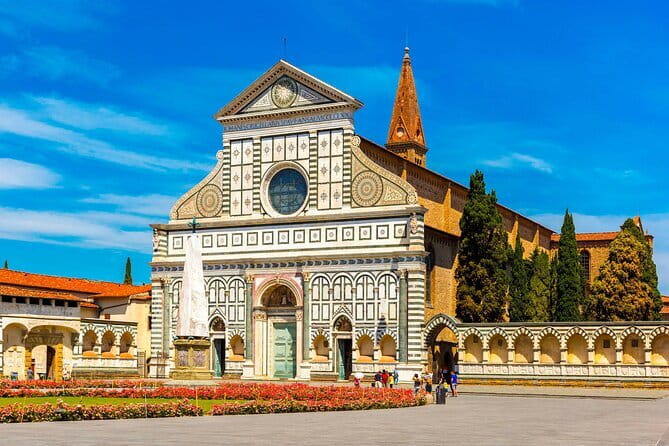
The route begins at the Basilica of Santa Maria Novella, one of Florence’s most graceful first stops. Its Gothic structure and decorated façade give you an immediate lesson in the city’s mix of religion, art, and civic pride.
The audio explains the church’s 13th-century origins and points out its rose window, frescoes, chapels, and cloisters. Inside, works linked with Masaccio and Ghirlandaio make this more than a quick photo stop, though you will need to handle any entrance arrangements yourself because tickets are not included.
This is a good place to test the app. Download it, activate your purchase, connect your headphones, and check that the route appears before you leave the square. One user initially had trouble identifying the correct app, then received detailed instructions by email. I would not wait until you are standing in the middle of Florence to sort this out.
More Audio Walking Tours in Italy
- Florence: 2.5 hour Audio Guided Walking Tour led by Host
★ 4.6 · 293 reviews - The Best of Florence Walking Tour with Audio Guide and Guide
★ 5.0 · 40 reviews - Verona Walking Tour with Audio and Written Guide by a Local
★ 4.5 · 157 reviews
San Lorenzo, Palazzo Medici, and the Medici story
From Santa Maria Novella, the route moves toward the Basilica of San Lorenzo. This church reaches back to the 4th century, then takes you into the Renaissance through Filippo Brunelleschi’s redesign, with calm proportions, columns, and chapels.
The nearby Medici Chapels connect the church to Florence’s most powerful family. Michelangelo’s work is part of the attraction, and the basilica helps explain how religion, family power, art, and money worked together in Renaissance Florence. Again, you should treat the stop as an audio explanation and orientation point unless you have separately secured admission.
Palazzo Medici adds the family’s private world. The rusticated stone façade looks firm and almost defensive from the street, while the Chapel of the Magi inside is known for elaborate decoration. The audio can give you the setting and significance, but it cannot replace time inside the palace. If these interiors are high on your list, check opening arrangements before relying on this tour alone.
The Duomo complex and Giotto’s Bell Tower
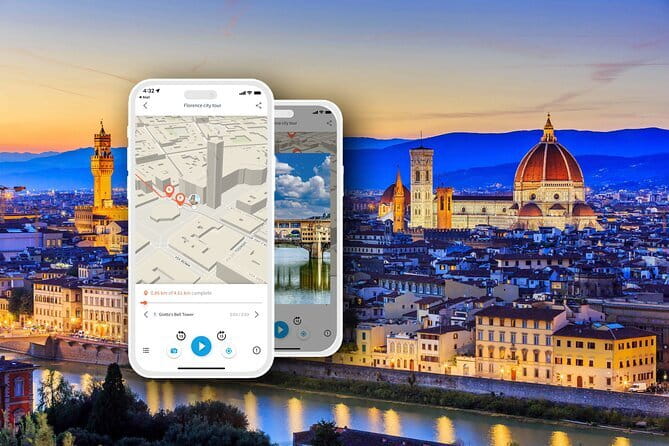
The Cathedral of Santa Maria del Fiore is the route’s great visual anchor. The marble façade, colored stone, sculptures, and Brunelleschi’s enormous brick dome make the building easy to recognize, and the recording provides context while you take in the scale.
The listed stop allows about 10 minutes and marks admission as free. The overall tour terms also say entrance tickets are not included, so do not read that timing as a full cathedral visit. It is better understood as a brief stop for orientation and exterior appreciation, with the option to arrange your own entry if you want more time.
Giotto’s Bell Tower sits beside the cathedral and offers a different view of the complex. Its 414 steps lead toward broad views over Florence, while the marble panels and reliefs reward a slower look from ground level. The audio explains the tower’s Florentine Gothic design, but climbing it would add time and effort beyond the basic route.
This is one reason the advertised 2.5 hours should be treated as approximate. Thirty recordings and so many major sights can only be sampled in that span. Add church visits, museum entries, shopping, food, or a bell tower climb, and the walk becomes a full morning or afternoon.
Piazza della Repubblica and Palazzo Strozzi
Piazza della Repubblica changes the mood. The square marks the center of modern Florence, with cafés, shops, and the Arch of Triumph. The audio connects the space with its earlier role as a Roman forum, giving you a quick sense of how the city has been reshaped over time.
The stop is listed at about 10 minutes, which is enough to hear the explanation and take in the square. It is not enough for a long café break, shopping, or careful people-watching. I would use it as a reset between older monuments.
Palazzo Strozzi is one of Florence’s finest Renaissance palaces. Its orderly façade and courtyard show how much power could be expressed through proportion and restraint rather than decoration alone. Today it hosts changing exhibitions, so the audio stop gives you the building’s setting while any exhibition visit requires a separate ticket.
The route also includes Palazzo di Parte Guelfa, tied to the Guelf political faction of medieval Florence. This is a useful stop for understanding that Florence was not only a city of painters and churches. Political rivalry shaped its buildings, streets, and public life too.
More Smartphone Audio Tours in Florence
- Florence: Timed Entry to Michelangelo’s David + Audio App
★ 4.6 · 19,496 reviews - Florence: Uffizi Priority Ticket & Masterpieces Audio App
★ 4.2 · 6,402 reviews - Florence: Michelangelo’s David Entrance Ticket and Audio App
★ 4.3 · 1,901 reviews - Florence: Uffizi & Accademia Priority Tickets with Audio App
★ 4.4 · 1,253 reviews
Mercato Nuovo and the civic heart of Florence

Mercato Nuovo brings you closer to daily city life. The market offers produce, local food, cheeses, and other specialties, with food counters and vendors adding a practical, sensory side to the route.
The planned stop is about 10 minutes. That is enough to look around and hear the recording, but you may want to pause longer if you are hungry or interested in local ingredients. The tour does not include food, so anything you buy is your own expense.
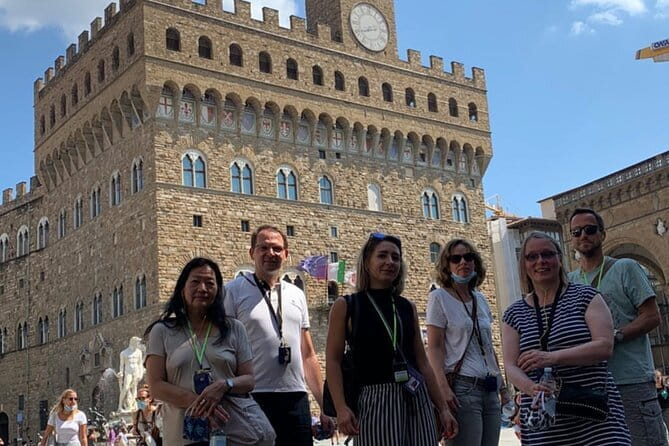
Next comes Palazzo Vecchio, the fortress-like seat of Florentine government. Its tower and heavy façade speak to civic power, while the Salone dei Cinquecento and its painted decoration reveal the grander side of public authority.
The route then reaches the Loggia dei Lanzi, an open-air sculpture gallery in Piazza della Signoria. Cellini’s Perseus and Giambologna’s Rape of the Sabine Women are among the works highlighted. This is one of the easiest art stops on the walk because you can see major sculpture without entering a museum or standing in a ticket line.
Dante, Santa Croce, and Florence’s intellectual side
Casa Museo di Dante offers a more personal historical angle. The small museum focuses on Dante Alighieri, his world, and the setting that shaped the Divine Comedy. Exhibits include manuscripts, drawings, and related objects, though the visit itself is not included in the tour price.
The Basilica di Santa Croce broadens the story again. Its Gothic interior and chapels connect Florence with Giotto and other artists, while tombs associated with Michelangelo, Galileo, and Machiavelli show the city’s long connection with art, science, and political thought.
You should allow extra time if you want to enter Santa Croce. The audio can tell you why the church matters, but the atmosphere of the chapels and cloisters is something you only get by going inside. This is a good example of the tour’s strength and limit: it gives you a clear route and useful background, while you decide which places deserve your ticket money.
Museo Galileo and the Uffizi
The Museo Galileo shifts the focus from painting and politics to scientific discovery. Its collection includes instruments from the Renaissance onward, with displays about Galileo’s work in astronomy, physics, and the natural sciences.
I like having this stop in the route because Florence can easily become a parade of churches and palaces. The museum shows another side of the city, where observation, measurement, and experiment mattered alongside art. Interactive displays are designed to make the material approachable for different ages, but entrance is not part of the audio tour.
The Uffizi is the major art stop. The building dates to the 16th century, and its collection includes Botticelli, Michelangelo, Leonardo da Vinci, and Caravaggio. Works such as The Birth of Venus and Primavera are reasons many people set aside several hours for the museum.
The tour can point you toward the Uffizi and explain its place in Florence, but do not confuse an audio stop with a museum ticket or a guided gallery visit. If the Uffizi is central to your plans, book and schedule it separately. The route is most useful here as a way to understand where the gallery fits into the city.
Ponte Vecchio and the walk toward the hills
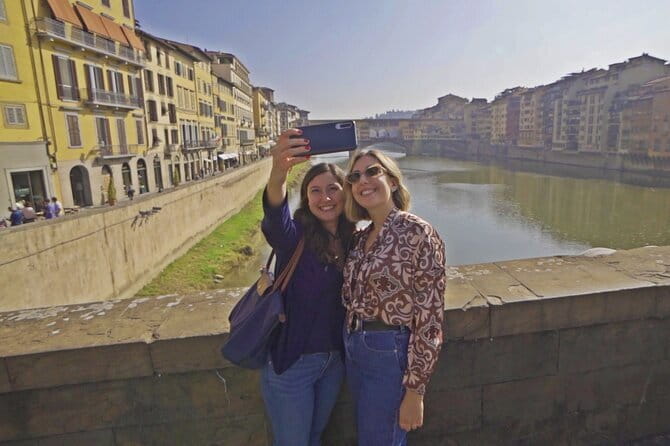
Ponte Vecchio gives you a change of scenery and a natural pause. The medieval stone bridge crosses the Arno and is lined with goldsmith shops, making it one of Florence’s most recognizable places.
The planned time is about 20 minutes, enough to cross, look at the river, and hear the account of the bridge and Vasari Corridor. The corridor was built as an elevated passage for the Medici family, linking Palazzo Vecchio with Palazzo Pitti so they could move around the city privately.
The corridor is an important piece of Medici history, but it is not included as an access experience. The audio explains what you are looking at from the public route. Expect crowds here at busy times, even though the tour is designed to let you move independently.
After Ponte Vecchio, the route turns toward La Casa di Galileo Galilei, presented as a place connected with the scientist’s life and work. Displays include personal items, celestial maps, and material related to the telescope. Like the Museo Galileo, this stop suits anyone who wants Florence to be more than a collection of famous paintings.
Villa Bardini and Forte Belvedere
Villa Bardini provides a quieter final stretch, with gardens, flowerbeds, art exhibitions, and a terrace overlooking Florence. Its hillside setting gives you a different view from the crowded center, and the combination of art, gardens, and city views makes it a pleasant change after so many dense streets.
Forte Belvedere or Forte di San Giorgio Firenze is the final listed stop. Built in the late 16th century under Francesco I de’ Medici, the fortress served defensive and residential purposes. The route allows about 15 minutes, with time to see the structure and its views over Florence and the surrounding Tuscan countryside.
The hillside finish is worth noting when planning your energy. The route is not only flat city pavement, and the later stops may feel more demanding after several hours of walking. The fortress also hosts art exhibitions and cultural events, though access and schedules are separate from the audio purchase.
The activity ends back at the starting point. Since the route includes many stops and the timing is approximate, use the map as a guide rather than a strict timetable.
What the $7.14 price really gives you
At $7.14 per person, this is an inexpensive way to get a structured introduction to Florence. You receive 30 recordings by a professional historian, an iPhone and Android app, landmark illustrations, an offline route map, GPS navigation, and one year of access.
That price is strong if you want flexibility. You can pause for lunch, skip a museum, repeat a recording, or spread the walk across more than one outing during the access period. It also avoids the cost of a private guide.
The tradeoff is that you must supply the practical side. Bring your own smartphone and headphones, download the app, activate the purchase, and keep an eye on the route. Transportation and admission fees are separate.
The GPS feature may not always be perfect in Florence’s dense center. One user lost time when the directional function and location display failed to work properly. The offline map helps, but I would still use the illustrations and street names instead of following the blue location dot blindly.
Who should choose this Florence audio walk?
I would choose it if you like setting your own pace and want clear background at a very low price. It suits independent visitors, repeat visitors who want a themed route, couples who dislike fixed group schedules, and families who may need to pause often.
It is less suitable if you want lively conversation, personal recommendations, help crossing the city, or detailed answers to questions as they come up. There is no guide waiting at the meeting point, and the tour does not include entry to the churches, palaces, museums, or tower.
The route also suits a first visit as an orientation walk, provided you accept that it covers a lot of ground lightly. For a slower art-focused day, choose two or three interiors and use this audio guide to connect them rather than trying to fully visit every stop.
Free cancellation is available up to 24 hours before the experience start time. Changes or cancellations inside that window are not refunded.
Should you book it?
Book this tour if you want an affordable Florence framework, reliable audio content, and the freedom to stop when you wish. The best features are the historian narration, the large range of sights, the offline map, and the one-year access period.
Skip it if your ideal day includes a human guide, reserved museum entry, or hands-on help with directions. Before you leave, download the correct app, activate the purchase, save the route offline, and bring headphones. With those simple steps, this is a practical way to put Florence’s major landmarks into order without paying for a full guided tour.
FAQ
Where does the Florence walking tour start?
It starts at the Basilica of Santa Maria Novella, at Piazza di Santa Maria Novella 18, 50123 Firenze FI, Italy.
Where does the tour finish?
The activity ends back at the meeting point.
How long does the walking tour take?
The approximate duration is 2 hours and 30 minutes. Stops, museum visits, meals, and optional climbs can make the day longer.
Is this a guided tour with a person?
No. This is a self-guided audio tour. No human guide will be at the meeting point.
What do I receive with the booking?
You receive 30 audio recordings narrated by a professional historian, an audio guide app for iPhone and Android, landmark illustrations, an offline map with the route, GPS navigation, and one year of access.
Do I need mobile data during the walk?
No. An offline map is available, so you can follow the route without relying on mobile data. Download and activate the app before setting out.
Are headphones and a smartphone included?
No. You must bring your own smartphone and headphones.
Are entrance tickets included?
No. Entrance fees and tickets are not included. The tour provides audio information and route guidance, while you arrange and pay for entries separately.
What language is available?
The experience is offered in English. The app information also states that access is available in your preferred language.
What is the cancellation policy?
You can cancel at least 24 hours before the experience start time for a full refund. Cancellations or changes made less than 24 hours before the start time are not refunded.
More Audio Walking Tours in Florence
- Sofia: City Monuments Guided Walking Tour with Audio Guide
★ 4.5 · 825 reviews - Self Guided Classic Freedom Trail Location Aware (GPS) Walking Audio Tour
★ 4.5 · 258 reviews - Valletta: Self-Guided Historical Walking Tour (Audio Guide)
★ 3.7 · 251 reviews - Cape Cod & Provincetown Self-Guided Driving & Walking Audio Tour
★ 4.0 · 207 reviews
More Smartphone Audio Tours in Italy
- Florence: Duomo Cathedral Timed Entry Ticket & Audio App
★ 3.7 · 472 reviews - Florence: Accademia Gallery David Entry & Audio Guide App
★ 4.2 · 406 reviews - Florence: Cathedral & Brunelleschi’s Dome Ticket & Audio App
★ 4.4 · 148 reviews - Uffizi Gallery Reserved Ticket & Digital Audio Guide App
★ 4.3 · 69 reviews
Latest audio tours in Florence
- Florence: Uffizi Gallery Audio Guided Tour led by Tour Leader★ 3.5 · 6 reviews
- Uffizi Combined Ticket:UFFIZI, PITTI, BOBOLI & digital audioguide★ 4.0 · 26 reviews
- Florence: Uffizi Gallery Reserved Ticket & Digital Audio Guide★ 4.5 · 3 reviews
- Florence: Uffizi Gallery Timed Entry Ticket with Audio★ 3.0 · 3 reviews
- Accademia Gallery Skip the line Tickets with Audio Guide★ 4.0 · 10 reviews
- Uffizi Gallery Audio-Guided Visit with optional Accademia Gallery★ 3.5 · 42 reviews
- Florence Baptistery & Opera Museum Audioguided tour with guide★ 3.5 · 41 reviews
- Self Guided Tours Florence With 100 Captivating Audio Stories★ 3.5 · 5 reviews
Audio Walking Tours, compared.

City Monuments Guided Walking Tour with Audio Guide
Read our review →

Self Guided Classic Freedom Trail Location Aware (GPS) Walking Audio Tour
Read our review →
Self-Guided Historical Walking Tour (Audio Guide)
Read our review →
Cape Cod & Provincetown Self-Guided Driving & Walking Audio Tour
Read our review →
Verona Walking Tour with Audio and Written Guide by a Local
Read our review →
Royal Walking Tour and Buckingham Palace Audio Tour
Read our review →
Bologna Walking Tour with Audio and Written Guide
Read our review →Browse the lists this tour appears in