Reviewed · ATHENS
Athens: Ancient Agora E-Ticket and Audio Tour
The Ancient Agora is where Athens feels most human. This was not only a field of ruins, but the city’s working center, where laws were shaped, people argued, merchants traded, and democracy took its first awkward steps. I like that this experience gives you a clear story to follow rather than leaving you to identify scattered stones on your own.
I also like the freedom of an offline audio tour. You can pause for photos, linger in the museum, or move at your own pace without waiting for a group. The pre-booked ticket is another practical plus, especially when you want a simple entrance plan.
The trade-off is that this is not a live tour. Some directions can be vague where paths run side by side, and the app may stop playing if you zoom in to take a photograph. At $30 per person, the value depends on whether you want guided context as you walk, not just admission.
Key points at a glance
- Follow the birth of democracy: Hear how Solon, the Boule, the assembly, and figures such as Aristides and Pericles shaped Athenian public life.
- Use your own phone: Download the audio and map before arrival, since there is no internet access inside the archaeological site.
- See more than the Agora ruins: The route includes the Agora Museum, Pnyx, Mars Hill, the Prison of Socrates, and the Theatre of Dionysus.
- Plan for 90 minutes to two hours: Add extra time if you want to study the museum or take photographs from the hills.
- Catch the museum’s upper view: The second floor offers a different look over the Panathenaic Way and is easy to miss.
- Know the limitations: This is a self-guided walk with some unclear directions, uneven access, and no live guide.
Why the Ancient Agora deserves your time
Many people arrive in Athens focused on the Acropolis. That makes sense, but the Ancient Agora explains how the city functioned below the hilltop temples. If the Acropolis shows you Athens at its most ceremonial, the Agora shows you Athens at work.
The site brings together government buildings, religious spaces, markets, meeting places, and roads. Your audio tour uses those remains to explain the growth of Athenian democracy. That matters because democracy here was not created in one grand moment. It developed through reforms, arguments, experiments, and safeguards against people who might seize too much power.
I find that approach more useful than a simple list of dates. The ruins can be hard to read at first, but the story gives each area a purpose. You begin to understand why a modest foundation mattered, or why an ordinary civic building could be as important as a temple.
The ticket and audio package costs $30 per person. That is more than a basic entry ticket, but it includes the admission and the audio content in several languages: English, Italian, Greek, German, Spanish, and French. If you would otherwise buy a separate guidebook or pay for a live tour, the price can make sense. If you only want a quick walk among the ruins, it may feel high.
More History Audio Tours in Athens
- Athens: National Archaeological Museum Ticket w/ Opt. Audio
★ 4.4 · 713 reviews - Athens: Roman Agora & Ancient Agora E-ticket & 2 Audio Tours
★ 4.1 · 107 reviews - Half Day Ancient Corinth and Canal VR Audio Guided Tour
★ 5.0 · 104 reviews
Starting with Solon and the first steps toward democracy
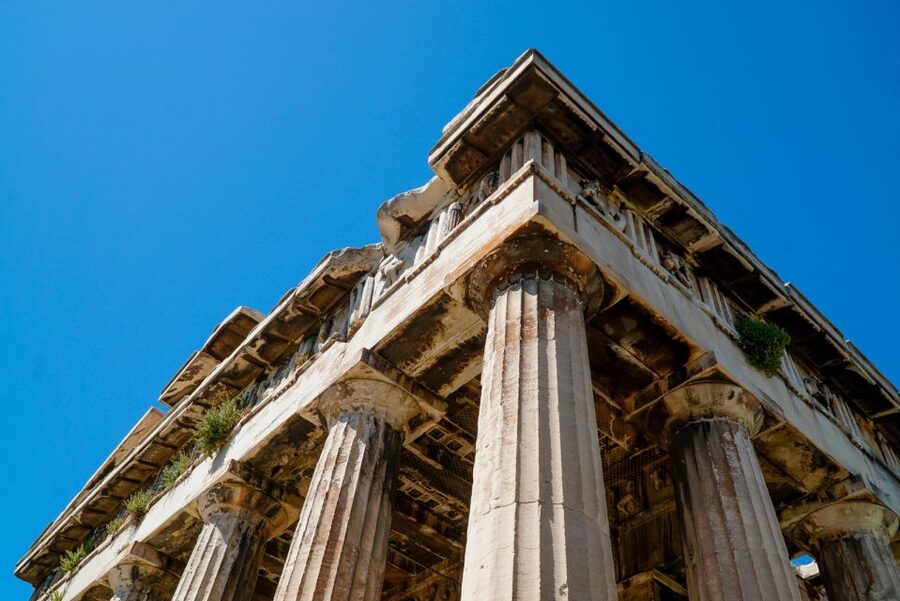
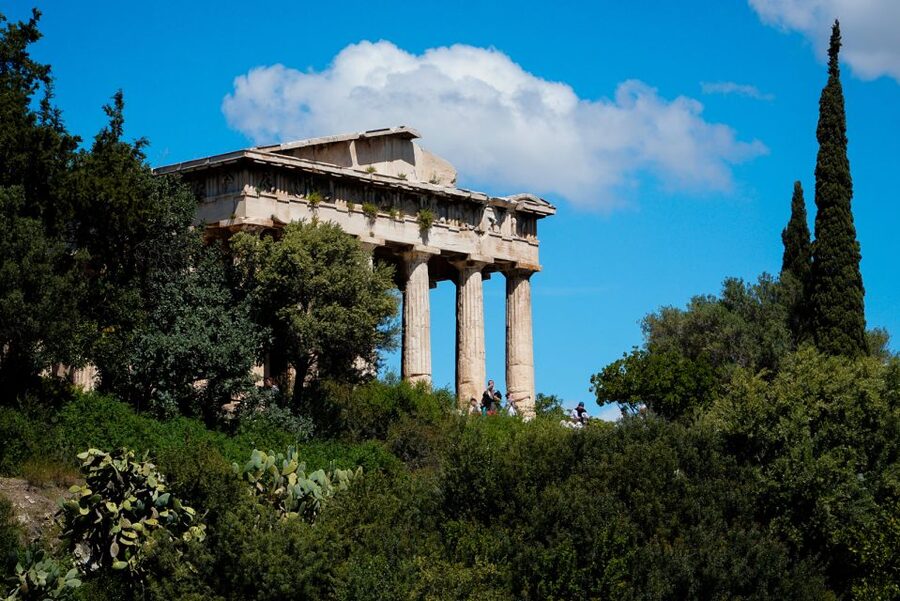
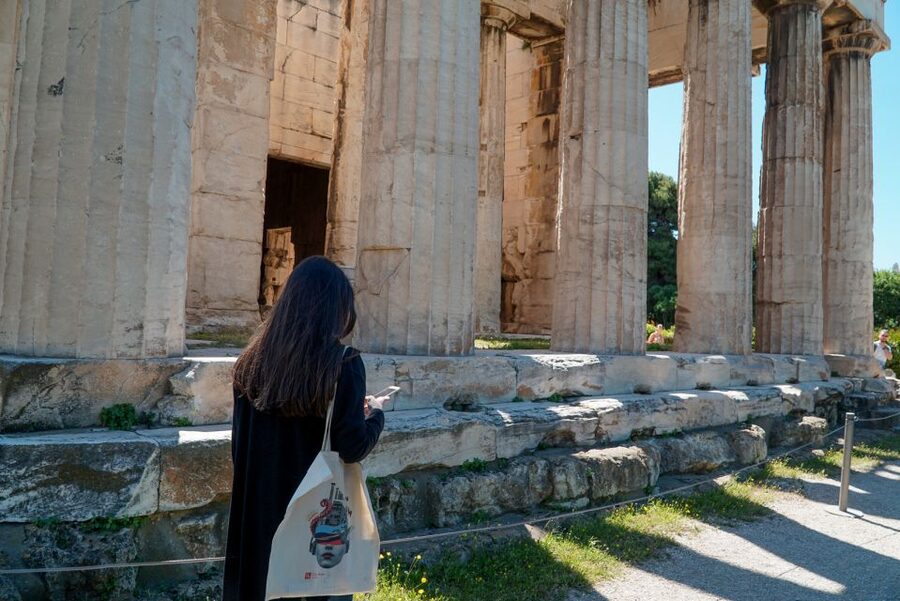
The tour begins near the foot of the hill where the Temple of Hephaestus rises above the site. This is a strong starting point because it places the political story in the physical center of ancient Athens.
You hear about Solon and the legal reforms that helped create the early civic system. The point is not that Athens suddenly became modern or equal. Ancient democracy excluded women, enslaved people, and foreigners. Still, it introduced a major change: eligible male citizens could take part in decisions affecting the city.
That distinction is worth keeping in mind as you walk. The tour presents democracy as an evolving system, not a perfect model. Its institutions were bold, but they could also be harsh and limited.
The Temple of Hephaestus is one of the clearest buildings in the Agora, and its setting helps you picture the area as a busy public center. You are not simply looking at a preserved temple. You are looking at one part of a much larger civic machine.
The Bouleuterion and the business of governing
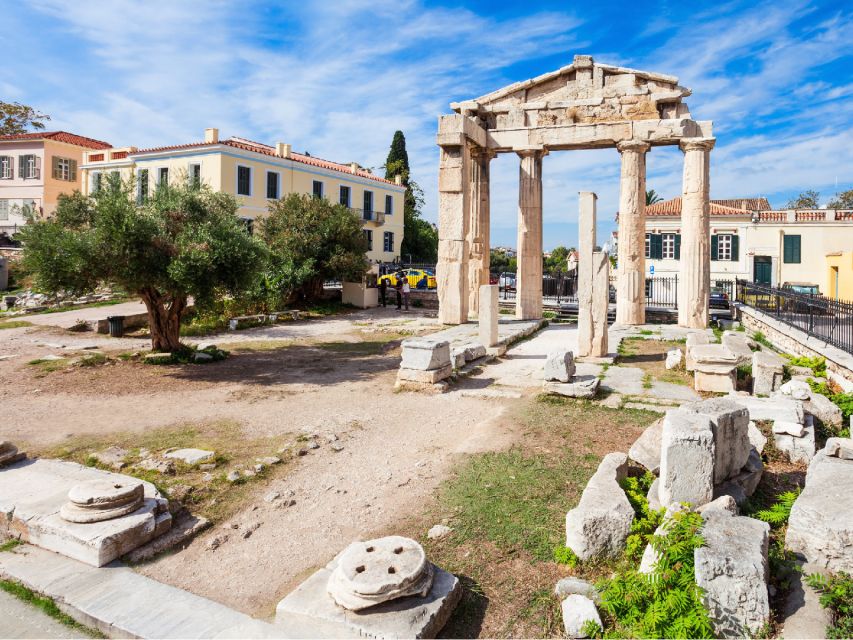
From the temple area, the route leads toward the Tholos and the ruined Bouleuterion. The Boule was a council of 500 Athenians who met to prepare laws and proposals for the popular assembly.
This stop helps explain how democracy worked in practice. The assembly could make major decisions, but someone had to prepare the business, organize proposals, and manage the city’s daily affairs. The Boule handled that important groundwork.
The remains are not always easy to recognize. You will need to use the audio and map to connect the foundations to their former purpose. This is one place where the tour’s structure is valuable, since a guidebook can leave you staring at low walls without much sense of scale.
The route also brings in stories about people such as Aristides the Just and Pericles. These personal details make the civic system easier to remember. You get a sense of individuals competing, persuading, serving the city, and sometimes becoming the subject of public suspicion.
The Agora Museum and its second-floor view
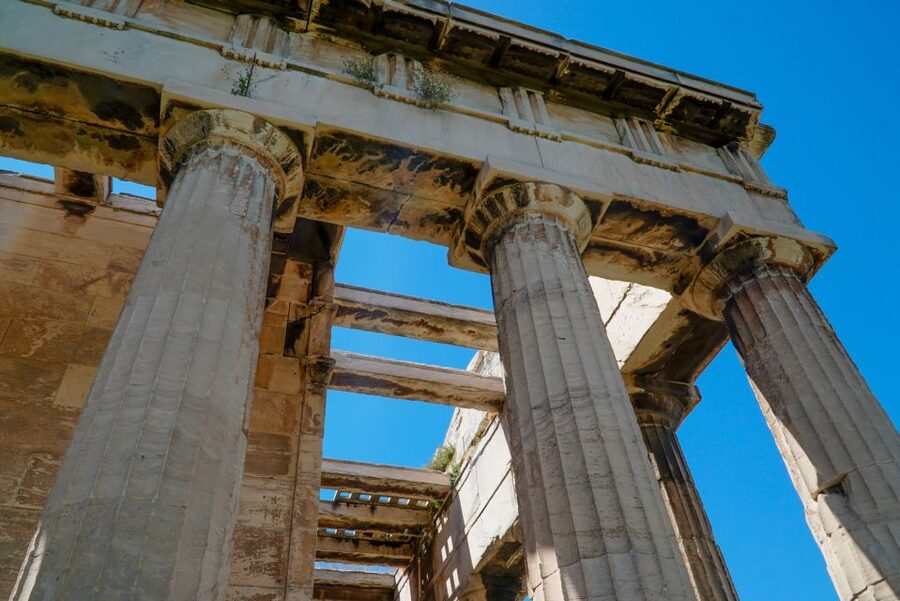
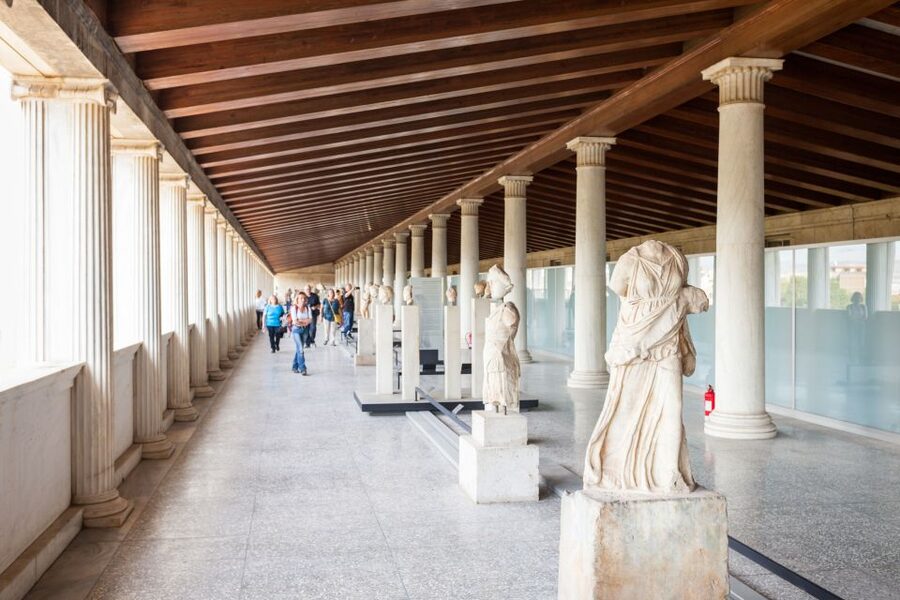
The Museum of the Ancient Agora is one of the most useful stops on the route. It gives you objects and explanations that the open-air ruins cannot provide.
The displays cover daily life and the workings of Athenian government. They also show some of the more severe tools used to protect democracy from perceived threats. The system could defend itself through voting and public decisions, but those decisions were not always gentle or fair.
Plan enough time here. The overall activity is advertised at 90 minutes to two hours, but rushing through the museum will weaken the visit. The building offers a pause from the sun, and its air conditioning is especially welcome on a hot afternoon.
Do not skip the second floor. It provides an unusual view over the Panathenaic Way, giving you a better sense of how movement through the Agora connected with the rest of the city. This upper viewpoint is easy to overlook if you follow the route too quickly.
More History Audio Tours in Greece
- Ancient Agora Self-Guided Tour with 3D & Audio (No Ticket)
★ 3.9 · 59 reviews - Athens National Archaeological Museum E-Ticket with Audio Guide
★ 3.0 · 57 reviews - Athens: Archaeological & Acropolis Museum Entry & Audio Tour
★ 4.3 · 21 reviews - Ancient Agora of Athens E-Ticket and Audio Tour
★ 3.5 · 5 reviews
Pnyx and Mars Hill: the best views on the walk

The itinerary expands beyond the central Agora to the Pnyx and Mars Hill. These hills add both political meaning and some of the best views toward the Acropolis.
The Pnyx is tied to the popular assembly, the place where citizens gathered to hear arguments and make decisions. It is one thing to learn about public speaking in ancient Athens. It is another to look across the city from a hill associated with that civic activity.
Mars Hill, also called the Rock of Ares, offers another memorable viewpoint. The route uses these stops to connect the physical setting with the idea of citizens gathering in public to debate the city’s future.
Be ready for directions that are not always perfect. Some paths run parallel, and the names of individual areas are not always clearly marked. The audio can also move ahead of your position if you are stopping often for pictures.
I recommend checking the offline map before setting off and paying attention to the next stop before leaving each location. You do not need to follow the route at a hurried pace, but you do need to stay alert to where the path leads.
The Prison of Socrates and the final walk to Dionysus
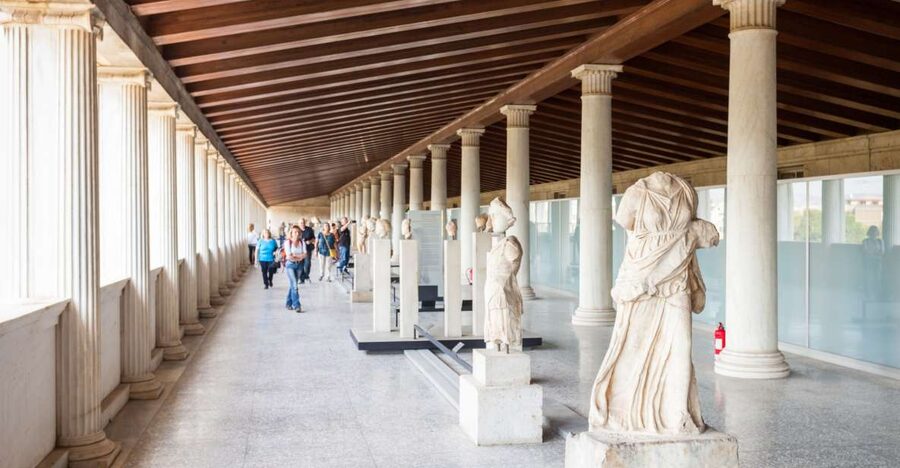
The route continues up Philopappos Hill to the Prison of Socrates. This stop connects the political story with one of Athens’ most famous philosophers.
The prison site is tied to the final period of Socrates’ life and gives the tour a more personal ending to its democracy story. Socrates questioned authority, challenged accepted ideas, and became entangled in the city’s legal and political culture. The stop offers useful context about his life and death without requiring a separate philosophy tour.
You should treat the prison as a historical site interpreted through tradition and place, rather than expect a preserved prison building with a full set of original objects. The value is in the setting and the story.
The walk ends near the Acropolis archaeological area, in front of the Theatre of Dionysus. This is a fitting finish. The theatre is associated with the tragedies of Aeschylus, Sophocles, and Euripides, and it gives you a final look at another side of public life in Athens: drama, performance, and shared civic culture.
At the end, you are also within easy reach of the Acropolis site. That makes the activity useful as part of a larger day, though you should not assume the Agora ticket includes entry to every nearby attraction.
How the audio tour works in real use
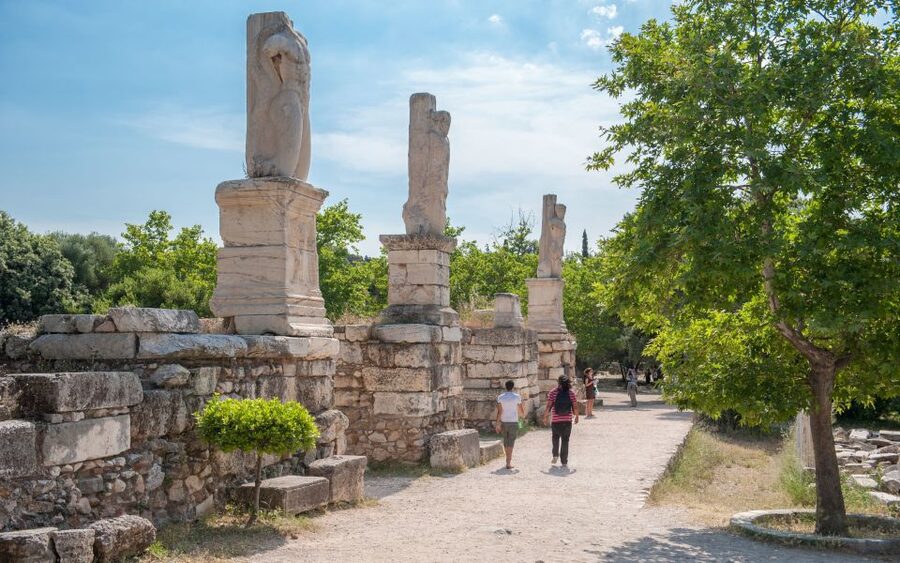
This is a smartphone experience, not a traditional guided walk. You receive the Ancient Agora ticket and separate instructions for the audio tour from the local provider, Clio Muse Tours. Check your spam folder if the message does not appear in your main inbox.
Download the e-ticket, audio content, and interactive map before you arrive. There is no internet access inside the archaeological site, so waiting until the entrance is a poor plan. You need a charged Android or iOS phone and your own headphones.
The audio is available in six languages. Its relaxed pace allows you to stop and continue, which suits visitors who want to take photographs or spend extra time at the museum. The app works well as a walking companion, but it is not flawless.
The main weakness is navigation. Some directions are vague, especially where paths look similar. One useful improvement would be clearer guidance to each stop. Also, if you zoom in while listening to take a photograph, the recording may stop. Downloading the content helps with signal problems, but it does not remove these app limitations.
There is no live guide, hotel transfer, food, or drink included. You arrange your own way to the entrance and carry your own phone and headphones.
Timing, heat, footwear, and access
The stated duration is 90 minutes to two hours. That is enough for the main route at a steady pace, but not necessarily enough for a slow museum visit, long photo stops, and careful reading of every display.
Early morning or late afternoon is the better choice in hot weather. The open parts of the site offer limited relief from the sun, while the museum provides an air-conditioned break. Comfortable shoes are essential because you will be walking across an archaeological area and visiting nearby hills.
Large bags and luggage are not allowed. Keep your daypack small and practical.
The route is not suitable for wheelchair users, and some points of interest are not wheelchair accessible. If you have mobility concerns, this is important to consider before paying because the route includes hills and areas with uneven access.
EU students and minors can enter free with valid identification, but they must queue for a zero-value pass. Non-EU students and visitors over 65 can receive reduced tickets through the ticket office, which also means queuing. For those groups, the $30 adult booking may not be the best value.
The audio guide is not compatible with Windows phones, iPhone 5 or 5C and older models, older iPod Touch devices, or older iPad models including the first iPad Mini.
Who gets the most value from this experience?

I would choose this tour if you like history but prefer to explore independently. You get a planned story, the freedom to pause, and enough structure to make sense of a large archaeological site.
It is also a good fit if you want more than the Acropolis. The Agora gives you a clearer look at civic life, and the route’s links to the Pnyx, Mars Hill, Socrates, and the Theatre of Dionysus make it feel like a wider walk through classical Athens.
Families with older children may appreciate the storytelling, though younger children may not stay focused for the full route. Students, history-minded visitors, and people who prefer audio to reading signs will get the most from it.
I would hesitate if you want a personal conversation with a guide, help finding every ruin, or a perfectly directed walking route. I would also compare the price with a combination ticket if you plan to visit the Acropolis and other archaeological sites. One traveler specifically found a combined Agora and Acropolis ticket useful, so it is worth checking your wider plans before booking separate admission.
Should you book the Ancient Agora audio tour?
Book it if you want the Agora explained as the birthplace of a working political system, not just a collection of stones. The stories about Solon, the Boule, Aristides, Pericles, and Socrates give the site shape, while the museum and hilltop views add variety.
Skip it if you only want a brief entrance ticket, need wheelchair-friendly access, or strongly prefer a live guide. At $30, this is a story-led visit with practical convenience, not the cheapest way through the gate.
For most independent visitors with a charged compatible phone, headphones, and two hours to spare, it is a useful way to see one of Athens’ most important sites on your own terms.
FAQ
How long does the Ancient Agora audio tour take?
The experience lasts about 90 minutes to two hours. Extra time may be useful if you want to spend longer in the Agora Museum or stop for photographs.
What is included in the $30 price?
The price includes an adult e-ticket for the Ancient Agora and a self-guided audio tour for Android or iOS. Offline audio content and an offline interactive map are also included.
Is there a live guide?
No. This is a self-guided audio tour on your smartphone.
What languages are available?
The audio guide is available in English, Italian, Greek, German, Spanish, and French.
Do I need internet access inside the Ancient Agora?
No internet access is available at the archaeological site. Download the ticket, audio tour, and map before your visit.
Do I need to bring my own phone and headphones?
Yes. A smartphone and headphones are not included. Bring a charged compatible Android or iOS phone and headphones.
Can I use a Windows phone?
No. The audio tour is not compatible with Windows phones.
Can I enter with the GetYourGuide voucher?
No. The entrance requires the separate e-ticket sent by the local partner. Download it to your phone or print it before arrival.
Are discounts available for students and older visitors?
EU students and minors can enter free with identification, but they must queue for a zero-value pass. Non-EU students and people over 65 can receive reduced tickets at the ticket office and must queue there.
Is the route wheelchair accessible?
No. The experience is not suitable for wheelchair users, and some points of interest are not wheelchair accessible.
More Smartphone Audio Tours in Greece
- Athens Audioguide – TravelMate app for your smartphone
★ 4.1 · 11 reviews - Athens: Kerameikos E-Ticket & Audio Tour
★ 4.1 · 10 reviews - Temple of Olympian Zeus: Self-Guided Audio Tour on your Phone (without ticket)
★ 4.0 · 8 reviews - E-ticket for Kerameikos with Audio Tour on Your Phone
★ 5.0 · 4 reviews
More Smartphone Audio Tours in Athens
- Acropolis Self-Guided Smartphone Tour w/Audio & 3D(No entry)
★ 3.9 · 62 reviews - Acropolis Museum E-Ticket and Multilingual Audio Guide
★ 4.0 · 42 reviews - Athens: Roman Agora E-Ticket and Audio Guide
★ 3.9 · 41 reviews - Acropolis E-Ticket with Audio Guide & Athens City Audio Tour
★ 3.5 · 28 reviews
Latest audio tours in Athens
- Athens Ticket Pass: Acropolis & 6 Sites with 5 Audio Guides★ 3.5 · 84 reviews
- Temple of Olympian Zeus: Self-Guided Audio Tour on your Phone (without ticket)★ 4.0 · 8 reviews
- Ancient Agora of Athens: A Self-Guided Audio Tour★ 3.5 · 3 reviews
- Self Guided Tour In Athens With 100 Captivating Audio Stories★ 4.0 · 4 reviews
- E-ticket for Kerameikos with Audio Tour on Your Phone★ 5.0 · 4 reviews
- Private Audio Guided Walking Tour in Athens★ 3.5 · 2 reviews
- Audioguided tour of Athens’ alternative neighbourhood of Exarchia★ 5.0 · 2 reviews
- Athens Hop-On Hop Off w/ Acropolis & Acr.Museum tickets & 3 audio★ 3.0 · 5 reviews
Smartphone Audio Tours, compared.
Colosseum & Forum with Audio Guide App -Optional Arena
Read our review →
Timed Entry to Michelangelo’s David + Audio App
Read our review →
Cathedral & Brunelleschi’s Dome Ticket & Audio App
Read our review →
Michelangelo’s David Priority Ticket & Audio App
Read our review →
Uffizi Priority Ticket & Masterpieces Audio App
Read our review →
Castel Sant’Angelo Entry Ticket & Digital Audioguide
Read our review →