Reviewed · ATHENS
Athens: Roman Agora & Ancient Agora E-ticket & 2 Audio Tours
The best thing about this Athens combo is its simple pairing of two nearby but very different archaeological sites. You begin at the Roman Agora, with the Gate of Athena Archegetis and the Tower of the Winds, then continue to the larger Ancient Agora, where the Stoa of Attalos and its museum give the city’s public life a human scale. I like the timed entry plan and the fact that the audio content works offline. The main drawback is that the narration may sound synthetic and does not always allow enough time to move between stops.
I also like that you can visit at your own pace, replay the commentary, and choose English, Spanish, German, French, or Italian. But this is not a live guided walk, and the changing entrance arrangements at the Ancient Agora require careful planning. If you qualify for free or reduced admission, buying this package may cost more than purchasing at the site.
Key points at a glance
- Two ancient sites in one day: Visit the Roman Agora and Ancient Agora with separate timed tickets.
- Start near Monastiraki: The Roman Agora entrance is about 230 meters along Areos Street from the metro station.
- Use the temporary Ancient Agora entrance: Construction has closed the main entrance, so you must approach on foot from Thissio via Apostolou Pavlou Street.
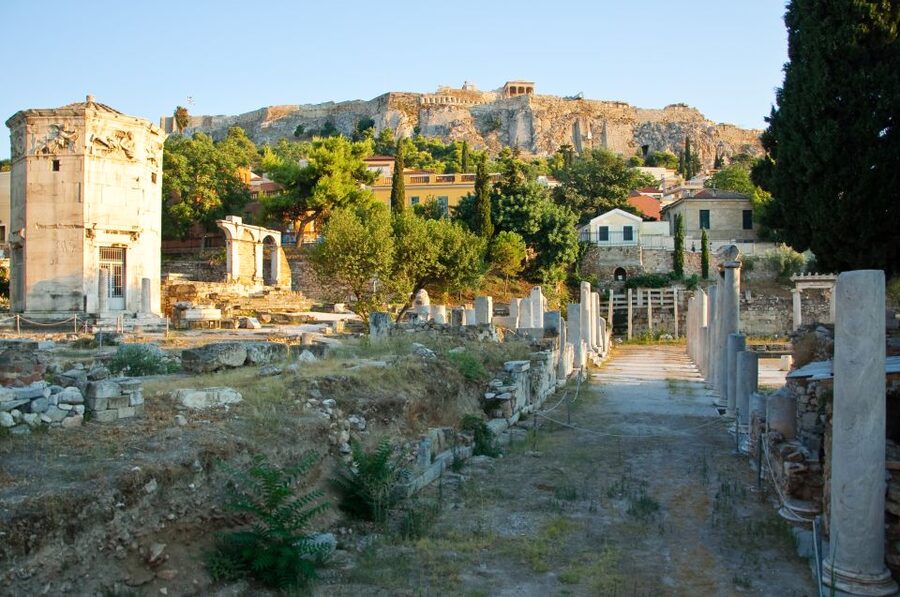
- See the Tower of the Winds: This unusual octagonal monument is one of the Roman Agora’s main highlights.
- Finish at the Stoa of Attalos: The restored colonnade contains the Ancient Agora museum and provides a strong final stop.
- Bring your own equipment: You need a charged Android or iOS phone, headphones, and 200 to 300 MB of storage.
Two agoras, two chapters of Athens
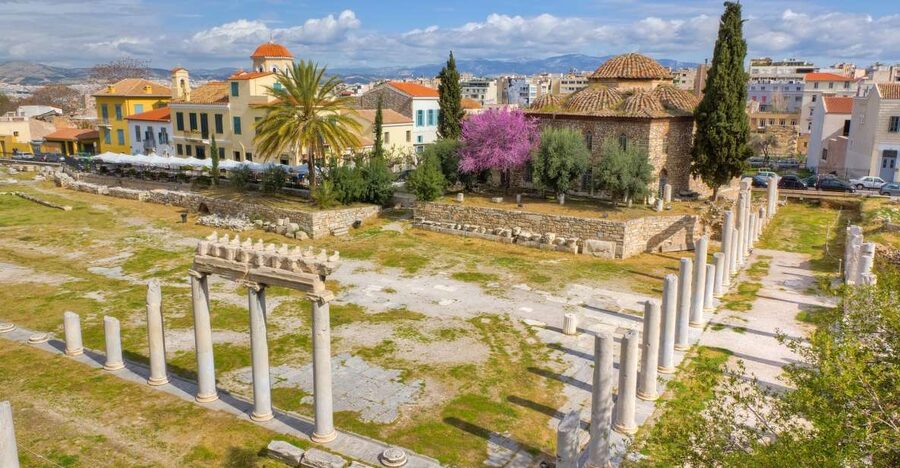
Athens’ two agoras sit close together, but they tell different stories.
The Roman Agora is the smaller and quicker visit. It was built during the Roman period as a commercial and civic center, after the older Greek Agora had already become the city’s main public gathering place. Its surviving monuments are compact, so this is a good first stop when you want to get your bearings before tackling the larger site.
The Ancient Agora is the more rewarding half of the day for most people. This was the heart of Athenian public life, where political debate, trade, religious activity, and everyday business took place. You also get more open ground, more ruins to examine, and a museum inside the restored Stoa of Attalos.
I like the order offered here: Roman Agora first, Ancient Agora second. It moves from a small, focused site to a wider and more meaningful setting. One booking note is important, though: the two entries are separated by two hours. You need to follow the selected schedule rather than wander in whenever you feel like it.
More History Audio Tours in Athens
- Athens: National Archaeological Museum Ticket w/ Opt. Audio
★ 4.4 · 713 reviews - Athens: Ancient Agora E-Ticket and Audio Tour
★ 3.9 · 413 reviews - Half Day Ancient Corinth and Canal VR Audio Guided Tour
★ 5.0 · 104 reviews
Choosing your two-hour schedule
The available pairings are:
- 8:00 a.m. Roman Agora, then 10:00 a.m. Ancient Agora
- 10:00 a.m. Roman Agora, then noon Ancient Agora
- 1:00 p.m. Roman Agora, then 3:00 p.m. Ancient Agora
- 2:00 p.m. Roman Agora, then 4:00 p.m. Ancient Agora
The morning options are the better choice in warm weather. Athens can be intensely sunny, and both sites involve outdoor walking on uneven surfaces. An early start also leaves the rest of the day open for the Acropolis area, Plaka, or a museum.
The afternoon options may suit you if you prefer a slower morning. They also give you time to reach the Roman Agora after breakfast or another central Athens activity. Just remember that the Ancient Agora is the larger site, and a 4:00 p.m. entry leaves less flexibility if you want to linger.
The two-hour gap is useful, but it is not a promise that you will have a guided transfer from one site to the other. There is no meeting point and no transportation. You are responsible for leaving the first site, walking through central Athens, and reaching the next entrance on time.
Entering the Roman Agora near Monastiraki
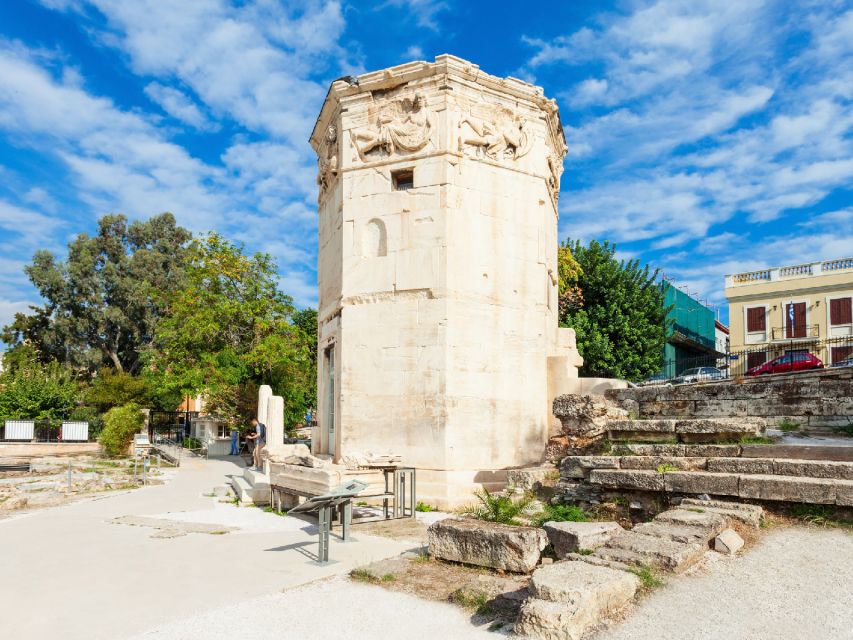
The easiest route to the Roman Agora is through Monastiraki station, served by metro lines 1 and 3. From there, walk along Areos Street for about 230 meters toward the entrance at Epaminonda 6 to 22.
This location is convenient if you are already in central Athens. It is close enough to Monastiraki’s shops and streets that you can combine the visit with other sightseeing. Still, keep your phone map available. A short walk can feel less obvious in the narrow streets around the site.
The Roman Agora does not take as long to cover as the Ancient Agora. That is one reason I recommend beginning here. You can listen to the opening audio sections, see the principal monuments, and still have enough time to move on without feeling rushed.
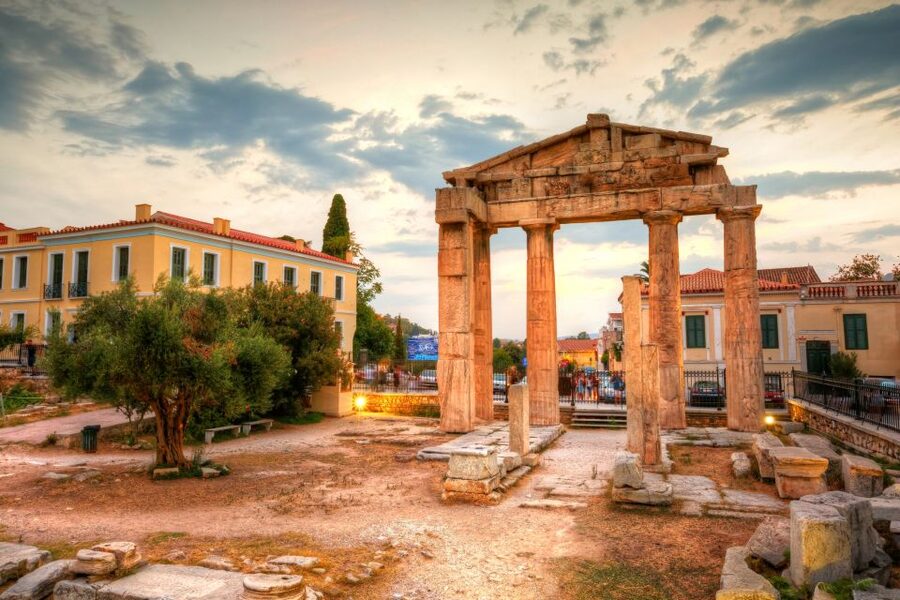
The Gate of Athena Archegetis is one of the first major sights to look for. Its large columns once marked an important entrance to the Roman marketplace. It gives you an immediate sense of the site’s public purpose, even though only part of the original complex survives.
The Tower of the Winds is the Roman Agora’s most distinctive structure. This octagonal building functioned as a water clock, weather indicator, and sundial. Its carved figures represent the winds, making the monument more than a simple ruin. Look closely at the exterior details before moving on. The building is compact, and the audio tour can help you notice features that are easy to pass without context.
The route ends inside the site at the Mosque of the Conqueror. That endpoint matters because you should not expect the audio tour to guide you back toward Monastiraki. Once you finish, make your own way to the Ancient Agora entrance.
Walking from the Roman Agora to the Ancient Agora
The two sites are close enough to connect on foot, but the experience is not a formal walking tour. You will need to manage the transition yourself.
For the Ancient Agora, the main entrance is temporarily closed because of construction. Use the temporary entrance on Apostolou Pavlou Street, at the level of Akamantos Street. The only stated access route is on foot from Thissio station.
This is the detail most likely to catch you out. If you simply follow an older map or head toward the usual entrance, you may lose time. Plan the second entry before you start the first audio tour, and allow extra time for finding the temporary gate.
The Thissio area is also a pleasant place to pause between visits. The experience details do not include a meal stop or a café arrangement, so treat the gap as your own time. Carry water, especially in summer, and do not assume you can rush across the city at the last minute.
More History Audio Tours in Greece
- Ancient Agora Self-Guided Tour with 3D & Audio (No Ticket)
★ 3.9 · 59 reviews - Athens National Archaeological Museum E-Ticket with Audio Guide
★ 3.0 · 57 reviews - Athens: Archaeological & Acropolis Museum Entry & Audio Tour
★ 4.3 · 21 reviews - Ancient Agora of Athens E-Ticket and Audio Tour
★ 3.5 · 5 reviews
Exploring the Ancient Agora and Stoa of Attalos
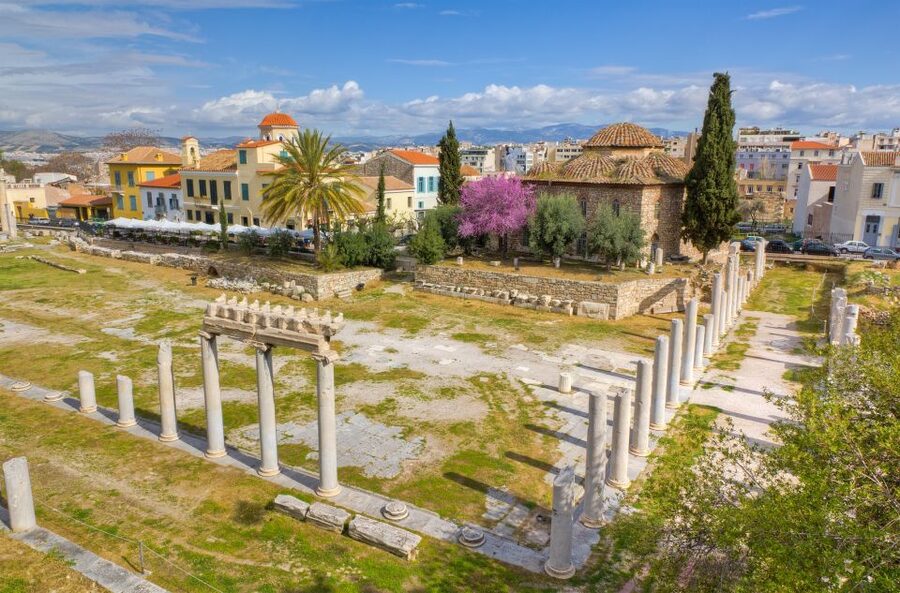
The Ancient Agora covers a much larger area than the Roman Agora. It is where the self-guided visit becomes more substantial, with open paths, scattered remains, and views back toward the city.
The word agora is often translated as marketplace, but that can make the site sound too narrow. This was also a public center for civic life. The attraction comes from seeing how many parts of Athenian society met in one place: commerce, politics, religion, and ordinary social activity.
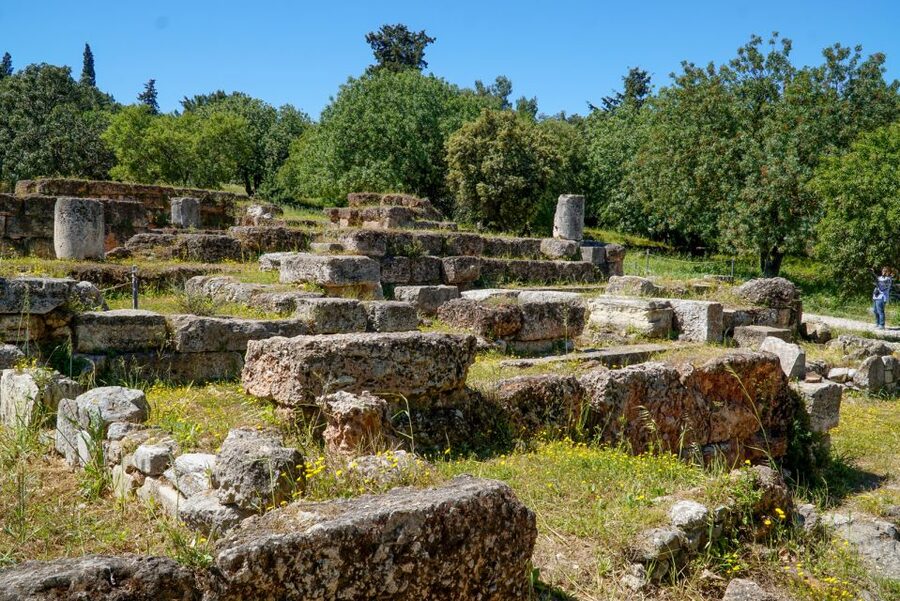
You will encounter archaeological remains rather than a fully rebuilt ancient town. That means the audio tour matters here. Without context, columns, stone foundations, and partial walls can blur together. With a good explanation, the open ground becomes easier to read.
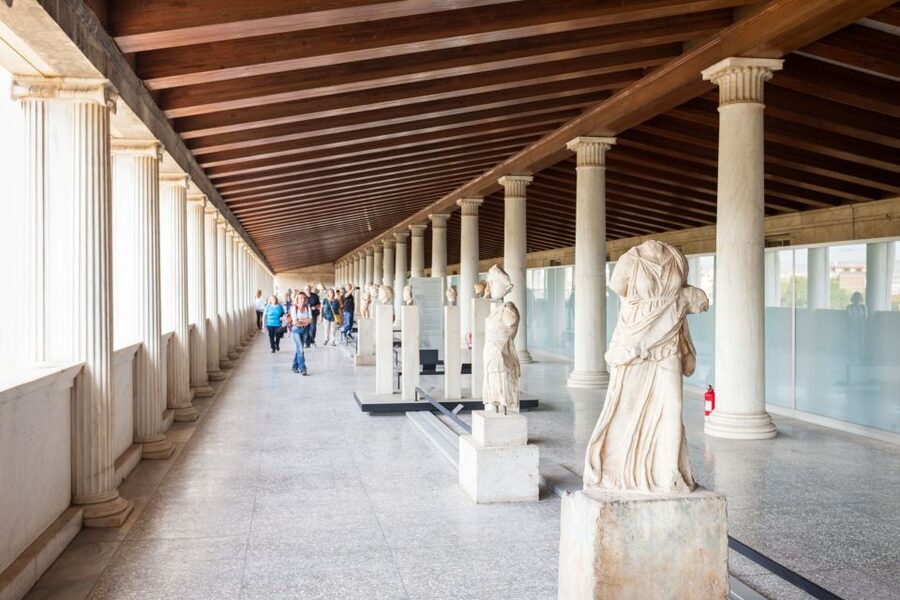
The Stoa of Attalos is the clearest architectural highlight. This long, restored colonnade houses the Ancient Agora museum. It also gives you a strong sense of scale, because you can walk along a building that resembles the kind of covered public space once used by people in the Agora.
The museum contains historical objects from the site. It is a useful stop at the end of the visit because the exhibits can put faces, tools, inscriptions, and daily activities behind the larger political story. The audio route ends at the Stoa, not far from the entrance, so you finish in a logical place rather than being left at a remote corner.
The Ancient Agora also offers fine city views. Bring sunglasses and a sun hat, and keep your camera ready. The best pictures may come from looking beyond the ruins toward Athens rather than photographing every stone at ground level.
How useful are the smartphone audio tours?
The audio tours are self-guided and available for Android and iOS. After receiving your ticket by email, download the app and activate the tours before you arrive.
The offline format is a real plus. The package includes text, recorded narration, and maps, so you do not need to rely on mobile data inside the archaeological sites. Download everything at your hotel or another reliable Wi-Fi location, not at the entrance while a time slot is ticking away.
You will need:
- A charged smartphone
- Headphones
- 200 to 300 MB of available storage
- Android version 5.0 or later, or a compatible iPhone
- The activation link sent with your booking
The tour is available in English, Spanish, German, French, and Italian. You can replay sections before or after the visit, which helps if you want to use the audio as a preview and then return to certain points later.
The audio format also gives you control. You can pause when you want to take pictures, skip a section, or move ahead if the site is crowded. A live guide cannot offer that same flexibility.
The limitation is the narration itself. Some sections may sound computer-generated, with awkward pronunciation or pacing. The timing may also give you too little time to walk from one point to the next. Treat the suggested route as a helpful outline, not a strict command. Pause the audio when needed and read the text if a spoken name is unclear.
You should also be aware that current construction changes may not be reflected fully in the commentary. Site conditions can change, and you must follow instructions from staff even if the app suggests another route.
What the $51 price really buys you
At $51 per person, this is not the cheapest way to see the two sites. The value comes from convenience rather than a personal guide.
You receive two time-slotted entry tickets, two audio tours, maps, text, and offline access. If you want a ready-made plan and do not want to sort out each ticket separately, that package can save effort. It is also useful if you prefer learning through your phone instead of joining a group.
The price is harder to justify if you only want admission. You are paying for the digital content and the convenience of advance organization, not for transportation, headphones, or a live expert.
Pay close attention to the ticket rules if you are visiting with children or anyone entitled to reduced admission. Free and reduced tickets are available only at the onsite ticket booth, and they do not receive skip-the-line privileges. This package is sold per device, not per participant, so think carefully about how many phones will actually be used.
A particularly important warning: if a 16-year-old qualifies for free admission at the site, a prepaid adult ticket may not be refundable through the booking provider. Check eligibility before purchasing. The non-refundable policy makes this a poor choice for anyone whose schedule or party size may change.
Who will like this setup?
I would recommend this experience to an independent visitor who wants structure but does not want a group. You get fixed entry times, a suggested order, and background information without following a guide with a flag.
It also suits couples or friends who like to stop for pictures and discuss what they are seeing. The ability to replay the audio helps if one person wants more detail than another.
Families need a little more care. The phone format can work well for older children, but the ticket rules are important, and the commentary may not be lively enough for every young listener. Check the age and admission details before paying for adult tickets.
People with reduced mobility should know that the archaeological sites are only partially accessible. The outdoor surfaces and changing entrance arrangements may affect how easily you can move through the sites. Contact the attraction or check current access instructions if this is a key concern.
Practical advice before you go
Wear comfortable shoes. The sites are outdoor archaeological areas, and you will be walking between monuments as well as between the two locations.
Bring sun protection. Sunglasses, a hat, and sunscreen are specifically recommended, and there may be limited shade during parts of the visit.
Charge your phone fully and download the content in advance. A dead battery turns a convenient audio tour into two admission tickets with no commentary.
Use your own headphones. They are not included, and sharing one set makes it harder for two people to follow the tour.
Keep the ticket email and activation link easy to find. You do not have to meet a representative, so your phone is your key to both the booking and the audio content.
Finally, stay flexible. Archaeological sites can change their routes, restrict certain areas, or impose special rules. Follow the instructions onsite, even when they differ from the planned audio route.
Should you book the Roman and Ancient Agora combo?
Book it if you want a self-guided day with both entry tickets arranged in advance, especially if you value offline maps and commentary in your own language. The Ancient Agora is the stronger part of the visit, while the Roman Agora works well as a shorter opening stop.
Think twice if you qualify for free or reduced admission, dislike phone narration, or want a live historian who can answer questions. The $51 cost is reasonable only when you will use the audio tours and appreciate the fixed plan.
My best practical choice would be the earliest schedule, with the Roman Agora at 8:00 a.m. and the Ancient Agora at 10:00 a.m. You avoid the worst heat, have time to find the temporary entrance, and finish at the Stoa of Attalos with the rest of the day still ahead.
FAQ
How long is the activity valid?
The tickets and audio tours are valid for one day. You must follow the time slots selected for the Roman Agora and Ancient Agora.
What time combinations are available?
You can choose 8:00 a.m. and 10:00 a.m., 10:00 a.m. and noon, 1:00 p.m. and 3:00 p.m., or 2:00 p.m. and 4:00 p.m. The Roman Agora is visited first in each pairing.
Where do I enter the Roman Agora?
The Roman Agora entrance is at Epaminonda 6 to 22 in Athens. From Monastiraki metro station, walk about 230 meters along Areos Street toward the site.
Where do I enter the Ancient Agora?
The usual main entrance is temporarily closed because of construction. Use the temporary entrance on Apostolou Pavlou Street at the level of Akamantos Street. Access is on foot from Thissio station.
Is a live guide included?
No. The experience includes two self-guided audio tours on your smartphone, but it does not include a live guide or transportation.
Which languages are available for the audio tours?
The audio tours are available in English, Spanish, German, French, and Italian.
What equipment do I need?
You need your own compatible Android or iOS smartphone, headphones, and a charged battery. The tour requires about 200 to 300 MB of storage, and smartphones or headphones are not provided.
More Smartphone Audio Tours in Greece
- Athens Audioguide – TravelMate app for your smartphone
★ 4.1 · 11 reviews - Athens: Kerameikos E-Ticket & Audio Tour
★ 4.1 · 10 reviews - Temple of Olympian Zeus: Self-Guided Audio Tour on your Phone (without ticket)
★ 4.0 · 8 reviews - E-ticket for Kerameikos with Audio Tour on Your Phone
★ 5.0 · 4 reviews
More Smartphone Audio Tours in Athens
- Acropolis Self-Guided Smartphone Tour w/Audio & 3D(No entry)
★ 3.9 · 62 reviews - Acropolis Museum E-Ticket and Multilingual Audio Guide
★ 4.0 · 42 reviews - Athens: Roman Agora E-Ticket and Audio Guide
★ 3.9 · 41 reviews - Acropolis E-Ticket with Audio Guide & Athens City Audio Tour
★ 3.5 · 28 reviews
Latest audio tours in Athens
- Athens Ticket Pass: Acropolis & 6 Sites with 5 Audio Guides★ 3.5 · 84 reviews
- Temple of Olympian Zeus: Self-Guided Audio Tour on your Phone (without ticket)★ 4.0 · 8 reviews
- E-ticket for Kerameikos with Audio Tour on Your Phone★ 5.0 · 4 reviews
- Ancient Agora of Athens: A Self-Guided Audio Tour★ 3.5 · 3 reviews
- Self Guided Tour In Athens With 100 Captivating Audio Stories★ 4.0 · 4 reviews
- Private Audio Guided Walking Tour in Athens★ 3.5 · 2 reviews
- Audioguided tour of Athens’ alternative neighbourhood of Exarchia★ 5.0 · 2 reviews
- Athens Hop-On Hop Off w/ Acropolis & Acr.Museum tickets & 3 audio★ 3.0 · 5 reviews
Smartphone Audio Tours, compared.
Colosseum & Forum with Audio Guide App -Optional Arena
Read our review →
Timed Entry to Michelangelo’s David + Audio App
Read our review →
Cathedral & Brunelleschi’s Dome Ticket & Audio App
Read our review →
Michelangelo’s David Priority Ticket & Audio App
Read our review →
Uffizi Priority Ticket & Masterpieces Audio App
Read our review →
Castel Sant’Angelo Entry Ticket & Digital Audioguide
Read our review →