

Reviewed · ATHENS
Athens: Roman Agora E-Ticket and Audio Guide
The Roman Agora is a small site with a surprisingly wide reach. In less than an hour, you can move from Roman-era public life to the Tower of the Winds, an ancient weather station, then on to a mosque built during Ottoman rule. I like the compact size and the way the ruins sit beneath the Acropolis, giving you a clear sense of Athens across two thousand years.
I also like the offline audio stories, which let you explore without joining a group or following a guide’s timetable. The main drawback is value: $18 is a little steep for a 45-minute to one-hour visit, especially when the site may be quiet and entry can sometimes be bought easily on location. The audio guide can also be hard to follow if you lose your position.
Key points to know before you go
- The Tower of the Winds is the star attraction: This unusual ancient structure connects astronomy, weather, and daily life.
- The site is compact: Plan on 45 minutes to one hour, not half a day.
- The audio guide works offline: Download the app, narration, text, and maps before you arrive.
- You explore without a live guide: You set the pace, but you are responsible for keeping your place in the app.
- The Acropolis view adds real value: The Roman Agora gives you a useful angle on Athens’ most famous monument.
- The $18 price rewards convenience more than length: It makes the most sense when you want skip-the-line entry and guided context.
A small site that explains a large part of Athens
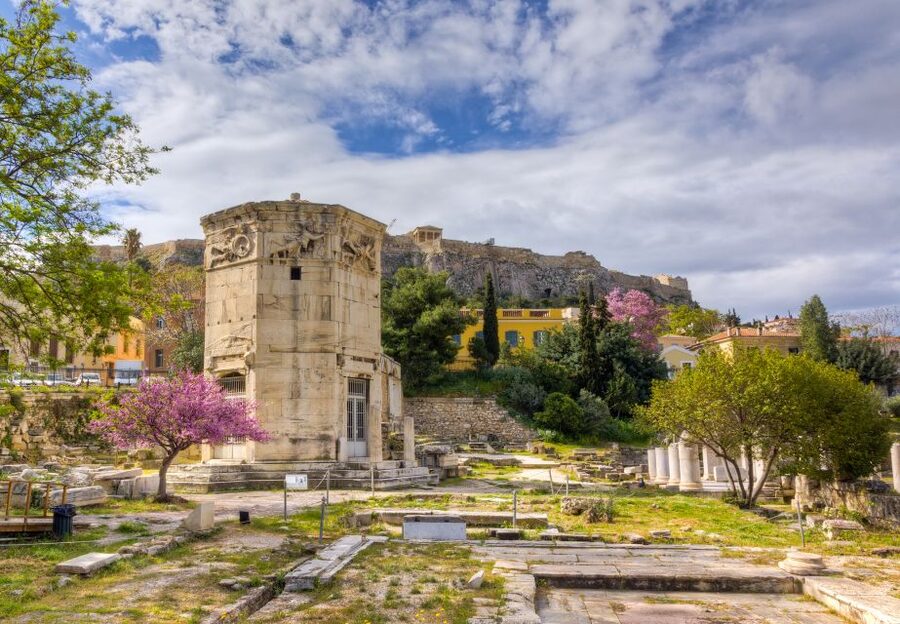
The Roman Agora is easy to underestimate. It occupies a compact area in central Athens, close to the Plaka district and within sight of the Acropolis. You will not spend hours wandering through endless ruins. Instead, you get a focused visit with several important structures packed into a short walk.
I like this format for a first or second day in Athens. You can fit the site between larger sights, and the audio tour gives you a reason to pause rather than simply glance at a few broken columns and move on. The stories connect the stones to ordinary urban life: shopping, public facilities, water, weather, religion, and city administration.
The experience combines an adult entry ticket with a downloadable self-guided tour from Clio Muse Tours. You receive an activation link by email, then install the app on an Android or iOS phone. The material includes audio narration, written information, and maps that can be used offline.
That last point matters. Athens is full of distractions, traffic, and uneven mobile service in crowded areas. Once the content is downloaded, you do not need roaming data while listening. You can also use the audio tour more than once, before or after your visit.
More Smartphone Audio Tours in Athens
- Athens: Ancient Agora E-Ticket and Audio Tour
★ 3.9 · 413 reviews - Athens: Roman Agora & Ancient Agora E-ticket & 2 Audio Tours
★ 4.1 · 107 reviews - Acropolis Self-Guided Smartphone Tour w/Audio & 3D(No entry)
★ 3.9 · 62 reviews
Getting oriented at the Roman Agora
There is no live guide waiting to gather you into a group. You enter with your ticket and begin the visit on your own. The exact meeting instructions can vary by the option booked, but the important point is that this is not a traditional guided tour with a fixed assembly point.
Download everything before leaving your hotel. Check your email, including the spam folder, for the activation instructions. The app needs roughly 100 to 150 MB of storage, so clear space in advance if your phone is full of photographs.
Bring:
- A charged Android or iOS smartphone
- Headphones
- Comfortable shoes
- Enough battery for the visit
The audio tour is available in English, Spanish, German, French, Italian, and Greek. It does not work with Windows phones, and older devices are excluded, including iPhone 5 and 5C models, older iPod Touch units, and older iPads.
At the entrance, the ticket is designed to let you skip the regular ticket line. That can be useful at a busy time. Free and reduced admission tickets are different: those must be obtained at the on-site ticket booth and do not include skip-the-line privileges.
One detail deserves attention: book per device, not per person. If two people want to listen separately on two phones, make sure the booking arrangement covers the devices you plan to use.
The Gate of Athena Archegetis sets the tone
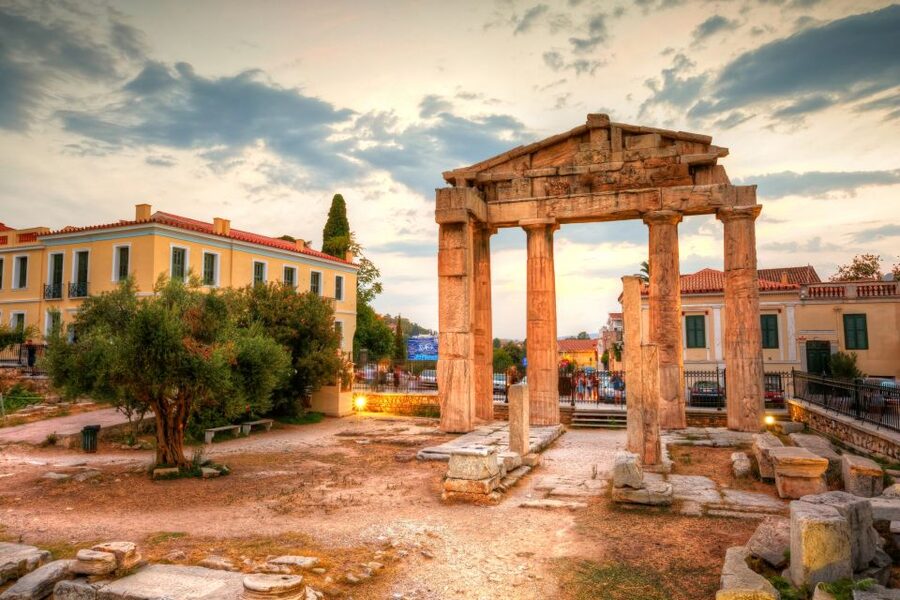
Your first major stop is the Gate of Athena Archegetis. This monumental entrance once marked the western edge of the Roman Agora, and its surviving columns give the site an immediate sense of ceremony.
The gate is more than a photo stop. It helps you picture the Agora as an organized public space rather than a loose scatter of ruins. The audio narration explains what the entrance meant and places it within the city’s changing political and religious setting.
I find this is where the audio format can help most. A live guide can point and speak while you look. With the app, you need to pause, listen, and check the map so that the narration matches the structure in front of you. If you keep your visit unhurried, the opening story should help you get your bearings.
The site is small enough that you can return to a structure if you miss something. Still, the navigation is not completely foolproof. One person found the audio tour difficult to follow spatially, so do not rush from one numbered stop to the next. Use the map and look for the feature being described before starting the full narration.
The Tower of the Winds is the main event
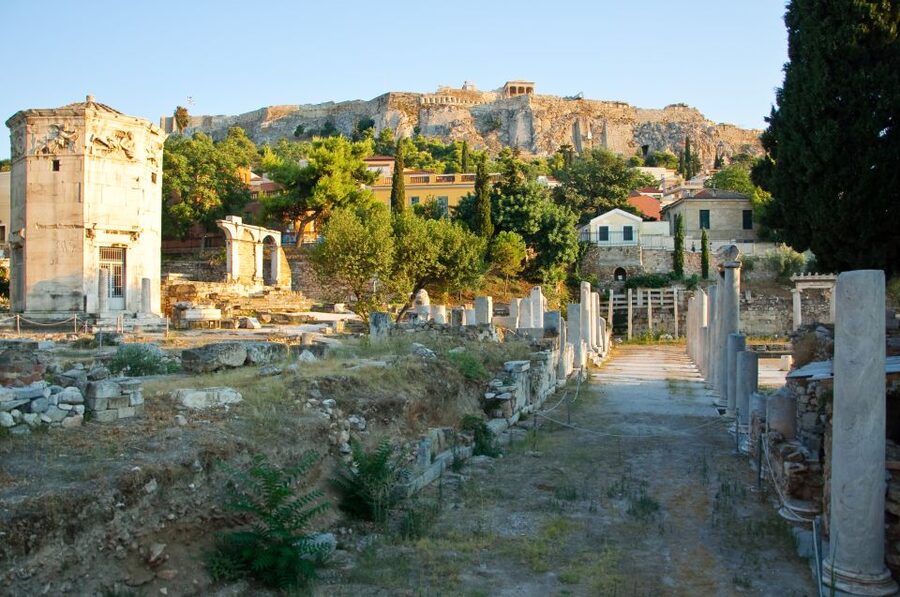
The Tower of the Winds is the Roman Agora’s most distinctive building. It is often described as an ancient weather station, and that gives you a useful starting point, but the structure also connects timekeeping, astronomy, and the winds that shaped life in the ancient city.
You can study the exterior and listen to the explanation of how the building related to the weather. The audio guide introduces the wind figures and the practical role of the tower, turning an unusual stone building into something more understandable.
This is the point where the self-guided format works particularly well. You can stand close, look up, pause the narration, and continue when you are ready. There is no need to keep pace with a group. If you are interested in ancient science or engineering, allow extra time here.
The Tower of the Winds also makes the visit worthwhile for people who have limited time in Athens. You get a memorable structure, a clear story, and a direct connection between ancient ideas and everyday activity. It is not a vast monument, but it is the kind of place you may remember more clearly than a larger site filled with similar columns.
More Smartphone Audio Tours in Greece
- Athens National Archaeological Museum E-Ticket with Audio Guide
★ 3.0 · 57 reviews - Acropolis Museum E-Ticket and Multilingual Audio Guide
★ 4.0 · 42 reviews - Acropolis E-Ticket with Audio Guide & Athens City Audio Tour
★ 3.5 · 28 reviews - Athens Audioguide – TravelMate app for your smartphone
★ 4.1 · 11 reviews
The mosque adds a later chapter
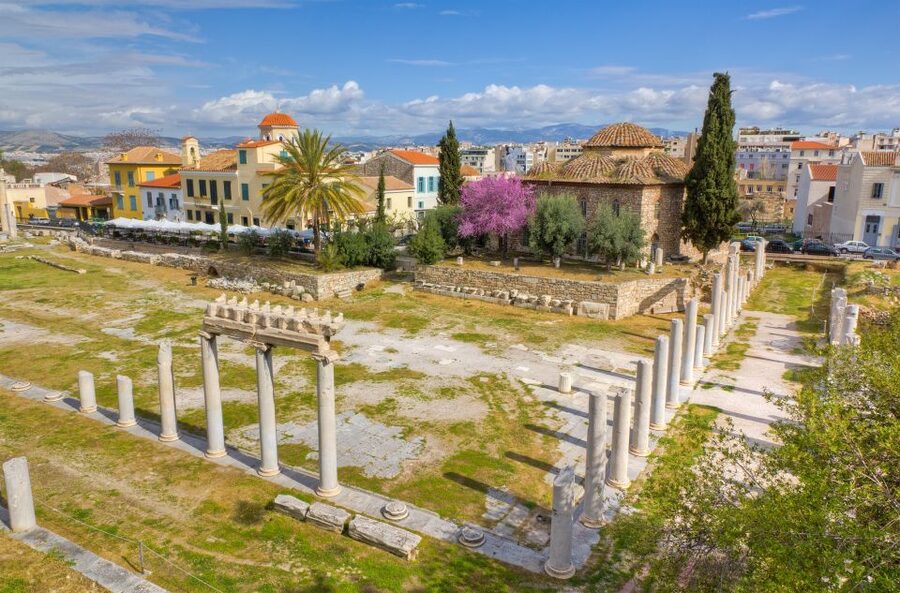
The Roman Agora was not used only during the classical or Roman periods. The Mosque of the Conqueror, also known as Fethiye Mosque, adds an Ottoman layer to the visit.
This is one of the site’s strongest features: you are not looking at a single frozen period. The Agora changed as Athens changed. A visit here can move from ancient civic life to Roman administration and then to Ottoman religious architecture, all within a short walking route.
The mosque helps you read Athens as a city that was repeatedly adapted and reused. The audio guide provides the background needed to understand why this later building belongs in the story of the Agora, even though it does not come from the same era as the Tower of the Winds.
Do not expect a long interior visit or a separate museum experience. The value is in seeing the structure as part of the wider site and understanding the successive uses of this central patch of Athens.
Fountain house, public toilets, and ancient shops
The smaller features may be the most revealing. The fountain house points to the importance of water in city life. The Vespasianae, or public toilets, offer a blunt reminder that ancient urban planning included practical facilities as well as grand monuments.
The shops help you imagine the Roman Agora as a working commercial area. These remains are not as visually dramatic as the Tower of the Winds, but they help answer a basic question: what did people actually do here?
I like this part of the visit because it shifts attention away from famous rulers and monumental architecture. You get clues about shopping, hygiene, movement, and public activity. The audio narration is useful here because the surviving walls may not explain themselves at a glance.
Give these stops your full attention instead of treating them as filler between the major monuments. The site’s strength is the mix of grand and ordinary details. The Gate makes an impression, but the fountain house, shops, and Vespasianae make the place feel lived in.
What the audio guide does well
The audio content is built from short stories rather than a long lecture. That suits the Roman Agora. You can listen to one explanation, look around, and then move on without having to remember a large block of dates and names.
The strongest part is the historical storytelling. The narration connects the ruins to daily habits and unusual details from the past, giving you more than a list of construction dates. One French-language user found the audio very effective for traveling back through the site’s history, and that matches the format’s main advantage: the stories help you picture activity that has disappeared.
You also get written content and maps. If you prefer reading, you can use the text instead of listening to every stop. If you want to revisit the experience later, the tour can be used again after the visit.
The weakness is orientation. Audio tours depend on clear stop markers and good map use. If you start the wrong track or walk ahead, the narration may not match what you see. I recommend listening to the first instruction completely, checking your position, and pausing whenever you need to relocate.
This is not a substitute for a live historian who can answer questions or adjust the explanation to your interests. It is better suited to independent visitors who enjoy controlling the pace and do not mind managing their own phone.
The Acropolis view gives the visit perspective
The Roman Agora offers a splendid view of the Acropolis. The view is not the same experience as visiting the Acropolis itself, and this ticket does not include transportation or entry to other Athens monuments. Still, the sightline helps place the Agora within the city.
You can look from a working urban center toward the monument that dominates Athens’ identity today. That contrast gives the Roman Agora useful context. The Acropolis was not isolated from city life. It rose above streets, shops, public buildings, religious sites, and practical facilities.
If you are already planning a full Acropolis visit, this smaller stop can add another angle without demanding a great deal of time. If you only have a brief stay in Athens, you need to decide if the $18 ticket fits your priorities. The Roman Agora gives you atmosphere and context, but it cannot replace the city’s larger archaeological sites.
Is $18 fair for less than an hour?
At $18 per person, this is a convenience purchase as much as a sightseeing purchase. You are paying for the adult entry ticket, the skip-the-line arrangement, and the audio material in one package.
The visit lasts 45 minutes to one hour for most people. That makes the cost higher per minute than a full-day archaeological pass. The value improves if you care about the audio stories, want to avoid a ticket queue, or prefer not to plan a visit around a live guide.
The value drops if you are comfortable buying a ticket on site and reading the ruins on your own. One recent visit found the site nearly empty and the ticket easy to purchase locally. Conditions can change, but that is a useful warning: skip-the-line access is not automatically worth paying extra for on a quiet day.
Because the activity is non-refundable, check your schedule, phone compatibility, and email access before booking. You do not want to pay for a digital tour that your device cannot run.
Who should book this Roman Agora experience?
I would recommend it to independent sightseers who want a short, structured introduction to the site. It suits you if you enjoy history in small portions, prefer to avoid a group, and are comfortable using an app while walking.
It is also a good fit for:
- First-time Athens visitors building a walking day around Plaka
- History fans interested in Roman, Ottoman, and everyday urban life
- People who want stories rather than only signs and ruins
- Visitors who need a flexible visit in one of six languages
- Anyone who prefers an offline tour and does not want roaming charges
I would hesitate if you want a live guide, a long archaeological visit, or the lowest possible entry price. I would also think twice if you dislike navigating with your phone. The site is compact, but the audio guide’s directions may require attention.
The experience is partially accessible for people with disabilities, but the information does not provide a detailed route or specify which areas may be difficult. Contact the provider before booking if full access is essential for you.
Should you book the Roman Agora e-ticket?
Book it if you want a self-paced visit with a ready-made historical narrative, especially during a busy period when skipping the ticket line matters. The Tower of the Winds, the Acropolis view, and the mix of ancient and Ottoman remains give this small site more substance than its size suggests.
Skip it if you are counting every euro, visiting during a quiet period, or already plan to use a broader Athens archaeological ticket. You may find the site easy to enter independently, and 45 minutes can feel short for $18.
My practical advice is simple: download the app before you arrive, bring headphones, and treat the audio guide as a story aid rather than a perfect navigation system. If you do that, the Roman Agora can make a fine short stop between Athens’ larger sights.
FAQ
How long does the Roman Agora audio tour take?
The visit is expected to take 45 minutes to one hour.
What does the ticket include?
It includes an adult entry ticket to the Roman Agora, skip-the-line service, and a self-guided audio tour for Android or iOS.
Is there a live guide?
No. This is a self-guided audio tour, and no live guide is provided.
Do I need a smartphone?
Yes. You need a compatible Android or iOS smartphone to access the ticket instructions and audio tour.
Do I need headphones?
Headphones are not supplied, so you should bring your own if you want to listen privately.
Can I use the audio guide without mobile data?
Yes. The tour includes offline text, audio narration, and maps. Download the content before your visit.
Which languages are available?
The audio guide is available in English, Spanish, German, French, Italian, and Greek.
Does the tour work on Windows phones?
No. The app is not compatible with Windows phones.
Can I buy a reduced admission ticket through this activity?
No. Free and reduced admission tickets must be obtained at the ticket booth on site, and they do not include skip-the-line privileges.
Can I use the audio tour again later?
Yes. The audio tour can be used repeatedly before or after your visit.
Latest audio tours in Athens
- Athens Ticket Pass: Acropolis & 6 Sites with 5 Audio Guides★ 3.5 · 84 reviews
- Temple of Olympian Zeus: Self-Guided Audio Tour on your Phone (without ticket)★ 4.0 · 8 reviews
- E-ticket for Kerameikos with Audio Tour on Your Phone★ 5.0 · 4 reviews
- Ancient Agora of Athens: A Self-Guided Audio Tour★ 3.5 · 3 reviews
- Self Guided Tour In Athens With 100 Captivating Audio Stories★ 4.0 · 4 reviews
- Private Audio Guided Walking Tour in Athens★ 3.5 · 2 reviews
- Audioguided tour of Athens’ alternative neighbourhood of Exarchia★ 5.0 · 2 reviews
- Athens Hop-On Hop Off w/ Acropolis & Acr.Museum tickets & 3 audio★ 3.0 · 5 reviews
Smartphone Audio Tours, compared.
Colosseum & Forum with Audio Guide App -Optional Arena
Read our review →
Timed Entry to Michelangelo’s David + Audio App
Read our review →
Cathedral & Brunelleschi’s Dome Ticket & Audio App
Read our review →
Michelangelo’s David Priority Ticket & Audio App
Read our review →
Uffizi Priority Ticket & Masterpieces Audio App
Read our review →
Castel Sant’Angelo Entry Ticket & Digital Audioguide
Read our review →
Pantheon Priority Entry Ticket & Audio Guide App
Read our review →Browse the lists this tour appears in