
Reviewed · PARIS
Montmartre – A Canvas of Art and History (Self-Guided audio tour)
Montmartre’s best feature is its mix of famous sights and ordinary Paris corners. This self-guided audio tour leads you from the Art Nouveau Église Saint-Jean de Montmartre uphill to Sacré-Cœur, then through old churches, artists’ squares, cabarets, cafés, and movie locations. You set the pace, so you can pause when a street catches your eye instead of keeping up with a group.
I like the low price of $5.78 and the freedom to begin when it suits you. I also like the GPS-triggered storytelling, which lets your phone explain each place as you reach it. The main drawback is that you must manage the technology yourself, and one user initially missed the activation code because it arrived in an inbox message.
Key points to know before you go
- Fifteen Montmartre sights: The route includes Sacré-Cœur, Saint-Pierre, the Love Wall, Place du Tertre, Musée de Montmartre, Moulin Rouge, and several smaller stops.
- Start at Église Saint-Jean: The tour begins at 19-21 Rue des Abbesses, near a handsome Art Nouveau church.
- End near Blanche Metro Station: The final point is Moulin Rouge at 82 Boulevard de Clichy.
- One to two hours: That estimate works for a moving tour with brief stops, but adding the museum or longer visits will take more time.
- Audio through your phone: You need the activation code and a working iOS device to follow the GPS-triggered guide.
- A private experience: No group schedule or guide meeting controls your day, and only your party takes part.
Why this Montmartre route works well on your own
Montmartre is easy to enjoy badly. You can rush uphill to Sacré-Cœur, take a few photos, and leave without noticing the streets that made the district famous. This route gives you a thread to follow through the neighborhood, linking its churches, painters, singers, cabarets, and film locations.
The audio format suits Montmartre particularly well because the district is made for wandering. You may want to stop at a café, look into a doorway, take a photo, or sit in a square for a few minutes. A scheduled walking group usually keeps moving. Here, you can pause the tour and continue when ready.
The route covers 15 places, though several are short exterior stops rather than full admissions. That is important when you plan your time. The listed duration is about one to two hours, but the route can stretch longer if you enter Musée de Montmartre, spend time inside Sacré-Cœur, or linger around Place du Tertre.
The guide’s stories are delivered through your phone and triggered by location. You do not need to keep checking a printed map for every stop. Still, you should arrive with your phone charged, audio ready, and the activation message easy to find.
More Self-Guided Audio Tours in France
- The Famous Graves of Père Lachaise – Self-Guided Audio Tour
★ 3.5 · 44 reviews - Montmartre Self-Guided Audio Tour: More Than Meets the Eye
★ 4.5 · 35 reviews - One Hour Père Lachaise Cemetery: A Self-guided Audio Tour
★ 3.5 · 26 reviews
Starting at Église Saint-Jean de Montmartre
The tour begins at Église Saint-Jean de Montmartre, at 19-21 Rue des Abbesses. This is a smart starting point because it introduces you to a less obvious side of the district before the route reaches its major sights.
The church is known for its Art Nouveau design and quiet spiritual atmosphere. Its opening hours are listed as 9:00 a.m. to 6:00 p.m. daily, and admission is free. The tour allows about five minutes here, enough for a short look and the opening audio story.
I like beginning here instead of at Sacré-Cœur. The basilica is Montmartre’s big draw, but starting with Saint-Jean gives the route a calmer first step. You see that Montmartre is not only white domes, souvenir shops, and portrait artists. Its religious buildings also show changing styles and layers of Parisian life.
From here, the route moves through the former artists’ quarter. The audio explains why this part of Paris became associated with painters, writers, musicians, and performers. The exact sequence includes several brief stops, so listen while walking and keep an eye on the GPS prompts.
Cabarets, cafés, and the world of Amélie
The route includes the oldest cabaret in Montmartre, with listed opening hours on Tuesday and Thursday through Saturday from 9:00 p.m. to 1:00 a.m. The experience is not presented as a cabaret show admission, so treat this as an exterior point and historical story unless you separately arrange entry.
You also pass a famous French cabaret where the French cancan began. This is one of the places where the tour connects present-day Montmartre with its stage history. It helps explain why the neighborhood became such a magnet for artists and nightlife.
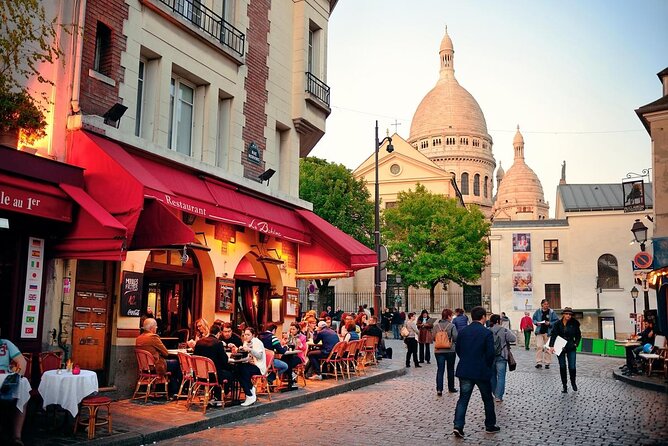
Another stop is the café featured in the film Amélie Poulain. Film locations can feel shallow when they are reduced to a photo stop, but this one works better when paired with the wider story of Montmartre’s cafés and creative culture. If you have seen the film, you will recognize the setting. If you have not, it remains a useful example of how the neighborhood continues to shape popular images of Paris.
The route also points out a bright pink building known for its artistic past. These short stops are part of the charm, but do not expect a long visit at every location. The value is in the connections between them, with the audio filling in details as you walk.
Sacré-Cœur and the view from the hill
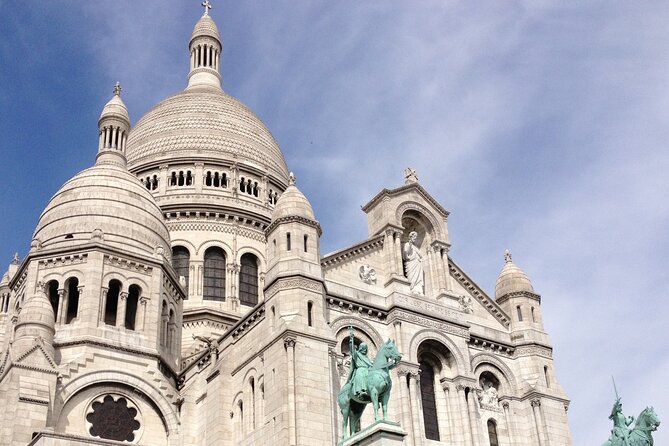
Sacré-Cœur is the route’s grand central stop. The basilica sits at the top of Montmartre Hill and is open daily from 6:30 a.m. to 10:30 p.m. Admission is free, and the suggested stop lasts about 15 minutes.
That time is enough to look around and hear the story, but it is not a full visit. You may want to remain longer inside the basilica or spend extra time outside taking in the Paris view. If you arrive during a busy period, the broad steps and forecourt can feel crowded, so build in flexibility rather than treating the 15-minute estimate as a hard limit.
The basilica matters for two reasons. It is a major religious site, and it is also the point where Montmartre’s steep streets open onto one of the city’s most recognizable views. The audio gives the stop context, while your own pace lets you decide whether the church, the view, or both deserve more time.
Because the route starts lower on the hill, you experience the change in atmosphere as you go. The early church and café stops feel local and street-level. Sacré-Cœur gives the walk a dramatic middle point.
More Self-Guided Audio Tours in Paris
- Montmartre: Secret Stories of Paris – Self-Guided Audio Tour
★ 4.0 · 13 reviews - Self-Guided Audio Tour -The Eiffel Tower, Exterior
★ 4.0 · 9 reviews - Self-Guided Audio Tour Tickets To The d’Orsay Museum
★ 3.0 · 9 reviews - Self-Guided Audio Tour – Montmartre: The heart of art and bohemia
★ 3.5 · 7 reviews
Saint-Pierre and the Love Wall
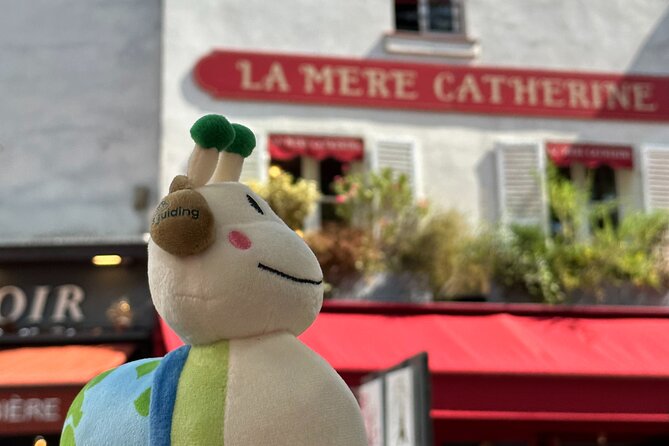
Église Saint-Pierre de Montmartre is one of Paris’s oldest churches. Its listed visiting hours vary by day. Monday is closed. On Saturday it opens from 9:00 a.m. to noon and 3:00 p.m. to 7:00 p.m. On Tuesday through Friday and Sunday, it is open from 9:00 a.m. to noon and 3:00 p.m. to 6:00 p.m.
The suggested stop is only five minutes, so you can treat the church as a quick interior or exterior visit depending on the time. Its age gives the route an important contrast with the newer Art Nouveau church at the beginning. Montmartre’s character comes partly from these sharp shifts in time and style.
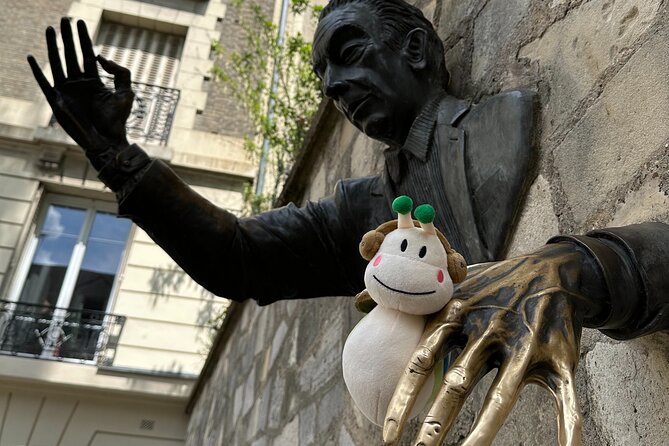
The Love Wall, or Le Mur des Je t’aime, offers a very different mood. It is a public display of the phrase I love you in many languages, designed as a symbol of affection and unity. The stop lasts about three minutes, and admission is free.
The wall is small and easy to miss if you are walking without a plan. That makes the audio route useful here. You get a clear reason to stop, take a look, and move on without turning the visit into a major detour.
The wall is open from 8:00 a.m. to 5:30 p.m. on weekdays and 9:00 a.m. to 5:30 p.m. on weekends. If you begin early, check the time before counting on entry.
Renoir’s Montmartre and Musée de Montmartre
The route points out the place shown in Auguste Renoir’s painting Le Bal du Moulin de la Galette. This stop brings the artists’ quarter to life without requiring a long museum visit. You are looking at a real setting tied to a famous work, not simply hearing a general story about painters.
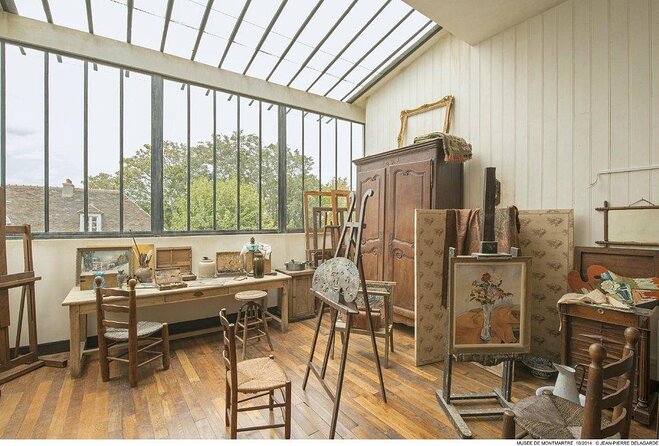
Musée de Montmartre is the route’s one listed paid admission. It opens daily from 10:00 a.m. to 7:00 p.m., and the suggested visit lasts 30 minutes. Your audio tour does not include the museum ticket, so you pay separately if you choose to enter.
I would treat the museum as an optional extension, especially if you have only one hour. The core route can be completed more quickly, while the museum adds a focused look at the district’s art and local past. If you enjoy painting and want more than street views, the extra half hour is likely worth considering.
The museum also changes the rhythm of the tour. Most stops are brief, outdoor points. Here, you can slow down, step inside, and give the district’s artistic story more attention. Just remember that the one to two hour estimate becomes less realistic if you add a full museum visit and unhurried time at the other sights.
Place du Tertre and the bohemian center
Place du Tertre is one of Montmartre’s best-known squares, filled with artists, cafés, and the atmosphere associated with the old bohemian quarter. The tour allows about three minutes, which is enough for orientation but not enough if you want to browse every artist’s display or sit down for a drink.
This is a place where I would ignore the clock. The square can be visually busy, and the point is not just to hear its story. Look around, notice how the cafés and artists share the same tight public space, then decide how long you want to stay.
The audio helps you understand why this square matters, but it cannot replace looking closely. It is one of the route’s most social stops, while the churches and museum offer a quieter experience. That range keeps the walk from feeling like a string of similar monuments.
The route then continues to Place Dalida, a square honoring the French singer. The suggested stop is three minutes. It also points out the house where she lived for more than 20 years, adding a personal link to the neighborhood rather than presenting her only as a name on a memorial.
Ending at Moulin Rouge
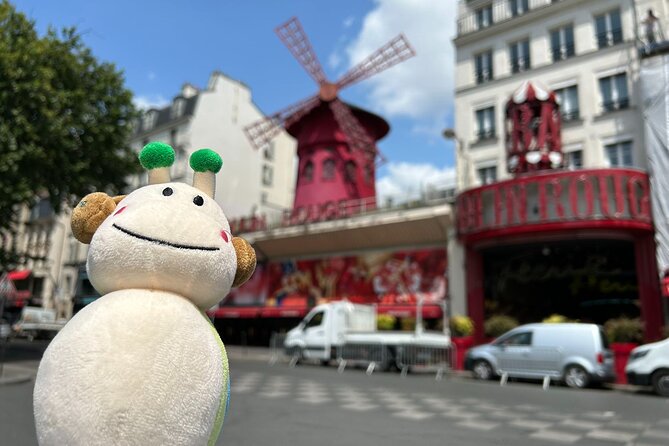
The tour ends at Moulin Rouge, 82 Boulevard de Clichy, near Blanche Metro Station on Line 2. The famous cabaret is tied to Montmartre’s performance culture and gives the route a natural finish among the theaters and nightlife of the lower hill.
Ending here makes practical sense. You begin near Rue des Abbesses and finish close to public transportation, so you can continue elsewhere in Paris without retracing the entire route. The experience is not a Moulin Rouge show ticket, however. It is a sightseeing and audio route that explains the cabaret’s place in Montmartre.
The route’s stop descriptions include both the oldest cabaret in Montmartre and the venue associated with the French cancan. Those references help frame the final walk as more than a trip to a single landmark. You move from churches and artists’ studios toward the entertainment district, following the neighborhood’s changing identity.
Price, pace, and the phone-based format
At $5.78 per person, this is inexpensive for a private experience. You are not paying for a live guide, museum admission, or cabaret entry. You are paying for a prepared audio route that lets your party explore independently.
That price is strongest if you want structure without a group. A private walking guide costs far more, while a free map gives you no spoken context. The tradeoff is that you must handle the route, phone, audio, and timing yourself.
One practical point deserves attention: the activation code is sent through an inbox message. The code was easy to miss at first, so check your messages before arriving and locate it before you start walking. This small step can prevent a frustrating delay at the first stop.
The experience is listed for iOS devices. Since the stories are GPS-triggered, keep your phone available as you move between locations. The route is near public transportation, and most people can participate, but the tour does not provide a live guide to solve technical problems or redirect you if you wander off route.
You can cancel free of charge up to 24 hours before the start time for a full refund. Changes or cancellations made less than 24 hours before the start are not accepted for a refund, and the cut-off follows Paris local time.
Who should book this Montmartre audio tour
I would recommend it most to independent visitors who want a clear route but dislike rigid schedules. It also suits solo visitors well. One of the strongest points of the experience is that you can see the main sights on your own while still hearing professional stories about the neighborhood.
It is a good fit if you want to combine major stops with smaller ones, such as the Love Wall, Dalida’s square, the pink building, and the Amélie café. A standard sightseeing map may show Sacré-Cœur and Moulin Rouge, but it is less likely to tie all these points together.
You should choose something else if you want a live guide who can answer questions, manage the walking pace, or provide personal recommendations. You should also allow extra time if Musée de Montmartre matters to you, since its ticket is separate and its visit adds about 30 minutes.
Should you book it?
Book this tour if you want a low-cost, flexible introduction to Montmartre with enough structure to keep you from missing the neighborhood’s smaller stories. The strongest reasons are the 15-stop route, the private pace, and the range from Art Nouveau and ancient churches to painters, singers, film locations, and cabarets.
Skip it if you want a full guided tour, a museum ticket, or a live person beside you. For $5.78, though, it offers good value, especially for a first visit or a solo afternoon. Check your activation message in advance, start at Église Saint-Jean, and leave room to linger at Sacré-Cœur and Place du Tertre.
FAQ
How long does the Montmartre audio tour take?
The experience is listed as lasting approximately one to two hours. Your visit may take longer if you enter Musée de Montmartre or spend extra time at Sacré-Cœur, Place du Tertre, or the cafés.
Where does the tour begin?
The tour begins at Église Saint-Jean de Montmartre, located at 19-21 Rue des Abbesses, 75018 Paris, France.
Where does the tour end?
It ends at Moulin Rouge, 82 Boulevard de Clichy, 75018 Paris, near Blanche Metro Station on Line 2.
Is the museum ticket included?
No. Admission to Musée de Montmartre is not included. The museum is open daily from 10:00 a.m. to 7:00 p.m., and the suggested visit lasts about 30 minutes.
Do I need a guide to take part?
No. This is a self-guided audio tour delivered through your phone. GPS-triggered stories play as you reach the listed places, and only your group participates.
Can I cancel for a full refund?
Yes. You can cancel at least 24 hours before the experience start time for a full refund. Cancellations or changes made less than 24 hours before the start time are not accepted for a refund.
More History Audio Tours in Paris
- Colosseum, Roman Forum & Palatine Hill with Audioguide App
★ 4.4 · 6,291 reviews - Venice: St. Mark Basilica Ticket, Audioguide+History Gallery
★ 3.9 · 4,780 reviews - Rome: Colosseum, Ancient Rome Tour or AudioGuided Tour
★ 4.4 · 2,879 reviews - Colosseum, Roman Forum & Palatine Hill Entry and Audioguide
★ 4.1 · 2,475 reviews
Latest audio tours in Paris
- The Tuileries Garden’s Classic Sights: A Self-Guided Audio Tour★ 4.0 · 3 reviews
- The French Revolution: Self Guided Audio Tour of Paris★ 4.5 · 3 reviews
- Audioguide – The Eiffel Tower and its secrets★ 4.0 · 4 reviews
- A Self-Guided Audio Tour Around Parc Montsouris★ 3.5 · 6 reviews
- Summit Eiffel Tower Audio Guide Tour with Unlimited Time Access★ 4.5 · 58 reviews
- Self-Guided Audio Tour -The Eiffel Tower, Exterior★ 4.0 · 9 reviews
- Trendy Marais, smartphone audioguided walking tour★ 5.0 · 6 reviews
- Self Guided Tours in Paris with 100 Captivating Audio Stories★ 3.5 · 3 reviews
Self-Guided Audio Tours, compared.

Acropolis Ticket & Optional Self-Guided Audio Tours
Read our review →


Ultimate Acadia National Park Self-Guided Driving Audio Tour
Read our review →

Akrotiri Ticket with Optional Self-Guided Audios
Read our review →
Browse the lists this tour appears in