
Reviewed · PARIS
Montmartre Self-Guided Audio Tour: More Than Meets the Eye
Montmartre is more than Sacré-Cœur and a few artists sketching portraits in Place du Tertre. This self-guided walk leads you through old churches, painters’ studios, cafés, a vineyard, windmills, and streets tied to Edith Piaf, Picasso, Renoir, Van Gogh, and Dalida. The GPS-triggered narration gives the neighborhood a clear story as you walk.
I like the freedom to stop for coffee, repeat a story, or pause the tour without holding up a group. I also like the offline access, which lets you download the audio, map, and route before setting out. The main drawback is the hill: Montmartre brings stairs and steep streets, and some users have found the app’s directions or GPS triggers less reliable than expected.
Key points to know before you go
- The route climbs through Montmartre: Expect hills, stairs, and a fair amount of walking.
- The tour links art to real places: Picasso, Modigliani, Renoir, Van Gogh, Utrillo, and Dalida all appear in the story.
- You finish at Sacré-Cœur: The route begins at 22 Rue des Abbesses and ends at the basilica.
- The app works at your pace: Start, stop, replay, or slow down without a scheduled group.
- Offline access is included: Download the audio, map, and geodata before walking.
- The price is modest: At $14.99 per person, it costs less than most guided walks, but you provide the phone, headphones, and navigation backup.
Starting near Rue des Abbesses
The tour begins at 22 Rue des Abbesses, a useful starting point in lower Montmartre. You are not dropped at the basilica and sent straight uphill. Instead, the route builds toward Sacré-Cœur while introducing the neighborhood’s art, cafés, stories, and side streets along the way.
That direction matters. Montmartre makes more sense when you see it as a former village and artists’ quarter, not simply as the hilltop church. The walk gradually shifts from ordinary neighborhood streets to the better-known sights near the summit.
You use the VoiceMap app on an Android or iOS phone. The audio is in English, and the GPS is designed to play the next segment when you reach the right place. Several people found the narrator easy to understand and pleasant to listen to. The voice includes humor and keeps the material from sounding like a list of dates.
Before leaving, charge your phone fully and download the tour. A portable charger is a sensible addition, since the GPS and audio can use battery power. You will also need your own headphones. Those costs are not included.
More Self-Guided Audio Tours in France
- The Famous Graves of Père Lachaise – Self-Guided Audio Tour
★ 3.5 · 44 reviews - One Hour Père Lachaise Cemetery: A Self-guided Audio Tour
★ 3.5 · 26 reviews - Montmartre: Secret Stories of Paris – Self-Guided Audio Tour
★ 4.0 · 13 reviews
The Wall of Love and Montmartre’s older roots
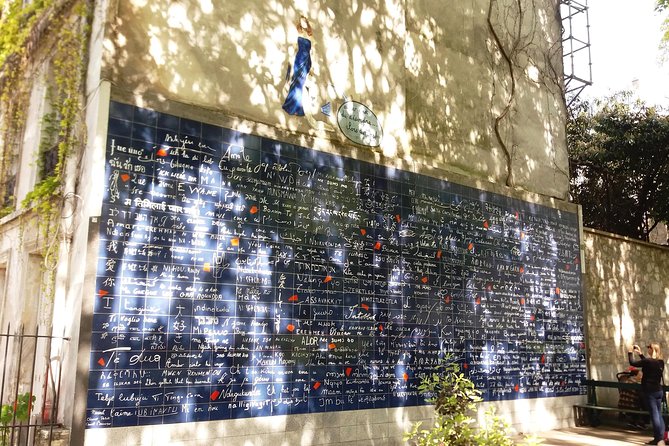
One early stop is the Mur des je t’aime, usually called the Wall of Love in English. Created in 2000 by Frédéric Baron and Claire Kito, the artwork covers its tiles with 311 ways to say I love you in 250 languages.
It is a quick stop, but it gives the route a change of mood. Montmartre is famous for painters and cabarets, yet this contemporary piece shows that the neighborhood’s public art is not all from the Belle Époque or the early twentieth century. The tour briefly pauses here rather than treating it as a major museum visit.
The walk also brings you to one of Paris’s oldest Christian sites. Written records of the church go back to 885. The stop provides useful context for Montmartre, where religious history and bohemian culture sit close together.
Do not expect a long interior visit or a guided church tour. The audio walk is built around brief stops and outdoor storytelling. If you want more time inside a church, you can pause the app, but entrance arrangements and opening times are not included in the $14.99 price.
Picasso, Modigliani, and the artists’ working quarter
Montmartre’s fame rests heavily on the artists who lived and worked here, and this is one of the strongest parts of the route. You visit the workshop where Picasso lived from 1904 to 1909. Modigliani also lived and worked there, along with Renoir, Juan Gris, Max Jacob, and the painter known as le Douanier Rousseau.
The important point is not only that famous people once rented rooms here. The stop helps you picture Montmartre as a place where artists shared buildings, ideas, money troubles, and cramped workspaces. The tour also passes Picasso’s first studio, giving you another link between the streets and his early career.
You continue through Place Émile-Goudeau, a small square with strong ties to Montmartre’s creative past. The route also passes the home of Dalida, the singer whose life and career remain closely connected with Paris.
These are mostly exterior stops. You should not book this walk expecting entry into Picasso’s former studio or Dalida’s home. The value comes from standing in the actual neighborhood and hearing how the people connected to it shaped its reputation.
From the Passe-Muraille to Rue de l’Abreuvoir
The route passes Le Passe-Muraille, a statue based on Marcel Aymé’s story about a man who could walk through walls. The sculpture is one of those quick Montmartre discoveries that is easy to miss if you are only following the main tourist streets.
You also pass a Statue of Saint-Denis before heading down Rue de l’Abreuvoir. This street is one of the most photographed corners of the hill, with a strong village feel and a sightline toward the upper part of Montmartre.
This section rewards a slower pace. The app may finish one audio segment before you have fully taken in the street, so pause when you want to look around. One benefit of a self-guided tour is that you do not have to choose between listening and taking photographs on someone else’s schedule.
The route is not always a straight march from one major sight to the next. Some users found the directions slightly unclear or felt there was backtracking. Keep the map open, listen for the next instruction, and do not treat the stated one to two hours as a strict timetable.
More Self-Guided Audio Tours in Paris
- Self-Guided Audio Tour -The Eiffel Tower, Exterior
★ 4.0 · 9 reviews - Self-Guided Audio Tour Tickets To The d’Orsay Museum
★ 3.0 · 9 reviews - Self-Guided Audio Tour – Montmartre: The heart of art and bohemia
★ 3.5 · 7 reviews - Bundle of Père Lachaise Cemetery: Self-Guided Audio Tours
★ 4.0 · 7 reviews
Maison Rose, the vineyard, and Lapin Agile
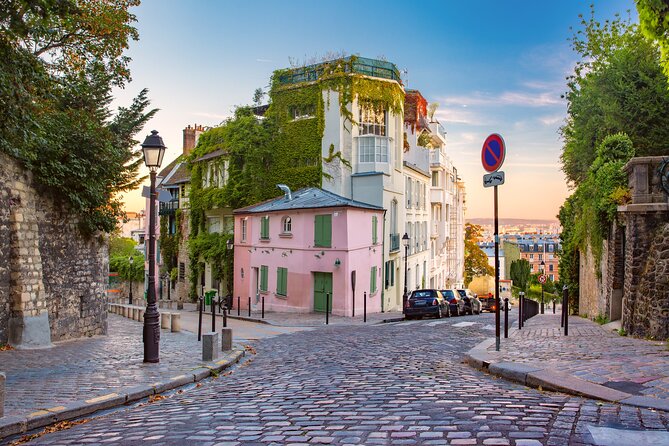
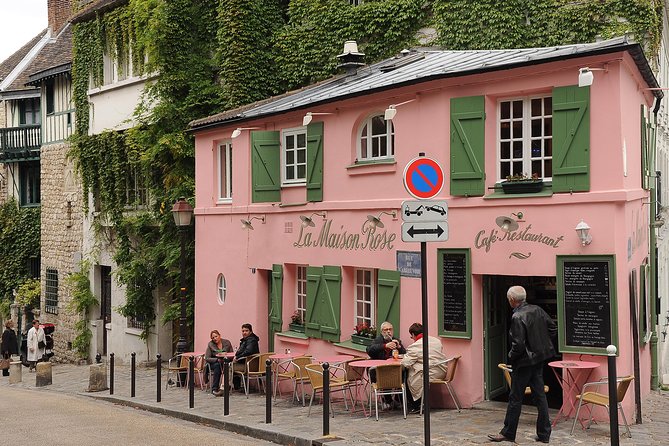
Maison Rose is one of Montmartre’s signature views. The pink house became famous through the work of local painter Maurice Utrillo. Later, singers such as Edith Piaf, Charles Aznavour, and Jacques Brel visited the restaurant, and Albert Camus was also a fan.
The story gives you more than a photo stop. It connects the building to painters, writers, and singers who used Montmartre as a home, workplace, or meeting place. The house is compact and the surrounding streets can be busy, so the app’s short explanation is useful without requiring a long visit.
Nearby is one of Paris’s last remaining vineyards. It is small enough for one person to care for, yet it plays a large part in Montmartre’s identity. Paris once had many vineyards, and this surviving patch keeps a visible link to the hill’s village past.
The route then passes Lapin Agile, which first opened in 1795 as a cabaret and drinking establishment. Its earlier names included Rendez-vous of Thieves and Cabaret of the Assassins. In 1880, caricaturist André Gill created the rabbit image that inspired its current name.
This is a good example of the tour’s approach. You do not just see a famous façade. You get the story of how the place changed names and gained its rabbit sign. The audio also places Lapin Agile within the old cabaret culture that helped make Montmartre famous.
Moulin de la Galette and the painters’ Montmartre
The Moulin de la Galette is one of the most rewarding stops for anyone interested in art. This windmill is one of only two left in Montmartre and once specialized in grinding wheat. It later became a restaurant visited and painted by artists including Renoir, Van Gogh, and Pissarro.
Renoir’s famous Bal du Moulin de la Galette shows the party held behind the recognizable façade rather than the windmill itself. Van Gogh painted several versions of the windmill, partly because his brother Theo lived nearby and he knew the area well.
The explanation helps you read the street differently. You are not looking at an isolated old mill. You are seeing a place that became part of the visual record of Montmartre. The stop works especially well if you enjoy comparing a modern street view with the paintings connected to it.
The route also visits a classic Montmartre restaurant whose name means simple and without ceremony. A restaurant has occupied the site since the 1500s, though the building has been rebuilt and renamed over the years. Degas, Renoir, Monet, Cézanne, Sisley, and Toulouse-Lautrec all ate or drank there. In 1886, Van Gogh painted La Guinguette à Montmartre there.
You can stop for food or a drink if you wish, but meals are not part of the tour. That flexibility is useful, though it also means you need to watch the time if you want to reach the artists’ square and Sacré-Cœur before closing hours at any particular attraction.
Place du Tertre and the final climb
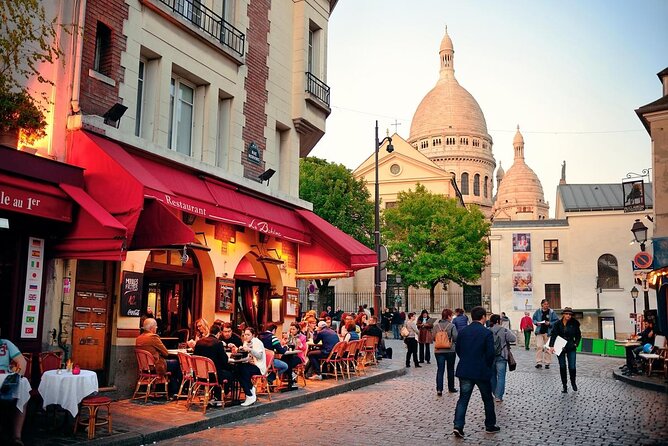
The walk passes Place du Tertre, the square most closely associated with Montmartre’s street artists. It is also one of the more crowded parts of the route. The audio helps explain why this square matters, but it cannot remove the noise or the crowds.
One important planning point comes here: the tour is a set route, not a menu of stops you can rearrange. If Place du Tertre is your main reason for visiting Montmartre, check the route and timing before you begin. One person using the tour reached the area late and missed the square when attractions were closing.
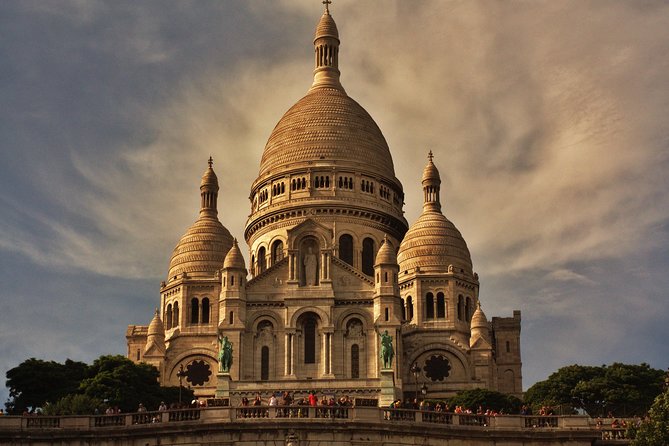
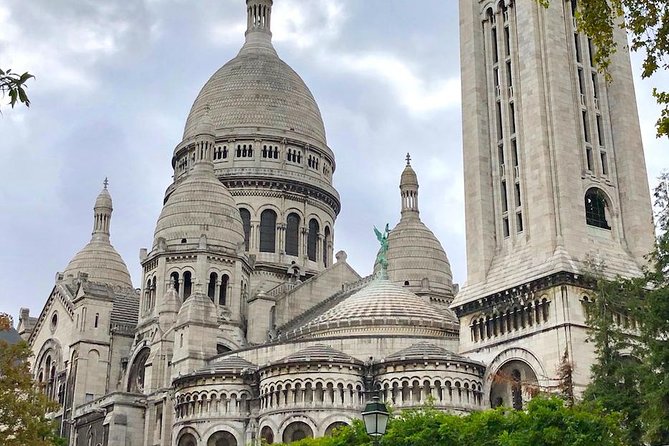
The route also passes a second Statue of the Chevalier de la Barre before making the final approach to Sacré-Cœur. The walk ends with a look inside the Basilica of the Sacred Heart.
The basilica is the natural finish because the hilltop gives the route a sense of arrival. You have moved from lower Montmartre through its artists’ streets, cafés, vineyard, and cabarets to the white-domed church above the city. The tour ends in front of the basilica at 35 Rue du Chevalier de la Barre, rather than transporting you elsewhere.
How long the walk really takes
The stated duration is about one to two hours, but that is best understood as the time for the core walking and audio. If you walk slowly, stop for photographs, enter a church, pause for a pastry, or sit at a café, allow at least four hours.
Montmartre’s terrain is the bigger issue. The route includes uphill walking and stairs. One person described it as physically impossible, while others completed it comfortably by taking breaks. The practical lesson is simple: this is not a flat stroll, and you should not schedule another demanding walking tour immediately afterward.
You can pause and restart the audio, and you can take the tour over more than one session. That makes the route easier to manage, though you should check the app’s access terms and plan your own stopping points. Comfortable shoes, water, and a charged phone will make a real difference.
What the app does well, and where it can fail
The best feature is the pace. You can stop whenever you like, replay a story, speed up the recording, or wander briefly without losing a live guide. The app can also give a gentle redirect if you stray from the route.
The offline audio, map, and geodata are helpful in Paris, where phone service and battery life are not always dependable. Downloading everything before you leave also reduces the need to manage data while walking.
Still, GPS is not perfect. Some people found locations slightly off, and one person reported that the audio stopped after the second stop. Another found that the app thought the group was lost while they were inside a church. These problems were not universal, but they are worth planning for.
If the app misbehaves, VoiceMap provides support by email and telephone. You should contact support rather than abandon the tour at once. Also keep the route map available so you can continue independently if a trigger does not play at the expected spot.
Is $14.99 a good value?
At $14.99 per person, this is a low-cost way to add structure and context to a Montmartre walk. You get lifetime access to the English tour, the VoiceMap app, and offline audio, maps, and geodata.
The value is strongest if you want stories but do not want a scheduled group. A private tour with a live guide costs more, while an unguided walk costs nothing but may leave you passing famous places without understanding their connections.
The tradeoff is that you pay for the audio only. Your phone, headphones, transportation, meals, and any museum or attraction tickets are separate. The tour is also available in English only.
Free cancellation is available up to 24 hours before the local start time. Cancellations made within 24 hours are not refunded.
Who should book this Montmartre walk?
I would choose this tour if you like exploring alone or with your own small group, want to stop often, and enjoy art and local stories more than a checklist of major monuments. It is especially useful for solo visitors who prefer not to join strangers and for couples or families who want control over the pace.
I would think twice if stairs are difficult, if you need a live person to answer questions at every stop, or if your main goal is to select only Picasso’s sites, the vineyard, or Place du Tertre. The route has a planned order, and it works best when you follow the whole story.
Book it if you can give Montmartre several hours, start with a full battery, and accept that a few GPS or direction issues may require patience. Skip it if you want a completely flat walk or a highly personalized itinerary. For independent visitors, the combination of art history, village streets, and Sacré-Cœur is a good deal at $14.99, provided you respect the hill.
FAQ
Where does the Montmartre audio tour start?
The tour starts at 22 Rue des Abbesses, 75018 Paris, France.
Where does the tour end?
It ends in front of the Basilique du Sacré-Cœur de Montmartre at 35 Rue du Chevalier de la Barre, 75018 Paris, France.
How long does the tour take?
The approximate duration is one to two hours. If you walk slowly, stop for cafés, music, photographs, or extra sightseeing, it can take at least four hours.
What language is the audio tour offered in?
The tour is offered in English.
Does the tour include a live guide?
No. It is a self-guided audio walking tour using the VoiceMap app.
Do I need internet access during the walk?
The tour includes offline access to the audio, maps, and geodata. You should download the material before starting.
Do I need to bring my own phone and headphones?
Yes. A smartphone and headphones are not included. A fully charged phone or portable charger is recommended.
Are food, drinks, transportation, or attraction tickets included?
No. Food and drinks, transportation, and tickets or entrance fees for museums or other attractions are not included.
Can I cancel for a refund?
Yes. You can receive a full refund if you cancel at least 24 hours before the experience start time. Cancellations within 24 hours are not refunded.
Latest audio tours in Paris
- The Tuileries Garden’s Classic Sights: A Self-Guided Audio Tour★ 4.0 · 3 reviews
- The French Revolution: Self Guided Audio Tour of Paris★ 4.5 · 3 reviews
- Audioguide – The Eiffel Tower and its secrets★ 4.0 · 4 reviews
- A Self-Guided Audio Tour Around Parc Montsouris★ 3.5 · 6 reviews
- Summit Eiffel Tower Audio Guide Tour with Unlimited Time Access★ 4.5 · 58 reviews
- Self-Guided Audio Tour -The Eiffel Tower, Exterior★ 4.0 · 9 reviews
- Trendy Marais, smartphone audioguided walking tour★ 5.0 · 6 reviews
- Self Guided Tours in Paris with 100 Captivating Audio Stories★ 3.5 · 3 reviews
Self-Guided Audio Tours, compared.

Acropolis Ticket & Optional Self-Guided Audio Tours
Read our review →


Ultimate Acadia National Park Self-Guided Driving Audio Tour
Read our review →

Akrotiri Ticket with Optional Self-Guided Audios
Read our review →
Browse the lists this tour appears in