
Reviewed · MEXICO
Chichen Itza: Self-Guided Tour with Audio Narration & Map
Chichén Itzá is far easier to appreciate when you know what you’re looking at, and this $9.99 self-guided audio tour gives you that missing context without tying you to a group. The app guides you through more than 37 stories, using GPS to start the narration near each monument.
I like the freedom to stop in the shade, take photos, repeat a section, or step away from the route and return later. I also like the offline setup, which saves you from relying on mobile data inside the archaeological zone. The main drawback is that the app must be downloaded and activated correctly before you arrive, and a small number of users have had trouble with access, passwords, or battery life.
Key points to know before you go
- GPS-triggered storytelling: Audio starts near each stop, with text and images available when you prefer to read.
- A route of roughly 1.5 to 2 miles: Plan on about two hours if you listen to most of the material and visit the main buildings.
- No entrance ticket included: You must buy admission to Chichén Itzá separately.
- Works offline after setup: Download the app and tour while you have strong Wi-Fi or cellular service.
- Best for independent exploring: You walk alone rather than following a guide or joining a group.
- Bring headphones and a charged phone: Audio is designed for hands-free use, and the route can drain your battery.
Why an audio guide helps at Chichén Itzá
Chichén Itzá is not a single monument. It is a broad archaeological site filled with pyramids, platforms, carved columns, ball courts, ceremonial buildings, and smaller structures that can be easy to pass without understanding.
Site signs provide some information, but they cannot explain every carving or connect the buildings into a larger picture. The Action’s Tour Guide app fills that gap with short audio segments, written explanations, photographs, and a map. You can listen as you walk, then pause beside a monument rather than crowding around a human guide.
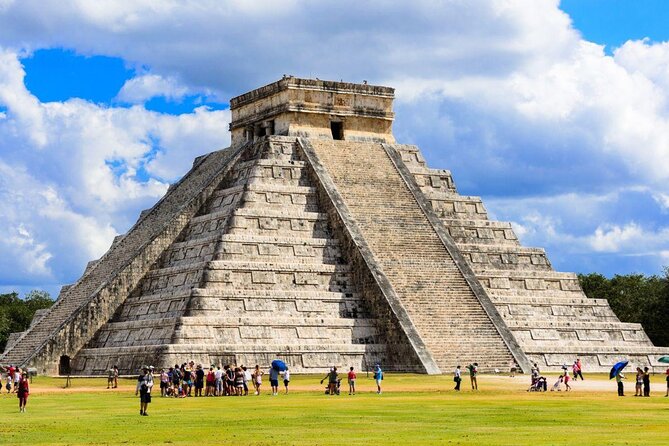
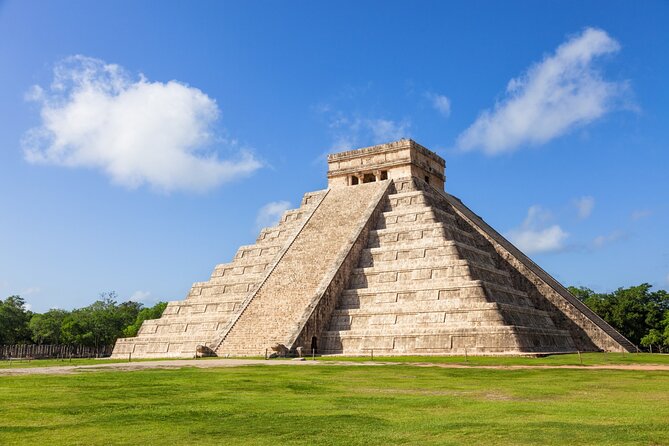
That format works especially well at El Castillo. You can look up at the pyramid while the app explains its connection with Kukulkan, the feathered serpent deity, and points out details in the design that are easy to miss from a distance.
You control the pace. If a story starts before you reach the building, keep walking and listen as you approach. If you want to take photos, buy a souvenir, or rest, pause the tour. The GPS can help you return to the route afterward.
The route usually takes one to two hours, though the total activity is listed as roughly two to three hours. The difference depends on how long you spend at each structure, how often you stop, and whether you explore beyond the main path.
More Self-Guided Audio Tours in the world
- Athens: Acropolis Ticket & Optional Self-Guided Audio Tours
★ 4.1 · 2,542 reviews - Gettysburg Battlefield Self-Guided Driving Audio Tour
★ 4.5 · 910 reviews - Joshua Tree National Park Self-Guided Driving Audio Tour
★ 4.5 · 762 reviews
Getting started with the Action app
This is a self-guided experience, so no one meets you at the entrance. After booking, you receive setup instructions and a password by email and text. Search for audio tour in your messages if the instructions are not easy to spot.
Download the separate Action’s Tour Guide app before reaching Chichén Itzá. Enter the supplied password, download the tour, and test it while you still have a strong signal. Once the content is on your phone, the tour uses GPS rather than mobile data.
At the site, open the app and launch the tour that matches your starting point and direction. Go to the first story location. The audio should begin automatically as you arrive at the correct area.
A little orientation at the start saves time. One practical tip is to check that the blue GPS marker matches your actual position before setting off. If the app seems to ask for the password again, closing and reopening it has helped resolve that problem.
Use headphones or earbuds. This keeps the narration clear and lets you hear the next instruction without holding your phone up. Couples can share a tour by using one earbud each, though you’ll want to stay aware of the people and paths around you.
Starting near the handicraft market
The route begins near the handicraft market, at the listed meeting point in the Chichén Itzá area. This is not a guided welcome, so you need to find the first story location yourself.
The opening material introduces the Maya and the broad setting of the site. It helps establish that Chichén Itzá developed over a long period and reflects both Maya and central Mexican, often called Toltec, influences.
The first few stops are brief. That is useful if you want to begin moving quickly, but do not expect a long historical lecture before reaching the main monuments. The strongest material comes once you are among the central structures.
El Castillo and the Great Ball Court
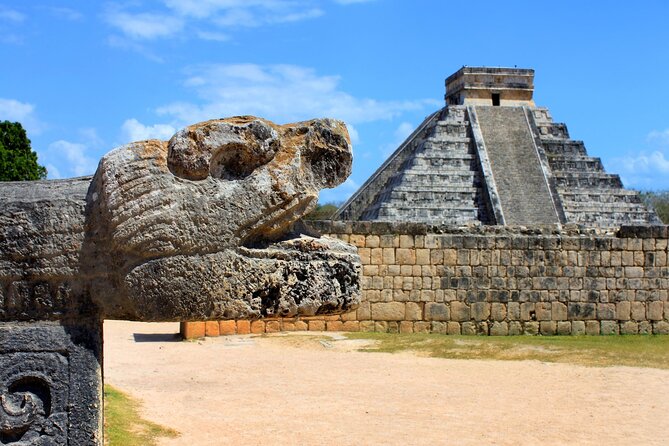
El Castillo, also called the Pyramid of Kukulkan, is the first major stop and the visual centerpiece of Chichén Itzá. The app explains its connection with Kukulkan and gives you a way to study the pyramid beyond its impressive size.
You cannot climb the pyramid, so the audio is valuable here. Look at the terraces, stairways, and proportions while listening. The narration encourages you to consider the building as a carefully planned monument rather than just a famous photograph.
Next comes the Great Ball Court, one of the site’s most memorable spaces. This is not simply an open sports field. Carved reliefs run along the walls, showing ball players and scenes tied to Maya ritual life.
The court is large enough that you may want to pause the audio and walk along the edge. The app’s short explanation gives you the basic purpose and symbolism without requiring you to stand in one place for a long time.
Nearby, the Tzompantli, or skull rack, offers a more unsettling look at ceremonial practice. Carvings show warriors, human heads, skulls, snakes, and eagles. This stop is brief but important because it makes clear that Chichén Itzá’s monuments were connected to power, warfare, sacrifice, and public ritual.
More Audio Tours in the world
- Barcelona: Sagrada Familia Entry Ticket with Audio Guide
★ 4.6 · 105,312 reviews - Rome: Pantheon Fast-Track Ticket and Official Audioguide
★ 4.5 · 27,353 reviews - Barcelona: Casa Batlló Entry with Self-Audioguide Tour
★ 4.7 · 25,359 reviews - Rome: Colosseum & Forum with Audio Guide App -Optional Arena
★ 4.2 · 24,770 reviews
Ceremonial platforms and the observatory
The Eagles and Jaguars Platform is a square structure with stairways on each side. Unlike a pyramid topped by a temple, it appears to have functioned as a flat ceremonial stage for dance, ritual, or public speeches.
This is a good example of why the audio adds value. Without explanation, the platform can look like another low stone base. The narration gives you a reason to stop and consider how public events may have used the space.
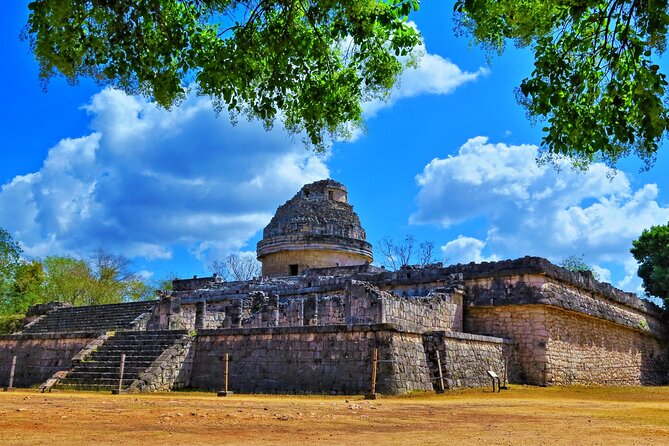
El Caracol is one of the site’s most distinctive buildings. The remains of a cylindrical observatory sit above the main structure, and its design is linked to watching the sky and tracking the movements of celestial bodies.
The tour includes El Caracol more than once in the stop list, along with the Ossuary and El Osario, which refer to the same general pyramid complex. Do not worry if the names seem repetitive. The route may present related material from different positions or angles, but you should still check the map so you do not retrace a long section unnecessarily.
The central complex and Temple of the Warriors
A longer explanation places Chichén Itzá in the context of the Yucatán Peninsula. The site was a major Maya center, and its surviving buildings show how different groups shaped the city over many centuries.
That broader stop is useful because the ruins can otherwise feel like a collection of unrelated structures. El Castillo, the Temple of the Warriors, El Caracol, and the other buildings make more sense when you see them as parts of a large ceremonial and political center.
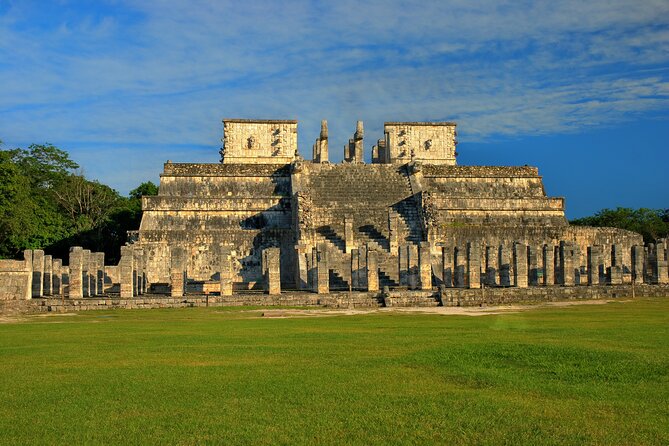
The Temple of the Warriors is one of the most striking stops after El Castillo. It has several broad tiers and a smaller temple above them, along with rows of columns carved with Toltec-style warriors.
You cannot climb the structure, but you can study the columns and upper levels from the surrounding path. The audio gives you a practical amount of information, though it is not an academic lecture. If you want exhaustive detail about Maya politics, customs, or every theory about the site’s decline, you may find the narration too brief.
The Ossuary, Red House, and Las Monjas
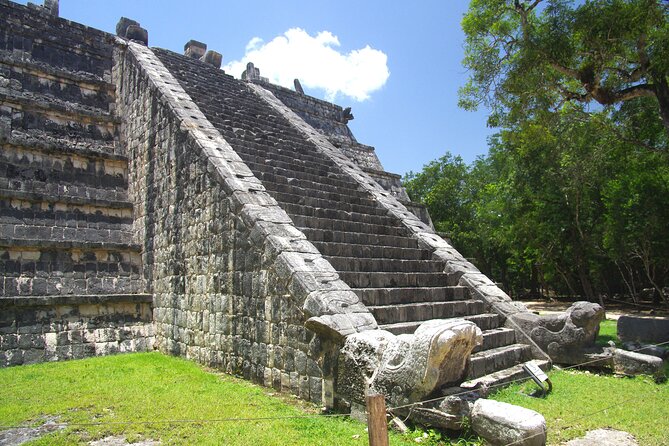
The Ossuary, also known as El Osario or the High Priest’s Grave, takes its name from human and animal remains found in the area. Archaeologists uncovered several tombs beneath the pyramid, believed to be connected with members of the Maya elite.
The stop gives the structure a more serious purpose than its shape alone suggests. Look for the way the pyramid rises from the surrounding plaza and compare its scale with El Castillo. It is smaller, but it still carries a formal and important role within the site.
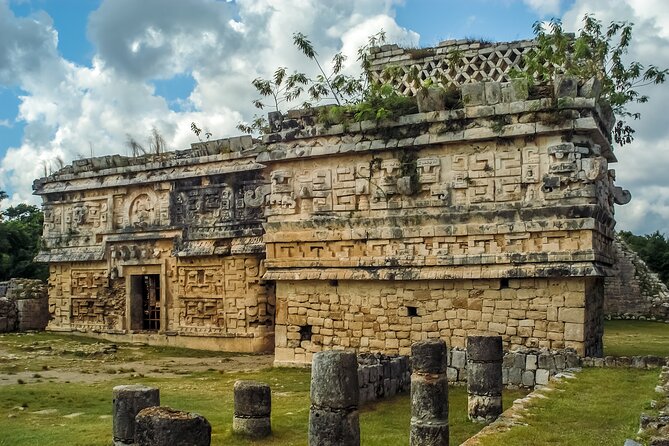
The Red House, or House of Little Holes, is a smaller building with latticework near the top. Its Maya name, Chichanchob, may refer to these small openings.
This is a quick stop, but it breaks up the larger monuments and lets you notice the decorative side of Chichén Itzá. The app’s images and text are useful here because smaller details can be hard to see from the walking path.
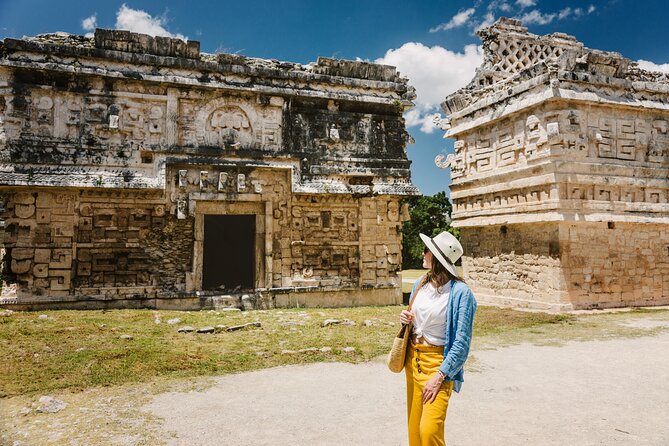
Las Monjas, or the Nunnery, is one of the most important buildings on the southern side of the site. Its walls contain many inscriptions, including references to a ruler named Kakupakal.
The name Nunnery is a later label and does not describe its original Maya function. The audio helps you focus on the inscriptions and architectural details rather than accepting the modern nickname at face value.
La Iglesia and the final stretch
La Iglesia is among the most photographed smaller buildings at Chichén Itzá. Its exterior is covered with decorative veneer, including masks of Chac, the rain deity. Look closely and you may also spot carved animals such as an armadillo, crab, snail, and tortoise among the decorations.
This is one of the places where the written descriptions and images can help. The carvings are easy to overlook if you are moving quickly, and the building is not as large as the main pyramid or ball court.
The route finishes back at the meeting area. Since the tour is private to your group and self-guided, you do not need to wait for other people or keep pace with a guide. You can also pause the activity, revisit a story, or listen again later. The supplied information describes access as lifetime with no expiry, although some older instructions refer to one year, so check the current terms shown when you book.
Price, value, and what you still need to pay
At $9.99 per person, this is one of the cheaper ways to add explanation to a visit that already has a substantial entrance cost. The price is especially useful if you are traveling as a couple or family and do not want to pay for a private guide.
The cost does not include entry to Chichén Itzá. It also does not include attraction passes, reservations, transportation, food, or any other park expenses. Treat the audio tour as an add-on to your admission ticket, not as the ticket itself.
The strongest value comes from flexibility. You can step into the shade while listening, skip a stop that does not interest you, replay a section in the car, or use the tour again on another visit if the access terms remain as advertised.
A private guide can respond to questions and adjust the explanation to your interests. This app cannot. It gives you a planned route and useful context, but you will not have someone beside you to explain a detail that catches your eye or change the order based on the crowd.
The main drawbacks to plan around
The app is only as reliable as your preparation. Download it before you arrive, enter the password, and test the audio. If you wait until the entrance, weak service or a rushed start could leave you troubleshooting instead of exploring.
Keep your phone charged. One person found that a drained battery spoiled the experience, and GPS use combined with audio can consume power. A portable charger is a smart addition.
The narration is available in English only. If someone in your group does not understand English, this will not serve as a shared guide. The amount of information is also moderate. You get clear explanations of the main buildings, but not a long treatment of Maya traditions, political history, or every debate surrounding the site.
GPS accuracy can vary. Audio may begin slightly before you reach a building, so use the map and your eyes as well as the automatic prompts. If you leave the route for photos or souvenirs, the app can help you return, but take a moment to match your position with the map.
Who should book this Chichén Itzá tour
I would choose this for independent visitors who want more than the park signs but less cost and structure than a private guide. It suits couples, families, solo visitors, and anyone who prefers walking at a personal pace.
It is also a good fit if you want to avoid standing in a tight group around a guide. You can listen from the shade, spread out across the plaza, and reunite with your group at the next stop.
I would look for another option if you need Spanish, French, or another language, if you want an expert available for questions, or if you dislike setting up apps. The product works best for people comfortable with a smartphone and willing to prepare before arrival.
Should you book it?
Book it if you want a low-cost way to understand the main ruins and you value freedom more than live conversation. For ten dollars, the GPS route, offline access, map, text, images, and more than 37 audio stories make a strong case.
Skip it if you expect a detailed scholarly guide, a live person, or a full explanation of every aspect of Maya civilization. Download the tour early, bring headphones and a charger, buy your entrance ticket separately, and allow about two hours for the full route. If you do those things, this is a practical companion for seeing Chichén Itzá on your own terms.
FAQ
Is the entrance ticket to Chichén Itzá included?
No. The $9.99 price covers the self-guided audio tour, map, and app access. You must purchase the archaeological-site entrance ticket separately.
How long does the audio tour take?
The route takes about one to two hours if you listen to most of the stories. The overall activity is described as lasting roughly two to three hours, depending on stops, photos, breaks, and side excursions.
How long is the walking route?
The route is described as more than 1.5 miles in one section and over two miles elsewhere in the tour information. Plan for a substantial amount of walking if you want to see all the listed structures.
Does the tour work without mobile data?
Yes. You must download the tour while connected to strong Wi-Fi or cellular service. After that, the audio and map work offline using your phone’s GPS.
What phone or device do I need?
An iPhone running iOS 15 or later, an Android device running version 9 or later, or an iPad or tablet with GPS and cellular connectivity is recommended.
How does the audio begin?
Open the Action’s Tour Guide app at the site and go to the first story location. The audio should begin automatically when you reach the correct area. You can also start stories manually.
Is a guide waiting at the meeting point?
No. This is a self-guided activity, and no staff member meets you at the start. You receive setup instructions and a password by email and text after booking.
Is the audio available in languages other than English?
No. The tour is offered in English only.
Can I cancel for a full refund?
Yes, if you cancel at least 24 hours before the experience start time. Cancellations made less than 24 hours before the start time are not refunded, and changes within that period are not accepted.
Latest audio tours in the world
- San Sebastian Scavenger Hunt & Highlights Self Guided Audio Tour★ 4.0 · 7 reviews
- San Marino’s Three Towers: An Audio Tour of the Ancient Republic★ 5.0 · 2 reviews
- San Marino Walking Tour with Audio and Written Guide★ 4.5 · 5 reviews
- Sampling San Sebastián’s History: A Self Guided Audio Tour★ 4.5 · 5 reviews
- Talking Buildings of Old San Juan: A Self-Guided Audio Tour★ 3.5 · 18 reviews
- San Marino: A Self Guided Audio Tour★ 4.5 · 14 reviews
- Essential Downtown SLO: A Self-Guided Audio Tour★ 4.5 · 27 reviews
- Silicon Valley Self-Guided Driving Audio Tour for Tech Lovers★ 4.0 · 24 reviews
Self-Guided Audio Tours, compared.

Acropolis Ticket & Optional Self-Guided Audio Tours
Read our review →


Ultimate Acadia National Park Self-Guided Driving Audio Tour
Read our review →

Akrotiri Ticket with Optional Self-Guided Audios
Read our review →
Browse the lists this tour appears in