Reviewed · SELF-GUIDED
Phuket Self-Guided Audio Tour
Phuket’s best feature is its variety, and this self-guided audio tour connects the island’s old town, Buddhist temples, markets, gardens, and nightlife in one flexible plan. You can start and finish anywhere, skip places that do not interest you, or spread the route across several days.
I like the low $9 price and the freedom to avoid a fixed group schedule. I also like having both an audio playlist and an interactive map, since you can preview the stops before setting out and then use your phone as a simple guide on location.
The main catch is that this is not a transport tour. Phuket’s attractions are spread across the island, and the listed two-hour duration does not account for getting between stops. Access to the links may also require patience, so download or test everything before leaving your hotel.
Key points to know before you go
- Ten very different stops: Old Town, temples, gardens, markets, Big Buddha, and Patong nightlife are all included.
- You control the route: Start anywhere in Phuket and finish wherever suits your plans.
- Two digital tools: A SoundCloud audio playlist and a Google My Maps route help you find and play each stop.
- Good value at $9: The price is modest, especially if you want background information without hiring a private guide.
- Allow extra time: The attractions are spread out, and the ten-minute itinerary entries do not include transport.
- Check access early: The links are sent before your selected travel time and remain valid for up to six days.
How this Phuket audio tour works
This is a private activity for your own group, but it is not a private vehicle tour and no guide meets you in person. Before your selected travel time, you receive two links by email.
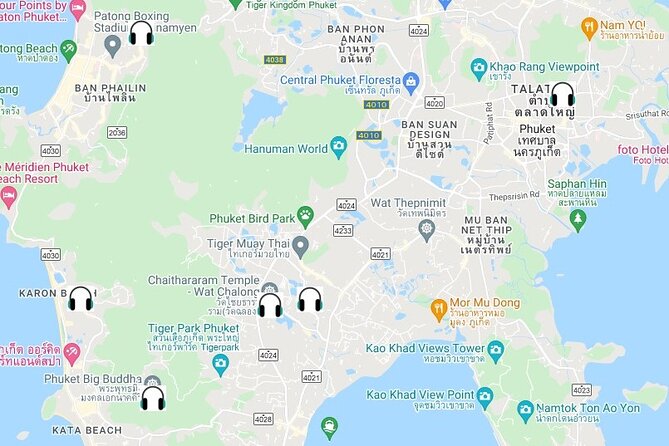
The first link opens the audio content through SoundCloud. You can listen to individual attractions or play through the entire collection before you go. The second link opens a Google My Maps route showing all ten points, with each map pin connected to its matching audio guide.
That setup is useful if you like to plan. You can decide in advance which stops deserve your time, then use the map while out in Phuket. The audio is available in several languages, although the supplied details do not name every language.
You can use the tour online or offline. For a smoother day, I would open the links while you have a reliable connection and save the route before leaving. The access links remain valid for up to six days, so you can split the experience instead of trying to reach every point in one outing.
One detail needs careful interpretation. The published duration is about two hours, while each stop is shown as a ten-minute visit. A provider response also describes the individual audio guides as roughly 20 minutes long. That means listening to all ten recordings could take much longer than two hours, before you add transport, meals, market browsing, and time inside the sights. Think of two hours as a light sampling plan, not a realistic full-island day.
More Self-Guided Audio Tours in the world
- Athens: Acropolis Ticket & Optional Self-Guided Audio Tours
★ 4.1 · 2,542 reviews - Gettysburg Battlefield Self-Guided Driving Audio Tour
★ 4.5 · 910 reviews - Joshua Tree National Park Self-Guided Driving Audio Tour
★ 4.5 · 762 reviews
Old Phuket Town and the story behind the streets
Old Phuket Town is the strongest place to begin if you want context before seeing the island’s temples and resorts. The audio focuses on the district’s Sino-Portuguese architecture and explains how tin mining helped shape Phuket’s past.
This stop gives you a useful way to read the streets. The buildings reflect Chinese and European influences, while the town’s development connects to Phuket’s mining economy and wider cultural exchange. You are not simply walking past colorful façades. You are listening for clues about why the town looks different from the beach areas.
Admission is free, and the stop is listed at ten minutes. In practice, you may want more time if you plan to look closely at the architecture. The audio can provide the background, but it cannot replace time spent wandering the streets, stopping for food, or checking the map as you go.
Old Town is also a practical starting point because it gives you a clear sense of Phuket’s local identity before the route shifts toward religious sites, markets, and entertainment districts.
Phuket Botanic Garden and Thai plant culture
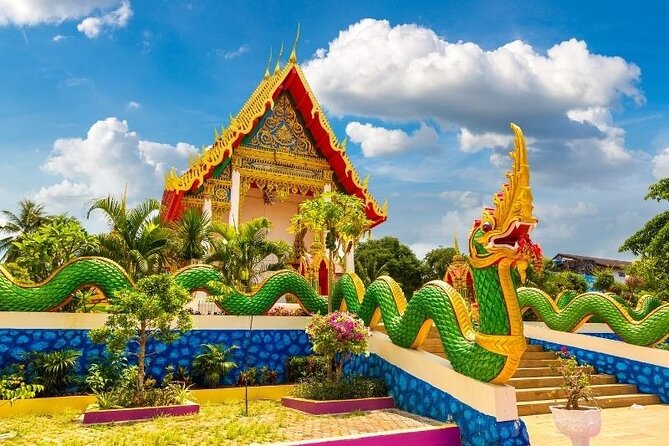
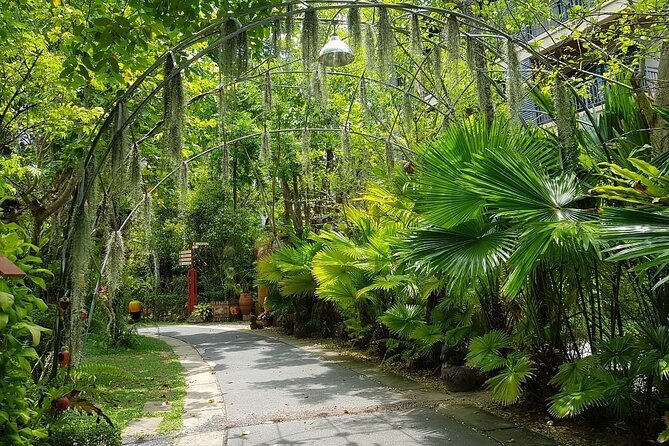
The Phuket Botanic Garden offers a change of pace from streets and temples. Here, the audio introduces Thailand’s plant life, the role of plants in Thai culture, and efforts to protect native species.
The garden is the first stop with an entry fee not included in the tour price. That matters when you compare the $9 cost with the real cost of the day. The audio itself is inexpensive, but you may need to pay separately at this attraction.
The listed visit is ten minutes, which is brief for a garden. You can treat the recording as an introduction, then decide how long you want to remain. If plants and conservation interest you, this is one stop where the fixed itinerary time may undersell the place.
I like this inclusion because it prevents the tour from becoming only a procession of temples and markets. It adds a little natural and cultural context, though you will need to plan transport carefully since the route does not include pick-up or drop-off.
Wat Chalong, Phuket’s major Buddhist temple
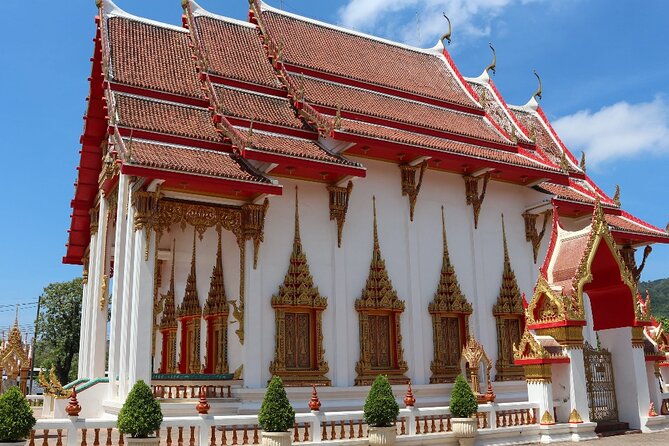
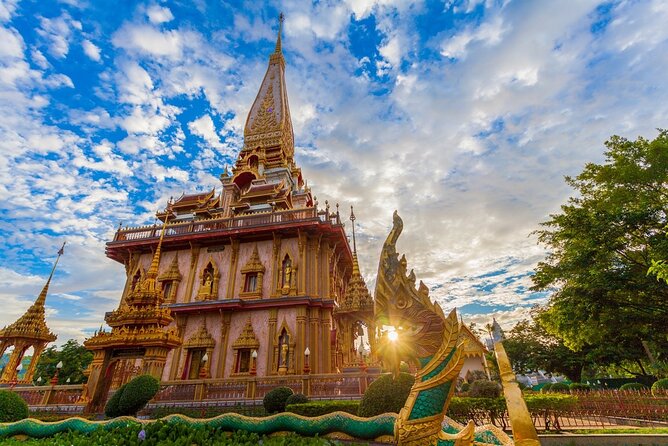
Chaithararam Temple, commonly called Wat Chalong, is described as Phuket’s largest and most important Buddhist temple. The audio covers its history, architectural details, and respected monks connected with the site.
The tour lists admission as free. You should still approach the temple as an active religious place, not just a sightseeing stop. Dress and behavior should be respectful, and the audio is best used quietly through headphones.
This is one of the route’s most valuable stops for understanding local spiritual life. Big Buddha is the famous image, but Wat Chalong offers a more grounded look at temple architecture and religious tradition. The ten-minute schedule gives you a starting point, though you may want to stay longer to take in the buildings and grounds.
The site can also anchor a southern Phuket route. Pairing it with Big Buddha makes more sense than treating either attraction as a quick isolated visit, since both relate to Buddhism but offer different settings and stories.
More Audio Tours in the world
- Barcelona: Sagrada Familia Entry Ticket with Audio Guide
★ 4.6 · 105,312 reviews - Rome: Pantheon Fast-Track Ticket and Official Audioguide
★ 4.5 · 27,353 reviews - Barcelona: Casa Batlló Entry with Self-Audioguide Tour
★ 4.7 · 25,359 reviews - Rome: Colosseum & Forum with Audio Guide App -Optional Arena
★ 4.2 · 24,770 reviews
Big Buddha and the island’s best-known statue
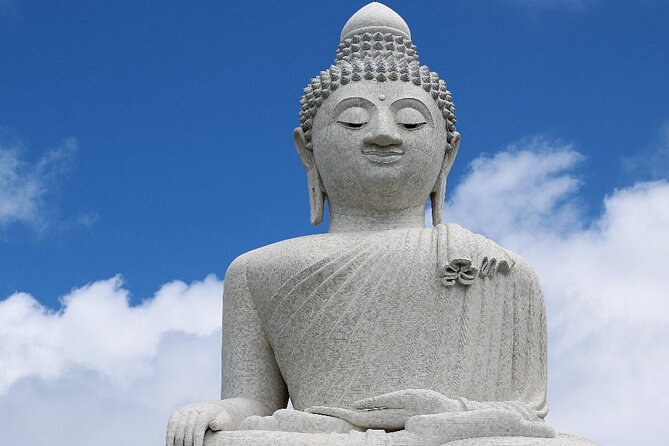
Big Buddha Phuket is represented by a 45-meter-high white marble statue. The audio explains the statue’s construction and its meaning in Thai Buddhism.
Admission is listed as free. The stop is one of the tour’s clearest photo and orientation points, but the recording gives it more purpose than a quick viewpoint visit. You learn why the statue was created and how it fits into Phuket’s religious life.
Ten minutes may be enough for the audio and a short look, but not necessarily for a relaxed visit. The attraction is a major landmark, so you may want to build in time for viewing, walking, and waiting if conditions are busy. The tour does not supply transportation, and this is not a stop you can casually reach from every other point on foot.
I would place Wat Chalong and Big Buddha in the same outing if your schedule allows. The pair gives you a stronger understanding of Phuket’s Buddhist sites than either recording alone.
Karon Temple Market and everyday local flavor
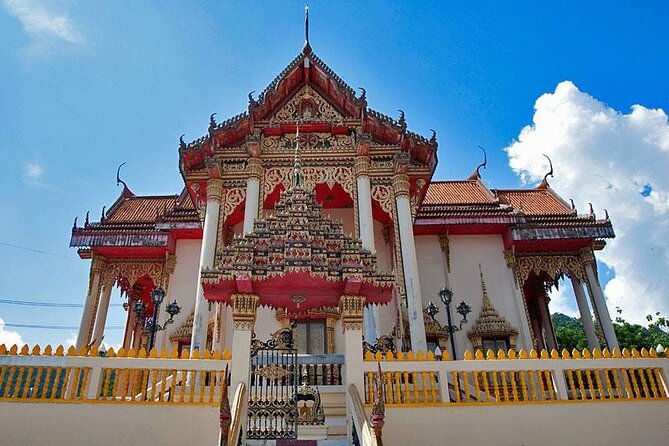
Karon Temple Market takes place on temple grounds and introduces Thai street food and traditional crafts. It is a good reminder that markets in Thailand are not only shopping areas. They can also be social spaces linked to local religious sites.
The stop is free, but market schedules can matter. The information supplied does not specify opening days or hours, so you should confirm that the market is operating before building your route around it.
The audio can explain what to look for, but this is a place where your senses do much of the work. You can browse food stalls, examine handmade goods, and see how a temple setting changes the feel of a market. The ten-minute entry is best viewed as the minimum listening time rather than a complete visit.
If you want the most local-feeling parts of the route, this stop deserves more attention than the brief schedule suggests.
Patong Temple and the quieter side of Patong
Suwan Khiri Wong Temple, also known as Patong Temple, sits in the middle of Phuket’s best-known resort and nightlife area. The recording covers the temple’s role in local spiritual life and its distinctive architecture.
That contrast is the point. Patong is associated with hotels, bars, and entertainment, but the temple offers a calmer place to consider the area’s local character. Admission is free, and the stop is easy to combine with Bangla Road because the two locations represent very different sides of the same part of Phuket.
You should not expect the audio to turn Patong into a quiet village. Instead, it helps you notice that religious life continues alongside tourism. Spend a few minutes at the temple, then use the map to decide how much time you want to devote to the surrounding streets.
Bangla Road and Phuket’s changing nightlife
Bangla Road is the route’s sharpest change of tone. The audio explains how this street developed from a quieter road into Phuket’s main entertainment strip and considers its effect on local tourism.
Admission is free, naturally, but the experience depends heavily on timing. The supplied details do not give a specific time of day for this stop, so you control when to visit. If you go earlier, you may find a different atmosphere from the evening scene the recording discusses.
This is a useful stop for understanding tourism rather than simply looking at nightlife. It shows how one street can become a symbol of Phuket’s modern economy. The audio adds context that you would miss if you only walked through taking photographs.
Keep your expectations practical. This is an urban entertainment area, not a cultural monument, and some visitors will find it noisy or uninteresting. If nightlife is not your priority, the map lets you skip it without losing the temple and historic stops.
Naka Market, a large weekend shopping stop
Naka Market is described as an expansive weekend market selling a wide range of goods. The audio explains the market’s role in local commerce and social life.
Because it operates as a weekend market, timing is especially important. The supplied information does not provide exact opening hours, so check before you travel across the island for this stop. Admission is free, but you will want to budget for food or purchases if you plan to browse properly.
This is another place where ten minutes is barely enough. The recording may orient you, but the main appeal is walking through the stalls and seeing the variety for yourself. I would avoid placing Naka Market and Chillva Market too close together unless markets are a major interest, since both need browsing time and transport.
Chillva Market and younger Phuket culture
Chillva Market uses shipping containers as shops and combines the familiar Thai market format with a more modern youth-oriented style. The audio explains that connection, making this a useful companion to Naka Market.
Admission is free. As with Naka Market, timing matters, and the information provided does not specify opening hours. You should verify that it is operating before treating it as a fixed part of your day.
The container-shop design gives the stop a clear identity. You are not only seeing what is sold, but also how market culture changes to suit newer tastes and settings. The recording helps connect the physical design to wider changes in Phuket’s social and commercial life.
Wat Phra Thong and the half-buried Buddha
Wat Phra Thong is known for a golden Buddha image that is partly buried in the ground. The audio introduces the legends surrounding the statue and explains its cultural importance.
An entry fee may apply, and it is not included in the $9 tour price. The temple is a good choice if you enjoy stories tied to religious places, though the audio presents the legend rather than proving it as historical fact.
This stop is farther from the central cluster of several other attractions, so it may work better as part of a northern Phuket route. Do not assume the ten-minute itinerary label includes the time needed to reach it. The map can help you plan, but the tour does not provide a vehicle.
What $9 really buys you
At $9 per person, the tour is priced as an affordable information service, not a full guided excursion. You are paying for access to the audio playlist and map covering ten attractions. You are not paying for transport, entry tickets, meals, or a person to lead you.
That is good value if you already have a scooter, taxi plan, rental car, or public transport route and mainly want background information. It is less useful if you expect someone to organize the day from your hotel.
The flexibility adds value. You can listen to one stop, take a break, and continue later. You can also ignore attractions that do not fit your interests. The links remain valid for up to six days, giving you room to divide the route.
One concern is technical access. A customer reported a long delay before reaching the playlist and difficulty getting support. I would not wait until you are standing outside the first temple. Open both links when they arrive, test the audio, and save the map for offline use where possible.
Who should book this experience
I would recommend it most strongly to independent visitors who like to set their own pace and already have a plan for getting around Phuket. It suits solo visitors, couples, and private groups who do not want to follow a guide’s timetable.
It also works for people who want a broad introduction. The route covers architecture, religion, plants, markets, commerce, and nightlife rather than repeating one type of attraction.
You may want to skip it if you need transport, a live guide, or a tightly organized two-hour excursion. The spread between the stops means the tour demands planning. Families and older visitors can participate, but the practical ease will depend on their transport arrangements and willingness to use a phone throughout the day.
Should you book the Phuket audio tour?
Book it if you want a cheap, flexible layer of information and already know how you will move around Phuket. The best value comes from choosing a few stops that match your interests, testing the links early, and allowing more than two hours.
I would not book it expecting a complete guided day. The $9 price is attractive, but the experience depends on your route planning, phone access, transport, and willingness to explore without a person beside you.
The strongest plan is to use the audio as a framework, not a rigid itinerary. Choose Old Phuket Town, Wat Chalong, Big Buddha, and one market for a focused day, then add Patong or Wat Phra Thong if time and location make sense.
FAQ
Where does the tour start and finish?
You choose both the starting point and the ending point because this is a self-guided activity. Both are listed as Phuket, Thailand.
How long does the tour take?
The stated duration is approximately two hours. The ten stops are each listed at ten minutes, but transport between attractions is not included, and the individual audio recordings may be longer.
How do I access the audio guide?
You receive a private SoundCloud link by email on your selected travel date, before your starting time. You can use it to play individual recordings or the full audio collection.
Is a map included?
Yes. You receive a private Google My Maps link showing the ten attractions. Each map point connects to its matching audio guide.
Can I use the tour offline?
Yes. The tour is available online and offline. It is sensible to open the links and prepare the map before leaving a reliable internet connection.
Are entry fees included?
No. Entry fees are not included where they apply. Phuket Botanic Garden and Wat Phra Thong are specifically listed as having admission not included, while the other listed stops show free admission.
Is transportation provided?
No. Pick-up, drop-off, and transport between attractions are not included. You arrange your own way around Phuket.
How long are the access links valid?
The private access links are valid for up to six days. You can use that period to plan the route or split the tour across more than one day.
Latest audio tours in the world
- Seville Maestranza Bullring Tour with Audio Guide★ 3.5 · 6 reviews
- Seville Scavenger Hunt and Highlights Self Guided Audio Tour★ 5.0 · 5 reviews
- Seville Audio guided walking tour 3h20 and 28 audio commentaries★ 5.0 · 2 reviews
- Royal Alcazar of Seville Entry Ticket with Audio Guide★ 4.0 · 42 reviews
- Seville Cathedral and La Giralda Entry Ticket with Audio Guide★ 3.0 · 9 reviews
- Seville Cathedral and Giralda Entry Tickets with Audio Guide★ 4.0 · 56 reviews
- Essential Seville’s Ancient History: An Audio Tour★ 5.0 · 9 reviews
- Sequoia National Park Self-Guided Audio Tour★ 4.5 · 9 reviews
Self-Guided Audio Tours, compared.

Acropolis Ticket & Optional Self-Guided Audio Tours
Read our review →


Ultimate Acadia National Park Self-Guided Driving Audio Tour
Read our review →

Akrotiri Ticket with Optional Self-Guided Audios
Read our review →