
Reviewed · SEVILLE
Seville Audio guided walking tour 3h20 and 28 audio commentaries
Seville’s great strength is how much history sits within an easy walk. This audio tour takes you from Plaza de España and Maria Luisa Park through the old center, across the river to Triana, and past the cathedral, Alcazar, bullring, and Las Setas. You get a city overview without being tied to a guide’s timetable.
I like the flexible format, with no expiration and no need to collect a ticket or booklet. I also like the route’s range: grand monuments share space with Sierpes Street, Santa Cruz lanes, a convent, palace houses, and the riverfront. The drawback is simple: you must supply your own headphones and attention, and the commentary may announce a monument before you have had time to take it in.
Key points at a glance
- 28 audio stops cover Seville’s major sights and lesser-known corners in about 3 hours 20 minutes.
- Las Setas, Triana, and Santa Cruz give the walk plenty of local character beyond the major monuments.
- Three language options are available: English, French, and Spanish. The tour is offered in English when booked in that language.
- Offline access and transcripts make the route practical when you want to save mobile data or read instead of listen.
- The $7.14 group price covers up to 15 people, making it inexpensive for families or friends.
- Admission tickets are not included, so visits inside the Alcazar, cathedral, bullring, or other paid sites cost extra.
A self-guided route with a useful citywide view
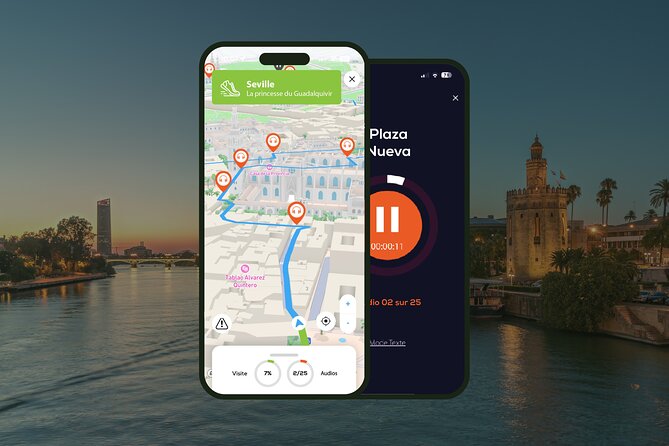
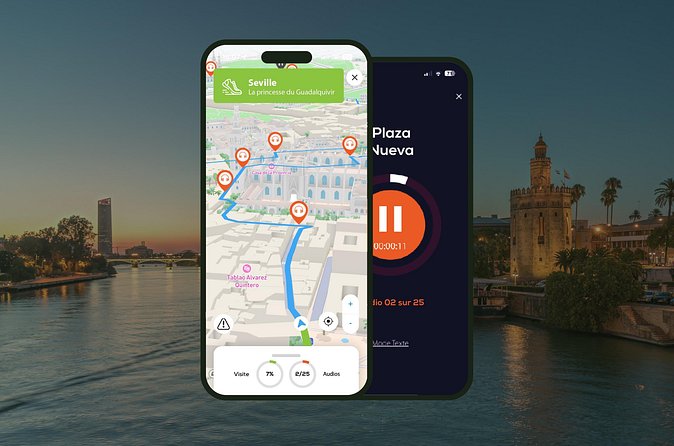
This is not a tour with a guide walking beside you. It is a phone-based route with 28 audio commentaries, interactive navigation, a 3D map, written transcripts, and suggestions for good photo locations. You can pause, replay, or stop for coffee, lunch, photographs, or a proper look inside a monument.
That freedom matters in Seville. The city rewards slow wandering, but its sights are spread across several districts. A fixed walking route helps you connect the dots without spending half your morning deciding which street to take next.
The full circuit lasts about 3 hours 20 minutes, though your actual day can be longer if you enter paid sites or linger at the plazas. You receive immediate access, and there is no expiration date. That means you can split the route over two outings if the afternoon heat, a museum visit, or your own energy calls for a break.
The price is especially strong for a group. At $7.14 per group for up to 15 people, it costs less than a typical individual admission and far less than a private, live walking tour. The tradeoff is that you do not get personal answers, spontaneous changes, or a local guide pointing out something unexpected in the moment.
More Audio Walking Tours in Spain
- Tarragona Walking Tour: An Audio Guide to Tarraco
★ 4.5 · 23 reviews - Ronda Old Town Walking Tour with Audioguide on Your Smartphone
★ 4.0 · 20 reviews - Audioguide City Walk Malaga for cruises (German & English)
★ 4.0 · 17 reviews
Plaza de España and Maria Luisa Park begin the walk
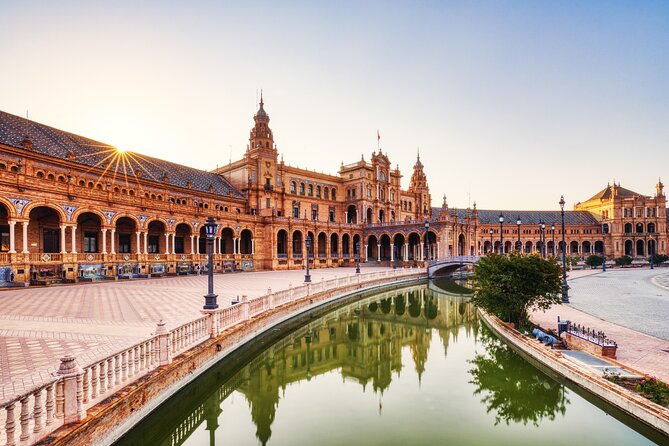
The route starts at Plaza de España, one of Seville’s most recognizable public spaces. Its curved architecture, tiled details, water, and broad setting make it a natural starting point, and the audio commentary gives you a reason to look beyond the first photograph.
From there, you pass through Maria Luisa Park toward the Spanish Steps. The park once belonged to the Palace of San Telmo before Princess Marie-Louise gave it to the city. That detail helps explain why the gardens feel more formal and carefully planned than an ordinary urban park.
The Spanish Steps were created for the 1929 Ibero-American Exposition. Their scale can seem almost theatrical, and the commentary encourages you to ask why Seville built such a grand setting in the first place. You get a good early lesson in the city’s habit of mixing ceremony, architecture, and public space.
The route also reaches the Prado Garden of San Sebastian, named for an old hermitage on the site. This part of the walk is quieter in feel than the main monuments and gives the tour a little breathing room before it moves into the denser old city.
From the Royal Tobacco Factory to the Guadalquivir
The next section brings you toward the Royal Tobacco Factory, a large building tied to Spain’s colonial trade and the arrival of tobacco from the Americas. The commentary places the building within that wider story rather than treating it as just another grand facade.
Nearby, you pass the Lope de Vega Theatre, built for the 1929 fair and first known as the exhibition theatre. These stops are useful because they show how much of Seville’s identity was shaped by major international events, not only by medieval and Renaissance monuments.
The route then reaches the Guadalquivir, the river that helped make Seville wealthy and influential. Its navigable waterway connected the city with Atlantic trade and the movement of goods. You do not need to be a history specialist to appreciate the practical point: Seville’s fortunes were tied to this river.
Crossing toward Triana gives the walk a welcome change of mood. You follow Betis Street, named for the Roman name of the Guadalquivir, with river views back toward the historic center. The riverfront is one of the better places to pause, and the photo recommendations are useful here.
Triana, Santa Ana, and a different side of Seville
Triana is often described as Seville’s bohemian and flamenco district, and this route gives it more than a quick glance from the bridge. You reach Santa Ana Church, known locally as the Cathedral of Triana, in a small neighborhood square.
The church adds a strong local focus to the walk. Instead of only moving from one famous monument to the next, you get a sense of how a distinct district has its own center and identity.
The San Telmo Bridge brings you back across the river, with a clear view of the Torre de Oro. This defensive tower is one of Seville’s familiar symbols, and its position beside the river makes practical sense once you understand the city’s historic relationship with water and trade.
You then reach the Palace of San Telmo, a large rectangular building with four towers and a central patio. It is not the most delicate structure in Seville, but it has presence and helps fill out the story of the city’s political and religious power.
Another self-paced route in Spain:
- Barcelona: Sagrada Familia Entry Ticket with Audio Guide
★ 4.6 · 105,312 reviews - Barcelona: Casa Batlló Entry with Self-Audioguide Tour
★ 4.7 · 25,359 reviews - Granada: Alhambra Entry Ticket with Audio Guide
★ 4.1 · 5,950 reviews - Casa Batllo Admission Ticket with Intelligent Audio Guide
★ 4.5 · 3,168 reviews
Sierpes Street, palace houses, and Las Setas
The route returns to the central streets, including Sierpes Street, one of Seville’s main pedestrian shopping lanes. It is narrow, busy, and lively, with the kind of everyday city activity that a monument-only itinerary can miss.
You also pass the Palace of the Marquis de la Motilla. Seville has many grand palace houses tucked into ordinary-looking streets, and this stop makes a useful point: some of the city’s most interesting architecture is not surrounded by a large plaza or a line of visitors.
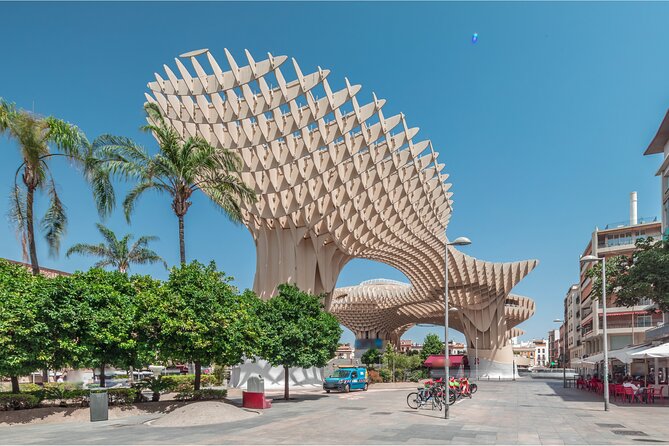
Las Setas, officially the Metropol Parasol, provides a sharp contrast. The huge wooden mushroom-like structure rises above the old center and is one of Seville’s most modern landmarks. Even if you have seen photographs, the scale makes more sense when you are standing at its base.
This is one of the route’s strongest contrasts: ancient streets, baroque churches, and a contemporary structure all appear within the same walk. You may choose to visit the attraction itself, but the audio route only includes the exterior unless you pay separately for entry.
Santa Cruz, Murillo Gardens, and the convent of Little Thérèse
The Santa Cruz district is one of the most picturesque parts of Seville, with narrow cobbled lanes and white and yellow houses. It is easy to get turned around here, so the interactive map has real practical value.
The route passes through the Murillo Gardens, which once belonged to the Alcazar until 1862. Their plants and shaded paths offer a pleasant transition between the tightly packed old quarter and the larger monument zone.
You also stop at the Church of the Convent of San José del Carmen, commonly associated with Little Thérèse. Founded in 1586 by Santa Teresa for the Discalced Carmelites, it remains a cloistered Catholic convent. The audio commentary gives context to a building you could otherwise pass without knowing its story.
Another stop brings in Seville’s connection with French culture through Beaumarchais and the romantic image of Andalusia. This is a brief but interesting reminder that Seville has long been shaped not only by its own residents, but also by the stories outsiders created about the city.
The Alcazar, city walls, and the cathedral quarter
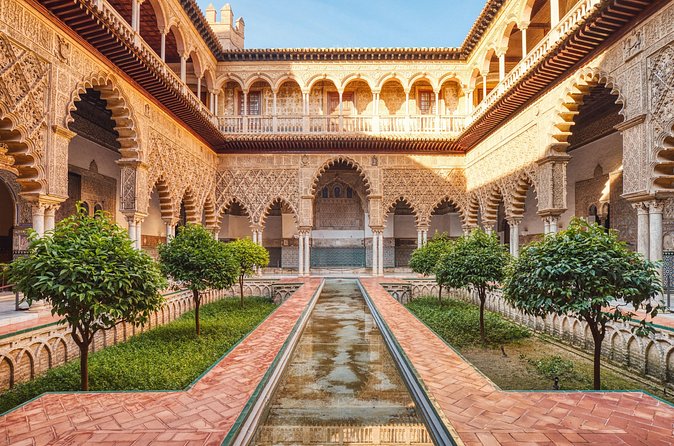
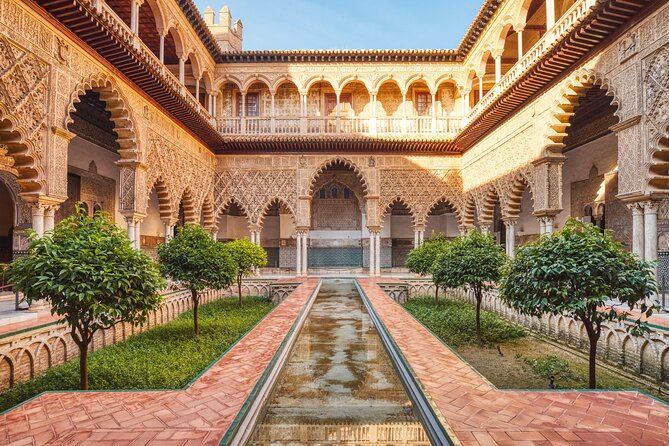
The tour then reaches the Lions Gate of the Alcazar. A long queue may form at this entrance, especially at busy times, so plan your expectations carefully. The walking guide does not include admission, and the audio commentary cannot replace the experience of entering the palace complex.
Even if you do not go inside, the exterior stop is valuable. The Alcazar is not just a palace in isolation. Nearby walls, gates, gardens, and former defensive structures show how Seville grew around fortified centers.
You pass a surviving corner tower from the Almohad fortress built around the old city center in the mid-12th century. It is easy to overlook, which is exactly why a narrated route helps. The commentary directs your eyes to a piece of the city that lacks the visual drama of the cathedral but carries important evidence of Seville’s Islamic period.
The General Archives of the Indies follows. The name refers to Columbus’s Indies, meaning the Americas, and the building houses the documentary record of Spain’s overseas empire. Even from outside, the location places Seville’s global ambitions beside its medieval core.
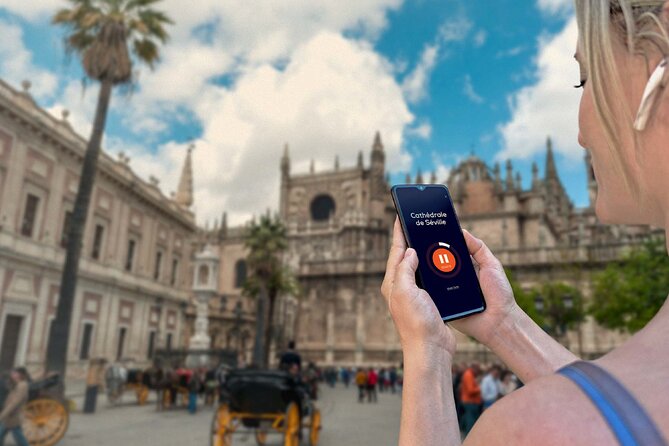
Then comes the Cathedral of Seville, one of the major sights of the entire walk. The route explains that a smaller Visigothic church occupied the site before the Umayyad conquest and that later Islamic and Christian buildings shaped what you see today.
The Giralda, Patio of the Oranges, and San Francisco Square
The Giralda, once the minaret of the mosque on the cathedral site, receives its own commentary. Its history is one of the clearest examples of Seville’s layered past, where Islamic and Christian architecture occupy the same landmark.
You can also look into the Patio of the Oranges through the Puerta del Perdón. This gives you a glimpse of the former mosque complex without requiring a separate visit. If you plan to enter the cathedral, allow extra time beyond the stated walking duration.
The route continues to San Francisco Square, once the heart of Seville’s civic life. Major celebrations took place here, and the city’s principal civil authorities had their offices nearby. The stop helps you understand how public space worked before modern streets and civic centers reshaped urban life.
The final major stop is the Church of the Divine Saviour, the largest church in Seville after the cathedral. Its baroque exterior and interior make it a useful companion to the cathedral, especially if you want to compare two different expressions of Seville’s religious architecture.
What the app adds, and where it falls short
The strongest practical feature is the combination of audio and text. If a street is noisy, your headphones are uncomfortable, or you simply prefer reading, you can use the transcripts. Offline mode means you can follow the route without using mobile data during the visit.
The 3D map is also more helpful than a simple list of addresses. You can see how the stops fit together and choose a shorter section if you do not want to complete the full circuit.
Still, this format asks more of you than a live guide does. You need a charged phone, and headphones are not supplied. You also need to look at your surroundings while checking navigation, so stop safely before reading the screen.
The audio can also move on before you are ready. One useful improvement would be to give clearer notice of the upcoming monument at the start of each site commentary. If you know what you are about to see, you can look up sooner and spend more time examining the building itself.
Who should book this Seville walk?
I would choose this tour if you want a low-cost orientation to Seville, prefer setting your own pace, or are traveling with a group of family or friends. It works particularly well on a first visit because it connects the major sights with neighborhoods you might not otherwise reach.
It is also a good choice if you like stopping for photographs, snacks, or a longer look at a square. The no-expiration format lets you split the route, and the three language options make it useful for mixed-language groups.
I would think twice if you want a live guide, detailed interior commentary, or help with entrance lines. Paid admissions are separate, and the walk cannot answer personal questions about the city as you go.
Cancellation is free up to 24 hours before the local start time. Changes or cancellations made within 24 hours are not refunded.
Should you book it?
Book it if you want a cheap, flexible framework for seeing Seville’s essential sights without joining a group at a fixed hour. The route is especially good at linking Plaza de España, Triana, Santa Cruz, Las Setas, the river, and the cathedral quarter into one understandable outing.
Skip it if you already know Seville well or want a human guide who can adapt the tour to your interests. At $7.14 for up to 15 people, though, the value is hard to argue with. Use it as your first walk, add admission tickets only where they matter most to you, and leave room for your own wandering.
FAQ
How long does the Seville audio tour take?
The walking route takes approximately 3 hours and 20 minutes. Extra time is needed if you enter paid attractions, stop for meals, or spend longer at the plazas and monuments.
Where does the tour start and finish?
It starts at Plaza de España on Avenida Isabel la Católica in Seville and ends back at the meeting point.
How many audio commentaries are included?
The experience includes 28 audio commentaries covering Seville’s monuments, neighborhoods, streets, and history.
Which languages are available?
The audio guide is available in English, French, and Spanish. The experience is offered in English when booked in English.
Are entrance tickets included?
No. Entry fees for paid sites along the route are separate and optional.
Can I use the tour without mobile data?
Yes. The experience includes an offline mode, so you can follow the route without using data during the visit. Text transcripts and an interactive 3D map are also included.
Latest audio tours in Spain
- Seville Scavenger Hunt and Highlights Self Guided Audio Tour★ 5.0 · 5 reviews
- Seville Maestranza Bullring Tour with Audio Guide★ 3.5 · 6 reviews
- Royal Alcazar of Seville Entry Ticket with Audio Guide★ 4.0 · 42 reviews
- Seville Cathedral and La Giralda Entry Ticket with Audio Guide★ 3.0 · 9 reviews
- Seville Cathedral and Giralda Entry Tickets with Audio Guide★ 4.0 · 56 reviews
- Essential Seville’s Ancient History: An Audio Tour★ 5.0 · 9 reviews
- Segovia from the Aqueduct to the Alcazar: A Self-Guided Audio Tour★ 4.5 · 10 reviews
- Secrets of Santiago de Compostela: Private Self-Guided Audio Tour★ 3.5 · 3 reviews
Audio Walking Tours, compared.

City Monuments Guided Walking Tour with Audio Guide
Read our review →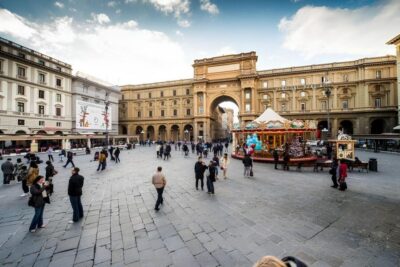
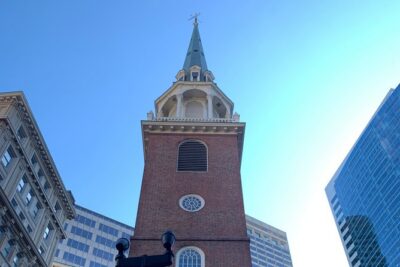
Self Guided Classic Freedom Trail Location Aware (GPS) Walking Audio Tour
Read our review →
Self-Guided Historical Walking Tour (Audio Guide)
Read our review →
Cape Cod & Provincetown Self-Guided Driving & Walking Audio Tour
Read our review →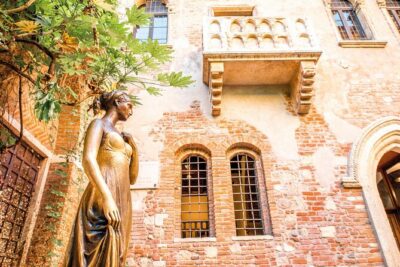
Verona Walking Tour with Audio and Written Guide by a Local
Read our review →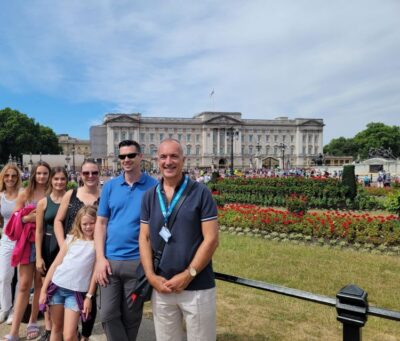
Royal Walking Tour and Buckingham Palace Audio Tour
Read our review →
Bologna Walking Tour with Audio and Written Guide
Read our review →Browse the lists this tour appears in