

Reviewed · PARIS
Musée d’Orsay Skip The Queue Ticket with Audio Guide Tour
The best part of this Musée d’Orsay visit is the freedom to explore one of Paris’s great museums without being tied to a live guide’s route. Your timed admission gets you past the ticket-purchase queue, then a phone-based audio guide points you toward major works by Monet, Renoir, Manet, Degas, Van Gogh, and Cézanne.
I like the choice of times throughout the day, and I like that you can stay inside until closing once admitted. The main caution is price: at $87.67 per person, this is a costly way to visit a museum if you only want a ticket. It also does not remove the required security check.
I also recommend reading the ticket instructions carefully before leaving for the museum. Public feedback tied to this experience includes complaints about missing tickets and long waits, although the operator responded that those bookings were made with another provider. That makes the exact delivery of your admission details especially important.
Key points to know before booking
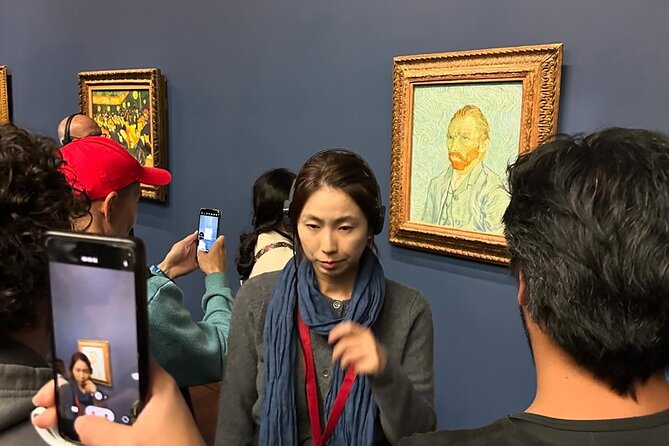
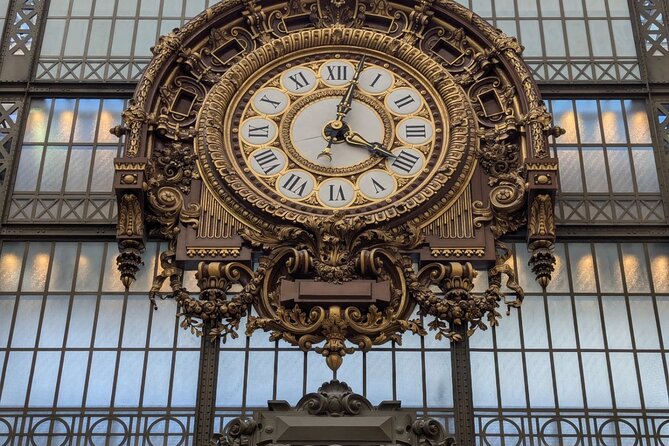
- The former railway station is part of the experience: The grand central hall, giant clock, and Beaux-Arts structure are nearly as memorable as the paintings.
- You skip the ticket-buying queue, not security: Every visitor must still pass the museum’s mandatory security check.
- The audio guide is digital and self-guided: You use it on your phone, with no live guide accompanying your group.
- The Impressionist galleries are the main draw: Renoir, Manet, Monet, and Degas are central to the visit, with Van Gogh, Cézanne, and Toulouse-Lautrec nearby.
- You are not limited to one hour inside: The suggested route takes about an hour, but you may stay until closing after entry.
- The ticket is fixed once issued: It is date and time specific, non-refundable, and cannot be changed.
Entering the Musée d’Orsay by the Seine
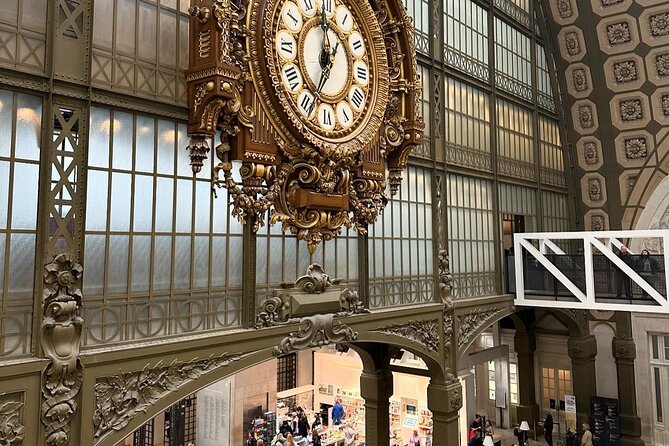
The Musée d’Orsay is at Esplanade Valéry Giscard d’Estaing, 75007 Paris, on the Left Bank along the Seine. It is easy to recognize because the museum occupies the old Gare d’Orsay, a grand Beaux-Arts railway station. Even before you reach the paintings, the building gives you a strong sense of place.
Your experience begins at the museum meeting point. A reserved admission time is meant to save you from buying a ticket at the museum, which matters most during busy periods. The important distinction is simple: skip-the-ticket-line does not mean skip-every-line. You still need to pass the mandatory security check before entering.
That distinction is worth keeping in mind when planning your day. Do not arrive assuming you can walk straight through the doors. Allow time for security, and keep your admission details easy to access on your phone or in the form provided with your booking.
The activity is described as private, meaning only your group participates. In practical terms, though, this is not a private guided tour. You enter with your own group and use a digital audio guide rather than walking beside a museum expert.
More Audio Tours in Paris
- Paris: Illuminations River Cruise with Audio Commentary
★ 4.3 · 12,340 reviews - Paris: Louvre Museum Hosted Entry and Mona Lisa Audioguide
★ 4.6 · 5,235 reviews - Paris: Orsay Museum Entry Ticket and Digital Audio Guide App
★ 4.4 · 3,170 reviews
The grand central hall and giant clock
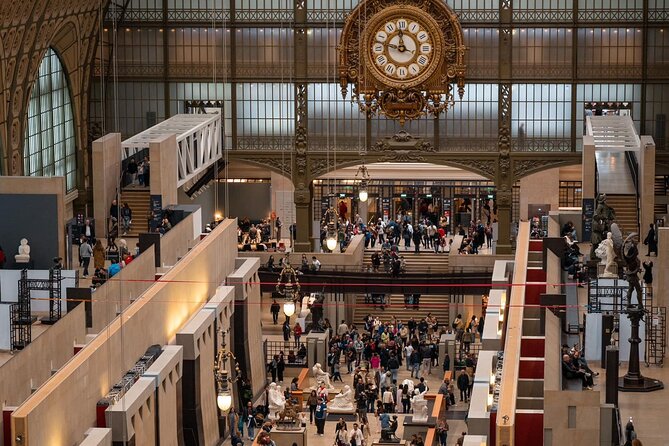
Once inside, begin in the museum’s vast central hall. This is one of the most recognizable interior views in Paris, with the old station architecture stretching above you and the giant clock providing a dramatic focal point.
I like starting here because it helps you understand the building before you begin looking at individual paintings. The Musée d’Orsay was not designed as a quiet modern gallery. Its former railway-station structure gives the visit a spacious, almost theatrical opening.
The central hall also works well as a meeting point if your group separates. The museum is large, and it is easy to lose track of where you are while moving between floors and galleries. A quick look at the layout, followed by the suggested route on your audio guide, can save you from wandering without a plan.
You should expect some walking. Comfortable shoes are a sensible choice, especially if you intend to stay beyond the suggested one-hour route. The supplied tour length is about one to two hours, while the entry itself allows you to remain inside until closing.
Impressionist galleries with Monet, Renoir, Manet, and Degas
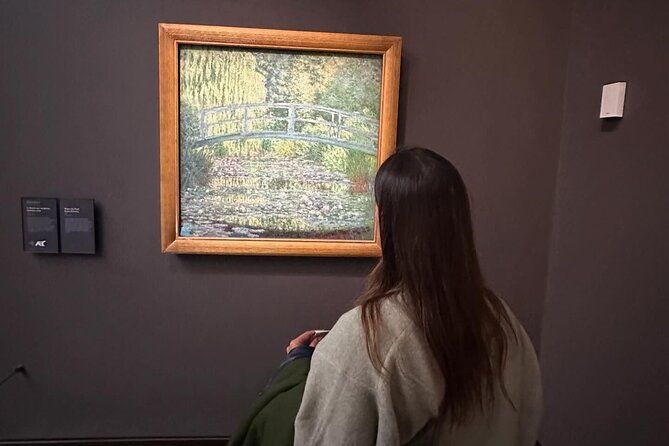
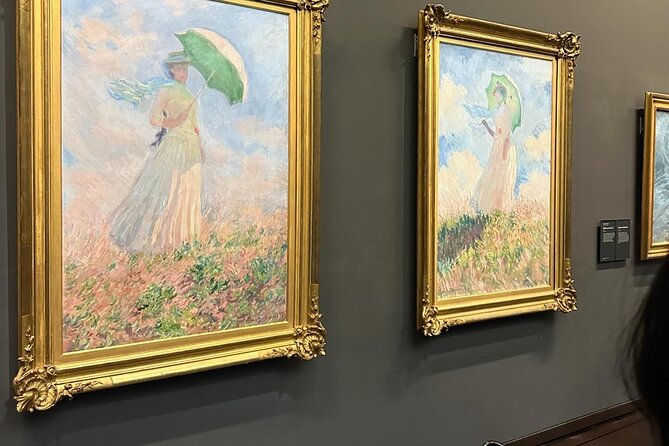
The main reason to book this experience is the Impressionist collection. The route takes you toward galleries containing important paintings by Renoir, Manet, Monet, and Degas, four names that define much of the museum’s appeal.
The audio guide can help you connect the paintings to the wider changes taking place in late nineteenth-century art. Instead of treating each canvas as an isolated masterpiece, use the commentary to follow the shift in subject, brushwork, light, and everyday scenes.
You are free to pause, move ahead, or leave the suggested route whenever you wish. That is a real advantage for different kinds of art lovers. If you know exactly which artists you want to see, you can go directly to those galleries. If you prefer a little structure, follow the recommended path and let the guide set the pace.
The drawback is that a phone audio guide depends on your own attention and equipment. You will not have a live person answering questions or pointing out a detail that catches your eye. For a first visit, the audio commentary provides useful direction, but it will not feel like a personal art lesson.
Still, the format suits visitors who dislike being rushed. I would rather spend extra time with one painting I care about than keep pace with a group. After entering, you control that choice.
Van Gogh, Cézanne, and Toulouse-Lautrec
The visit does not end with the best-known Impressionists. The route also includes major works associated with Cézanne, Van Gogh, and Toulouse-Lautrec, along with other artists active in the late nineteenth century.
This section is one reason the museum deserves more than a quick dash through the Monet rooms. The collection shows how varied the period was. You move from Impressionist experiments with light and modern life to later approaches that became more personal, expressive, and boldly designed.
The audio guide is useful here because it gives you a suggested order through a large collection. I recommend listening to the commentary for the works that interest you most, then turning it off for a while when you want to look quietly. You do not need to treat the guide as a command. It is a tool.
You might find that one hour is enough for a focused first look, especially if you already know your priorities. If you want to see the Impressionist galleries, nineteenth-century painting, and Art Nouveau areas at a calmer pace, use the ability to stay until closing.
Another self-paced route in Paris:
- From Paris: Giverny Day Trip with Audio Guide or Live Guide
★ 4.3 · 2,372 reviews - Paris: Eiffel Tower Access w/ Audioguide and Optional Cruise
★ 4.0 · 1,630 reviews - Giverny and Monet’s House Half Day Trip from Paris Guide or Audio
★ 4.0 · 1,319 reviews - Paris: Catacombs Entry & Seine River Cruise with Audio Guide
★ 4.4 · 1,150 reviews
Art Nouveau design by Mucha and Guimard

Make time for the Art Nouveau section. This part of the museum broadens the visit beyond paintings and shows how artists and designers brought flowing lines, decorative forms, and new visual ideas into everyday objects and architecture.
The collection includes decorative works and designs connected with Alphonse Mucha and Hector Guimard. Their presence adds a different rhythm after the galleries of framed paintings. Here, look for the relationship between art, design, and daily life rather than focusing only on individual canvases.
I like this portion because it prevents the visit from becoming a single-style art checklist. The Musée d’Orsay is especially good for showing the period’s movement across painting, sculpture, decorative art, and design.
If your time is short, you may be tempted to skip this section for the Impressionist rooms. I would not do that automatically. The Art Nouveau displays offer some of the museum’s most distinctive variety, and the audio guide can help you understand why the designs matter.
What the digital audio guide adds
The audio guide is accessed on your phone and offers commentary on museum highlights, the layout, and the institution’s role in art history. This makes the visit more structured than simply walking from room to room with a map.
You can use it in two ways. First, follow the suggested route and listen as you go. This is the easiest choice if you are visiting the Musée d’Orsay for the first time. Second, use the route as a starting point, then branch off toward artists or galleries that match your interests.
The guide is offered in English. That is important to confirm before booking if you need another language, since the stated offering is English only.
Do not expect a live guide named in the booking details, because no live guide is included. The audio format gives you privacy and control, but less personal explanation. If you want to ask why a particular painting matters, you will need to rely on the recording, museum labels, or your own reading.
Is $87.67 a fair price?
At $87.67 per person, the value depends on what you want from the booking. You are paying for a reserved entry arrangement, an audio guide, and the convenience of not buying your admission at the museum. You are not paying for a live art historian or a fully hosted private tour.
The price may make sense if you have a tight Paris schedule and want a set entry time. It may also suit you if you value a self-guided route but do not want to plan the museum from scratch.
The value is weaker if you are comfortable arranging a museum visit on your own and mainly want admission. In that case, the added cost can feel high, especially because the experience does not let you bypass security.
The public rating attached to the experience is 3.7 out of 5 from 12 reviews. Two serious complaints describe missing tickets and being sent to a long ticket line. The operator replied in both cases that the reservations were made with another provider and could not be found in its records. You cannot resolve that uncertainty by assuming every complaint applies to this operator, but you should still treat ticket delivery as a practical concern.
After booking, check that you receive the admission details and know exactly where to go. Do not wait until the morning of your visit to discover that the ticket information is missing.
Timing, transport, and staying inside
The activity is near public transportation, and the meeting point is the Musée d’Orsay itself. No separate transportation is included, so you make your own way to the museum.
The listed visit takes about one to two hours, with one hour shown for the museum stop. That shorter figure appears to describe the suggested route, not a limit on your time inside. Once admitted, you can continue exploring until closing.
This flexibility is one of the strongest features. You can make the museum a focused stop between other Paris sights, or give it a longer part of your day. I would avoid scheduling something immediately after your entry time because security and the size of the museum can make the visit take longer than expected.
The ticket is date and time specific. Once issued, it cannot be changed, and the activity is non-refundable. Book only after you are confident about your Paris schedule.
Who should book this Musée d’Orsay visit?
This experience suits you best if you want:
- A reserved museum entry time
- A self-guided visit rather than a live group tour
- English commentary on major works and the museum layout
- Freedom to stay beyond the suggested route
- A simple introduction to Impressionist, Post-Impressionist, and Art Nouveau collections
It is less suitable if you want a personal guide, a low-cost museum ticket, or a guarantee of passing through security without waiting.
Art newcomers may appreciate the suggested route because the museum can feel large and confusing at first. Repeat visitors may prefer a direct visit to their favorite galleries and may not need the audio commentary.
Families and mixed-interest groups can also benefit from the flexible format. One person can spend more time with paintings while another moves ahead. Just remember that everyone still follows the museum’s entry and security rules.
Should you book it?
Book this experience if a reserved entry time and an English phone audio guide are worth paying extra for. The former railway station, giant clock, Impressionist galleries, Van Gogh and Cézanne works, and Art Nouveau design make the Musée d’Orsay an excellent Paris stop, and the option to stay until closing gives you welcome freedom.
Skip it if you want a live guide or the lowest possible price. You should also wait until the ticket details arrive before finalizing your plans, and contact the provider promptly if anything is unclear. This can be a convenient museum visit, but it is not a magical pass past every queue, and the price demands careful attention to what is actually included.
FAQ
Where does the Musée d’Orsay visit begin?
It begins at the Musée d’Orsay, Esplanade Valéry Giscard d’Estaing, 75007 Paris, France.
How long does the visit take?
The scheduled visit is approximately one to two hours, with about one hour allocated to the museum route. After entry, you may remain inside until closing.
Is this a live guided tour?
No. This is a self-guided visit using a digital audio guide on your phone. No live guide is included.
What language is the audio guide offered in?
The experience is offered in English.
Can I skip the museum security check?
No. The ticket lets you skip the line to purchase admission, but every visitor must pass the mandatory security check.
What artists and collections can I see?
The visit includes Impressionist and Post-Impressionist works by artists such as Renoir, Manet, Monet, Degas, Cézanne, Van Gogh, and Toulouse-Lautrec. It also includes Art Nouveau designs associated with Alphonse Mucha and Hector Guimard.
Can I explore at my own pace?
Yes. A suggested route is provided, but you are free to explore independently and stay inside until closing after you enter.
Can I change or cancel my ticket?
No. The ticket is date and time specific, non-refundable, and cannot be changed once issued.
Latest audio tours in Paris
- The Tuileries Garden’s Classic Sights: A Self-Guided Audio Tour★ 4.0 · 3 reviews
- The French Revolution: Self Guided Audio Tour of Paris★ 4.5 · 3 reviews
- Audioguide – The Eiffel Tower and its secrets★ 4.0 · 4 reviews
- A Self-Guided Audio Tour Around Parc Montsouris★ 3.5 · 6 reviews
- Summit Eiffel Tower Audio Guide Tour with Unlimited Time Access★ 4.5 · 58 reviews
- Self-Guided Audio Tour -The Eiffel Tower, Exterior★ 4.0 · 9 reviews
- Trendy Marais, smartphone audioguided walking tour★ 5.0 · 6 reviews
- Self Guided Tours in Paris with 100 Captivating Audio Stories★ 3.5 · 3 reviews
Paris Audio Tours, compared.
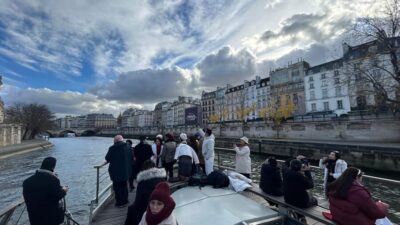
Illuminations River Cruise with Audio Commentary
Read our review →
Louvre Museum Hosted Entry and Mona Lisa Audioguide
Read our review →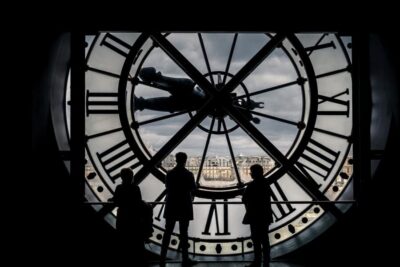
Orsay Museum Entry Ticket and Digital Audio Guide App
Read our review →
Giverny Day Trip with Audio Guide or Live Guide
Read our review →
Eiffel Tower Access w/ Audioguide and Optional Cruise
Read our review →
Giverny and Monet’s House Half Day Trip from Paris Guide or Audio
Read our review →
Catacombs Entry & Seine River Cruise with Audio Guide
Read our review →
Tootbus Panoramic by Night Bus Tour with Audioguide
Read our review →Browse the lists this tour appears in