
Reviewed · ITALY
Brindisi Walking Tour with Audio and Written Guide by a Local
Brindisi’s story is written along its harbor, Roman road, medieval churches, Norman cathedral, and former military walls. This self-guided walk gives you the freedom to follow that story at your own pace, with audio and written guidance from Matteo and a route that ends beside the sea.
I like two things right away: the low $7.21 price makes it an easy way to get your bearings, and the restaurant advice adds something useful after the sightseeing ends. The main drawback is simple: there is no person waiting at the first stop. You need a smartphone, an internet connection, and enough independence to follow Google Maps and activate the digital guide correctly.
Key points to know before you book
- A two to three hour route links Brindisi’s castles, churches, archaeological remains, museum, Roman columns, seafront, and sailor monument.
- Audio and written content is available in English, Spanish, Italian, German, and French.
- The walk starts at Bastione San Giacomo and finishes at the Monument to the Italian Sailor beside the harbor.
- The route is self-guided, so you can pause, skip a stop, wander, or continue listening after reaching the waterfront.
- The Archaeological Museum and cathedral are free to enter, while San Giovanni al Sepolcro and the sailor monument may involve admission costs.
- Internet access is required, and headphones are not supplied.
A low-cost way to meet Brindisi
At $7.21 per person, this is not a full guided tour with a local walking beside you. It is a digital guidebook with an audio track, written explanations, a mapped route, historical notes, and food suggestions. That distinction matters more than the price.
If you like being told exactly where to go, but dislike being tied to a group schedule, this format has real appeal. You can stop for photographs, sit in a church, spend longer in the museum, or pause the narration for a coffee. You also avoid the usual problem of trying to hear a guide in a crowded street.
The route takes about two to three hours, although your own pace will decide the final time. The listed stops add up to roughly two hours and forty minutes, not counting walking between them. That makes this a useful half-day plan for a first visit to Brindisi, especially if you are arriving by ship or fitting the city between other Puglia plans.
The guide is offered in several languages, but the English audio has one issue to keep in mind. Some Italian place names are pronounced with an American accent, and the local names may not always sound as they do in Brindisi. The written guide and map help make up for this, but if accurate Italian pronunciation matters greatly to you, read along rather than relying only on the audio.
More Audio Walking Tours in Italy
- Florence: 2.5 hour Audio Guided Walking Tour led by Host
★ 4.6 · 293 reviews - Verona Walking Tour with Audio and Written Guide by a Local
★ 4.5 · 157 reviews - Bologna Walking Tour with Audio and Written Guide
★ 4.5 · 132 reviews
From Bastione San Giacomo to Frederick’s castle
Your starting point is Bastione San Giacomo on Via Nazario Sauro. The bastion is dedicated to Saint James, patron saint of Spain, and began as a defensive structure. After its military role ended, it served as a public slaughterhouse, oil depot, and customs house.
That change of use gives you a quick lesson in how Brindisi has adapted its old buildings. A defensive wall is not just a military relic here. It became part of the working city, linked to trade, storage, taxation, and food.
The next castle is associated with Emperor Frederick II. It is also called the earth castle and is described as the second in chronological order among Brindisi’s four historic castles. This is a good early stop because it places the city’s later buildings in a wider political story: Brindisi was not simply a port for modern ferries, but a strategic point shaped by emperors, armies, pilgrims, and commerce.
The opening section is likely to appeal most to people who enjoy context. You are not just checking off monuments. You are seeing how a port city changed as its military and commercial needs changed.
San Giovanni al Sepolcro and the city’s medieval faith
The first named stop is Tempio di San Giovanni al Sepolcro, or the Church of the Holy Sepulchre. It was built by the Canons Regular of the Holy Sepulchre before 1128, the year it first appears in a surviving document.
You get about 20 minutes assigned to this stop, but admission is not included. Check the opening situation before relying on entering, since the digital tour can explain the site even if the doors are closed. The church is especially important for understanding Brindisi’s connection to religious travel toward Jerusalem.
This stop also shows why a self-guided tour can work well in a small historic center. The written notes can give you the basic setting before you enter, while the audio lets you look closely rather than keep your eyes on a guide holding a flag.
The drawback is that a digital explanation cannot answer questions about a specific carving or change the pace for your interests. If you want a specialist to point out details inside the church, a live tour would be a better match.
San Pietro degli Schiavoni and the layers below the city

The Area Archeologica di San Pietro degli Schiavoni is a free archaeological stop. Its name comes from a Slavic community, mainly Greeks and Albanians, that settled in this part of Brindisi from the fifteenth century onward. The community centered on a church of San Pietro, though no physical traces of that church remain today.
This is a useful reminder that Brindisi’s past was shaped by movement across the Adriatic. The city was connected to people arriving from the eastern Mediterranean and the Balkans, not only to Rome and the rest of Italy.
You have around 20 minutes here. Because the site is archaeological rather than monumental, the written information is particularly helpful. Without some explanation, exposed remains can be hard to read. The guide gives you a reason to pay attention to what is left, what has disappeared, and how later communities occupied the same urban space.
Another self-paced route in Italy:
- Rome: Pantheon Fast-Track Ticket and Official Audioguide
★ 4.5 · 27,353 reviews - Rome: Colosseum & Forum with Audio Guide App -Optional Arena
★ 4.2 · 24,770 reviews - Florence: Timed Entry to Michelangelo’s David + Audio App
★ 4.6 · 19,496 reviews - Rome: City Sightseeing Hop-on Hop-off Bus with Audioguide
★ 4.0 · 16,045 reviews
Brindisi Cathedral and the road to Jerusalem
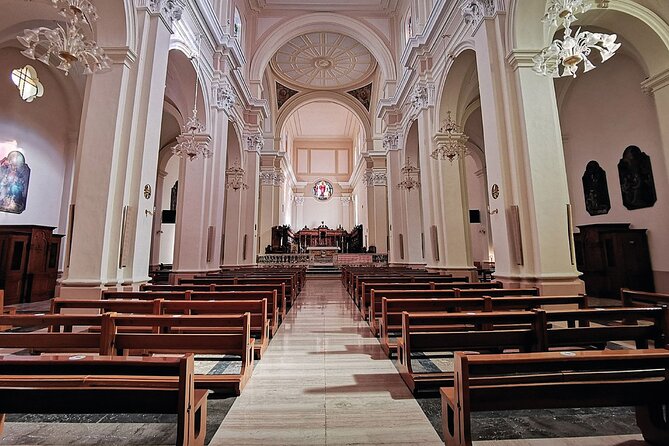
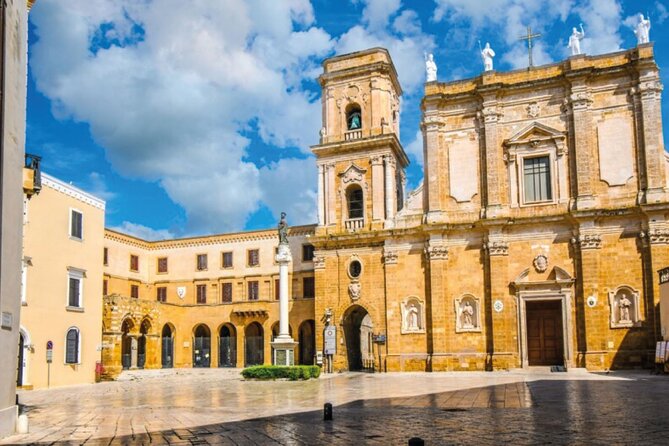
The Cathedral of San Giovanni Battista marks the city’s recovery under Norman rule. Its construction represented a renewed Brindisi, supported by the Normans as they expanded toward the east.
Brindisi soon regained an important commercial role. It became a key route for people moving from Rome toward Jerusalem, which helps explain why the cathedral and the Church of the Holy Sepulchre belong together in this walk. One represents the city’s political and religious renewal, while the other points toward pilgrimage and the Holy Land.
The cathedral stop lasts about 20 minutes and admission is free. I like this section of the route because it connects architecture with geography. Brindisi was valuable partly because of where it sat, at the end of routes leading toward the Adriatic and beyond.
The digital guide is useful here as a way to slow down the visit. Instead of taking one quick photograph and moving on, you can listen to the explanation, look around, and then continue when you are ready.
The Francesco Ribezzo Museum in 30 minutes

The Provincial Archaeological Museum of Brindisi, named for scholar Francesco Ribezzo, was founded in 1884. It covers several sections, including antiquarian material, inscriptions, statues, prehistoric finds, Messapian and Roman archaeology, and underwater archaeology.
This is the longest planned stop, at about 30 minutes, and admission is listed as free. That is good value for a city walk because the museum gives you objects to support the stories you hear in the streets. Brindisi’s past can otherwise feel scattered across churches, walls, and harbor views.
The Messapian material is especially useful for placing the Roman period in context. The Roman story did not begin the history of the area. The museum’s prehistoric, Messapian, Roman, and underwater sections let you see a longer sequence.
Allow extra time if museums are a priority for you. The stated two to three hour duration is an estimate, and a museum visit can easily stretch if you read labels carefully. If your schedule is tight, listen to the guide before entering, then decide how much of the collection you want to see.
Roman columns and the Appian Way
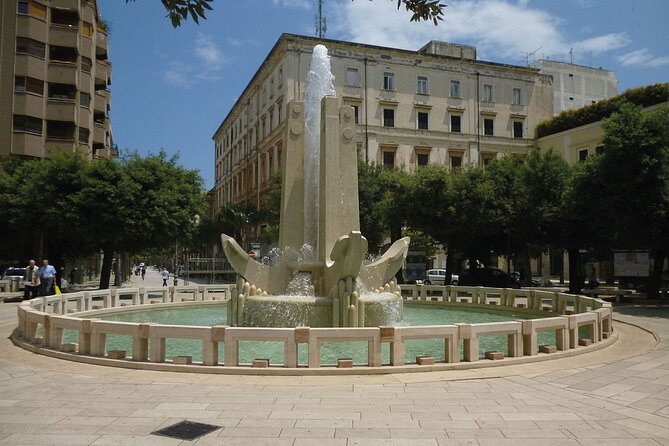
At Via Colonne 53, you reach one of Brindisi’s clearest symbols: the Roman columns. Their purpose is linked to several theories, with the most accepted explanation placing their construction around AD 110 under Emperor Trajan.
The leading idea is that the columns marked the end of the historic Appian Way. That gives this stop unusual power. You are not looking at an isolated Roman monument. You are looking at the point where one of antiquity’s major roads reached Brindisi, the port that connected Italy to routes across the sea.
The stop lasts about 10 minutes and is free. That may sound brief, but the columns work as a compact landmark. The audio explanation can add the historical background while you take in the position above the city and harbor.
This is one of the places where clear map guidance matters. Local names can sound unfamiliar in an audio recording, so keep the written place names and Google Maps open on your phone.
Virgil’s staircase and the harbor promenade
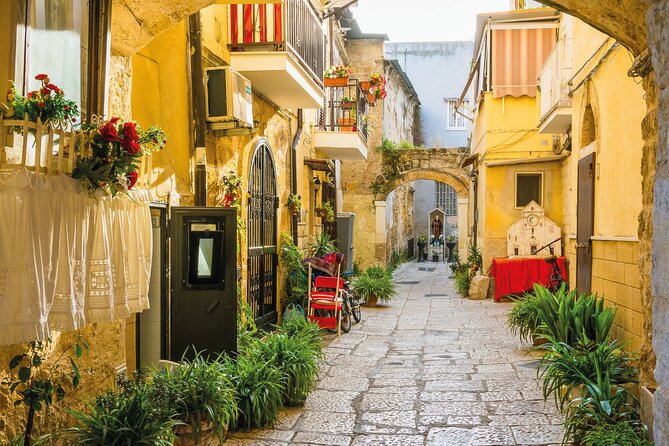
The Monumento a Virgilio is a staircase linking Brindisi’s historic center with the seafront. It is named for Virgil, the first-century BC poet, and the tour explains the connection between the poet and the city.
The stop is planned for about 10 minutes. It is less about entering a major building and more about understanding how Brindisi’s upper streets meet its waterfront. The change in level also prepares you for the final part of the route.
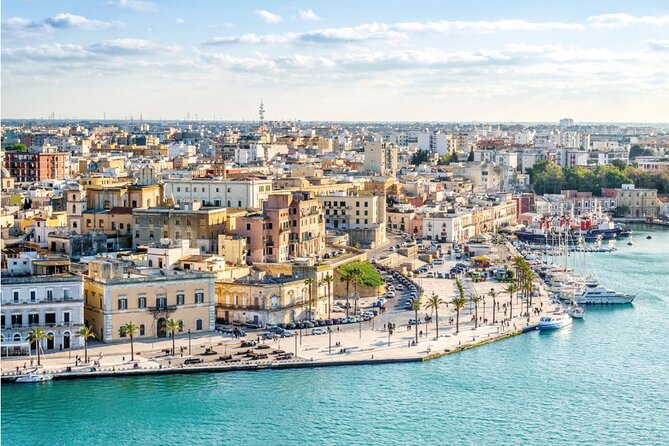
From there, the Lungomare Regina Margherita offers a 15-minute walk with views across the water and port. This is a smart point in the itinerary to slow down. You can listen while walking, then stop the audio if you want quiet time by the harbor.
One of the strongest features of this format is that the final stops do not force you into a fixed group. You can continue along the waterfront with the last pieces of narration in your ears, then stay out for a drink or meal. Local restaurant suggestions are included, and Antica Osteria La Sciabica is specifically associated with the harbor-front recommendations. Focaccia and spritzers also get a practical mention in the food advice.
The Italian Sailor monument finishes the route
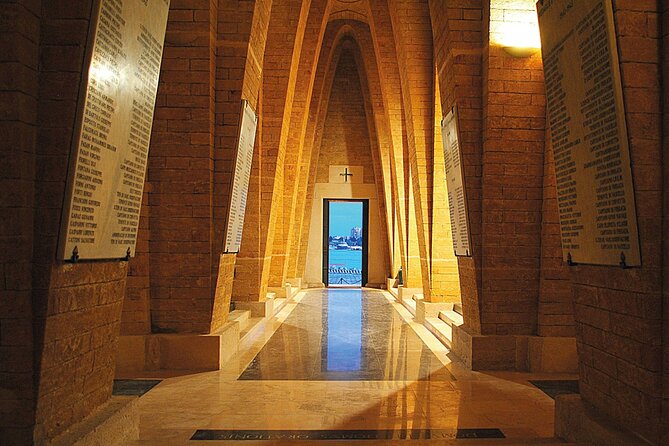
The walk ends at the Monument to the Italian Sailor on Via Ammiraglio Millo. The monument was planned after the First World War to honor sailors, alongside similar memorial ideas in cities such as La Spezia, Trieste, and Venice.
The final stop is assigned about 20 minutes, and the ticket costs 3 euros. That fee is not included, so budget for it if you want to enter or visit the monument as intended.
Ending here works well. The route moves from walls and castles through religious and archaeological sites, then down to the port. You finish with a monument tied directly to Italy’s naval identity and Brindisi’s long relationship with the sea.
The endpoint also gives you a clear place to stop using the guide. There is no need to retrace your steps to the starting point, which makes this practical for a port visit or for anyone continuing elsewhere in the city.
What the digital format gets right
The best feature is control. You can listen in English or choose Spanish, Italian, German, or French, and you can move at your own speed. The written text is valuable when a name is hard to catch in the audio or when you want to revisit a historical detail.
The route is also well suited to people who prefer not to join a crowd. The listed maximum is 108 people, but this is not a walking group assembled around one guide. You use the material independently, so your experience depends on your phone, your map reading, and your timing.
The food recommendations add value beyond the monuments. A basic audio tour often ends at the final sight. Here, the advice can help you choose where to eat afterward, with local dishes and harbor-side places included.
You should download nothing unless the provider specifically supplies it. Internet access is required, and there is no offline version. Use your own smartphone speakers or headphones, since headphones are not included.
Who should book this Brindisi walk?
I would choose this tour if you want a cheap, flexible introduction to Brindisi and are comfortable managing a phone while walking. It suits independent visitors, couples, solo sightseers, and anyone who wants to pause at the museum or linger beside the harbor.
It is less suitable if you expect a person to greet you, lead you from stop to stop, pronounce every Italian name locally, or answer questions as you go. The instructions make clear that there is no in-person guide, and one early misunderstanding can ruin the experience if you arrive expecting a group.
The route is near public transportation, service animals are allowed, and most people can participate. Still, you should be prepared for normal city walking between historic sites and for stairs at the Virgil monument.
Free cancellation is available if you cancel at least 24 hours before the local start time. Cancellations or changes inside that window are not refunded or accepted.
Should you book it?
Book this Brindisi walking tour if you want structure without a schedule. For $7.21, you get a well-planned route through the city’s main historic sights, multilingual audio and text, map support, and useful restaurant advice.
Skip it if you want a live guide or if you will not have dependable internet. Bring headphones if you have them, read the place names as well as listening, and check the extra fees for San Giovanni al Sepolcro and the 3 euro sailor monument.
For an independent visitor who wants to understand why Brindisi matters, then finish with a harbor walk and a plate of local food, this is a sensible buy.
FAQ
How long does the Brindisi walking tour take?
The experience takes approximately two to three hours, depending on your walking speed and how long you spend at each stop.
Is this a guided tour with a person?
No. It is a self-guided digital tour with audio, written information, maps, history, curiosities, and local restaurant advice.
Where does the tour begin?
The tour begins at Bastione San Giacomo, Via Nazario Sauro 6, Brindisi.
Where does the tour end?
It ends at the Monument to the Italian Sailor, Via Ammiraglio Millo 2, beside the waterfront.
What languages are available?
The audio guide and written material are available in English, Spanish, Italian, German, and French.
Do I need internet access?
Yes. You need a smartphone with an internet connection to activate and use the digital guide. There is no offline version.
Are headphones included?
No. You can listen through your smartphone speakers or bring your own headphones.
Are admission tickets included?
Admission is not included for San Giovanni al Sepolcro or the Monument to the Italian Sailor. The sailor monument ticket costs 3 euros. The archaeological area, cathedral, museum, and Roman columns are listed as free.
Can I cancel for a refund?
Yes, if you cancel at least 24 hours before the experience start time. Cancellations made less than 24 hours in advance are not refunded.
Is the tour suitable for most people?
Most people can participate. The activity is near public transportation, service animals are allowed, and the route connects several city sights on foot.
Latest audio tours in Italy
- Orgosolo Multilingual Audioguide★ 4.5 · 42 reviews
- Pantheon Skip the Line Entry Tickets with Digital Audio Guide★ 3.5 · 52 reviews
- Audio guide in Vatican Museums and Sistine Chapel★ 4.5 · 12 reviews
- St. Peter’s Basilica: Dome Climb with Lift & Audioguide★ 4.5 · 13 reviews
- The Roman Jewish Ghetto: A Self-Guided Audio Tour★ 4.0 · 8 reviews
- Experience: The Pantheon Audio Tour★ 4.5 · 4 reviews
- Trastevere: A Self-guided Audio Tour of Rome’s Medieval Village★ 4.5 · 3 reviews
- Navova square underground with audioguide★ 4.5 · 17 reviews
Audio Walking Tours, compared.

City Monuments Guided Walking Tour with Audio Guide
Read our review →

Self Guided Classic Freedom Trail Location Aware (GPS) Walking Audio Tour
Read our review →
Self-Guided Historical Walking Tour (Audio Guide)
Read our review →
Cape Cod & Provincetown Self-Guided Driving & Walking Audio Tour
Read our review →
Verona Walking Tour with Audio and Written Guide by a Local
Read our review →
Royal Walking Tour and Buckingham Palace Audio Tour
Read our review →
Bologna Walking Tour with Audio and Written Guide
Read our review →Browse the lists this tour appears in