
Reviewed · ITALY
Pompeii: Entry Ticket with Audio Guide
Pompeii is not a tidy collection of ruins behind glass. It is a whole Roman city, with streets, shops, bathhouses, temples, theaters, villas, and election notices still spread across a huge archaeological site. You walk where residents walked before Vesuvius buried the city in AD 79. The scale is the first surprise, and it is also the main reason to allow more than a quick stop.
I like the freedom to explore at your own pace, and I like having an audio guide to explain details that bare walls cannot. The preserved mosaics, frescoes, public buildings, and everyday shops become far easier to understand with context. The main drawback is practical: ticket collection and audio-guide pickup can be confusing, and even six hours may not be enough to see everything.
Key points to know before you go
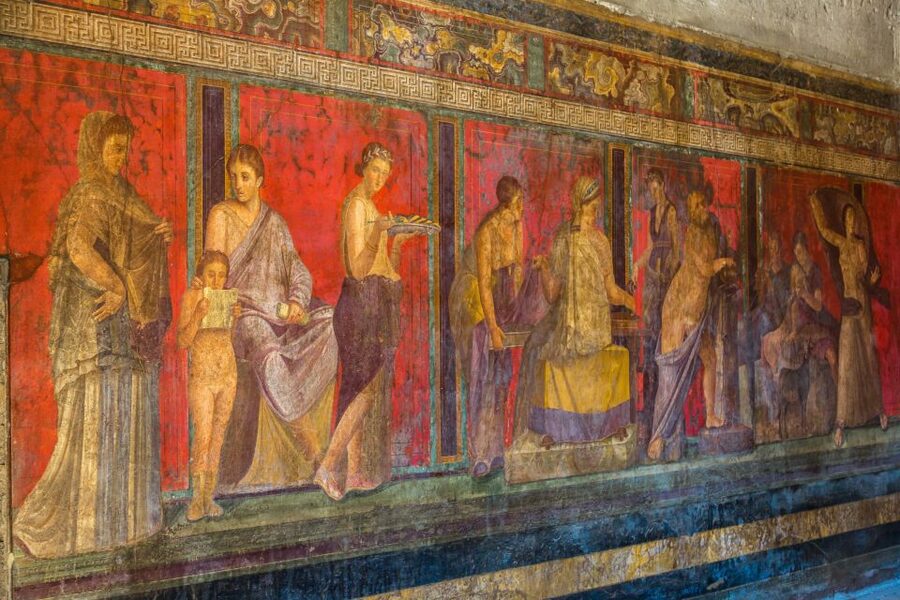
- Choose your Pompeii carefully: Pompeii Express covers the ancient city only, while Pompeii+ adds Villa of the Mysteries, Villa of Diomedes, and Villa Regina in Boscoreale with its Antiquarium.
- Allow at least several hours: The site is enormous. Some people spend a full day and still miss sections.
- Use the audio guide for orientation: The official device includes a map, while the digital guide uses your phone and can drain its battery.
- Collect tickets at the right place: Show your phone voucher at Porta Marina Superiore or Piazza Esedra, and check the audio-guide desk instructions before joining a long line.
- Bring photo ID: You need valid identification to collect the physical audio guide, which is held as a deposit.
- Dress for ancient streets: Expect heat, uneven paving, and a great deal of walking. Comfortable shoes, water, and sun protection matter.
Pompeii is a city, not a single monument
The first mistake you can make at Pompeii is treating it like a one-hour attraction. This is an ancient urban area with a network of streets and districts. You might begin at a forum, then walk past a bakery, a bathhouse, a temple, and a private home before realizing you have covered only one small part of the site.
That scale is what makes the visit so powerful. At many archaeological sites, you look at foundations and try to picture the rest. At Pompeii, walls often rise high enough to show room layouts, doorways, courtyards, and painted decoration. Ancient streets still guide your feet. Stepping stones cross some roads, and large public buildings give you a clear sense of how Roman life was organized.
The eruption of Vesuvius caught Pompeii’s roughly 11,000 residents by surprise on August 24, AD 79. Ash and volcanic material covered the city, preserving details that would otherwise have vanished. The visit is not only about disaster. It is about ordinary life: where people bought food, bathed, worshipped, watched performances, and lived in houses ranging from modest to grand.
More Audio Tours in Italy
- Rome: Pantheon Fast-Track Ticket and Official Audioguide
★ 4.5 · 27,353 reviews - Rome: Colosseum & Forum with Audio Guide App -Optional Arena
★ 4.2 · 24,770 reviews - Florence: Timed Entry to Michelangelo’s David + Audio App
★ 4.6 · 19,496 reviews
Choosing between Pompeii Express and Pompeii+
The Pompeii Express ticket includes the ancient city itself. This is the core visit, and it contains enough to fill a serious day. You can see the main urban streets, temples, theaters, villas, baths, public buildings, the forum area, and the amphitheater.
Pompeii Express is the sensible choice if you have limited time or want to concentrate on the most famous area without adding extra transport and planning. It is also the safer choice for a short stop from Naples, Sorrento, or the Amalfi Coast, since the ancient city alone can easily absorb several hours.
The Pompeii+ ticket includes the ancient city plus three suburban sites: Villa of the Mysteries, Villa of Diomedes, and Villa Regina in Boscoreale with its Antiquarium. The Villa of the Mysteries is the big draw. Its frescoes are among the most memorable sights connected with Pompeii, and adding it can make the higher-priced option worthwhile if you have enough time.
Pompeii+ requires more planning. The last entry for this option is 3:30 p.m. from November 1 through March 31 and 5:30 p.m. from April 1 through October 31. Do not choose the extended ticket casually and then arrive late. The extra sites have value only if you can reach them before closing and still give the main archaeological city the time it deserves.
Collecting the voucher and audio guide
Your phone voucher is not always the same thing as the final entry ticket. You show it at the Porta Marina Superiore or Piazza Esedra ticket office, depending on the instructions for your booking. The audio-guide desk is beside the official ticket office at Porta Marina Superiore, at Via Villa dei Misteri n. 2.
This is where you need to pay attention. Lines for people buying tickets on the spot can be long, while the voucher and audio-guide process may use a different queue. Several visitors found the entrances and meeting directions unclear, so do not simply join the first line you see. Look for the audio-guide booth and ask staff to confirm where voucher holders should go.
If you select the physical audio guide, you must show valid identification. Your ID is held as a deposit while you use the device. A driving licence is accepted as an example of useful identification, but the activity instructions say to bring a passport or ID card, so bring a document rather than relying on a photo of one.
The physical device must be collected and returned at the same official desk. That return requirement is easy to forget when you are tired and ready to leave. Set a reminder on your phone, especially if you exit through another part of the site.
What the audio guide adds
Pompeii has signs, maps, and staff, but the site can still feel confusing without a plan. The audio guide gives you a way to connect individual buildings to the wider city. It explains Roman daily life as you walk, helping you understand why a bathhouse, market, temple, or house mattered.
The physical audio guide includes a map, which is particularly useful. Pompeii’s streets can feel repetitive, and it is easy to lose track of what you have seen. The map helps you orient yourself and decide if you should continue toward the amphitheater, return to the forum, or cut across to another district.
The digital audio guide is available through instructions sent with your booking confirmation. It is offered in English, German, French, Italian, Spanish, Chinese, Japanese, Portuguese, and Russian. The physical audio guide has the same broad language selection.
There are tradeoffs. The phone version gives you written information as well as audio, but it uses your battery. The physical unit avoids that problem, yet you must collect it, keep track of it, and return it. Bluetooth headphones do not work with the official device, and headphones are not included, so check what connection the supplied unit requires before you arrive.
The audio guide is not a private tour. You will not have a guide walking beside you, answering questions, or changing the route to suit your interests. If you prefer to stop often, skip sections, or focus on architecture, self-guided access works well. If you want a tightly organized story with someone pointing out details in person, this ticket is not a substitute for a guided tour.
Another self-paced route in Italy:
- Rome: City Sightseeing Hop-on Hop-off Bus with Audioguide
★ 4.0 · 16,045 reviews - Venice: La Fenice Opera House Entry Ticket with Audio Guide
★ 4.6 · 11,742 reviews - Rome: Colosseum, Forum, Palatine Hill Entry & Audioguide App
★ 4.4 · 10,957 reviews - Rome: St. Peter’s Basilica & Dome Entry Ticket & Audio Tour
★ 4.2 · 7,537 reviews
The forum, temples, and public heart of the city

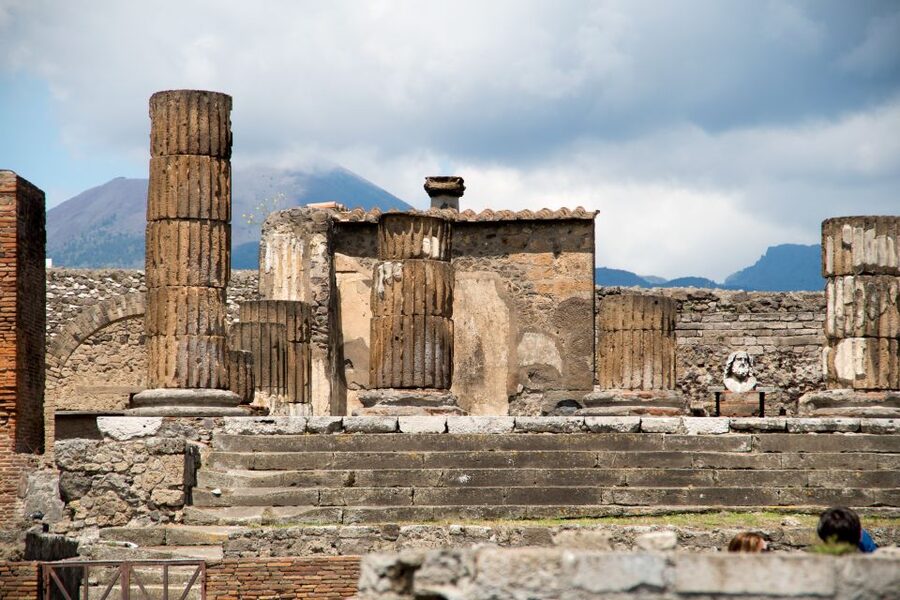
Make your way toward the forum, Pompeii’s civic and religious center. From here, the site begins to feel less like scattered ruins and more like a working city. The temples of Venus, Apollo, and Jupiter show how religion shaped public space, while surrounding buildings reveal the business and political life of Pompeii.
The forum is also a good place to pause and get your bearings. The city extends in several directions, and the main roads can tempt you into wandering without a plan. Use the map to mark what you have seen. This simple habit saves time and prevents the familiar end-of-day complaint: we spent hours there, but somehow missed the most important section.
The Temple of Apollo and the Temple of Jupiter each offer a different look at the religious world of ancient Pompeii. You will see columns, raised platforms, and open areas where ceremonies and public life once met. The audio guide helps explain the role of these spaces instead of leaving you with a collection of stones and names.
Villas, mosaics, and private Roman life

The private homes are among the most rewarding parts of the site. The House of the Faun is a major highlight, with its Hellenistic influence and large scale. It gives you a sense of how wealthy owners used courtyards, reception rooms, decoration, and sculpture to display status.
The Villa of the Mysteries is especially important if you select Pompeii+. Its frescoes remain the reason many people choose the extended ticket. The villa lies outside the central ancient city, so you need to budget time for it rather than treating it as a quick extra.
Other houses may be less famous but just as revealing. Look for painted walls, mosaic floors, small courtyards, and the arrangement of rooms around open spaces. The pleasure comes from noticing domestic details. Pompeii is not only about emperors or famous battles. It shows how people designed homes, welcomed visitors, cooked, bathed, and moved through daily routines.
Some buildings may be closed for restoration or safety work. That can be disappointing when the audio guide describes a room you cannot enter. Preservation is an ongoing task at a site this large, so keep your route flexible and do not measure the whole visit by one closed house.
Baths, markets, and everyday details
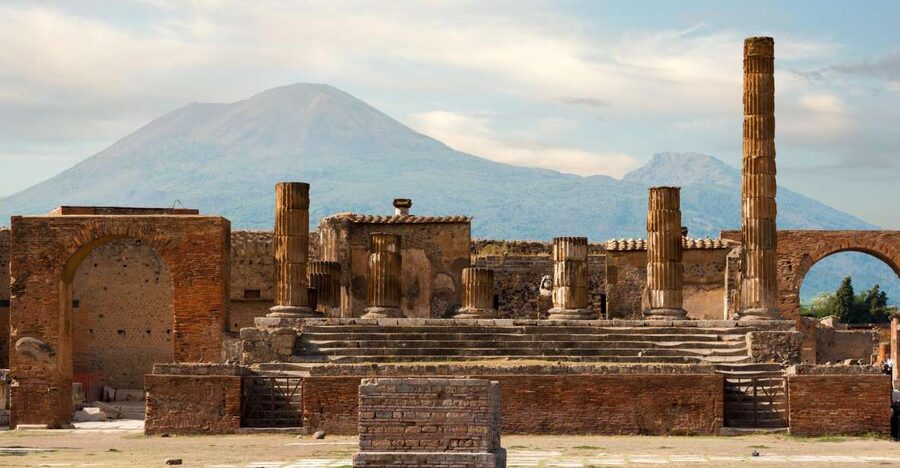
The public baths are a good reminder that Roman life involved much more than temples and grand villas. Look closely at the mosaics and the structure of the rooms. The decoration and planning show how practical buildings could also be carefully designed.
The market area brings the ancient city down to street level. You can picture people buying food, meeting friends, and carrying out the ordinary business of the day. This is one of the places where the audio guide earns its keep, because a row of counters or rooms may be hard to interpret without an explanation of how it functioned.
These smaller details are what give Pompeii its human scale. A city of 11,000 people needed food sellers, tradespeople, public services, places to worship, and places to relax. You see the remains of that system in fragments, then begin to recognize the city as a lived-in place rather than a frozen museum.
Theaters, amphitheater, and the city’s grand scale
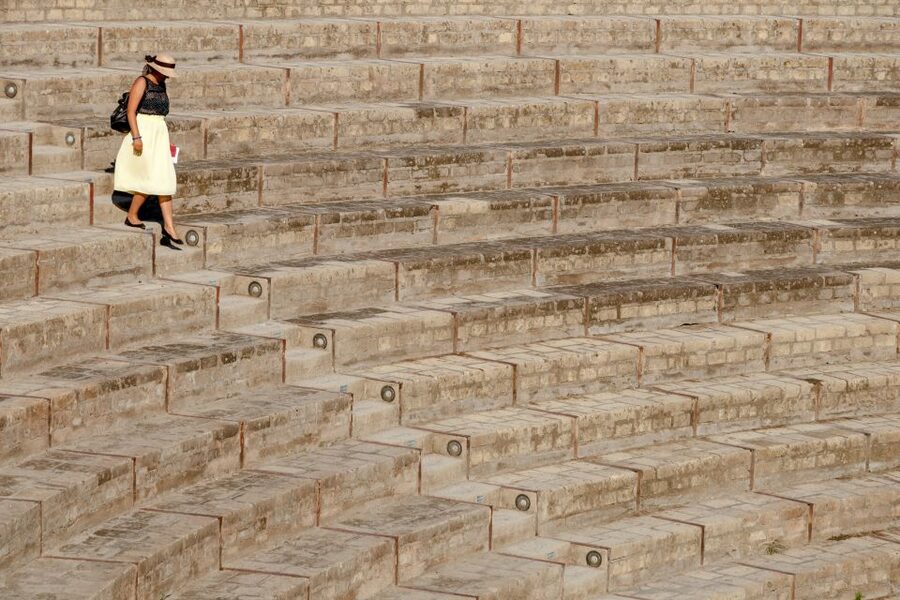
The amphitheater helps you understand how public entertainment fitted into Pompeii. Sit or stand where you can take in the shape of the arena and audience seating. Even without a performance, the building explains how large crowds gathered and how the city used public space.
The theaters offer a different atmosphere. Their layout brings you closer to the social life of the city, where performances were part of public culture. The audio guide can help you distinguish the buildings and understand their different purposes.
Do not rush these areas just because they are open and easy to photograph. Give yourself a moment to consider the movement of crowds, the views from the seating, and the engineering needed to build such structures. Pompeii’s public buildings make the city feel substantial and organized.
The casts, preservation work, and what may be closed
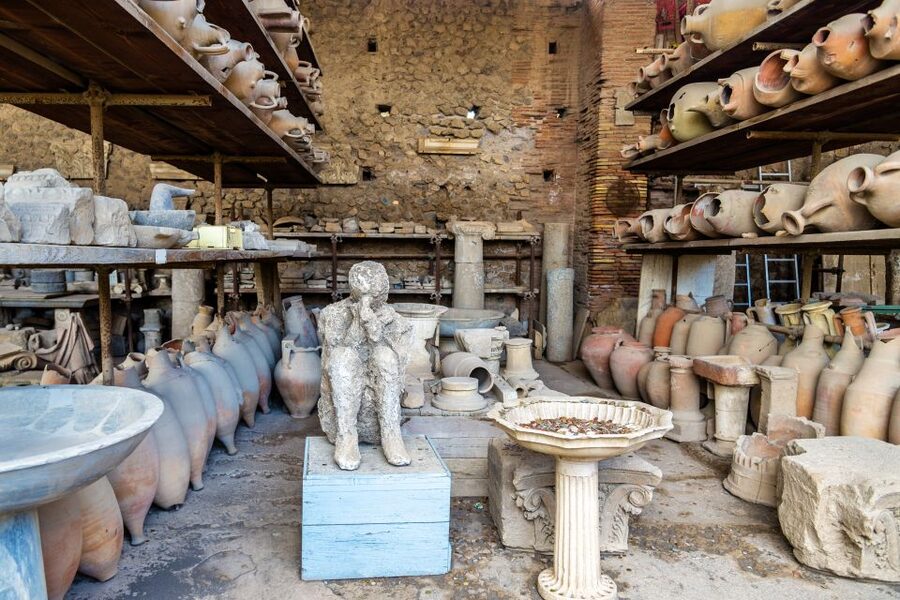
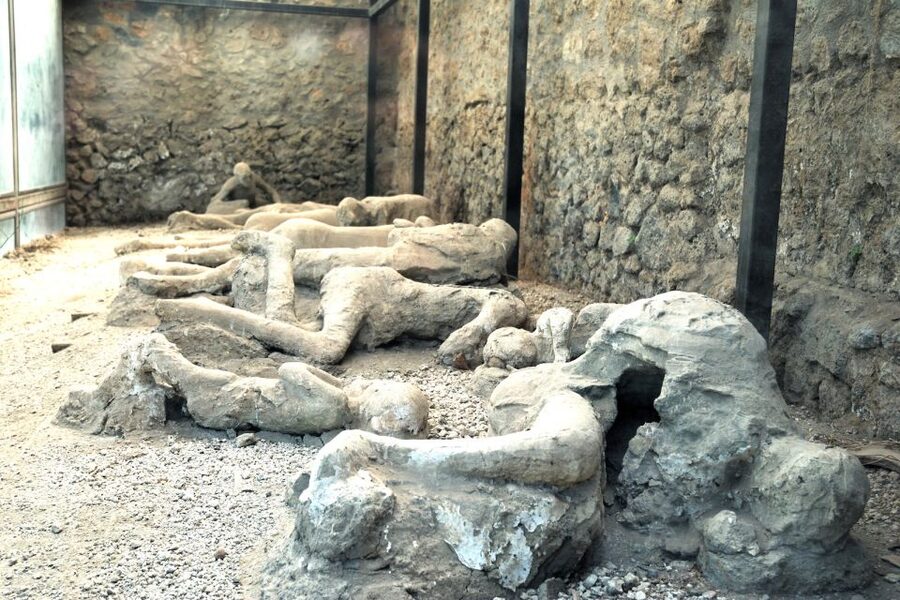
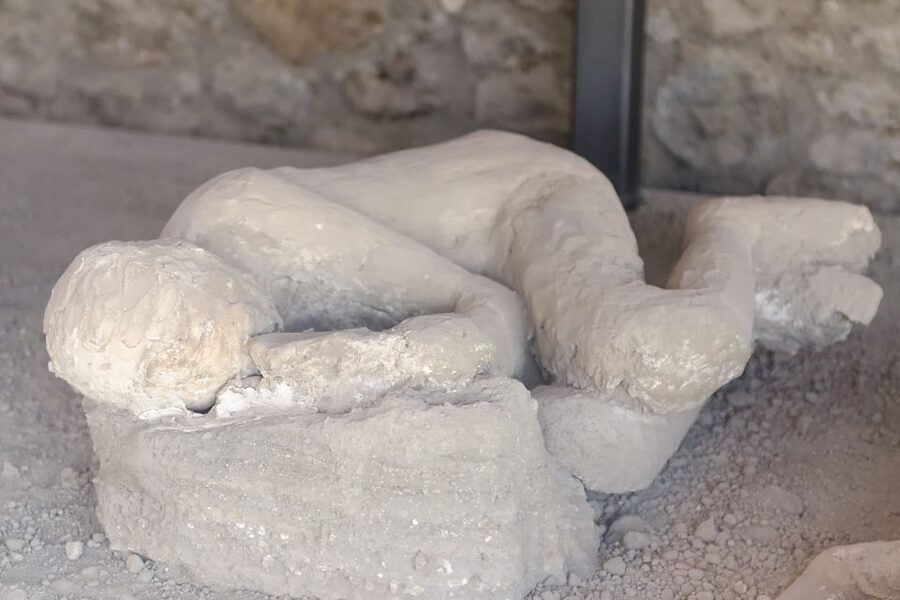
The human casts are among Pompeii’s most emotionally difficult sights. They show the final moments of people caught by the eruption, but their location and availability can change. Some areas containing casts have been closed during restoration work, so do not assume every famous display will be accessible on the day you visit.
More broadly, expect some uneven paths and active preservation work. Ancient paving can be tiring underfoot, and you need to watch where you step. The site is wheelchair accessible, but access across every ancient surface may not feel equally easy, particularly where roads are uneven.
The work of conserving Pompeii is visible. That can mean scaffolding, barriers, or a closed doorway, but it also means the site is being protected for future visits. Keep your expectations flexible and focus on the sections that are open.
How much time should you plan?
Two hours can give you a taste, especially if you arrive late or are visiting with children. It is not enough for a complete visit. You might see the forum, a few major houses, and a public building, but you will leave large areas unexplored.
Three to four hours is a better minimum for the main highlights. Six hours gives you a much fuller experience, though even that may not cover every region. People who arrive in the morning and stay until late afternoon can still find that sections remain unseen.
A full day makes sense if you choose Pompeii+ and want to include the suburban villas. Start early, keep an eye on the final entry times, and avoid spending too long in the first few blocks. The city rewards steady progress more than a frantic final hour.
Pompeii is physically demanding. One visit involved about 22,000 steps, and that is a useful warning rather than an exact rule. Wear supportive walking shoes, carry water, and bring a hat or small umbrella for shade. Summer heat can become tiring quickly, since much of the route is outdoors and shade is not guaranteed.
There is a café on site selling food and drinks, including cold beer, but it is still sensible to bring water and small snacks. A sandwich, cereal bars, or similar food can save you from cutting the visit short when you are far from the exit.
Is the $40 price good value?
At around $40 per person, this is not the cheapest archaeological admission in Italy. The value depends on how much of Pompeii you use. If you spend only two rushed hours inside, the price feels less attractive. If you give the site half a day or more and use the audio guide, it becomes a fair price for access to one of Europe’s most important archaeological areas.
The reserved entry is useful during busy periods, but do not assume it eliminates every wait. You may still need to collect a ticket or find the correct desk. The main advantage is planning ahead, not guaranteed instant passage through every gate.
The digital guide is included, while the physical audio guide is an option you add when booking. That gives you flexibility. Use the phone guide if you want written information and do not mind managing battery life. Choose the physical unit if you prefer a separate device and a built-in map, but remember the ID deposit and return trip.
If you qualify for free admission, check the rules before paying. Entry is free for EU citizens under 18, as well as disabled citizens and their relatives. This activity is also refundable if canceled at least 24 hours in advance, and the reserve-now, pay-later option can help if your schedule is still shifting.
Who should book this Pompeii ticket?
I would choose it for independent visitors who want structure without joining a group. It suits history fans, photographers, families who need to pause or move at their own speed, and anyone staying in Naples, Sorrento, or near the Amalfi Coast who can set aside a proper block of time.
The standard ticket is best for a first visit with limited hours. Choose Pompeii+ if the Villa of the Mysteries is a priority and you have enough time for the extra sites. If your visit is already part of a tight day trip, the add-on may create more pressure than value.
Book this experience if you are prepared for a large, uneven, outdoor site and willing to spend several hours walking. Skip it only if your schedule allows a very short stop, since Pompeii deserves more than a rushed look at two or three ruins. Bring your ID, collect the audio guide at the correct desk, use a map, and plan your route before the first ancient street pulls you in.
FAQ
What does the Pompeii Express ticket include?
Pompeii Express includes entry to the ancient city of Pompeii. It does not include the suburban villas, including the Villa of the Mysteries, Villa of Diomedes, or Villa Regina.
What does the Pompeii+ ticket include?
Pompeii+ includes the ancient city of Pompeii, the Villa of the Mysteries, Villa of Diomedes, and Villa Regina in Boscoreale with its Antiquarium.
Is a guided tour included?
No. This is a self-guided visit with a digital audio guide included. An official physical audio guide is available if you select that option.
Where do I collect my ticket?
Show your voucher at the Porta Marina Superiore or Piazza Esedra ticket office. Follow the booking instructions carefully because the entrances and queues can differ.
Where do I collect the physical audio guide?
Collect it at the official audio-guide desk near the ticket office at Porta Marina Superiore, at Via Villa dei Misteri n. 2. You must return it to the same desk after your visit.
Do I need identification?
Yes. Bring a passport or ID card. A valid ID is required as a deposit when you collect the physical audio-guide device.
Can I use Bluetooth headphones with the audio guide?
No. Bluetooth headphones do not work with the physical audio-guide device. Headphones are not included.
What languages are available?
The audio guide is available in English, Italian, Chinese, Japanese, Portuguese, Russian, German, French, and Spanish.
How late can I enter with the Pompeii+ ticket?
For Pompeii+, the last entry is 3:30 p.m. from November 1 through March 31, and 5:30 p.m. from April 1 through October 31. Check your arrival time carefully before choosing this option.
Latest audio tours in Italy
- Pantheon Skip the Line Entry Tickets with Digital Audio Guide★ 3.5 · 52 reviews
- Audio guide in Vatican Museums and Sistine Chapel★ 4.5 · 12 reviews
- St. Peter’s Basilica: Dome Climb with Lift & Audioguide★ 4.5 · 13 reviews
- The Roman Jewish Ghetto: A Self-Guided Audio Tour★ 4.0 · 8 reviews
- Experience: The Pantheon Audio Tour★ 4.5 · 4 reviews
- Trastevere: A Self-guided Audio Tour of Rome’s Medieval Village★ 4.5 · 3 reviews
- Navova square underground with audioguide★ 4.5 · 17 reviews
- The Colosseum’s Attic with 3rd, 4th & 5th Levels with Audio Guide★ 4.5 · 20 reviews
Italy Audio Tours, compared.
Pantheon Fast-Track Ticket and Official Audioguide
Read our review →
Colosseum & Forum with Audio Guide App -Optional Arena
Read our review →
Timed Entry to Michelangelo’s David + Audio App
Read our review →
City Sightseeing Hop-on Hop-off Bus with Audioguide
Read our review →
La Fenice Opera House Entry Ticket with Audio Guide
Read our review →
Colosseum, Forum, Palatine Hill Entry & Audioguide App
Read our review →
St. Peter’s Basilica & Dome Entry Ticket & Audio Tour
Read our review →