
Reviewed · MALLORCA
Palma de Mallorca Medieval Jewish Quarter Audio Guide
Palma’s medieval Jewish Quarter is not a place of grand ruins and preserved streets. Much of the old quarter has vanished, which makes this GPS-guided audio walk useful: it helps you picture the community that once lived behind today’s walls and along today’s narrow lanes. The commentary was created by Dani Rotstein, and the route takes about an hour to an hour and 15 minutes.
I like the freedom to stop, look around, and set your own pace. I also like the very low price of $9.99, especially since you get lifetime access, offline maps, and a virtual playback option. The main drawback is simple: you need your own smartphone and headphones, and the experience will not suit you if you want a live guide to answer questions.
Key points at a glance
- A GPS route through medieval Jewish Palma: Start near Basilica de Sant Francesc and finish at Plaça de Santa Eulàlia.
- Dani Rotstein’s commentary: The narration supplies context for places where little physical evidence remains.
- Four notable stops: See Carrer de la Pelleteria, the Church of Mount Zion, the Tower of Love, and the statue of Jafuda Cresques or Jaume Ribes.
- A flexible one-hour walk: Pause whenever you like, or use the virtual playback option from another location.
- Offline use included: Download the audio, map, and geographic data before setting out.
- A strong budget choice: At $9.99 per person, the tour costs less than most live walking tours, but offers no personal guide.
What this Palma audio walk really offers
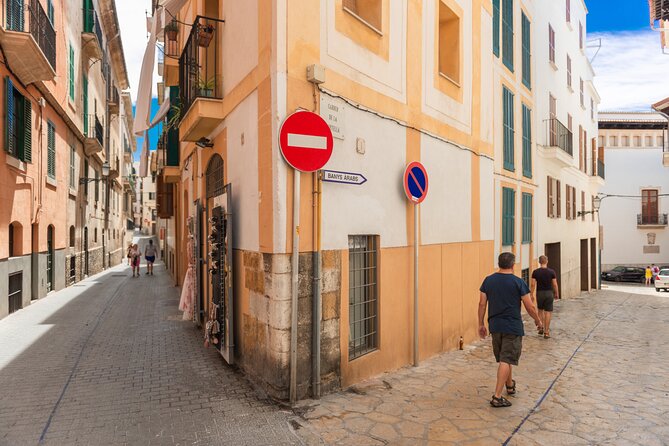
This is less a sightseeing checklist than a historical walk through a quarter that has been partly erased by time and later development. You will not move from one perfectly preserved medieval building to the next. Instead, the route uses streets, landmarks, and spoken explanation to help you read the old quarter.
That distinction matters. If you need visible ruins at every turn, the tour may feel light on physical sights. If you enjoy connecting present-day streets with earlier communities, the format makes good sense.
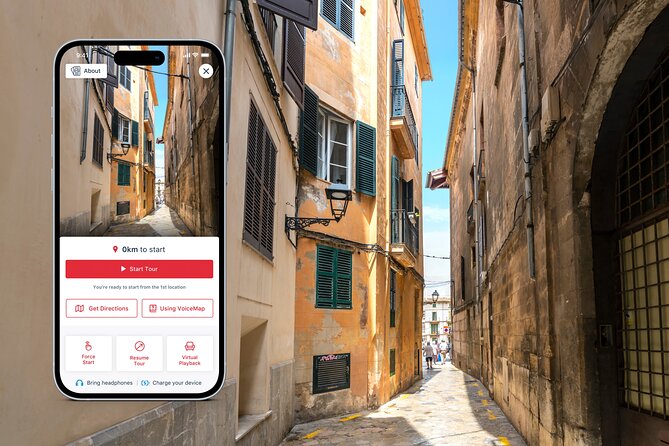
The GPS function is the key feature. Once you reach the correct starting point, the audio begins according to your location, and directions guide you from one point to the next. That reduces the usual problem with self-guided walks: wondering if you are standing in the right alley or walking in the wrong direction.
You can take the route privately, with only your own group participating. There is no meeting time with a guide, no need to keep pace with strangers, and no pressure to move on while you are still looking at a place.
More Audio Tours in Spain
- Barcelona: Sagrada Familia Entry Ticket with Audio Guide
★ 4.6 · 105,312 reviews - Barcelona: Casa Batlló Entry with Self-Audioguide Tour
★ 4.7 · 25,359 reviews - Granada: Alhambra Entry Ticket with Audio Guide
★ 4.1 · 5,950 reviews
Starting near Basilica de Sant Francesc
The walk begins at Centre Maimó Ben Faraig, near Basilica de Sant Francesc at Carrer de l’Almudaina, 9, in Palma’s central district. This gives you a clear point to enter the old town and get oriented before the historical commentary begins.
Follow the directions in the app carefully. The tour is designed to start when you are in the right location, so arriving close to the stated starting point matters. You should have your phone charged and the audio, map, and geographic data available offline before you begin.
The route is open to use at any time during the stated operating period, from May 22, 2024 through February 16, 2027. The published hours cover every day and all hours, which gives you plenty of freedom. Still, a daylight start may make it easier to spot street details and follow directions through the old town.
The opening section sets up the medieval Jewish Quarter. Since the route is self-guided, you can pause the narration whenever you want to examine a building, check the map, or let your group catch up.
Carrer de la Pelleteria and the feel of the old quarter
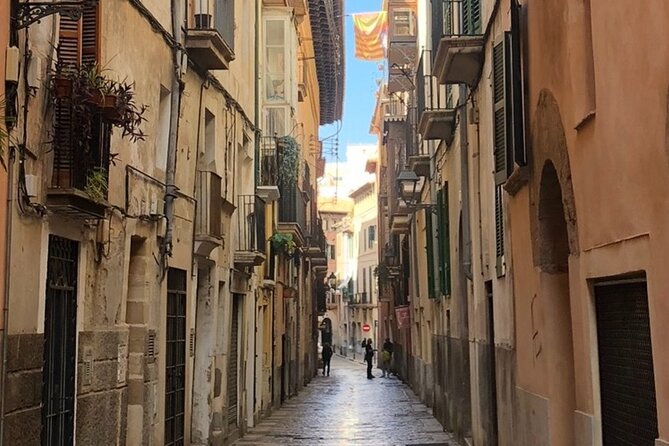
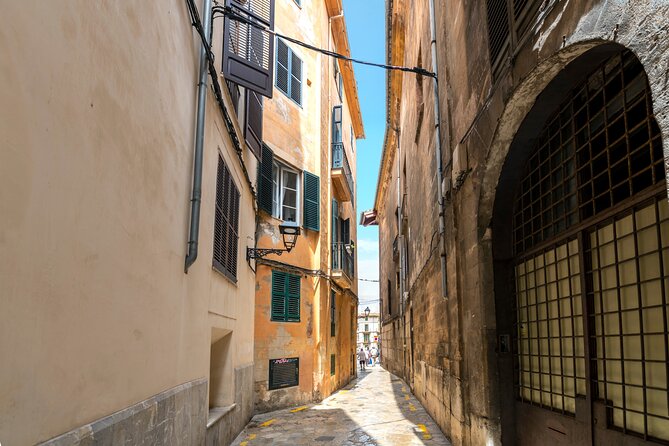
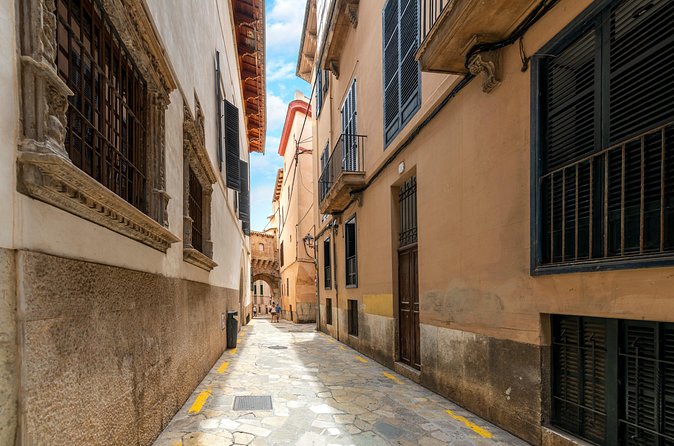
The route passes through Carrer de la Pelleteria, one of the narrow streets that helps convey the shape of old Palma. This is where the audio format earns its keep. A street may look ordinary at first glance, yet the commentary can explain how it fits into the earlier Jewish neighborhood.
Do not expect a large, clearly marked attraction here. The value lies in the setting and the story attached to it. The walk asks you to pay attention to alleys, corners, and the pattern of the old town rather than only to formal monuments.
One useful tip is to avoid rushing through this part. Since you can listen at your own pace, stop for a moment when the narration points out a detail. The route was made for people who might not locate these spots without help, so the directions are part of the experience, not just a way to get from one major sight to another.
The trade-off is that the neighborhood may feel subtle. You need some imagination, and the audio carries much of the historical weight. That is not a flaw in the route so much as an honest reflection of what remains visible today.
The Church of Mount Zion and Palma’s Jewish communities
The Church of Mount Zion is one of the most important places on the route. Its connection to Palma’s Jewish and Converso communities gives the stop more weight than a quick photo opportunity.
The audio places the church within the story of those communities, helping you understand why the site matters even if you arrive without much visible evidence of the medieval quarter. You can stop outside, listen, and consider how the building fits into the changing religious and social life of Palma.
This is one of the tour’s stronger stops for anyone interested in the movement between Jewish and Christian identities in medieval Mallorca. The subject is not treated as a simple story of one group appearing and another replacing it. The mention of Converso communities points to a more complicated past, one shaped by pressure, change, and shifting public identity.
The tour information does not promise entry inside the church, so plan this as an exterior stop with audio commentary. That is important if you are looking for an indoor visit or formal admission. The route is built around the streets and locations of the quarter, not around included museum access.
Another self-paced route in Spain:
- Casa Batllo Admission Ticket with Intelligent Audio Guide
★ 4.5 · 3,168 reviews - Madrid: Las Ventas Bullring Tour with Audio Guide
★ 4.6 · 3,154 reviews - Cordoba: Mosque-Cathedral E-Ticket with Audio Guide
★ 4.1 · 2,895 reviews - Nerja: Caves of Nerja Entry Ticket with Audio Guide
★ 4.6 · 1,616 reviews
The Tower of Love and a story with scandal
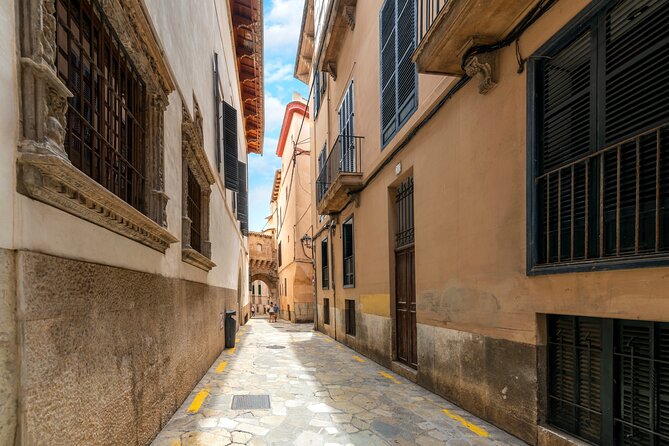
The Tower of Love adds a different mood to the walk. This location is tied to scandal as well as history, giving the route a more personal and dramatic turn after the broader discussion of Palma’s communities.
You will want to give this stop time rather than treating it as another point on a map. The name alone invites curiosity, but the audio is what explains why the tower has become part of Palma’s local story.
This kind of stop helps keep the walk from feeling like a list of dates and religious sites. Medieval neighborhoods were made of real people, private conflicts, and public consequences. A story linked to scandal can make the past easier to picture, even when the physical remains are limited.
The practical limitation is that an audio guide cannot respond to your questions or adjust the length of the explanation. If the story catches your interest, you can replay it, since the tour offers unlimited lifetime use. That is a useful advantage over a one-time spoken presentation.
Jafuda Cresques or Jaume Ribes
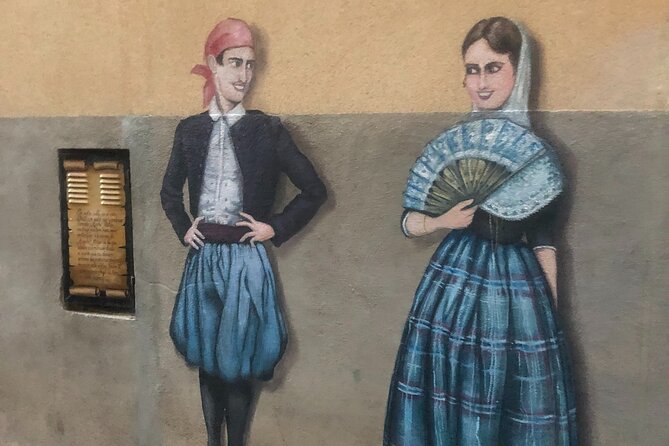
The route passes the statue of Jafuda Cresques or Jaume Ribes, a striking reminder of the different identities connected with Palma’s Jewish and Converso past. Even the paired name is worth noting, since it points to the way identity and public life could shift across religious and political lines.
This stop gives the walk a visible focal point. Unlike a street whose importance may be hard to spot, a statue provides something concrete to find while the audio supplies the surrounding context.
You can use this point as a chance to slow down and review what the tour has covered so far. The route links places that may not announce their medieval importance on their own, so the statue helps bring the themes together.
Because the experience is self-guided, you are free to spend extra time here or move on quickly. That flexibility is especially handy if you are fitting the walk between other plans in Palma’s old town.
Why GPS audio works well here
A traditional live tour has one obvious advantage: you can ask questions. This audio walk has a different strength. It gives you a private route through places that might be easy to miss, and it does not require a group to gather at a fixed time.
The GPS activation is designed to start the commentary when you are in the right place. Directions then help guide you along the route. One of the strongest details about this experience is that the navigation and spoken instructions are meant to work together, rather than forcing you to keep checking a separate printed map.
Offline access is another practical plus. You can use the audio, map, and geographic data without relying on a constant internet connection. Download everything before you start, then keep your phone in a pocket or bag while listening.
You also receive a virtual playback option. That means you can listen to the tour like an audiobook from somewhere else, even before or after your walk. It is not a substitute for seeing the streets, but it adds value if you want to revisit the historical material later.
The value of $9.99 per person
At $9.99 per person, this is priced as a small add-on rather than a major excursion. For that fee, you receive the GPS route, directions, audio, offline content, and unlimited lifetime use.
I consider that good value if you are already planning to explore central Palma. The tour gives structure to an area you might otherwise walk through without noticing its historical connections. Two particularly useful features are the ability to pause and the ability to reuse the tour later.
The price is less compelling if you expect a personal guide, detailed conversation, or access to historic interiors. Nothing in the experience includes a live host, smartphone, headphones, or admission to a church or other site. You are paying for the route and narration, not a full guided excursion with entrance tickets.
The small group format also keeps the cost predictable. Only your group participates, so you are not joining a large public walk. For couples, families, or friends who prefer privacy, that can make the audio format more appealing.
How long the route takes
Set aside about one hour to one hour and 15 minutes. The shorter time may suit a steady pace with limited stopping. The longer estimate gives you room to listen, follow directions, and pause at the main locations.
I would not schedule another activity too tightly after the finish. Self-guided walks often take longer when you stop for photos, check the map, or replay a section. The published duration is an estimate, not a strict appointment.
The route ends at Plaça de Santa Eulàlia in central Palma. That makes the finish easy to identify and leaves you in the old town rather than returning to the starting point. Remember that this is a one-way walk, so plan your next stop from the ending square.
Who should choose this experience
I would recommend this tour most strongly to you if you enjoy history but do not need a live speaker. It is also a good fit if you like walking alone or with your own group and want to avoid fixed departure times.
It works well for:
- Independent visitors exploring Palma’s old town
- People interested in Jewish and Converso history
- Couples and families who prefer a private route
- Visitors who want a low-cost activity between other plans
- Anyone who appreciates map-based directions and audio storytelling
It may not be the best choice if you want extensive indoor sightseeing, a guide who can answer questions, or a route built around grand surviving buildings. The physical remains of the medieval quarter are limited, and the spoken narrative does much of the work.
Service animals are allowed, the route is near public transportation, and most people can participate. The data does not provide a detailed accessibility assessment, so if you have specific mobility needs, check the route conditions before booking.
Booking, equipment, and cancellation
Bring your own smartphone and headphones. Those are not included, and the tour depends on having a working phone for GPS, audio, and maps.
Confirmation is provided at booking. Since the experience can be used independently, you do not need to coordinate with a live guide. You should still follow the directions to the exact starting point at Centre Maimó Ben Faraig near Basilica de Sant Francesc.
Free cancellation is available if you cancel at least 24 hours before the experience start time. Cancellations within 24 hours are not refunded, and changes made in that period are not accepted. The cut-off uses Palma’s local time.
Should you book the Palma Medieval Jewish Quarter Audio Guide?
Book it if you want an inexpensive way to give shape to Palma’s less obvious history. The route’s best qualities are its careful GPS directions, its access to streets you might otherwise miss, and Dani Rotstein’s ability to connect modest modern settings with the lives once tied to them.
Skip it if you need a live guide, guaranteed indoor visits, or a procession of preserved monuments. The quarter’s story is stronger than its remaining physical evidence, and you will need to listen closely and use your imagination.
At $9.99, with offline access and lifetime reuse, the risk is small. For an independent visit to central Palma, this is a sensible historical walk and a particularly good choice for travelers who like their sightseeing flexible, private, and guided by a phone rather than a flag in the air.
FAQ
How long does the Palma Medieval Jewish Quarter Audio Guide take?
The tour takes approximately one hour to one hour and 15 minutes.
How much does the audio tour cost?
The price is $9.99 per person.
What language is the tour offered in?
The tour is offered in English.
Where does the tour begin?
It begins at Centre Maimó Ben Faraig near Basilica de Sant Francesc, at Carrer de l’Almudaina, 9, in Palma’s central district.
Where does the tour end?
The route ends at Plaça de Santa Eulàlia in central Palma.
Do I need to bring my own phone and headphones?
Yes. A smartphone and headphones are not included, so bring your own.
Can I cancel for a refund?
Yes. You can receive a full refund if you cancel at least 24 hours before the experience start time. Cancellations within 24 hours are not refunded.
Latest audio tours in Spain
- San Sebastian Scavenger Hunt & Highlights Self Guided Audio Tour★ 4.0 · 7 reviews
- Sampling San Sebastián’s History: A Self Guided Audio Tour★ 4.5 · 5 reviews
- Spain’s Golden City: A Salamanca Audio Tour★ 4.0 · 17 reviews
- E-Ticket to Mérida Roman Theatre with Audio Guide★ 3.5 · 3 reviews
- Palma de Mallorca: City Walk Audio Guide in 7 Languages on Phone★ 3.5 · 6 reviews
- Self-Guided Audio Tour – The Kingdom of Mallorca★ 3.5 · 7 reviews
- Malaga Scavenger Hunt and Highlights Self Guided Audio Tour★ 4.5 · 4 reviews
- Soller’s Secret Stories: An Audio Tour by Travel Author★ 4.5 · 2 reviews
Mallorca Audio Tours, compared.
Palma: Caves of Genova Ticket & Digital Audio Guide
Read our review →
Palma’s Alternative History: A Self-Guided Audio Walk
Read our review →

Palma de Mallorca: City Walk Audio Guide in 7 Languages on Phone
Read our review →
Soller’s Secret Stories: An Audio Tour by Travel Author
Read our review →Browse the lists this tour appears in