
Reviewed · MALLORCA
Palma’s Alternative History: A Self-Guided Audio Walk
Palma’s story is packed into a compact old-town walk, from a salty lake built during the 1960s tourism boom to a Gothic cathedral, an Arab palace, old churches, and a town square where the route ends. Sandra, a longtime resident, provides the narration, guiding you through the city’s Roman, medieval, royal, and modern chapters.
I like the freedom to pause and restart, especially if you want to step inside Santa Eulalia Church or stop at the old noble house that now serves as a lounge bar. I also like the low $9.99 price, which gives you a useful introduction without tying you to a group or a fixed departure time.
The main caution is the VoiceMap app. It has worked well for some people, but one user reported repeated crashes and another found it drained the phone battery quickly. Download the tour and map before setting out, and begin with a well-charged phone.
Key points to know before you go
- Start beside Palma’s postcard view: Parc de la Mar faces the Cathedral and Almudaina Palace.
- Follow Sandra’s local narration: The walk connects famous sights with smaller streets, courtyards, churches, and a historic bar.
- Expect about one hour to 90 minutes: Your pace, pauses, and time inside open buildings will affect the total.
- The route crosses several eras: You’ll hear about Talayotic culture, medieval Palma, the Spanish Inquisition, royal power, and the tourism boom.
- Use the app carefully: VoiceMap supplies offline audio, maps, and geodata, but battery use and occasional app trouble are real considerations.
- Finish at Plaça de Cort: The walk ends near Palma’s town hall, close to the old city center.
Starting at Parc de la Mar beneath the Cathedral
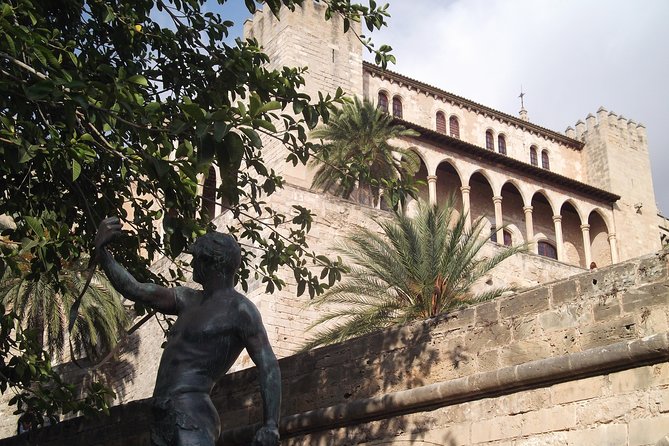
The walk begins at Parc de la Mar, a broad square with a small saltwater lake. Across the water, Palma’s Cathedral and the Almudaina Palace create an immediate lesson in the city’s layered past: Christian worship, royal rule, and the older Islamic foundations of Mallorca all meet in one view.
The park itself is not ancient. It was built over the sea in the 1960s, when Mallorca was in the middle of a major tourism boom. That detail gives the route a useful opening note. Palma is not only a medieval city preserved under glass. It has changed quickly, sometimes in ways that are easy to miss when you are focused on the Cathedral’s flying buttresses and carved stone.
This is a good place to start the audio, check your map, and make sure the phone is behaving. The route is self-guided, so there is no group waiting and no guide standing at a meeting point with a flag. You can begin when it suits you during the stated operating period, which runs every day around the clock.
More History Audio Tours in Spain
- Madrid: Archaeological Museum E-Ticket and Audio Guide
★ 4.3 · 115 reviews - Historic Ciutadella: A Self-Guided Audio Tour
★ 4.5 · 29 reviews - Ronda Old Town Walking Tour with Audioguide on Your Smartphone
★ 4.0 · 20 reviews
Palma’s Art Nouveau turn
One stop brings you to a grand Art Nouveau monument built in the early 1900s. The details provided for the walk do not name the building, but the point is clear: Palma’s story does not stop with Gothic churches and Arab walls.
The early twentieth century brought new wealth, new styles, and a desire to make the city look modern. As you listen, look up at the building’s façade rather than rushing past at street level. Art Nouveau often rewards that small change in habit, with decorative lines and shapes that are easy to miss among signs and traffic.
This part of the tour helps break up the medieval focus. You are not simply moving from one old stone building to another. The audio shows how Palma shifted from a historic island capital into a city shaped by commerce, architecture, and later tourism.
A seventeenth-century house with a practical pause
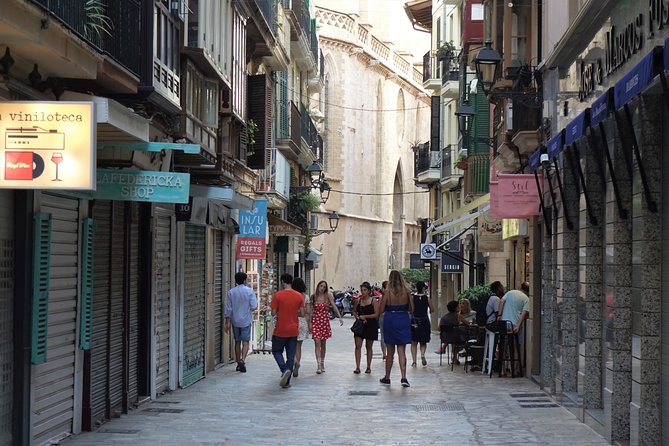
The route visits a typical noble Majorcan house once called Can Marcel. Built in the seventeenth century, it now contains a lounge bar with a rustic, authentic design.
That makes this stop useful in two ways. First, you get a look at the kind of aristocratic home that helped define old Palma’s streets. Second, you have a natural place to pause. Because the walk is not locked to a guide’s timetable, you can stop for a drink if the bar is open, then return to the audio when you are ready.
The route description does not promise a reserved table, food, or drink, so treat the lounge bar as an optional break rather than part of the ticket. Still, it is a good example of how a self-guided walk can leave room for ordinary city life. A historic building is more interesting when you can see how it is used today.
Santa Eulalia and the kings before the Cathedral
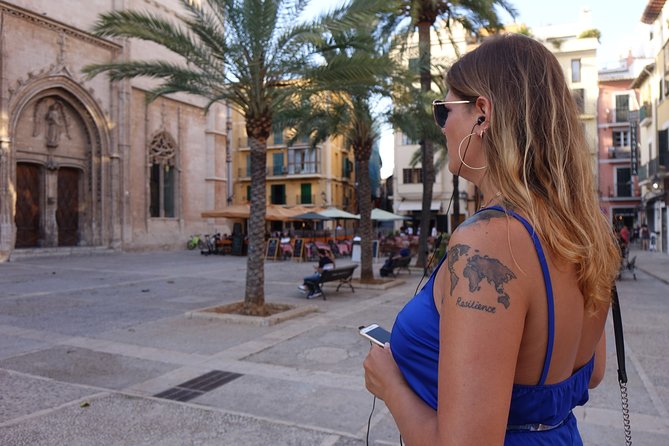
Santa Eulalia Church is one of Mallorca’s oldest churches, dating to the thirteenth century. Before the Cathedral was completed in 1601, the first kings of Mallorca were crowned here.
That fact gives the church real weight. It was not simply a neighborhood place of worship. It served as a royal stage while Palma’s great Cathedral was still under construction. Inside, the decoration is Baroque, creating another visual shift from the exterior’s older structure.
Admission is free, which makes this one of the better stops for a pause inside. The audio can tell you why the building matters, but it cannot replace looking around in person. Check the church’s conditions when you arrive, since open access can vary, but the tour specifically identifies the interior as free to visit.
I like this stop because it gives you a reason to pay attention to a building that might otherwise be overshadowed by the Cathedral. Palma has several major sights close together, and the smaller one can sometimes provide the clearer sense of how the city grew.
More Self-Guided Audio Tours in Spain
- Madrid: El Retiro Park Self-Guided Audio Tour
★ 3.8 · 134 reviews - Ronda Self-Guided Audio Tour with Andalucia Travel Expert
★ 4.5 · 26 reviews - Gaudi and La Sagrada Familia Exterior Self-Guided Audio Tour
★ 3.5 · 25 reviews - Valencia: Self-guided Audio Tour on Your Smartphone
★ 4.0 · 21 reviews
The street that once carried Sa Riera
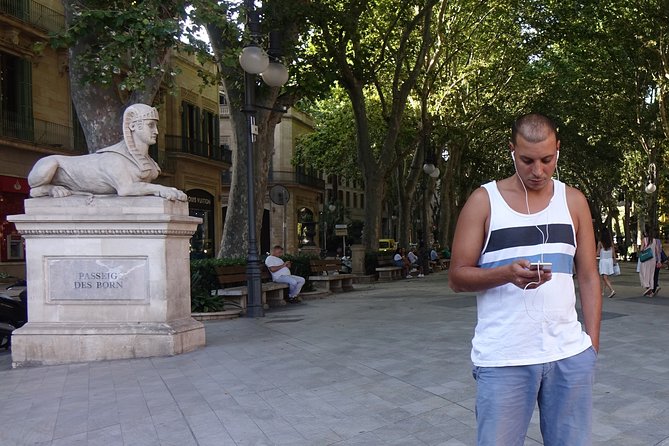
At another point, the walk follows a street where the torrent of Sa Riera once flowed. The watercourse divided Palma into two parts, and knights’ tournaments were held along it.
You can use this stop to picture a city that looked very different from today’s paved streets. A torrent is not just a name on a map. It shaped movement, boundaries, and public events. The mention of tournaments also adds a touch of medieval drama without requiring a museum visit or a long detour.
This is the kind of information that works especially well in an audio walk. You are standing in an ordinary-looking street, then the narration gives it an older purpose. Keep the map open here and listen for the next location. The route’s only real navigation complaint came from having to relocate manually after getting off track, so it pays to glance at your position rather than follow the audio blindly.
The Cathedral of Light
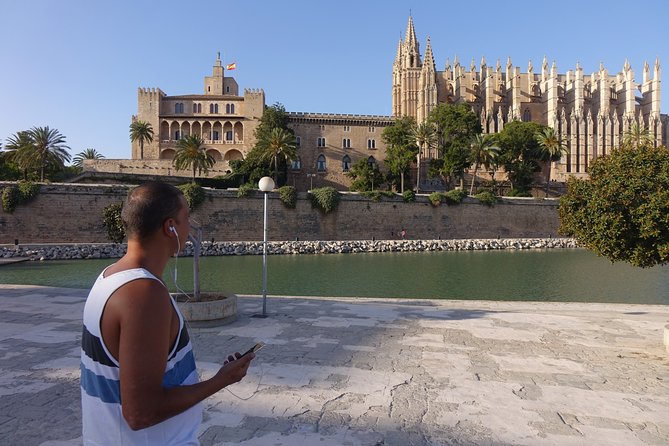
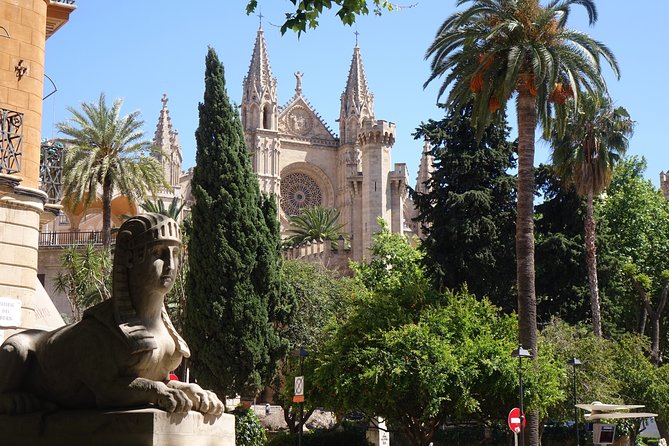
The Cathedral of Palma, known locally as La Seu, is the route’s grandest sight. Construction began in 1230 and ended 371 years later, in 1601. The long building period says something about medieval construction: this was a project carried across generations, not a quick civic improvement.
The nickname Cathedral of Light fits the experience of seeing the building from Parc de la Mar, where the façade catches the eye across the water. The tour gives you the historical frame, but you should allow your own time to look at the scale and Gothic detail.
Entrance fees are not included. If you want to go inside, you will need to buy a separate ticket, and that visit can extend the walk beyond the advertised one to 90 minutes. The audio route is therefore best seen as an introduction to the Cathedral rather than an admission package.
You may decide that the exterior is enough for this particular outing. If you have already planned a separate Cathedral visit, simply pause the tour and return to it later. That flexibility is one of the strongest reasons to choose self-guided audio over a fixed walking group.
Almudaina Palace and Mallorca’s royal past
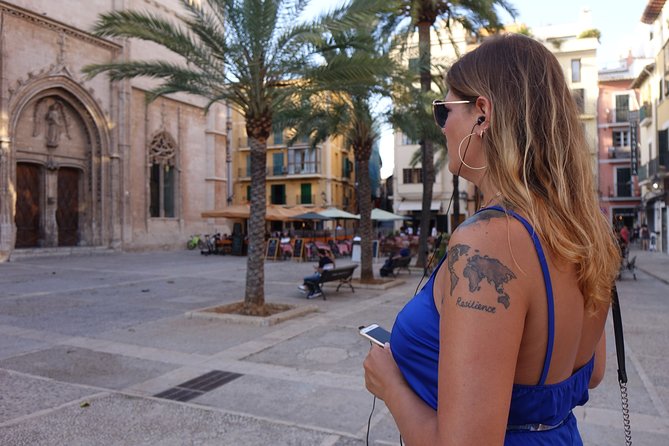
Facing the park is Almudaina Palace, built in the tenth century by an Arab king. It is described as Palma’s oldest monument and now serves several roles: official royal residence, museum, and military building.
The palace gives the walk one of its clearest links to Mallorca’s Islamic past. The Cathedral represents the Christian city that followed, while the Almudaina preserves the memory of an earlier ruling power. Hearing both stories from the same starting point helps you read Palma as a city built in layers rather than as a single-period monument.
The palace remains connected to Spain’s modern monarchy. King Philip VI receives official visitors there, including presidents from other countries. Admission is not included, so decide in advance if you want to add the museum or palace visit. The route itself can be completed without entering.
A free Gothic look at the old maritime exchange
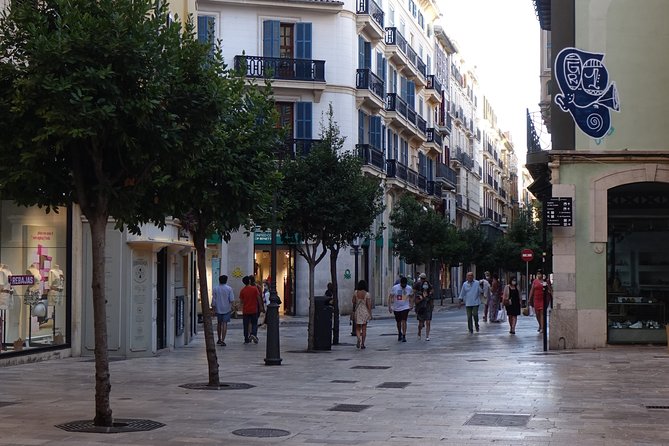
The walk also reaches a beautiful Gothic building completed in 1428. It once served as Palma’s maritime stock exchange and is open to the public without an admission charge.
Its original purpose points to Palma’s commercial life. This was a port city tied to shipping, trade, and business, not only a place of churches and royal ceremonies. The building’s Gothic style gives you another architectural marker, but its former use adds the practical story behind the stone.
Since entry is free, this is one of the easiest stops to add extra time to. Still, opening access can change, so do not treat the included audio as a guarantee that every door will be open at the exact moment you arrive. If you find it closed, the exterior remains part of the route.
Squares, saints, and the center of Palma
The walk visits a central square described as Palma’s Mile Zero, then continues to another handsome square built in the middle of the nineteenth century. That second square hosts the feast of Saint Sebastian each January 19, honoring Palma’s patron saint.
These stops shift the focus from buildings to public life. Squares tell you how a city gathers, celebrates, and marks its calendar. The Saint Sebastian connection also gives you a reason to think beyond the usual summer image of Mallorca. Palma’s identity is tied to local festivals and civic traditions as much as to seaside holidays.
The route ends at Plaça de Cort, near Palma’s town hall. This is a sensible finish because it brings you into the city’s civic heart rather than leaving you at an isolated monument. If you still have energy, you can continue exploring on your own. If not, the endpoint is a clear place to stop and orient yourself.
What the $9.99 price really buys you
At $9.99 per person, this is inexpensive for a private experience, provided you are comfortable guiding yourself. You receive lifetime access to the tour, the VoiceMap app for Android and iOS, and offline access to the audio, map, and geodata.
That last feature matters. Palma’s old center has many turns, and a downloaded route is more useful than relying on a constant data connection. You still need your own smartphone and headphones. Transportation, food, drinks, museum tickets, and other entrance fees are separate.
The price is especially fair for a first visit or a short stay. You get a structured route through major sights without paying for a private human guide. The tradeoff is that you cannot ask Sandra a question at the moment you see something unusual, and the route depends on your phone.
The tour has an overall rating of 4.2 from 18 reviews, which suggests a generally positive but not flawless experience. The strongest praise centers on clear stories about major sights, smaller discoveries, and the freedom to move at your own pace. The sharpest criticism concerns the app rather than the idea of the route itself.
Battery, navigation, and how to make the app work for you
VoiceMap uses location data to trigger the audio as you move. That is convenient when it works, but location services and audio can use a lot of battery. One person found the app especially energy-hungry, while another reported repeated crashes that required closing and reopening it and manually marking the location.
I would prepare in three simple ways:
- Charge your phone fully before leaving.
- Download the audio, map, and geodata in advance.
- Carry a power bank if you have one.
Keep the route map available and check your position at turns. The walk is not difficult for most people, but an audio tour cannot physically steer you back if you wander away from the route. The supplied information says most people can participate and that the start is near public transportation.
The walk is private in the sense that only your group takes part, but it is not a private live-guided tour. You will be listening to recorded narration, choosing your own pace, and handling your own navigation.
Who should choose this Palma walk?
I would choose this for a first visit when I want a quick historical framework before returning to individual sights. It suits independent visitors, couples, families with older children, and anyone who dislikes fixed group schedules.
It is also a good fit if your time in Palma is limited. In about an hour, or up to 90 minutes with pauses, you can connect the Cathedral, Almudaina Palace, Santa Eulalia, the old maritime exchange, historic squares, and the town hall area.
I would be more cautious if you want a detailed interior tour of every monument, a live guide, or guaranteed trouble-free technology. The ticket does not include attractions, and the app has had technical complaints. Anyone who finds phone navigation stressful may prefer a guided walk or a paper-based route.
The tour is offered in English, while the access details also list English or French. Confirm your preferred language when booking. The cancellation policy is strict: the experience is non-refundable and cannot be changed after purchase.
Should you book Palma’s Alternative History?
Book it if you want a low-cost, flexible introduction to Palma that connects famous sights with lesser-known stories. Sandra’s route gives you more than a checklist of monuments: you hear why a church mattered before the Cathedral, how a torrent divided the city, and how a noble house now fits modern Palma.
Skip it if app reliability is a dealbreaker or if you want admissions and a live guide included. For most independent visitors, the value is strong at $9.99, as long as you arrive with a charged phone, downloaded content, and realistic expectations about what a self-guided tour can do.
FAQ
Where does the audio walk start?
It starts at Parc de la Mar in Palma, Mallorca, beside the small saltwater lake facing the Cathedral and Almudaina Palace.
Where does the tour finish?
The route ends at Plaça de Cort in central Palma, roughly an hour after starting and near Palma’s town hall.
How long does the walk take?
The estimated duration is about one hour to one hour and 30 minutes. Stops inside buildings and personal pauses can make it longer.
What language is the tour in?
The tour is offered in English. The access details also list lifetime access in English or French, so confirm the language option when booking.
Is the tour guided in person?
No. It is a self-guided audio walk using the VoiceMap app. Only your group participates, and you can begin or pause the tour when you choose.
What does the price include?
The $9.99 price includes lifetime access, the VoiceMap app for Android and iOS, and offline access to the audio, maps, and geodata.
Are entrance fees included?
No. Tickets for the Cathedral, Almudaina Palace, museums, and other attractions are not included. Santa Eulalia Church and the Gothic maritime exchange are identified as free to visit.
Do I need to bring my own phone and headphones?
Yes. A smartphone and headphones are not included. Download the route in advance and bring a fully charged phone because the app may use significant battery.
Latest audio tours in Spain
- Seville Maestranza Bullring Tour with Audio Guide★ 3.5 · 6 reviews
- Seville Scavenger Hunt and Highlights Self Guided Audio Tour★ 5.0 · 5 reviews
- Seville Audio guided walking tour 3h20 and 28 audio commentaries★ 5.0 · 2 reviews
- Royal Alcazar of Seville Entry Ticket with Audio Guide★ 4.0 · 42 reviews
- Seville Cathedral and La Giralda Entry Ticket with Audio Guide★ 3.0 · 9 reviews
- Seville Cathedral and Giralda Entry Tickets with Audio Guide★ 4.0 · 56 reviews
- Essential Seville’s Ancient History: An Audio Tour★ 5.0 · 9 reviews
- Segovia from the Aqueduct to the Alcazar: A Self-Guided Audio Tour★ 4.5 · 10 reviews
Self-Guided Audio Tours, compared.
Acropolis Ticket & Optional Self-Guided Audio Tours
Read our review →

Ultimate Acadia National Park Self-Guided Driving Audio Tour
Read our review →

Akrotiri Ticket with Optional Self-Guided Audios
Read our review →
Browse the lists this tour appears in