
Reviewed · ITALY
Catania Walking Tour with Audio and Written Guide by a Local
Catania’s best sights are spread through a compact but layered old center, and this self-guided walking tour connects them in a sensible three-to-four-hour route. You move from the lava-stone walls of Ursino Castle to the fish market, cathedral square, Roman ruins, Baroque churches, and the Benedictine Monastery.
I like two things right away: the very low price of $7.83 and the freedom to stop, skip, eat, or change direction whenever you wish. The audio and written guide come in five languages, and Google Maps helps you keep moving without carrying a paper map.
The tradeoff is simple: this is not a personal tour. You need a smartphone, internet access, and a little preparation to activate the guide. One practical issue is the starting point at Ursino Castle, which may be inconvenient if you have already walked through central Catania.
Key points to know before you book

- Ursino Castle begins the route: Start among lava-stone defenses built for Frederick II of Swabia, then work toward the heart of old Catania.
- The fish market is a real slice of city life: A short stop at A’ Piscaria gives the route a local, working character before the grand monuments.
- Five languages are available: You can use audio and written material in English, Spanish, Italian, German, or French.
- The ancient amphitheater costs extra: The Roman Amphitheater is viewed from outside on the route. Entry is optional and costs €4.
- You set the pace: Pause the audio, take a meal break, wander off route, or finish somewhere other than the listed endpoint.
- The main limitation is digital: Bring a charged phone, an internet connection, and headphones if you prefer not to use the speaker.
Why this low-cost Catania walk works
At $7.83 per person, this is best understood as a digital walking companion rather than a traditional guided excursion. You are paying for a prepared route, commentary, map links, historical notes, curiosities, and restaurant suggestions. That is a strong deal if you want structure without a fixed group, fixed pace, or meeting time.
The route covers the core sights in about three to four hours, though the digital format makes that estimate flexible. You can spend a full hour at Ursino Castle, move quickly through the smaller stops, or pause for lunch near the market and continue later.
I especially like the way the route mixes famous buildings with ordinary city life. The cathedral and university square are essential Catania, but the fish market gives you a closer look at how the historic center functions day to day. The path also brings you along Via dei Crociferi, one of the city’s most striking streets, before ending at the large Benedictine Monastery of San Nicolò l’Arena.
The route is not difficult to understand, but you should read the activation instructions in your booking voucher carefully. The provider sends the details at booking and again before the activity. A problem with access can spoil an otherwise inexpensive outing, so activate the guide before you set off.
More Audio Walking Tours in Italy
- Florence: 2.5 hour Audio Guided Walking Tour led by Host
★ 4.6 · 293 reviews - Verona Walking Tour with Audio and Written Guide by a Local
★ 4.5 · 157 reviews - Bologna Walking Tour with Audio and Written Guide
★ 4.5 · 132 reviews
Starting with lava stone at Ursino Castle
The walk begins at Ursino Castle in Piazza Federico di Svevia. Allow about an hour here if you want to take in the setting and listen to the castle commentary without rushing.
The castle was first built close to the sea, with a moat and other defensive works around it. Etna’s eruptions and the changing shape of Catania later altered that relationship with the coast. The walls give you a useful first lesson in the city’s building material: squared blocks of dark lava stone form the outer wall, while the inner defensive wall is less regular.
The castle’s exact name has an uncertain origin, a small detail that suits Catania’s layered past. The square around it is named for Frederick II of Swabia, the Holy Roman Emperor and King of Sicily who commissioned the fortress.
Admission to this stop is listed as free. The digital guide gives you the background while you look around, but you will not have a person beside you to answer questions. If you prefer to linger over architecture or take photographs, this is one of the places where the self-guided format makes sense.
One practical point: starting here can feel out of the way if you are already staying near Piazza del Duomo. You may have walked past several later stops before reaching Ursino Castle. You can still follow the route in order, but the flexibility of this product means you can also begin elsewhere and use the map links to join it.
A’ Piscaria, Catania’s fish market

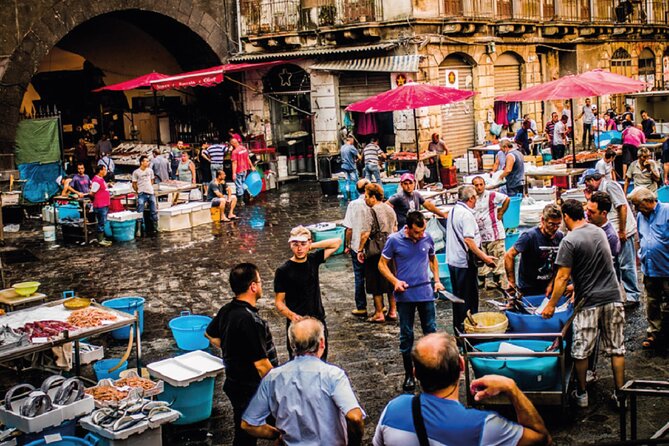
From the castle, the route heads toward A’ Piscaria, also called Piscarìa in the local Sicilian dialect. The stop takes about 20 minutes and brings you close to Piazza del Duomo and the Fontana dell’Amenano.
This is an important change of mood. The castle gives you military history. The market gives you a living part of Catania, where food, trade, and conversation have long shaped the character of the center. You may find the market more rewarding if you listen to the commentary before arriving, then put the phone away for a few minutes and simply watch the scene.
The stop is free, but market activity can vary by time and day. The supplied information does not promise a particular range of stalls or opening schedule, so treat this as a route highlight rather than a guaranteed food event.
The guide also includes advice on local restaurants serving authentic food. That can be useful here, since you are already near one of the city’s best areas for a meal. I would use the restaurant suggestions as a starting point, then check the map and your own appetite before deciding where to eat.
Water, cathedral stone, and Piazza del Duomo
The next stops form the visual center of the walk. First comes the Fontana dell’Amenano, a marble fountain created in 1867 by Neapolitan sculptor Tito Angelini. It represents the Amenano, the underground river that runs below Catania.
You only need about 10 minutes here, but the fountain helps explain the city’s relationship with water and its buried layers. It is also close to Piazza del Duomo, so the route does not waste time sending you across town between attractions.
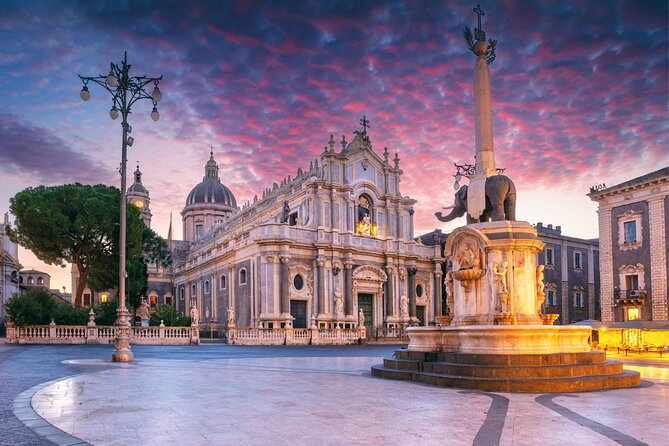
Piazza del Duomo receives about 20 minutes in the suggested schedule. This is Catania’s main civic and religious square, home to the Cathedral of Sant’Agata and other important monuments. The square works well as a pause point because you can stop the guide, sit nearby, take photographs, and decide how quickly to continue.
The digital commentary is useful here because the square can seem like a collection of handsome façades at first glance. Historical notes and curiosities give you a better sense of why the cathedral, fountain, and surrounding buildings belong together.
Another self-paced route in Italy:
- Rome: Pantheon Fast-Track Ticket and Official Audioguide
★ 4.5 · 27,353 reviews - Rome: Colosseum & Forum with Audio Guide App -Optional Arena
★ 4.2 · 24,770 reviews - Florence: Timed Entry to Michelangelo’s David + Audio App
★ 4.6 · 19,496 reviews - Rome: City Sightseeing Hop-on Hop-off Bus with Audioguide
★ 4.0 · 16,045 reviews
Inside the story of Sant’Agata Cathedral

The Cathedral of Sant’Agata is another 20-minute stop. It is a major example of Sicilian Baroque architecture and is dedicated to Catania’s patron saint.
The first church on this site was built in 1090 over the remains of a Roman temple dedicated to Jupiter. The cathedral was later rebuilt after the earthquake of 1693, which destroyed much of Catania. That sequence matters. The building is not simply an old church preserved unchanged. It reflects destruction, rebuilding, and the city’s repeated effort to recover.
The guide can help you notice those layers before you move on. Since admission is listed as free, the stop offers good value, though you should remember that religious buildings can have their own access rules at particular moments. The provided details do not give a separate opening schedule for the cathedral.
As with the rest of the tour, you control the amount of time. If sacred art and architecture interest you, pause the audio and explore slowly. If your main goal is a broad introduction to Catania, the suggested 20 minutes is enough to keep the route moving.
Piazza Università and its four legends
Piazza Università is a smaller stop, scheduled for about 10 minutes. Its name comes from the Palazzo degli Studi, also called Palazzo Università.
The square’s four bronze lampposts are the detail to watch for. Each represents a figure from Catania stories: Gammazita, Cola Pesce, the brothers Anfinomo and Anapia, and the paladin Uzeta. The lamps give the square a playful local touch and show how Catania’s identity includes legend as well as formal history.
This is exactly the kind of stop that can disappear if you explore alone with no plan. It is not the largest monument on the route, but the guide points you toward a specific detail and gives you a reason to pause.
Ten minutes is enough for a look and a few photographs. If you want to learn the stories in more detail, you can replay the written section later. The ability to stop and restart is one of the strongest parts of this format.
The Roman Amphitheater, viewed from outside
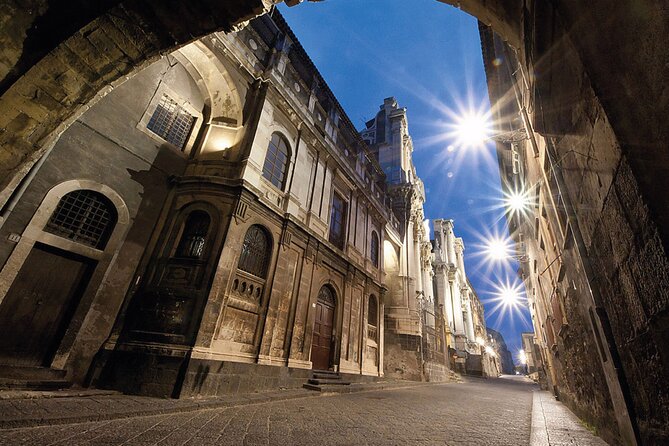
Beneath Piazza Stesicoro lies a Roman theater dating to the first century BC. Over time, eruptions from Etna and earthquakes covered and damaged parts of the site. The route spends about 25 minutes here, but the walk does not include entry.
You can visit the amphitheater independently for €4. That extra cost is modest, but it changes the value calculation slightly. If you want the full archaeological experience, budget for the ticket and allow extra time. If you are content with the exterior and the guide’s explanation, you can keep moving without paying more.
This is one of the clearest limits of the tour. The route brings you to an important site, but it does not provide admission or an inside visit. I would decide before starting if you want to enter, since that choice affects your timing.
Via dei Crociferi and Catania’s Baroque face

Via dei Crociferi receives about 10 minutes, though you may naturally spend longer walking along it. This is one of Catania’s oldest and most evocative streets, lined with architecture that has also attracted film productions.
The short time allocation does not mean the street is unimportant. It simply reflects the fact that this is an open public road rather than a single building with a queue or entrance. Listen to the commentary as you walk, then look up at the façades and note how the street feels different from the market and cathedral square.
This part of the route is especially good for people who prefer an outdoor city walk to a string of interior visits. It also gives you room to adjust the pace. Stop for coffee, take a side street, or continue directly toward the monastery.
Finishing at the Benedictine Monastery
The final listed stop is the Benedictine Monastery of San Nicolò l’Arena in Piazza Dante Alighieri. The suggested time is 30 minutes, and admission is listed as free.
The monastery was a major force in Catania, especially during the eighteenth century. Its size, rooms, and the noble backgrounds of its monks helped make it an important institution in the city. Ending here gives the walk a strong final chapter after the castle, market, cathedral, and Roman remains.
The listed endpoint is not a compulsory finish. Because the product is digital, you can stop anywhere, extend the walk, or use Google Maps to return to your starting area. That matters if you are tired, have dinner plans, or want to spend more time in the center.
The route operates throughout the day, with the stated availability running from midnight to 11:30 p.m. That broad window is useful, but you should still plan around the places you want to see rather than assume every monument will be open at every hour.
What you get for $7.83
The price is the main reason to consider this experience. For less than the cost of many short guided walks, you get:
- Audio and written commentary
- Five language choices
- Google Maps connections
- Historical notes and local curiosities
- Restaurant advice
- A planned route through major Catania sights
- The freedom to pause and change direction
That is excellent value for an independent visitor who enjoys learning through a phone. The format is also good for couples or families who do not want to keep up with a group.
The value is weaker if you want a human guide, lively conversation, or help with spontaneous questions. The experience can accommodate up to 104 people in its wider booking system, but you do not walk as part of a personal group. The number is less important here than the fact that everyone uses the digital guide independently.
Group discounts may be available, which can make the cost even more appealing for several people. Headphones are not included, so bring your own if you want to listen privately. Otherwise, you can use your phone’s speaker.
Who should choose this digital walk
I would choose this tour if you like setting your own schedule and want a clear introduction to Catania’s historic center. It suits independent adults, couples, families with older children, and anyone who wants to stop for food or photographs without asking a guide to wait.
It also works well if you have already done a few traditional guided tours and want something lighter. You can listen closely at the castle and cathedral, skim the shorter sections, and return to the written notes later.
I would think twice if you dislike using your phone while walking, have unreliable internet, or want a guide with you in person. The provider does offer support around activation, but the basic responsibility still belongs to you. Read the voucher, activate the guide, and check that the audio works before leaving.
Free cancellation is available when you cancel at least 24 hours before the start time. Inside that window, the amount is not refunded, and late changes are not accepted.
Should you book the Catania walking tour?
Book it if you want a cheap, flexible route through Catania’s main historic sights, and you are comfortable using a smartphone. The strongest parts are the clear sequence from Ursino Castle to the Benedictine Monastery, the useful restaurant tips, the five language options, and the freedom to explore at your own speed.
Skip it if you want personal stories, live conversation, or included entry to the Roman Amphitheater. For most independent visitors, though, $7.83 is a small price for a well-organized orientation to Catania. Start with the activation details, bring headphones, and treat the route as a framework rather than a rulebook.
FAQ
How long does the Catania walking tour take?
The experience takes approximately three to four hours, depending on how long you spend at each stop and whether you pause or make detours.
Is this a guided tour with a person?
No. It is a self-guided digital experience using audio and written material on your smartphone.
Which languages are available?
The audio guide and written guide are available in English, Spanish, Italian, German, and French.
Where does the route begin?
The listed starting point is Ursino Castle at Piazza Federico di Svevia, 21, in Catania.
Where does the listed route end?
The listed final stop is the Benedictine Monastery of San Nicolò l’Arena at Piazza Dante Alighieri, 32. Since the guide is digital, you can choose to finish elsewhere.
Is entry to the attractions included?
The listed stops are free, but entry to the Roman Amphitheater is not included. Its independent admission price is €4.
Do I need a smartphone and internet connection?
Yes. You need a smartphone with internet access to activate and use the digital guide. Activation details are provided in your booking voucher.
Are headphones included?
No. You can listen through your phone’s speaker or use your own headphones.
Can I cancel for a full refund?
Yes, if you cancel at least 24 hours before the experience start time. Cancellations made within 24 hours are not refunded.
Latest audio tours in Italy
- Orgosolo Multilingual Audioguide★ 4.5 · 42 reviews
- Pantheon Skip the Line Entry Tickets with Digital Audio Guide★ 3.5 · 52 reviews
- St. Peter’s Basilica: Dome Climb with Lift & Audioguide★ 4.5 · 13 reviews
- Audio guide in Vatican Museums and Sistine Chapel★ 4.5 · 12 reviews
- The Roman Jewish Ghetto: A Self-Guided Audio Tour★ 4.0 · 8 reviews
- Experience: The Pantheon Audio Tour★ 4.5 · 4 reviews
- Trastevere: A Self-guided Audio Tour of Rome’s Medieval Village★ 4.5 · 3 reviews
- Navova square underground with audioguide★ 4.5 · 17 reviews
Audio Walking Tours, compared.

City Monuments Guided Walking Tour with Audio Guide
Read our review →

Self Guided Classic Freedom Trail Location Aware (GPS) Walking Audio Tour
Read our review →
Self-Guided Historical Walking Tour (Audio Guide)
Read our review →
Cape Cod & Provincetown Self-Guided Driving & Walking Audio Tour
Read our review →
Verona Walking Tour with Audio and Written Guide by a Local
Read our review →
Royal Walking Tour and Buckingham Palace Audio Tour
Read our review →
Bologna Walking Tour with Audio and Written Guide
Read our review →Browse the lists this tour appears in