Reviewed · AUDIO TOURS
3-Days in Bucharest: Smart Audio Guide with Travel Instructions
Bucharest is easiest to understand when you connect its grand boulevards, Orthodox churches, communist-era landmarks, and old merchant buildings. This three-day smart audio guide does that with a self-guided route rather than a person leading you from stop to stop. You use the app on your own schedule, with travel instructions and audio commentary in English.
I like the way the plan mixes major sights with places that show everyday Romanian culture, especially the Village Museum, Manuc’s Inn, Stavropoleos Monastery, and Caru’ cu bere. I also like the practical setup: one app can run on several phones, and a human assistant is available through WhatsApp at any time.
The main thing to consider is that this is not an all-inclusive tour. You pay about $12.09 per person, but entrance tickets, food, drinks, and mobile data are extra. Some days also pack in several stops, so you will need to manage your pace and transport carefully.
Key points to know before booking
- A self-guided Bucharest route: You follow a customized mobile app instead of joining a fixed group.
- Three very different days: The plan moves from village architecture and communist history to museums, thermal pools, churches, bookstores, and Romanian food.
- Useful English audio: The app includes travel information, directions, and a history section that helps explain what you are seeing.
- Good for independent visitors: You can adjust the timing, pause for meals, and explore without keeping up with a guide.
- Admissions are separate: Most museums, churches, the mansion, Therme Bucuresti, and other paid sights require extra payment.
- WhatsApp help is included: You have access to a human assistant throughout the trip, not just an automated app.
How the smart audio guide works in Bucharest
This product is best understood as a digital trip plan with audio commentary, not a traditional guided tour. Before you begin, you receive access to a customized mobile application. The app is prepared for your Bucharest visit and can be made available as early as one day before arrival.
That early access matters. You can look through the route, check the order of sights, and get a sense of how much time each day requires. You are not meeting a guide at a single starting point and then moving as one group. Instead, the app accompanies you as you make your way around the city.
The route is offered in English. It includes attraction details, travel information, and historical notes. A human assistant is available by WhatsApp at all times, which is useful if you need help with the app or the day’s plan.
One practical advantage is that the same Smart Audio Guide can be used on multiple phones at the same time. That makes the $12.09 price especially appealing for two or more people traveling together. Still, each person should have a charged phone, and you need roaming or mobile data for the app to work as intended.
The listed hours run from midnight to 11:30 p.m. daily, so you are not tied to a narrow departure time. The route is private in the sense that only your own group uses it, but there is no live guide walking with you.
More Audio Tours in the world
- Barcelona: Sagrada Familia Entry Ticket with Audio Guide
★ 4.6 · 105,312 reviews - Rome: Pantheon Fast-Track Ticket and Official Audioguide
★ 4.5 · 27,353 reviews - Barcelona: Casa Batlló Entry with Self-Audioguide Tour
★ 4.7 · 25,359 reviews
Day 1: Village life, communist history, and old Bucharest
The opening day gives you a broad look at Bucharest. It begins with rural Romania, moves to the private world of Nicolae Ceausescu, then shifts toward parks, monuments, and old commercial buildings.
Dimitrie Gusti Village Museum
Allow about two hours at the Muzeul National al Satului Dimitrie Gusti. This open-air museum brings houses, churches, farm buildings, tools, furniture, ceramics, and textiles from different Romanian regions into one city setting.
This is one of the smartest first stops because it gives you context for the country beyond Bucharest. You see how homes and working buildings differed from one region to another. The buildings are not just empty façades. The collection includes household objects and technical installations, so the visit has a more practical feel.
You will want comfortable shoes and enough time to walk between sections. Admission is not included, and the museum can easily absorb more than a quick look if you stop to read the audio notes and examine the interiors.
Ceausescu Mansion
Next comes the former private residence of communist leader Nicolae Ceausescu, his wife Elena, and their three children. Plan on about an hour, with admission paid separately.
The appeal here is the sharp contrast with the Village Museum. You move from traditional homes and regional craft to the controlled private world of Romania’s former ruling family. The mansion gives the political story a domestic setting, which can make the period easier to picture.
The app can help you understand the people connected with the house, but you should expect the visit to be more focused than a large national museum. Check the entrance arrangements before setting out, since your ticket is not part of the package.
Another self-paced route in the world:
- Rome: Colosseum & Forum with Audio Guide App -Optional Arena
★ 4.2 · 24,770 reviews - Amsterdam: 75 Minute City Canal Cruise with Audio Guide
★ 4.4 · 19,938 reviews - Florence: Timed Entry to Michelangelo’s David + Audio App
★ 4.6 · 19,496 reviews - Amsterdam: City Centre Canal Cruise including Audioguide
★ 4.3 · 16,901 reviews
National Theatre and Triumph Arch
The National Theatre Ion Luca Caragiale gets about 30 minutes in the plan. Its modern architecture makes it a quick visual stop, especially if you enjoy contemporary civic buildings and theater design.
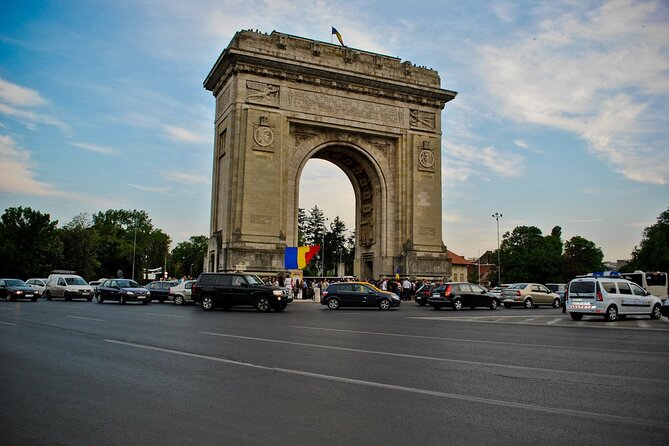
The Triumph Arch receives about 20 minutes. Bucharest’s arch commemorates Romania’s victory in the First World War and the union of territories inhabited by Romanians. The comparison with Paris is obvious, but the Romanian monument carries its own national story.
These short stops work well as part of a moving city route. They are not full museum visits. You will get the most from them if you use the audio notes while looking at the buildings, rather than expecting a long interior visit.
Herastrau Park and Manuc’s Inn
King Mihai Park, commonly called Herastrau Park, provides a slower hour. The park is free to enter and gives you a break from museums and architecture. The route describes it as one of Bucharest’s most varied parks, making it a useful pause between indoor stops.
Manuc’s Inn then brings you back to the city’s older trade routes. A han was a lodging place where merchants could stay with horses and carts, and Hanul lui Manuc preserves that commercial idea in central Bucharest. Allow about 90 minutes, although your actual time may depend on whether you stop for food or simply look around.
Day 1 is full, but it has a clear theme: Romania as a country of village traditions, political power, public monuments, and old trade. You should not expect every stop to be a long guided visit. The strength is the range.
Day 2: National collections, communist scale, and thermal water
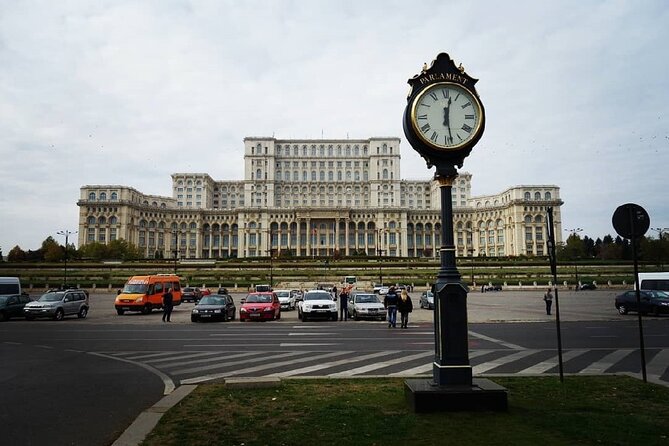
The second day shifts between museums, monumental city planning, and a modern spa complex. It may be the most demanding day to organize because the stops have very different settings and admission arrangements.
National Museum of Romanian History
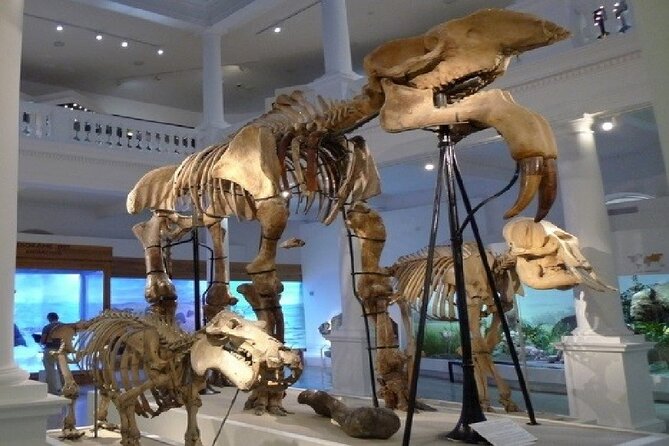
Set aside about two hours for the Muzeul National de Istorie a Romaniei. Its collections cover a wide span, with archaeological, geological, paleontological, ethnographic, zoological, mineralogical, and osteological material.
The unusual exhibits include a Deinotherium giganteum skeleton estimated at 7.5 to 8 million years old, Egyptian mummies, human fetuses, and a real cave. That mix gives the museum more range than a museum devoted only to political history.
The audio guide’s history section can be particularly useful here. With so many kinds of objects, it helps to have a sense of what deserves your attention instead of trying to absorb every display. Admission is separate, so include that in your daily budget.
Uranus and Boulevard Unirii
The Uranus stop concerns the huge administrative complex commonly associated with Romania’s communist period. It is described as the second-largest administrative building for civilian use in the world after the Pentagon. The visit is planned for about 90 minutes.
That size is the point. This is not just another grand government building. It represents the scale of the urban changes made under communist rule, including the planning of broad avenues and monumental public spaces.
Boulevard Unirii follows with about an hour. It is one of Bucharest’s key roads and an important transit route. The boulevard helps you read the city as a planned capital rather than a collection of unrelated buildings. It is free to visit, though you should allow for traffic and city walking when planning the day.
Therme Bucuresti
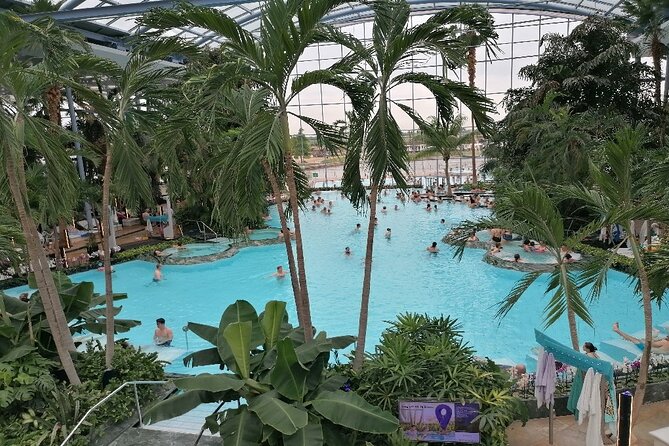
Therme Bucuresti receives three hours, making it the longest stop of the day. This modern spa complex has indoor and outdoor thermal-water pools, saunas, water slides, and a wave pool.
The stop gives the itinerary a welcome change of pace. After museums and large civic buildings, you can swim, use the pools, relax in the saunas, or choose the slides and wave pool. It is not a minor add-on, so check the separate admission cost before you commit to the plan.
Three hours sounds generous, but it can pass quickly in a large spa complex. You also need to account for the journey there and back. The route provides travel information, but the package does not include admission or food and drinks.
Antim Monastery
The final planned stop is Antim Monastery, built between 1713 and 1715 on the site of an older wooden church. Allow about an hour.
Its age and Orthodox character give the day a quieter finish. It also helps balance the enormous communist-era buildings with an older religious site. Admission is not included, and as with any place of worship, you should pay attention to any posted visiting rules when you arrive.
Day 2 is rewarding for people who like contrasts. You get fossils and mummies, monumental urban planning, thermal pools, and an old Orthodox monastery. It is less compact than the Old Town day, so use the app’s timing information and do not assume every stop will fit comfortably if you linger.
Day 3: Old Town, Calea Victoriei, and Romanian dining
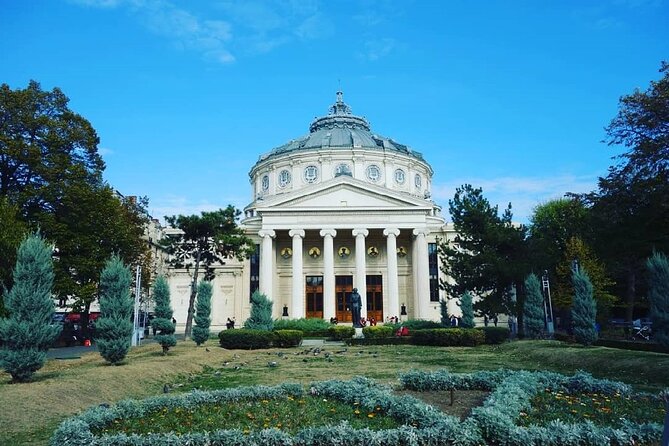
The last day is the most walkable in character, with cafés, churches, a bookstore, a historic bank building, and Bucharest’s best-known ceremonial avenue.
Valea Regilor and Stavropoleos Monastery
Valea Regilor is an Egyptian café intended to bring an Oriental atmosphere to central Bucharest. The plan gives it 30 minutes and no admission charge. It can serve as a short coffee or tea pause rather than a major sightseeing stop.
Stavropoleos Monastery follows, with about 30 minutes. Built in 1724 by the Greek monk loanichie Stavropoleanulos, it is an Orthodox monastery in the Brancovenian Romanian style.
This is a small stop, but it carries a lot of architectural interest. The monastery introduces a refined religious style within the central city, and the app’s historical notes can help you notice details that would be easy to miss on a quick walk past.
Carturesti Carusel and Palatul CEC
Carturesti Carusel is one of Bucharest’s best-known bookstores. The building dates from the early twentieth century, and the visit is planned for an hour.
You do not need to be shopping for books to enjoy this stop. The building itself is the reason to go, while the store gives you a chance to pause indoors. Admission is listed as not included, though the practical cost here may be whatever you choose to buy.
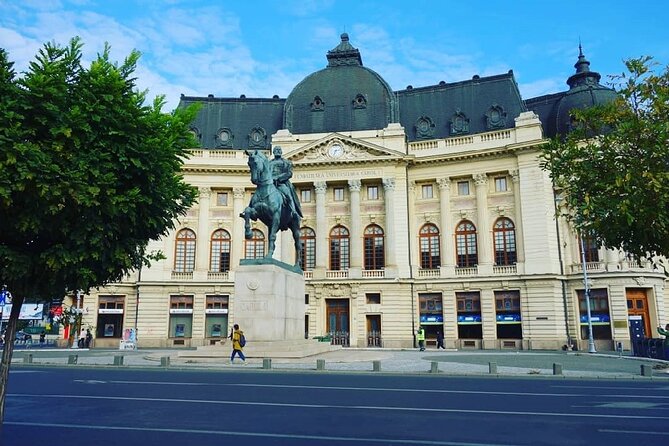
Palatul CEC gets about 30 minutes. The CEC banking institution began in 1864 under a law initiated by Romanian ruler Alexandru Ioan Cuza. This stop adds financial history to the day’s religious, commercial, and cultural themes.
Calea Victoriei
Allow three hours for Calea Victoriei, the longest stop on the final day. This is Bucharest’s classic promenade, with boyar houses, churches, inns, hotels, luxury shops, cafés, and state institutions along the route.
The avenue is linked with Bucharest’s old nickname, Little Paris, especially because of the city’s resemblance to Paris during the interwar period. The comparison is not a reason to skip the Romanian character of the street. Use the audio information to connect the architecture with the city’s own past.
Three hours allows you to walk at an easy pace and stop along the way. It also gives you room to adjust the day if an earlier site takes longer than expected. Some attractions along the avenue may charge their own admission, and food and drinks are not part of the tour price.
Caru’ cu bere
The final stop is Caru’ cu bere, planned for about 90 minutes. The restaurant is presented as a place for traditional Romanian music, dancing, and food.
This is a fitting end because it moves the trip from looking at Romanian culture to taking part in a meal setting connected with it. You pay for your own food and drinks, so consider the $12.09 guide price as a planning and commentary fee rather than a meal package.
The route does not guarantee a particular performance schedule or menu. Still, the stop gives you a clear suggestion for an evening built around Romanian food rather than another monument.
What the $12.09 price really buys you

At $12.09 per person, the cost is low for a three-day city plan. You are paying for the customized app, audio guide, travel information, attraction planning, access across multiple phones, and WhatsApp assistance.
The value is strongest if you want structure but not a fixed group. You can avoid spending hours deciding what to see next, while still choosing when to start, how long to stay, and where to pause.
The price does not cover the biggest variable costs. You still need to pay for museum and attraction admission, Therme Bucuresti, meals, drinks, and mobile data. Transport costs are also not listed as included, so budget for getting between stops.
If you already know Bucharest well, you may not need the full route. If this is your first visit, the app can save planning time and help you move beyond the most obvious center.
Who will get the most from this format
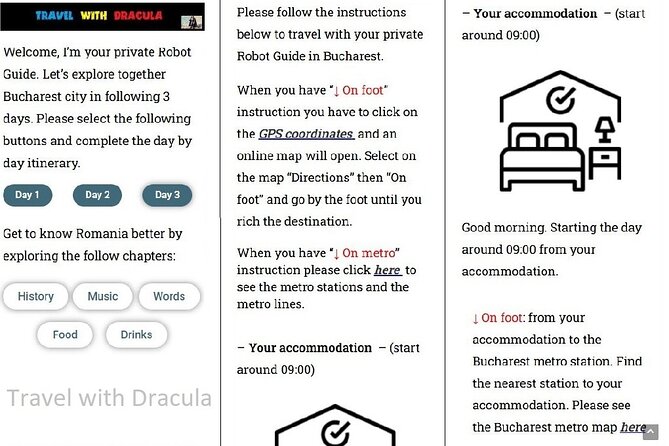
I would choose this for a solo visitor, a couple, or a private group that wants help without a live guide. The app-based format gives you privacy and flexibility, while WhatsApp support provides a human backup.
It also suits a mixed-interest group. One person can focus on architecture, another on Romanian political history, and another on food and cafés. The itinerary includes enough variety to keep the three days from feeling repetitive.
You should be comfortable with a moderate amount of walking and with using a phone throughout the day. The plan includes parks, museums, churches, boulevards, and a spa, so sensible footwear and a charged phone will make the experience easier.
This may not suit you if you want every ticket handled in advance, a guide physically present at each sight, or a relaxed schedule with only one major stop per day.
Practical details before you reserve
Confirmation is provided at booking. The activity is near public transportation, but the material does not state that transfers between stops are included. Treat the route as a plan that you navigate yourself.
The itinerary is available daily during the stated operating period, from August 1, 2024 through February 16, 2027. You can cancel for a full refund up to 24 hours before the local start time. Changes or cancellations made inside that window are not accepted for a refund.
The product has three published ratings at the top score, and the written feedback repeatedly highlights the app’s precise directions, easy operation, and useful history section. One user said the system made solo travel easier, while another praised the time saved and the ability to see many Bucharest sights while eating well. The product creator, Adrian, replied directly to one message and noted that new city products are developed slowly around the company’s own experience.
Those comments point to the product’s real strength: planning help. They do not change the need to check opening times, ticket prices, and local transport on the day you visit.
Should you book the Bucharest Smart Audio Guide?
Book it if you want a low-cost, flexible framework for three days and are happy to handle tickets, meals, data, and transport yourself. The route covers an unusually broad range, from regional village buildings and Ceausescu’s home to Therme, Old Town churches, Calea Victoriei, and Romanian dining.
Skip it if you want a traditional walking tour or a package with admissions included. For an independent visitor, though, $12.09 is a modest price for a ready-made plan, English audio, multi-phone access, and WhatsApp help. The best approach is to use it as your backbone, then adjust the pace when a museum, church, meal, or boulevard deserves extra time.
FAQ
Is this a guided tour with a person walking beside me?
No. It uses a customized Smart Audio Guide mobile application. A human assistant is available through WhatsApp, but a live guide is not described as accompanying you in person.
How long does the Bucharest activity last?
The planned duration is three days, approximately. Each day includes several stops with suggested time allocations.
What language is the audio guide offered in?
The experience is offered in English.
Can several people use one Smart Audio Guide?
Yes. One Smart Audio Guide can be used on multiple phones at the same time.
Is mobile data included?
No. You need roaming or mobile data for your phone.
Are entrance tickets included?
No. Admission tickets for the listed paid attractions are not included.
Are meals and drinks included?
No. Food and drinks are not included, including at the planned dining stop.
Is Therme Bucuresti included in the price?
No. The three-hour visit is part of the suggested itinerary, but admission is not included.
Is transportation between attractions included?
The package includes travel information, but the provided details do not state that transportation is included.
Can I cancel for a refund?
Yes. You can cancel at least 24 hours before the local start time for a full refund. Cancellations or changes made less than 24 hours before the start time are not accepted for a refund.
Latest audio tours in the world
- Seville Maestranza Bullring Tour with Audio Guide★ 3.5 · 6 reviews
- Seville Scavenger Hunt and Highlights Self Guided Audio Tour★ 5.0 · 5 reviews
- Seville Audio guided walking tour 3h20 and 28 audio commentaries★ 5.0 · 2 reviews
- Royal Alcazar of Seville Entry Ticket with Audio Guide★ 4.0 · 42 reviews
- Seville Cathedral and La Giralda Entry Ticket with Audio Guide★ 3.0 · 9 reviews
- Seville Cathedral and Giralda Entry Tickets with Audio Guide★ 4.0 · 56 reviews
- Essential Seville’s Ancient History: An Audio Tour★ 5.0 · 9 reviews
- Sequoia National Park Self-Guided Audio Tour★ 4.5 · 9 reviews
Audio Tours, compared.
Sagrada Familia Entry Ticket with Audio Guide
Read our review →
Pantheon Fast-Track Ticket and Official Audioguide
Read our review →
Colosseum & Forum with Audio Guide App -Optional Arena
Read our review →
75 Minute City Canal Cruise with Audio Guide
Read our review →
Timed Entry to Michelangelo’s David + Audio App
Read our review →
City Centre Canal Cruise including Audioguide
Read our review →