
Reviewed · REYKJAVIK
Snaefellsnes Peninsula Self-Guided Driving Audio Tour
Snæfellsnes is often called Iceland in miniature, and this self-guided drive shows you why. In one long sweep, you get a glacier-capped volcano, black-sand beaches, lava fields, waterfalls, fishing villages, basalt cliffs, and enough stories about trolls, elves, Vikings, and heroic farmers to keep the road lively. The audio starts automatically as you reach each location, so you can keep your eyes on the road.
I like the freedom to stop, skip, or restart without waiting for a group. I also like the practical value: one $49.99 purchase covers up to four people in the car, and the tour works offline after you download it. The main caution is timing. The route covers more than 89 miles and includes over 83 audio stories, so three to four hours is a brisk estimate if you actually stop for walks, photos, caves, and side trips.
Key details before you drive

- An 89-mile route with more than 83 stories: You get steady commentary rather than a few isolated facts.
- GPS-triggered audio: Stories begin as you reach the right point, allowing hands-free listening while driving.
- Offline access: Download the tour on strong Wi-Fi or cellular service before you leave.
- Lifetime use: Start, pause, and repeat the tour on later trips without an expiry date.
- A strong price for a car group: The $49.99 fee covers up to four people, not each individual.
- A flexible alternative to a bus tour: You choose your stops, breaks, walking time, and pace.
What this Snæfellsnes audio tour actually does
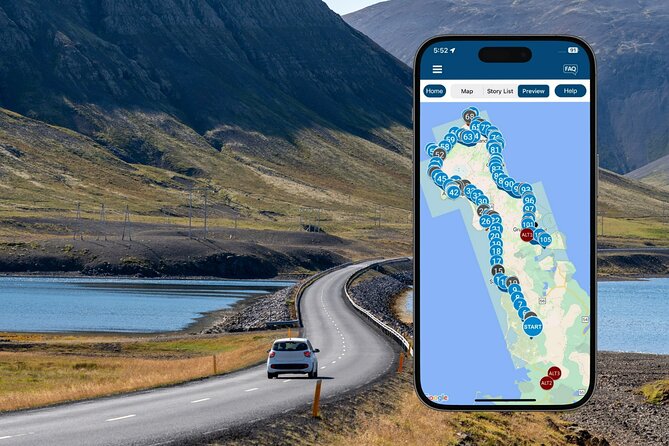
This is not a guided excursion with a driver waiting at a meeting point. No person meets you at the start. Instead, you use a separate Action audio tour app on your phone, enter the password sent by email and text, and drive yourself from the starting point at the Snæfellsnes Visitor Center.
Once the tour is downloaded, the app uses your location to trigger the next story. You hear instructions and background information as you approach each stop, then continue along the planned route. If you pull over for lunch, stop for photos, or leave the app for a while, the GPS can pick up where you left off.
That setup is especially useful in Iceland, where mobile coverage can vary and driving routes are easy to misjudge. The offline maps and audio keep the tour working without Wi-Fi or a live signal. Just do the download before leaving reliable service. The app works best on an iPhone with iOS 15 or later, an Android device with version 9 or later, or an iPad or tablet with GPS and cellular connection.
Connect your phone to the car by Bluetooth, USB, or AUX. Apple CarPlay is supported for audio playback, while Android Auto support is still on the way. If the sound does not trigger correctly, support is available, but testing the setup before you pull away is wise.
More Driving Audio Tours in the world
- Gettysburg Battlefield Self-Guided Driving Audio Tour
★ 4.5 · 910 reviews - Joshua Tree National Park Self-Guided Driving Audio Tour
★ 4.5 · 762 reviews - Ultimate Acadia National Park Self-Guided Driving Audio Tour
★ 4.0 · 521 reviews
The southern approach: church, spring, seals, and waterfalls
The first stops ease you into the peninsula with a mix of faith, folklore, and local geology. Ingjaldshólskirkja is a good early pause. The current church dates from 1903, but a church has occupied this property since the early 1300s. The stop is free and takes about five minutes in the tour plan.
At Ölkelduvatn Mineral Spring, the subject changes from religion to geology and taste. Water from Ölkelda farm contains minerals including calcium, magnesium, and iron. The audio explains how iron oxide forms when iron meets oxygen and water, using the familiar example of rust on outdoor metal. It is a small stop, but it gives you a useful way to read the reddish tones that appear in Icelandic ground and stone.
Ytri Tunga Beach adds one of the peninsula’s best-known seal stories. The tale follows a farmer who found a seal skin, locked it away, and later discovered a young woman sitting on the chest. This is the kind of folklore that works well in an audio tour because you can hear the story while looking across the coast where seals may be spotted.
Keep expectations sensible here. The tour supplies the story and the stop, but it does not promise an animal sighting. Your view will depend on weather, season, and luck.
Bjarnarfoss brings you to a waterfall linked with the Lady of the Mountain, a legendary figure treated as an embodiment of Iceland. The waterfall is another short stop, but it adds variety before the route moves toward Búðakirkja.
Búðakirkja and the Snæfellsjökull viewpoint
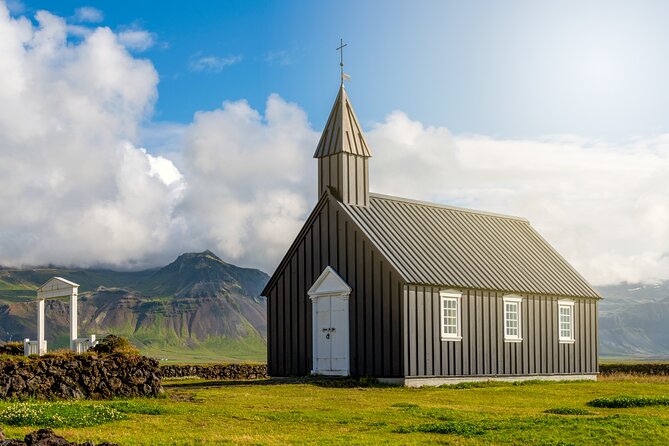
Búðakirkja is the small black church that many people remember most clearly from this drive. Its dark exterior, simple shape, and isolated setting make it a natural photo stop. The audio adds a playful reference to an elf-sized wedding, tying the building to Iceland’s stories of hidden people.
This is also a good example of why a self-guided format suits the peninsula. You can linger at the church if the light is good, or move on quickly if the weather turns. A scheduled bus group gives you less choice.
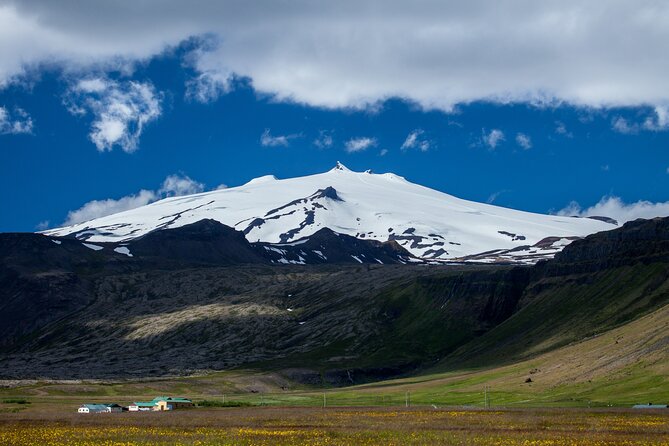
At the Snæfellsjökull viewpoint, the tour connects two defining forces of Iceland: volcanoes and ice. Snæfellsjökull is a volcano topped by a glacier, though the ice has been shrinking. The audio points out that in 2012, for the first time in recorded human history, the summit could be seen without ice from this viewpoint.
That detail gives the stop more weight than a standard scenic lookout. You are not simply taking a picture of a mountain. You are seeing a changing feature of Iceland, and the commentary helps you notice what may not be obvious from the road.
Ravines, echoes, and the Arnarstapi detour
Rauðfeldsgjá Gorge is one of the few stops where the walking time matters. The trail to the ravine is about half a mile, moderately challenging, and takes around 20 minutes. In summer, you may be able to climb inside toward the small waterfall.
Wear shoes suitable for uneven ground and allow more than the five-minute audio segment if you want to explore. The app’s timing describes the commentary, not the complete visit.
Sönghellir Cave is another short but memorable detour. Its name means cave of songs, and its twisting rock walls create a strong echo. You can test the acoustics yourself, while the audio connects the sound to stories of the Huldufólk, Iceland’s hidden people.
Arnarstapi is an optional detour with a high return for a short visit. Here you can look over jagged coastal cliffs, see a dramatic stone arch, walk across a natural bridge, and find a statue of Bárðar Snæfellsás, the local troll figure tied to the peninsula.
The route then brings you to Gatklettur, a natural arch near the coast. The audio places the area in the story of Arnarstapi as a fishing port, where natural harbors and plentiful herring supported local work. It is a useful reminder that these cliffs were not only scenic objects. They shaped where people lived and how they made a living.
More Self-Guided Audio Tours in the world
- Athens: Acropolis Ticket & Optional Self-Guided Audio Tours
★ 4.1 · 2,542 reviews - Ultimate Lake Tahoe Self-Guided Driving Audio Tour
★ 4.5 · 435 reviews - Scenic Newport, RI Self-Guided Driving Audio Tour
★ 4.5 · 325 reviews - Arches National Park Self-Guided Driving Audio Tour
★ 4.5 · 288 reviews
Lóndrangar, Malarrif, and the western coast
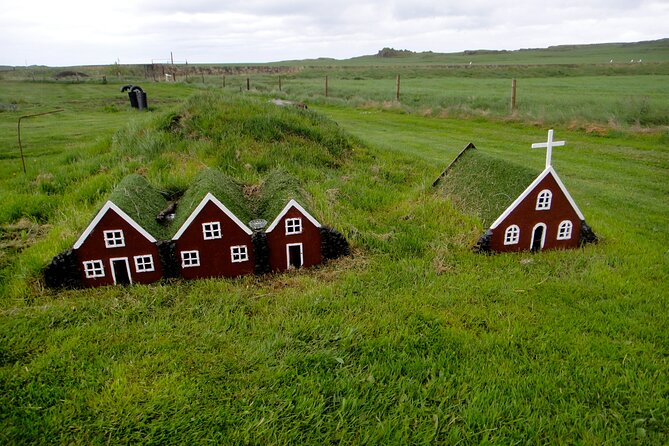
At Lóndrangar View Point, two basalt columns rise above the cliffs. Their shape explains the nickname rocky castle. Basalt formations such as these are among the best visual clues to Iceland’s volcanic past, and the viewpoint gives you a clean stop for photographs without needing a long hike.
Malarrif Lighthouse adds a bright human mark to the dark cliffs. Built in 1917, it helped sailors navigate the coast. Its unusual form, often compared with a rocket ready to launch, makes it easy to recognize.
The route continues to Vatnshellir Cave, an 8,000-year-old lava tube. This is not a conventional cave carved slowly by water. It formed when lava continued flowing beneath a cooled surface, leaving a hollow passage behind.
The audio explains the formation, but attraction entry, reservations, and admission fees are not included in the tour price. That distinction matters. You can enjoy the surrounding route without entering, but if you plan to go inside, check arrangements separately before setting out.
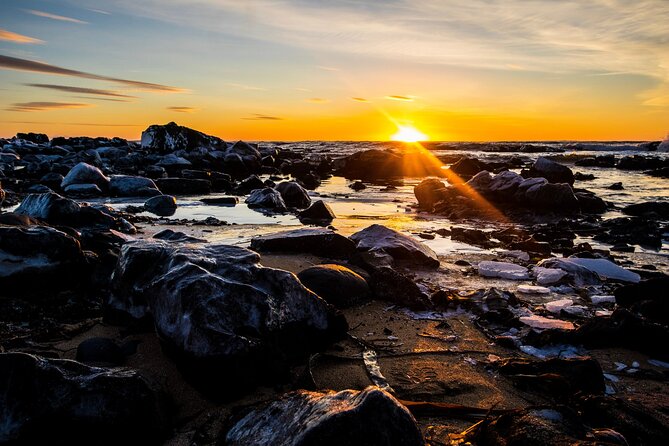
Djúpalónssandur Beach gives you dark volcanic shore, two lagoons, and another strong piece of local tradition. In the 1100s, a Catholic bishop reportedly blessed the pools, giving them supposed healing powers. The path to them is called Nautastígur, or Path of the Bulls, because farmers once led bulls there to drink.
The beach is a place to slow down, but use care around the coast. The supplied information does not promise swimming conditions or a safe bathing experience. Treat the lagoons and shoreline as places to look and walk, not as a guaranteed water activity.
Craters, turquoise water, and two lighthouses
Saxhóll Crater offers a different view of volcanic activity. The audio describes a phreatic eruption, when water, steam, and molten rock burst outward after magma meets water-saturated rock. The crater is the hollow left behind by that violent process.
Skarðsvík Beach is memorable for contrast. Its water can look almost tropical in color, while the surrounding volcanic rock remains unmistakably Icelandic. The short stop makes a useful photo break, especially if you want something different from black-sand beaches.
At the end of the road, the orange Svörtuloft Lighthouse contrasts sharply with the dark lava cliffs. It dates from 1931 and helped ships and fishing boats avoid the rocky western coast. Öndverðarnesviti is another lighthouse farther along, built in 1973 to guide sailors around the peninsula’s rough tip.
Two lighthouses in one stretch may sound repetitive, but their locations help you understand the coast as a working place. The audio keeps the stops from becoming simple photo markers by explaining the danger these structures addressed.
Hellissandur, waterfalls, and the famous Kirkjufell view
Hellissandur was once a fishing village and is now known for large murals, galleries, and the Maritime Museum. It is a good place to break up the drive with town streets instead of another viewpoint. If you prefer local culture to scenery alone, give this stop extra time.
Svöðufoss shows the connection between glacier and waterfall. Meltwater from Snæfellsjökull helps feed many waterfalls on the peninsula, and the glacier-capped mountain behind the falls makes that relationship easy to grasp.
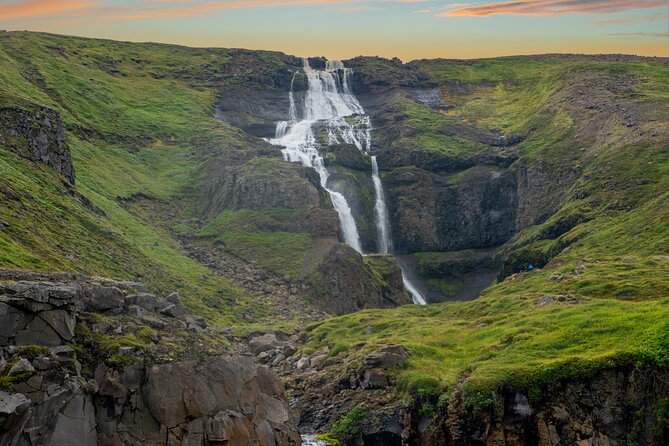
Bæjarfoss overlooks Ólafsvík. Its name means Town Falls, and the waterfall is within easy walking distance of the town. This stop can work well as a brief stretch of the legs, though the exact time you spend there is up to you.
Kirkjufellsfossar and Kirkjufell are the visual high point for many people. The pointed mountain rising behind the waterfalls is one of Iceland’s most recognizable views, and Game of Thrones fans may recognize it from the series.
The nearby Kirkjufell viewpoint explains that the mountain is not a volcano. It is a nunatak, a peak left rising above surrounding ice. Glacial erosion shaped its steep sides and unusual cylindrical form.
This is the place where weather matters most to your expectations. Clouds can hide the summit, wind can make the waterfall spray unpleasant, and good light may tempt you to stay much longer than five minutes. The audio gives you context, but you control the photo stop.
Finishing at Grundarfjörður and Kolgrafarfjörður
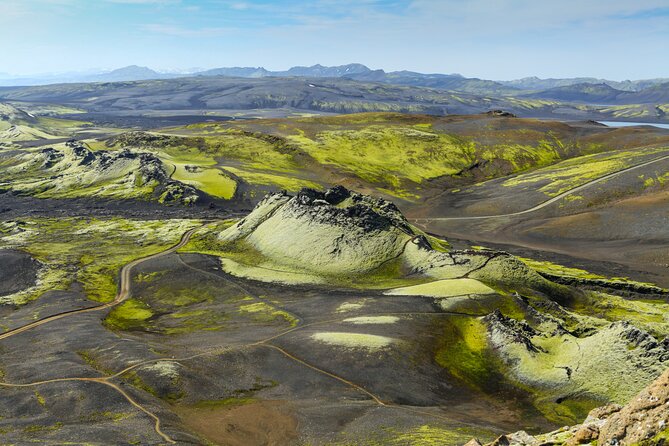
Grundarfjörður sits beside a wide lava field called Berserkjahraun. The tour links the area to the Eyrbyggja saga, including the story of a tenth-century farmer who hired two powerful berserkers to work his fields.
You finish at Kolgrafarfjörður Viewpoint, where the route gathers together the main themes of the day: basalt cliffs, old volcanoes, dark lava, waterfalls, villages, and glacier ice. The endpoint is useful because it gives the drive a clear finish instead of leaving you to guess when the commentary has ended.
The route is long enough that you should treat three to four hours as the minimum touring time, not a strict appointment. The 83-plus audio stories may play quickly while you drive, but walks at Rauðfeldsgjá, time at Arnarstapi, a cave visit, a town break, or repeated photo stops can extend the day.
Price, pace, and who gets the best value
At $49.99 per group of up to four, this is good value if you are already renting a car and want structure without a private guide. Split four ways, the cost is modest compared with paying four separate admission prices for a conventional guided outing. The audio also remains available for life, with no expiry, so you can reuse it on another Iceland trip.
The value is weaker if you want a person to answer questions in real time, handle winter driving, or adjust the route around conditions. This is a navigation and storytelling tool, not a chauffeur or a substitute for checking road and weather information yourself.
I would choose it for independent couples, families, and small groups who want to stop often. It also suits repeat visitors, since you can pause the tour, skip familiar sites, and return to bonus stories later. It is less suitable if your phone is old, you forget to download the app, or you prefer not to manage directions and audio while driving.
Free cancellation is available if you cancel at least 24 hours before the scheduled start time. Changes or cancellations inside that window are not accepted for a refund.
Should you book the Snæfellsnes audio tour?
Book it if you want the peninsula’s major sights tied together by clear GPS-triggered stories, and if you value privacy and control more than live conversation. The strongest reasons are the offline function, the lifetime access, the well-spaced mix of scenery and folklore, and the car-based price.
Skip it if you want a tightly timed three-hour outing with no walking, or if you need a human guide beside you. For everyone else, download it at home, connect it to your stereo, leave room for extra stops, and treat the published duration as a guide rather than a deadline. That approach lets you enjoy Búðakirkja, Snæfellsjökull, Djúpalónssandur, and Kirkjufell without rushing past the very places that make Snæfellsnes special.
FAQ
How much does the Snæfellsnes audio tour cost?
The tour costs $49.99 per group of up to four people. The price is for the car group rather than each individual.
How long is the route?
The route is more than 89 miles and takes approximately three to four hours to complete. Extra time is sensible if you walk at the gorges, visit a cave, stop in towns, or take longer photo breaks.
Does the tour work without Wi-Fi or mobile signal?
Yes. You must download the tour while you have strong Wi-Fi or cellular service. After that, the maps and audio work offline.
Where does the tour start and finish?
The listed starting point is the Snæfellsnes Visitor Center in Iceland. The route finishes at Kolgrafarfjörður Viewpoint on Snæfellsnesvegur.
Is a guide included in the car?
No person meets you at the start. This is a private, self-guided activity using the Action audio tour app and GPS-triggered commentary.
Can I use the tour more than once?
Yes. The tour includes lifetime access with no expiry date. You can start, pause, restart, and use it again on later trips.
Latest audio tours in the world
- San Sebastian Scavenger Hunt & Highlights Self Guided Audio Tour★ 4.0 · 7 reviews
- San Marino’s Three Towers: An Audio Tour of the Ancient Republic★ 5.0 · 2 reviews
- San Marino Walking Tour with Audio and Written Guide★ 4.5 · 5 reviews
- Sampling San Sebastián’s History: A Self Guided Audio Tour★ 4.5 · 5 reviews
- Talking Buildings of Old San Juan: A Self-Guided Audio Tour★ 3.5 · 18 reviews
- San Marino: A Self Guided Audio Tour★ 4.5 · 14 reviews
- Essential Downtown SLO: A Self-Guided Audio Tour★ 4.5 · 27 reviews
- Silicon Valley Self-Guided Driving Audio Tour for Tech Lovers★ 4.0 · 24 reviews
Driving Audio Tours, compared.


Ultimate Acadia National Park Self-Guided Driving Audio Tour
Read our review →


Browse the lists this tour appears in