
Reviewed · RIGA
Riga’s Architecture: A self-guided audio tour of the city’s art nouveau history
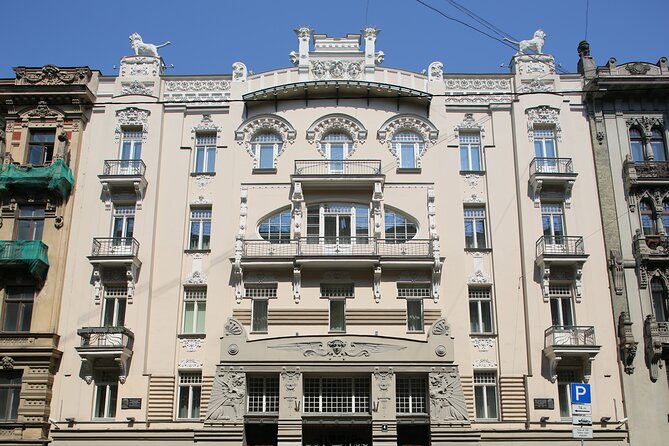
Riga has more than 800 Art Nouveau buildings, and this short walk takes you straight into the city’s grandest concentration of them. You’ll learn how to read the style, from theatrical façades to the quieter National Romanticism of Latvian architects. I like the clear, brisk narration and the way the route links architecture with people, politics, and film history. I also like the offline maps and audio, which let you walk without chasing a guide or using mobile data.
The main trade-off is simple: this is an audio walk, not a guided visit. You get no live guide to answer questions, and the tour does not include entry to museums or other buildings. At roughly 30 to 45 minutes, it is useful for a quick introduction, but you may want extra time afterward to look around Alberta Street.
Key points to know before you go
- Riga’s National Art Museum begins the walk, giving you an easy central meeting point near public transportation.
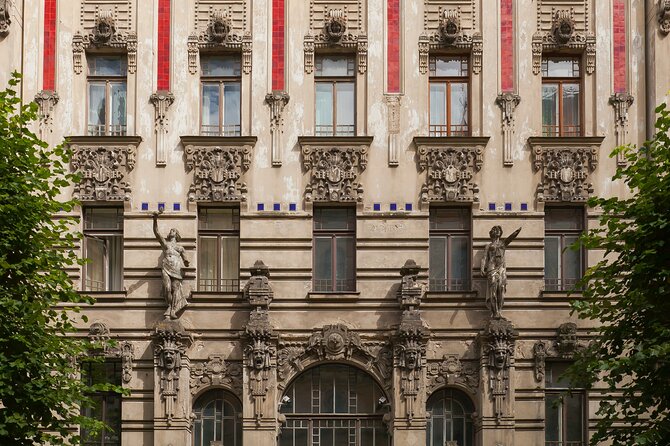
- Mikhail Eisenstein’s ornate buildings are a major focus, with details that help you spot Art Nouveau on your own.
- Alberta Street supplies the visual payoff, with stops at numbers 2a, 4, 11, 13, and 12.
- National Romanticism adds a Latvian angle, showing how local architects adapted an international style.
- VoiceMap works offline, including the audio, map, and location data after setup.
- The $5.20 price buys lifetime English access, but the booking cannot be refunded or changed.
Why Riga is such a strong city for Art Nouveau
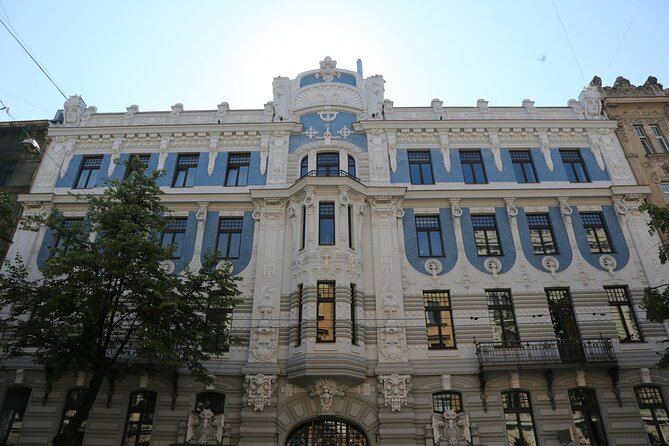
Riga is not a city with one handsome Art Nouveau building and a few scattered examples. It has more than 800 buildings in the style, giving you a real urban district to explore rather than a single postcard stop.
That matters because Art Nouveau makes more sense when you see several buildings close together. You can compare the exaggerated decoration of one façade with the cleaner lines of another. You can spot repeated ideas, then see how architects bent those ideas into something more local.
The walk focuses on Riga’s central Art Nouveau area, where streets such as Alberta iela and nearby Elizabetes iela gather some of the city’s best-known examples. The audio explains how to identify the style, so you are not left simply staring at elaborate façades and wondering what you should notice.
Look up as you walk. The most interesting details are often high above street level: sculpted faces, unusual figures, dramatic curves, plant forms, and decorative framing around windows. A short audio tour is useful here because it gives your eyes a job. You are not only taking pictures. You are learning what the building is trying to do.
More History Audio Tours in the world
- Colosseum, Roman Forum & Palatine Hill with Audioguide App
★ 4.4 · 6,291 reviews - Venice: St. Mark Basilica Ticket, Audioguide+History Gallery
★ 3.9 · 4,780 reviews - Rome: Colosseum, Ancient Rome Tour or AudioGuided Tour
★ 4.4 · 2,879 reviews
Starting at the Latvian National Museum of Art
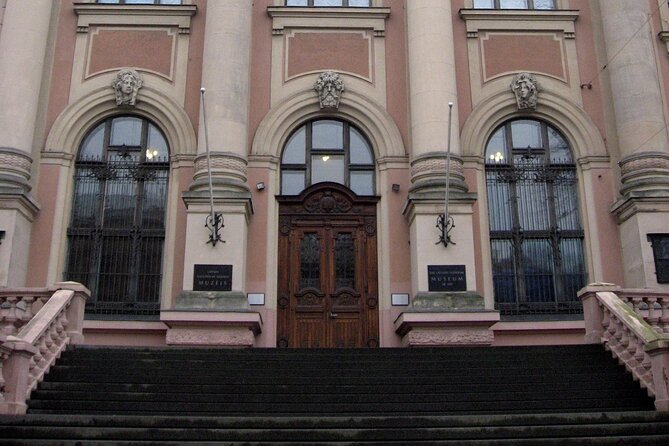
The route begins at the Latvian National Museum of Art on Jaņa Rozentāla laukums. This is a practical starting point in central Riga, and the location is near public transportation, which makes it easy to add before or after other city sightseeing.
You do not need to enter the museum for this walk. The tour begins outside, and no museum admission is included. That keeps the cost low, but it also means you should treat the museum as a meeting landmark rather than part of the audio experience.
At the start, the narration sets up the basic story of Art Nouveau and gives you a way to recognize it. This introduction is important because the route is short. Instead of using the first few stops to explain every term, you can begin looking for the features the audio has pointed out.
The tour is private in the sense that only your group uses it, but there is no live person walking with you. You follow the VoiceMap app on your own phone. The app is available for Android and iOS, and the audio, map, and geographic data can be used offline once downloaded.
That offline option is one of the strongest practical features. Streets, buildings, and phone screens do not always cooperate, especially when you are trying to listen and look up at the same time. Having the route saved ahead of time reduces that fuss.
Elizabetes 10b and the first lesson in reading façades
The first brief stop is at Elizabetes 10b. This gives the route an early architectural example before it moves deeper into the Alberta Street group.
The audio uses the buildings as teaching tools. You learn to look past the overall effect and notice how Art Nouveau uses decoration, symmetry, windows, sculptural forms, and surface detail. Riga’s buildings can be visually busy, so a few useful pointers make a real difference.
This is also where the short length of the route becomes clear. The stop is brief rather than a long lecture. That will suit you if you want an efficient introduction before continuing to explore alone. If you enjoy architectural detail and want every façade explained, you may find yourself pausing the audio and spending longer at each address.
That is easy to do with a self-guided walk. You can stop for photographs, replay a section, or simply look around without holding up a group. The trade-off is that you must manage the pace yourself.
Alberta 2a and Mikhail Eisenstein’s theatrical style
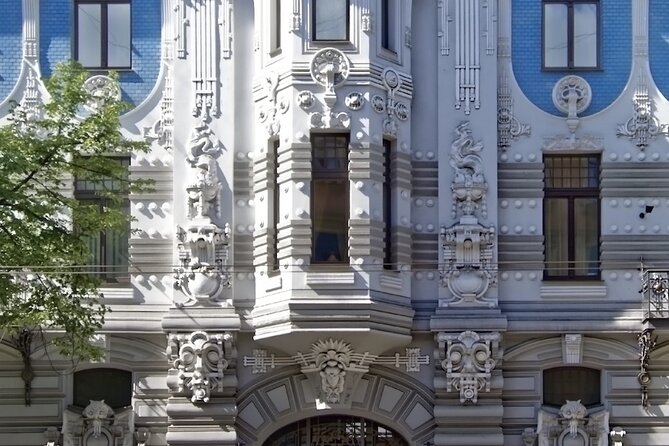
The route then reaches Alberta 2a, one of several stops on Alberta Street. This part of the walk focuses on the visual drama that makes Riga’s Art Nouveau district so memorable.
Mikhail Eisenstein is a central figure in the story. His buildings are known for highly decorative façades, and the audio helps you understand why they attract so much attention. Look for the feeling of performance in the design. The architecture is not shy. It uses ornament to create mood and character.
The tour also connects Mikhail Eisenstein with his son Sergei, who became a legendary Soviet filmmaker. That family link gives the architecture a human angle. You are not only learning the name of an architect. You are hearing about a family connected to two different kinds of visual storytelling, one in stone and plaster, the other on film.
This is one of the better details in the experience because it helps the information stick. Architectural names can blur together after a few stops. A connection to Sergei Eisenstein gives Mikhail’s work a more memorable place in Riga’s story.
More Self-Guided Audio Tours in the world
- Athens: Acropolis Ticket & Optional Self-Guided Audio Tours
★ 4.1 · 2,542 reviews - Gettysburg Battlefield Self-Guided Driving Audio Tour
★ 4.5 · 910 reviews - Joshua Tree National Park Self-Guided Driving Audio Tour
★ 4.5 · 762 reviews - Ultimate Acadia National Park Self-Guided Driving Audio Tour
★ 4.0 · 521 reviews
Alberta 4 and the value of a short route
At Alberta 4, the walk continues its close look at the street’s famous buildings. Because the stops are close together, the route does not require transportation between addresses. You can move through the district on foot and keep the story in sequence.
The tour takes about 30 to 45 minutes, though the exact time depends on how often you pause. The stated length is enough for a focused introduction, not a full morning devoted to every architectural detail in the neighborhood.
I see that as a strength if your Riga schedule is tight. You can fit this walk between major sights, use it as an orientation to the district, or take it early in your stay and return later to explore at greater length.
It can feel too brief if you want a slow architectural study. The answer is to treat the audio as a framework rather than a finish line. Let it explain the main ideas, then revisit the street at your own pace. The route ends nearby, so you can easily continue looking at buildings after the narration stops.
Alberta 11 and the courtyard lesson
The stop at Alberta 11 adds a different kind of interest: the courtyard of one of Riga’s impressive residential buildings.
Street façades get most of the attention in Riga, but courtyards help explain how these buildings functioned as homes. A façade faces the city and makes a public statement. A courtyard gives you a sense of the residential setting behind that statement.
The courtyard is particularly useful because it breaks the habit of looking only at the front of a building. The audio brings attention to the interior side of urban architecture, showing that the design story does not end at the pavement.
You should pay attention to the wording of the route and the physical setting here. It is described as a brief stop, not a promise of a full building tour or museum visit. The experience does not include tickets or entry fees to attractions, so you should not expect access to private interiors beyond what the route makes available.
That limitation is worth knowing before you book. The tour is best for exterior architecture and selected accessible views, not for a detailed examination of Riga’s interiors.
Alberta 13 and the move toward National Romanticism
At Alberta 13, the audio turns toward the way Latvian architects developed a more local style called National Romanticism.
This is an important part of the route because it keeps the story from becoming a parade of lavish decoration. Art Nouveau arrived as an international style, but architects in Riga did not simply copy buildings from elsewhere. They adapted ideas to local taste and identity.
National Romanticism gives you another way to read the streetscape. Instead of asking only how ornate a building is, you can ask how it feels rooted in Latvia. The style adds a local voice to the wider Art Nouveau movement.
For me, this is where the tour offers more than a checklist of pretty buildings. It gives you a reason to compare. One façade may seem theatrical and heavily decorated. Another may feel more solid, restrained, or connected to regional ideas. The audio supplies the context that turns those differences into part of a story.
Because the route covers several addresses in a compact area, you can make these comparisons right away. You do not have to remember a building from an hour earlier or cross the city to find the next example.
Finishing at Alberta 12
The tour ends at Alberta 12, keeping you in the same Art Nouveau district. That is convenient because the final stop does not leave you at an awkward transport point or far from the buildings you have just been studying.
The end location also gives you a natural chance to continue on foot. The audio itself is finished, but your architectural walk does not have to be. You may want to revisit a façade, take photographs, or compare the final building with the earlier stops while the terms are still fresh.
The route’s final position is part of its value. You are not simply returned to a starting point with no sense of where you are. You finish among Riga’s signature Art Nouveau streets, with the city’s design language still in front of you.
Keep in mind that the tour listing gives opening hours from midnight to midnight, Monday through Sunday. That reflects the self-guided format rather than a staffed attraction. You can begin at a time that suits you, but you still need your phone, headphones, and a downloaded copy of the tour.
What the $5.20 price really buys
At $5.20 per person, this is a low-cost way to add structure to an architectural walk. The value is strongest if you want a short English introduction and do not need a live guide.
You receive lifetime access to the tour, not just one use during a single afternoon. The VoiceMap app also offers other self-guided tours after download, so the purchase may be more useful if you plan to use that platform again.
The price does not cover food, drinks, transport, museum tickets, or entry to other attractions. It also does not provide a smartphone or headphones. Those omissions are normal for an audio walk, but they matter when you compare the total cost with a live walking tour.
The experience is non-refundable and cannot be changed after booking. I would only buy it once your Riga plans are firm. Since it is often booked about five days ahead, there is no clear need to reserve far in advance, though checking your schedule before payment is wise.
Who will enjoy this Riga audio walk
I would choose this tour if you like architecture but prefer to set your own pace. It suits independent visitors, couples, families with older children, and anyone with only a short window in Riga.
It also works well if a live walking tour is unavailable or does not fit your schedule. You can listen without joining a larger group, and only your own party participates.
The format is less suitable if you want lively conversation, spontaneous questions, or access to building interiors. You should also bring patience for using a phone while walking. The app supplies the route and audio, but you remain responsible for starting it, following the map, and managing your own pauses.
Most people can participate, and the route is near public transportation. Still, the supplied information does not give detailed guidance about surfaces, step-free access, or restroom stops, so you should check those practical needs before booking if they are important for your group.
Should you book it?
Book this Riga audio tour if you want an inexpensive, focused introduction to the city’s Art Nouveau district. The best reasons are the compact route, the connection between Mikhail Eisenstein and Sergei Eisenstein, the courtyard stop, and the explanation of National Romanticism.
Skip it if you need a live guide or a longer visit with museum entry. At 30 to 45 minutes, it is a smart primer rather than a complete study of Riga’s architecture.
For most independent visitors, the $5.20 price is easy to justify. Download the audio and map before you start, bring headphones, and leave a little extra time at Alberta Street. The narration gives you the tools. The façades provide the rest.
FAQ
Where does the Riga Art Nouveau audio tour start?
It starts at the Latvian National Museum of Art, at Jaņa Rozentāla laukums 1 in central Riga.
Where does the tour end?
The tour ends at Alberta iela 12 in Riga’s Centra district.
How long does the audio tour take?
The approximate duration is 30 to 45 minutes.
What buildings and streets are included?
The route begins at the Latvian National Museum of Art, then stops at Elizabetes 10b, Alberta 2a, Alberta 4, Alberta 11, Alberta 13, and ends at Alberta 12.
What is included with the booking?
You receive lifetime access to the English-language tour, the VoiceMap app for Android and iOS, and offline access to the audio, map, and geographic data.
Do I need to pay for museums or bring my own equipment?
Museum tickets and other attraction entry fees are not included. You must provide your own smartphone and headphones, and transportation and food are also not included.
Latest audio tours in the world
- Seville Maestranza Bullring Tour with Audio Guide★ 3.5 · 6 reviews
- Seville Scavenger Hunt and Highlights Self Guided Audio Tour★ 5.0 · 5 reviews
- Seville Audio guided walking tour 3h20 and 28 audio commentaries★ 5.0 · 2 reviews
- Royal Alcazar of Seville Entry Ticket with Audio Guide★ 4.0 · 42 reviews
- Seville Cathedral and La Giralda Entry Ticket with Audio Guide★ 3.0 · 9 reviews
- Seville Cathedral and Giralda Entry Tickets with Audio Guide★ 4.0 · 56 reviews
- Essential Seville’s Ancient History: An Audio Tour★ 5.0 · 9 reviews
- Sequoia National Park Self-Guided Audio Tour★ 4.5 · 9 reviews
Self-Guided Audio Tours, compared.
Acropolis Ticket & Optional Self-Guided Audio Tours
Read our review →


Ultimate Acadia National Park Self-Guided Driving Audio Tour
Read our review →

Akrotiri Ticket with Optional Self-Guided Audios
Read our review →
Browse the lists this tour appears in