
Reviewed · ROME
Pantheon Fast-Track-Entry Tickets with Audio guide
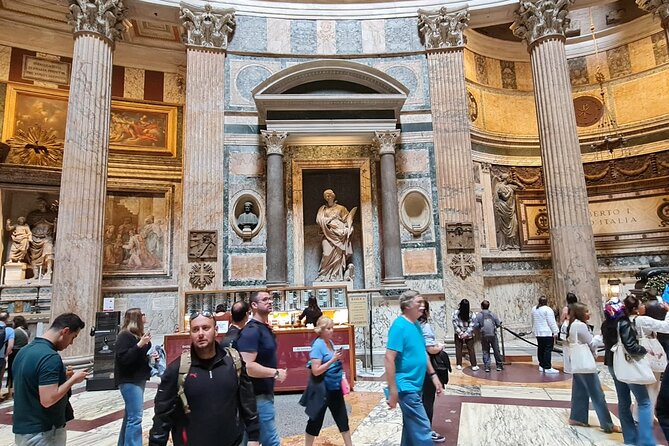
The Pantheon’s great surprise is overhead: the open oculus lets daylight, and sometimes rain, fall straight into the ancient room. I like this ticket for two practical reasons: the $13.23 price is modest, and the audio guide lets you look around without being tied to a live group. The 15-minute entry window also helps you plan a busy Rome day.
The catch is that fast-track does not always mean a guide ushers you past every line. You are buying an arranged admission time and help with entry, not a full guided tour. The audio link is sent through WhatsApp, and headphones are not provided, so bring your own.
Key points to know before booking

- The oculus is the main event: Look up as soon as you enter. The circular opening controls the room’s changing light and gives the dome its famous character.
- This is a short self-guided visit: Allow about 45 minutes, with no step-by-step walking route through the building.
- The meeting point comes first: Begin at Piazza della Minerva, then finish at the Pantheon on Piazza della Rotonda.
- The audio guide is phone-based: It arrives as a link through WhatsApp, so charge your phone and pack headphones.
- Fast entry can depend on operations: Several accounts describe delays, missed meeting staff, changed opening times, or ticket shortages.
- The low price is attractive: At $13.23, the ticket can save time on a crowded day, but the service is less reliable than the price suggests.
Why the Pantheon is worth your time
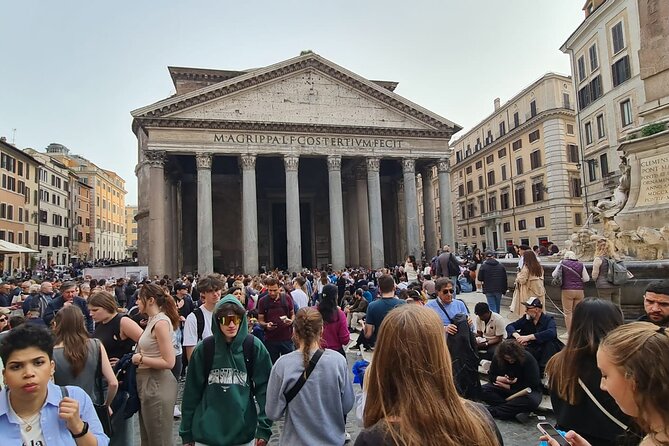
Rome has no shortage of grand buildings, but the Pantheon earns its place on a first visit. Its exterior can look almost plain beside the surrounding streets. Inside, the enormous dome changes the scale of the room at once. You are standing beneath one of the world’s largest unreinforced concrete domes, built without the modern steel framework you might expect.
The building began as a temple commissioned by Marcus Agrippa during the reign of Augustus in 27 BC. Emperor Hadrian directed its rebuilding around 126 AD, and much of the structure has survived in remarkably complete form. It later became a Christian church, the Basilica of Santa Maria ad Martyres.
That change of purpose is part of what makes the visit interesting. You are not looking at a frozen ruin. The Pantheon moved from pagan worship to Christian use, and the present interior reflects that long shift. The building still feels unified, though, because the dome remains the commanding idea.
I recommend entering with one question in mind: how did Roman builders make a concrete dome this large hold itself up? The answer is not supplied in full by a quick visit, but the shape gives you clues. The dome becomes lighter toward the top, and the oculus removes weight at its center. Your audio guide should help you notice these choices instead of simply taking a few photographs and leaving.
More Audio Tours in Rome
- Rome: Colosseum & Forum with Audio Guide App -Optional Arena
★ 4.2 · 24,770 reviews - Rome: City Sightseeing Hop-on Hop-off Bus with Audioguide
★ 4.0 · 16,045 reviews - Rome: St. Peter’s Basilica & Dome Entry Ticket & Audio Tour
★ 4.2 · 7,537 reviews
Starting at Piazza della Minerva
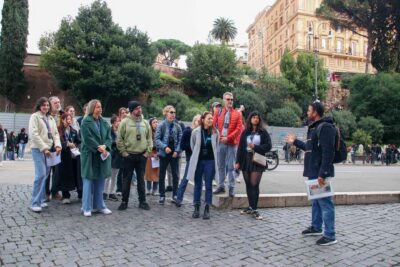
Your meeting point is Piazza della Minerva, a short walk from the Pantheon. This is not the final entrance itself, so do not go straight to the Pantheon and assume the staff will find you there. The arrangement begins at the square near Santa Maria sopra Minerva, then continues to the Pantheon at Piazza della Rotonda.
The instructions call for arriving 15 minutes early. Follow that advice. Several poor experiences came from staff arriving late, visitors being unsure whom to look for, or the meeting arrangement not matching the expected sign. One useful detail is that the local sign may read Kay Kay rather than simply KK. Keep your phone available in case the provider contacts you through WhatsApp.
The meeting point is near public transportation, and the activity is open to most people. The group limit is 30, although the service often functions more like an entry-assistance arrangement than a conventional tour group. That distinction matters. You are not signing up for a guide who spends the whole visit beside you.
At this stage, the staff member may give you a short overview and show you how to open the audio guide. That quick orientation is useful, especially if you have not used a phone-based guide before. It can also include nearby suggestions for other churches and cathedrals, though you should not expect a long city walk.
What fast-track entry really means here
The best version of this experience is simple. You arrive at the appointed time, meet the staff member, receive or confirm your ticket, and enter without wasting a long stretch in the regular admission queue. On a very busy day, that can easily justify the $13.23 cost. The Pantheon is compact, so losing 30 or 45 minutes outside can cost more than the ticket in practical sightseeing time.
Still, keep your expectations measured. The ticket does not guarantee that you will walk past every person waiting at the building. Some accounts describe the service as little more than purchasing admission in advance. Others describe a quick and friendly entry that saved a great deal of time.
That difference may come from crowd levels, staff timing, opening arrangements, or the day’s operating rules. The safe approach is to treat this as prearranged entry with assistance, not as a private priority lane. If your Rome schedule is packed tightly, leave some breathing room around the appointment.
The exact timing is supposed to be within a 15-minute window. That is helpful, but it is not the same as walking in at any moment during the day. Arrive early, stay near the stated meeting place, and keep your confirmation close at hand.
Inside the Pantheon: what to notice first
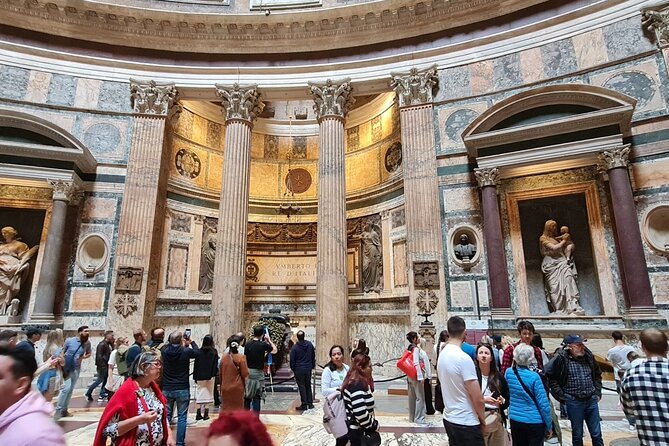
Once inside, look up before reading anything. The oculus is a perfectly circular opening at the crown of the dome. It brings in a direct shaft of daylight, creating a moving pattern of brightness across the interior. The light changes as the day goes on, so the room never looks quite the same twice.
The oculus is also open to the sky. That small fact makes the building feel more direct and physical than many ancient monuments. Rain can enter, and the floor is designed to deal with water. The supplied information does not promise a specific weather experience, so think of the opening mainly as the source of the Pantheon’s remarkable light.
Next, study the dome itself. The Pantheon’s concrete construction was a major engineering achievement, especially because the dome is not reinforced with modern materials. The audio guide is meant to point out details that are easy to miss, including the relationship between the dome, its opening, and the room below.
The building’s scale can be hard to judge in a photograph. Take a moment to look from the center toward the walls, then back to the ceiling. You will get more from the visit if you pause instead of trying to record every angle on your phone.
Another self-paced route in Rome:
- Colosseum, Roman Forum & Palatine Hill with Audioguide App
★ 4.4 · 6,291 reviews - Vatican & Sistine Chapel Ticket with Optional Audio Guide
★ 4.1 · 5,405 reviews - Rome: Castel Sant’Angelo Entry Ticket & Digital Audioguide
★ 4.7 · 5,347 reviews - Rome: Castel Sant’Angelo Entry Ticket & Audio App
★ 4.3 · 4,952 reviews
How useful is the audio guide?
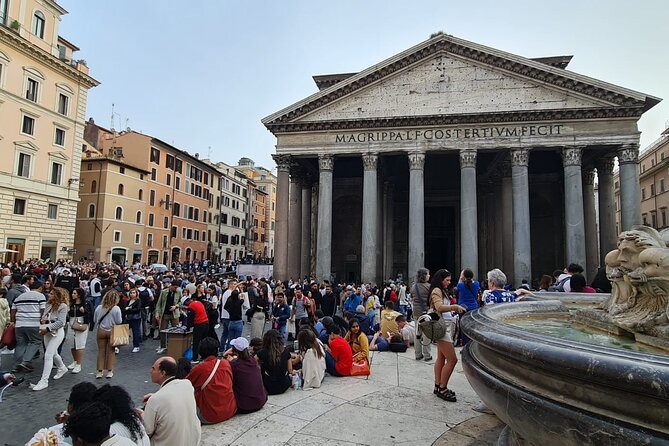
The audio guide provides an overview rather than a traditional walking tour. It can explain the Pantheon’s dates, architectural design, changing religious role, dome, and oculus. That is enough to give meaning to a 45-minute visit, especially if you arrive with no background information.
Do not expect spoken directions such as start here, now turn left, or examine this particular chapel next. The Pantheon is largely one vast interior space, and the audio does not create a strict route through it. Plaques in the building provide additional information at various points, but you will need to choose your own order.
The guide is accessed through a link sent on WhatsApp. That is convenient if your phone is working, but it adds a few practical concerns. You need enough battery, a reliable data connection or access to the link, and a way to hear the recording in a noisy public space. Bring your own headphones, since none are supplied.
If you prefer a highly structured explanation from a live guide, this product may feel thin. If you like to move at your own speed, pause whenever you wish, and spend extra time beneath the dome, the format makes sense. I would download or open the link before entering if possible, rather than trying to solve phone problems in the doorway.
The building’s two lives
The Pantheon’s original role was a pagan temple associated with the Roman gods. The rebuilding under Hadrian gave Rome the structure you see today, with its famous dome and central opening. The building’s survival is remarkable in a city where so many ancient monuments remain only as fragments.
Its later life as the Basilica of Santa Maria ad Martyres added a Christian function. That is why the interior is not presented as a bare archaeological shell. You are seeing an ancient Roman building that continued to serve a religious purpose over centuries.
I find this more interesting than a simple before-and-after story. The Pantheon is both ancient architecture and an active church. The change tells you something about Rome’s habit of adapting older buildings rather than clearing them away.
The audio guide can provide the basic framework, but the room rewards your own attention. Look at how the light enters. Notice how the dome draws your eye upward. Then consider how different the space must have felt when its religious meaning was pagan, and how that meaning changed after its conversion.
Time, price, and the practical tradeoff
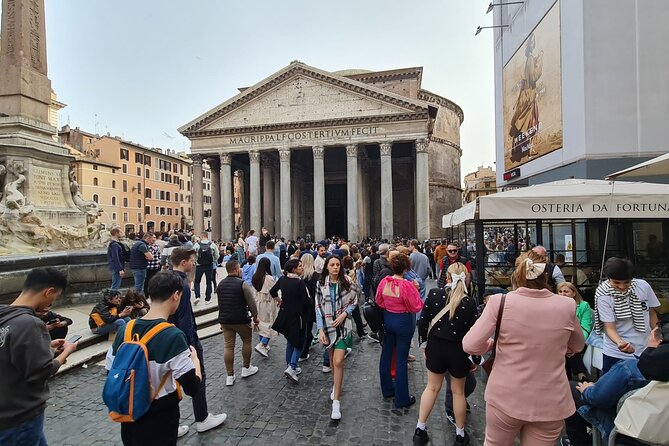
The advertised visit lasts about 45 minutes. That is enough for the main interior, the dome, the oculus, and a measured listen to the audio guide. It is not a full half-day activity, and that is part of its appeal. You can fit it between other central Rome sights without giving up an entire morning.
At $13.23 per person, the price is reasonable if it saves you from a long queue. The ticket is less compelling if the line is short or if the meeting process causes a delay. You are paying not just for admission, but for advance timing, contact with an entry assistant, and an audio introduction.
The service is booked about 23 days ahead on average. That suggests you should not leave it until the last minute if the Pantheon is central to your schedule. Book early enough to secure the time you want, then verify the meeting instructions and opening time close to the visit.
The biggest value comes on a crowded day. One positive account described the ticket as worth it because the regular line was huge. That is the clearest case for booking. If you are visiting during a quieter period and have a flexible schedule, buying admission directly may be a simpler choice.
Important concerns about timing and reliability
The service has a free cancellation policy only when you cancel at least 24 hours before the start time. Cancellations inside that window are not refunded, and changes made inside 24 hours are not accepted. Cut-off times use local Rome time, so check the clock carefully if you are booking from another country.
The more serious concern is operational reliability. Some bookings have involved late staff, no one at the meeting point, an unexpected mass affecting opening, or more tickets being sold than were available. One account described an early time slot that did not match the Pantheon’s actual opening that day. Another described arriving early but still being unable to enter at the appointed time.
These problems are not small if you have train tickets, museum reservations, or a tight airport departure. I would avoid placing this booking immediately before something you cannot miss. Keep the confirmation, meeting instructions, and provider contact details together, and arrive at least 15 minutes early.
Communication through WhatsApp can be a strength when staff respond quickly. It can also be frustrating if you need a refund or urgent correction and receive no answer. The product is inexpensive, but a low price does not remove the need for careful planning.
Who should book this Pantheon ticket?
I would consider it a good fit for you if:
- You want a short visit rather than a long guided program.
- You prefer exploring independently.
- You want basic historical and architectural context while you look around.
- You are visiting on a busy day when the regular line may be long.
- You are comfortable using a WhatsApp audio link on your own phone.
- You can keep some flexibility around the entry time.
I would be more cautious if you need a guaranteed priority lane, a live historian, a detailed route through the interior, or flawless timing. Families may like the freedom to move at their own pace, but the audio guide’s phone format may be less useful for a group that needs one shared explanation.
The Pantheon itself suits almost everyone who enjoys architecture, ancient Rome, or beautiful interiors. The question is not the building. The question is how much certainty and guidance you want from the ticket service.
Should you book it?
Book this experience if your main goal is low-cost, timed entry with a basic audio introduction, especially on a day when lines look long. The Pantheon is worth seeing, and the short format fits neatly into a Rome itinerary.
Skip it if you expect a fully guided tour or a guaranteed escort past every queue. Given the reports of late meeting staff, mismatched opening times, and ticket shortages, I would build in extra time and confirm the arrangements before you set out.
The strongest reason to buy is time saved. The weakest part is the uneven handling of the meeting and entry process. If you accept that tradeoff, this can be a practical way to see one of Rome’s most impressive interiors without spending much.
FAQ
Where does the activity begin?
It begins at Piazza della Minerva, 00186 Roma RM, Italy.
Where does the visit end?
It ends at the Pantheon on Piazza della Rotonda, 00186 Roma RM, Italy.
How long does the experience last?
The visit lasts approximately 45 minutes.
What does the ticket include?
It includes admission to the Pantheon and access to an audio guide.
In what language is the experience offered?
The experience is offered in English.
How is the audio guide provided?
The audio guide is sent as a link through WhatsApp.
Do I need to bring headphones?
Yes. Headphones are not provided, so bring your own if you want to listen privately.
How early should I arrive?
You should arrive 15 minutes before your scheduled time at the meeting point.
How many people can join the activity?
The activity has a maximum group size of 30 people.
Can I cancel for a full refund?
Yes, if you cancel at least 24 hours before the experience starts. Cancellations or changes made less than 24 hours before the start time are not accepted for a refund.
Latest audio tours in Rome
- Pantheon Skip the Line Entry Tickets with Digital Audio Guide★ 3.5 · 52 reviews
- St. Peter’s Basilica: Dome Climb with Lift & Audioguide★ 4.5 · 13 reviews
- Audio guide in Vatican Museums and Sistine Chapel★ 4.5 · 12 reviews
- The Roman Jewish Ghetto: A Self-Guided Audio Tour★ 4.0 · 8 reviews
- Experience: The Pantheon Audio Tour★ 4.5 · 4 reviews
- Trastevere: A Self-guided Audio Tour of Rome’s Medieval Village★ 4.5 · 3 reviews
- The Colosseum’s Attic with 3rd, 4th & 5th Levels with Audio Guide★ 4.5 · 20 reviews
- Self-Guided Audio Tour – The gods of the Palatine★ 3.5 · 5 reviews
Rome Audio Tours, compared.
Colosseum & Forum with Audio Guide App -Optional Arena
Read our review →
City Sightseeing Hop-on Hop-off Bus with Audioguide
Read our review →
St. Peter’s Basilica & Dome Entry Ticket & Audio Tour
Read our review →
Colosseum, Roman Forum & Palatine Hill with Audioguide App
Read our review →
Vatican & Sistine Chapel Ticket with Optional Audio Guide
Read our review →
Castel Sant’Angelo Entry Ticket & Digital Audioguide
Read our review →

Colosseum, Forum, & Palatine Hill with Audio Guide
Read our review →Browse the lists this tour appears in