
Reviewed · USA
Minneapolis River Walk: A Self-Guided Audio Tour
Minneapolis has a river story that is part industry, part theater, part geology, and part oddball local trivia. This self-guided walk ties those threads together as you go from Open Book Literary Center to Nicollet Island, with stories about flour mills, St. Anthony Falls, Nerf Balls, and even cougar attacks along the way.
I like the freedom to start when you want and stop whenever something catches your eye. I also like the clear, humorous narration and the way the app redirects you when you wander off course. The main drawback is practical: the tour is one-way, and it does not return you to your starting point. You’ll also need your own phone and headphones.
Key points to know before you go
- The route starts at Open Book, but you begin from the building’s exterior rather than checking in with staff.
- The Guthrie Theatre, Mill City Museum, and Mill Ruins Park give the walk a strong mix of culture and industrial history.
- St. Anthony Falls and the lock and dam are central to the story, even though the falls have been altered by engineering.
- VoiceMap uses GPS, so the narration starts as you reach each location and can help correct a wrong turn.
- The walk ends at Nicollet Island Pavilion, not back at Open Book, so plan for the return trip.
- The $9.99 price is good value if you want context and direction without paying for a private live guide.
A river walk with an unusual Minneapolis cast

This is not a boat ride. It is a walking tour beside the Mississippi River, and that distinction matters. One poor experience came from expecting a cruise, so make sure you understand the format before booking. You will be on foot for roughly an hour to an hour and a half, moving between Minneapolis landmarks with an audio guide in your ear.
The route is private in the sense that only your group uses the experience, but there is no live guide walking beside you. You download the VoiceMap app, enter the voucher code, and follow the map and GPS prompts. The narration is in English only.
The tone is one of the tour’s strongest features. The writing does not stick only to dates and names. It brings in stranger details, including the story of Nerf Balls and references to cougar attacks, which help break up the more technical material about mills, dams, and river engineering. The narrator is described as local, with a calm delivery, clear sound, and a few well-placed jokes.
That mix should suit you if a formal lecture sounds tiring. You get useful background, but you can pause to take photographs, look inside an attraction, or simply enjoy the river without asking a guide to wait.
More Self-Guided Audio Tours in the USA
- Gettysburg Battlefield Self-Guided Driving Audio Tour
★ 4.5 · 910 reviews - Joshua Tree National Park Self-Guided Driving Audio Tour
★ 4.5 · 762 reviews - Ultimate Acadia National Park Self-Guided Driving Audio Tour
★ 4.0 · 521 reviews
Starting at Open Book Literary Center

The tour begins outside Open Book at 1011 Washington Avenue South. This literary center makes an apt starting point because the first instructions introduce the VoiceMap system, the city, and the building before the walking route gets underway.
You do not need to go inside to check in. The audio tour starts at the front door, and staff at the building may not know how to help with the app. Downloading the tour before you arrive is the safer plan, especially if you have a tight schedule.
This first section is useful for getting your bearings. You learn how the location-based narration works, then move into the river district. If you are not used to audio walks, take a moment here to check that your volume, headphones, map, and voucher code are working.
The tour includes offline access to the audio, map, and geographic data. That is a real advantage. You do not need to rely on a constant mobile signal once everything is downloaded, though your phone still needs enough battery for the walk.
The Guthrie Theatre and Minneapolis culture
One of the first major sights is the Guthrie Theatre. The tour explains the theater’s history and its role as one of Minnesota’s central cultural institutions.
This is a welcome change of pace from the industrial material that follows. Minneapolis is often introduced through its mills and river, but the Guthrie shows how the same district also became an important place for the performing arts. You are not simply walking past a large modern building. You are getting a sense of how the city uses this part of the riverfront today.
The route includes a projection toward the river with views across the water. That extension is a worthwhile part of the walk, particularly if you want more than a straight line between landmarks. The river views help connect the theater to the older working waterfront nearby.
You will not receive admission to a performance or any other attraction as part of the $9.99 fee. Think of the Guthrie stop as an exterior visit with commentary, not a theater tour.
Mill City Museum and the machinery of the river

Next comes Mill City Museum, a key stop for understanding why this stretch of the Mississippi mattered. The commentary gives you background on the museum as you pass by, tying the building to Minneapolis’s milling past.
This is where the route’s subject becomes more concrete. Waterfalls are scenic, but here the river was also a source of power. Mills, channels, and dams changed the shoreline and helped shape the growth of the city.
The tour does not include museum entry, so you have a choice. You can stay on the planned route and hear the exterior explanation, or pause the audio and visit the museum separately if you have extra time. That flexibility is one reason I see this as a useful first look at the area rather than a replacement for every attraction along the way.
If your schedule is short, the outside commentary still gives you enough context to appreciate the ruins and river works. If you have half a day, pairing the audio walk with the museum could give you a fuller picture, but you would need to pay the museum’s admission separately.
Another self-paced route in the USA:
- Los Angeles: Hop-On Hop-Off Bus Tour with Audio Guide
★ 3.7 · 2,030 reviews - City Sightseeing Hop-On Hop-Off Bus Tour with Audio Guide
★ 3.0 · 1,083 reviews - Medieval Torture Museum Ticket with Audio Guide and Ghost Hunting
★ 5.0 · 962 reviews - San Francisco: Alcatraz, Ferry & Audio Tour w/ Night Option
★ 4.4 · 617 reviews
Mill Ruins Park and the city beneath the city

The route then passes Mill Ruins Park, where the remains of the milling district sit beside the modern riverfront. This part of the walk makes the city’s industrial past easier to picture. Instead of hearing only about old factories, you are looking at physical traces of them.
The park also helps the tour shift between built history and open space. The walk is not a string of indoor museum stops. You are outside, moving through the remains of the old mill zone and along the water.
Pay attention to your footing here and elsewhere. One person suffered a fall on an uneven sidewalk crack near Gold Medal Park, damaging a phone and glasses. That does not mean the route is unusually difficult, but it is a reminder to look up from the screen and watch the pavement.
The app’s map is helpful, but you should not stare at it every second. Use the audio prompts to guide you, then pause when you need to cross an area or examine the surroundings.
St. Anthony Lock and Dam, now permanently closed
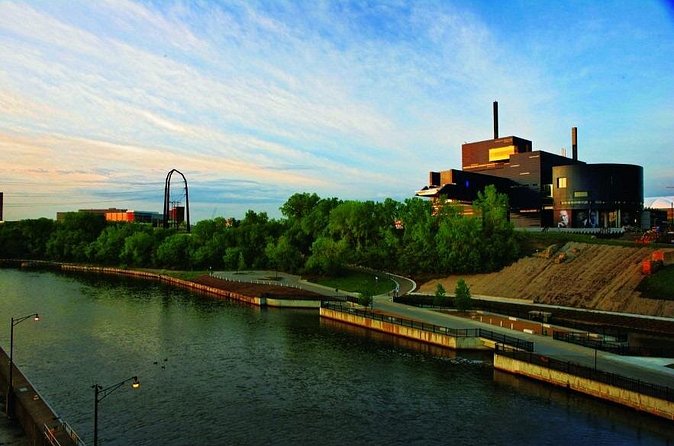
The route continues past St. Anthony Lock and Dam. The narration explains how the lock and dam were used and why the lock is permanently closed.
This is one of the most valuable stops for making sense of the river as an engineered system. The Mississippi here is not only a natural feature. It has been shaped for transport, power, flood control, and industrial use.
You will hear about the practical role of the structure rather than simply stopping for a scenic photograph. That added explanation helps answer a question you might otherwise have while walking: why are there so many unusual channels, walls, and changes in water level along this part of the river?
GPS performance can vary around buildings and enclosed spaces. One person found the route worked especially well once away from the larger structures. If the audio does not trigger exactly when expected, check your position on the map instead of assuming the tour has stopped working.
A closed bridge or detour can also cause trouble. If part of the route is unavailable on the day you visit, the directions may not immediately make the best alternate path clear. Check current access before starting if construction or closures are a concern.
St. Anthony Falls, natural force and human control

The walk next brings you to the story of St. Anthony Falls. You can see where the falls would have been if the dam had not altered the river, and the narration explains more about the falls themselves.
This is the heart of the tour. The falls are not just a pretty stopping point. They explain why Minneapolis developed here and why the river became so valuable to industry.
The commentary also deals with how the falls changed over geological time and how human engineering altered them. That gives you two useful layers of context. First, the falls are a natural feature shaped by the river and the rock beneath it. Second, the modern scene reflects decisions made to control that natural force.
I like this part because it asks you to compare what you see with what once existed. You are not only admiring the river. You are trying to read the changes made to it.
The audio’s humor helps here. A long explanation of water management can become dry, but the unusual side stories keep the walk moving. The narrator’s pace is described as calm and easy to follow, so you can look around without feeling rushed.
Walking beside the Mississippi River

After the falls and dam, the route follows a section of the Mississippi River. This stretch gives you time to absorb the setting rather than move from landmark to landmark every few minutes.
The walk combines urban views with quieter river scenes. That contrast is one of its better qualities. You see the city’s cultural and industrial side, then have space to watch the water and consider how much of Minneapolis grew from this river corridor.
The self-guided format works well here. You can pause the narration for photographs, stop for food on your own, or simply slow down. You are not holding up a group, and nobody is asking you to keep moving.
On the other hand, an audio walk asks you to manage yourself. You need to keep track of the route, battery, headphones, and surroundings. If you prefer a guide who handles navigation and answers questions, this is not the right format.
The route generally takes about 60 to 90 minutes without long attraction visits. Some people stretch it longer by pausing, exploring, or taking breaks. The flexible timing makes it workable during a short stay or even a layover, provided you leave enough time to get back to your next appointment.
Finishing on Nicollet Island

The tour ends at Nicollet Island Pavilion at 40 Power Street. While you walk there, the narration covers Nicollet Island and the person it was named after.
This ending gives the route a change in mood. You finish away from the starting point, with the river story moving toward the island rather than circling back through the original district.
The one-way design is the clearest weakness. Several people liked the route but wished it formed a loop. The walk back to the starting side of the river may be manageable, but it still takes extra time and energy. If you parked near Open Book, build that return into your plans. If you are using public transportation or a rideshare, think about arranging your pickup from the end instead.
The ending can also feel abrupt because the audio stops at the pavilion rather than guiding you through a full return journey. That is not a serious problem if you know it in advance. It is an avoidable surprise if you assume the app will deliver you back to Open Book.
What $9.99 gets you
At $9.99 per person, this is a modestly priced way to add meaning to a walk you might take anyway. You receive lifetime access in English, the VoiceMap app for Android and iOS, and offline access to the audio, map, and geographic data.
The value is strongest if you want three things:
- A clear route through the river district
- Historical context without joining a scheduled group
- The freedom to pause, restart, or listen again later
The value is weaker if you expect admission to museums, a live guide, food, transportation, or a boat ride. None of those are included. You also need to supply your own smartphone and headphones.
The lifetime access is handy. If you run short of time, you can return to the tour later rather than trying to finish every stop in one visit. The audio can also be replayed from home, although the experience makes the most sense when you are looking at the places being described.
Free cancellation is available up to 24 hours before the scheduled start time. Inside that window, the price is not refunded, so keep the timing rule in mind when booking.
Who should book this audio walk?
I would choose this tour if you like exploring independently but still want a story to follow. It suits solo visitors, couples, and friends who do not want to match a guide’s pace. It can also work for a short visit because the basic route takes about an hour to an hour and a half.
It is a good match for:
- First-time visitors seeking an introduction to Minneapolis
- Local residents who want a fresh reason to walk the river district
- People interested in theater, mills, river engineering, and local oddities
- Anyone who prefers a private outing instead of a group tour
- Visitors with limited time who want a planned route
You may want another option if you have difficulty walking for an extended period, need a fully guided accessible route, or expected a boat trip. Uneven pavement is possible, and the route does not include transportation.
Should you book the Minneapolis River Walk audio tour?
Book it if you want an affordable, flexible introduction to Minneapolis’s riverfront, especially if you enjoy local stories delivered with a little humor. The best parts are the clear narration, accurate map, unusual details, and strong run of sights from the Guthrie Theatre through the old mill district and St. Anthony Falls.
Before you start, download the tour, charge your phone, bring headphones, and note both endpoints. Start outside Open Book, not at a check-in desk, and plan how you will leave Nicollet Island.
For $9.99, this is a sensible way to understand the river district on your own terms. Just treat it as a one-way walking tour, not a complete attraction pass or a cruise.
FAQ
How long does the Minneapolis River Walk audio tour take?
The tour takes approximately one hour to one hour and 30 minutes. You can make it longer by pausing, stopping at attractions, or taking breaks.
Where does the tour begin?
It begins outside Open Book Literary Center at 1011 Washington Avenue South in Minneapolis. You start at the front door and do not need to check in with the building’s staff.
Where does the tour end?
The tour ends at Nicollet Island Pavilion, 40 Power Street. It does not return you to Open Book.
Is this a boat tour?
No. This is a self-guided walking tour beside the Mississippi River. Transportation is not included.
What language is the audio tour in?
The tour is offered in English.
What do I need to bring?
You need a smartphone and headphones. The VoiceMap app provides offline access to the audio, map, and geographic data after download.
Are museum tickets included?
No. Tickets and entrance fees for museums or other attractions along the route are not included. Food, drinks, and transportation are also excluded.
Latest audio tours in the USA
- Sequoia National Park Self-Guided Audio Tour★ 4.5 · 9 reviews
- Sequoia and Kings Canyon Audio Tour Self Guide National Park Tour★ 5.0 · 3 reviews
- Kings Canyon National Park Self-Guided Audio Tour★ 4.0 · 4 reviews
- Sedona, Arizona Self-Guided Audio Tour★ 4.0 · 36 reviews
- Sedona & Red Rock State Park Self-Guided Driving Audio Tour★ 3.0 · 30 reviews
- Downtown Seattle Self-Guided Walking Audio Tour★ 4.5 · 6 reviews
- Uncover Seattle: Self-Guided Audio Tour★ 3.5 · 7 reviews
- Haunted Savannah Self-Guided Walking Audio Tour★ 4.5 · 3 reviews
Self-Guided Audio Tours, compared.

Acropolis Ticket & Optional Self-Guided Audio Tours
Read our review →


Ultimate Acadia National Park Self-Guided Driving Audio Tour
Read our review →

Akrotiri Ticket with Optional Self-Guided Audios
Read our review →