
Reviewed · ITALY
Lucca Walking Tour with Audio and Written Guide by a Local
Lucca is easy to walk, but its best details can slip past you: a Roman amphitheater hidden beneath an oval piazza, an emerald legend above a church, and trees growing from a medieval tower. This self-guided route lets you explore those sights with audio, written notes, and map support, rather than keeping pace with a group.
I like the pause-and-restart freedom, especially if you want time for pizza, gelato, or a look inside a church. I also like the low price, $6.36 per person, and the way the walk links Lucca’s walls, Roman center, towers, churches, and food culture in one route.
The main drawback is that you must bring a smartphone with an internet connection and activate the guide correctly from your voucher. You also pay separately for several sights, and the full route can take four to five hours if you stop inside the monuments.
Key points to know before you go
- Eight central Lucca sights: The route runs from Porta San Pietro to Basilica di San Frediano and covers the city’s main historic core.
- A self-guided format: Listen through your phone speaker or headphones, pause whenever you like, and return to the route after a meal or shopping stop.
- Torre Guinigi costs €8: The climb includes 230 steps and rewards you with views from the tower’s tree-topped summit.
- Several entries cost extra: The cathedral, Torre delle Ore, and Basilica di San Frediano are not included in the $6.36 guide price.
- Local food advice is part of the experience: The guide includes information about Italian aperitivo and authentic local restaurants.
- A flexible family option: The route can work well with children because you control the pace and can stop whenever attention fades.
A low-cost way to get your bearings in Lucca
At $6.36 per person, this is priced more like a useful city guide than a traditional guided tour. You are paying for a planned route, audio commentary, written information, navigation, and local suggestions, not for a guide walking beside you.
That distinction matters. If you want conversation, spontaneous questions, and a human guide pointing out details in real time, this will feel limited. If you prefer to set your own pace, it offers a lot for the money.
The route takes about four to five hours when you include the listed stops and possible interior visits. Some people complete it faster, especially if they stay outside the churches and towers. The audio can also be paused, so you are not forced to finish in one sitting.
Lucca is a particularly good city for this format. Its historic center is compact, the route uses recognizable landmarks, and you can easily stop for food without losing the thread. The walk begins at Porta San Pietro and ends at Basilica di San Frediano, giving you a clear direction across the old center.
More Audio Walking Tours in Italy
- Florence: 2.5 hour Audio Guided Walking Tour led by Host
★ 4.6 · 293 reviews - Verona Walking Tour with Audio and Written Guide by a Local
★ 4.5 · 157 reviews - Bologna Walking Tour with Audio and Written Guide
★ 4.5 · 132 reviews
Starting at Porta San Pietro
Porta San Pietro is the southern entrance through Lucca’s Renaissance walls. Built in 1566 on the road toward Pisa, it is one of the city’s most imposing gateways and a sensible place to begin.
The stop itself takes about 10 minutes and has no admission fee. Use this opening moment to understand the walls around you. Lucca’s fortifications are not just a backdrop for photographs. They define the shape of the old city and help explain why the historic center feels separate from the modern streets beyond it.
Because this is the meeting point, check your voucher before setting out. The listed start is Sortita Porta San Pietro, at Porta San Pietro in Lucca. You will need your phone ready to activate the guide, and the instructions for doing that are supplied with your booking confirmation.
Piazza Napoleone and the city’s political heart
From the gate, the route continues to Piazza Napoleone, also called Piazza Grande. This broad square was once the center of political power in Lucca. Today, it is used for cultural events and concerts, including the Lucca Summer Festival.
The planned stop is about 10 minutes and free. The square works well early in the walk because it gives you a sense of Lucca as a living city rather than a string of isolated monuments. Listen to the explanation, then look at how the open space contrasts with the narrower streets nearby.
Event activity can change the feel of the piazza, so allow yourself a little flexibility. The digital format helps here. You can pause the commentary if the square is noisy or if you want to take photographs before continuing.
Duomo di San Martino and its unusual facade
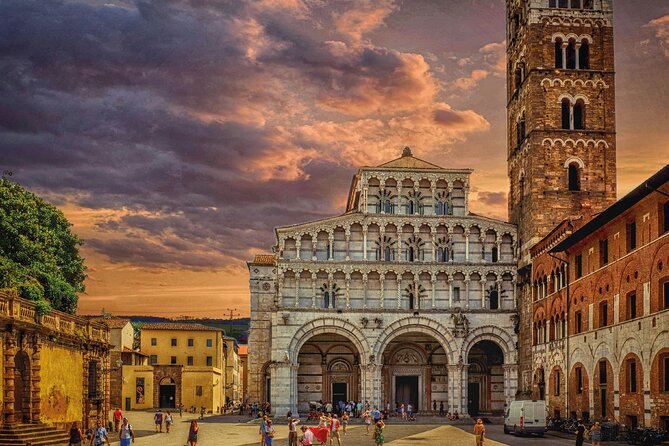
The exterior of Duomo di San Martino is the next major stop. The cathedral facade is famously asymmetrical because one of its arches had to be made smaller to accommodate the pre-existing bell tower. That small irregularity is easy to miss without a prompt to look for it.
The suggested time here is 25 minutes. The route views the church from outside, but you may enter if you wish. Admission is not included, so check the current entry arrangements when you arrive.
Inside are important works, including the funerary monument of Ilaria del Carretto, the Sacred Conversation by Ghirlandaio, the Last Supper by Tintoretto, and an altarpiece by Fra Bartolomeo. You do not need to enter to appreciate the exterior, but the interior option gives this stop more weight than a quick photograph.
This is one place where your actual timing can change sharply. Stay outside and you may need only the suggested 25 minutes. Go in, and you should allow extra time for the art and architecture.
Another self-paced route in Italy:
- Rome: Pantheon Fast-Track Ticket and Official Audioguide
★ 4.5 · 27,353 reviews - Rome: Colosseum & Forum with Audio Guide App -Optional Arena
★ 4.2 · 24,770 reviews - Florence: Timed Entry to Michelangelo’s David + Audio App
★ 4.6 · 19,496 reviews - Rome: City Sightseeing Hop-on Hop-off Bus with Audioguide
★ 4.0 · 16,045 reviews
Torre delle Ore and Lucca’s medieval skyline
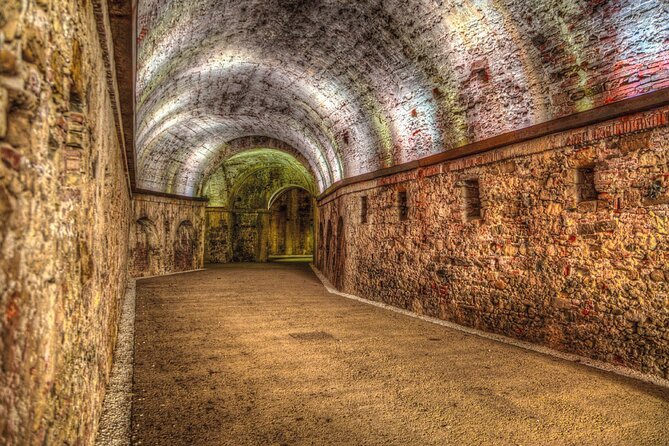
Torre delle Ore introduces a different side of Lucca. The city is often associated with its many churches, but medieval Lucca also had numerous towers built by wealthy families. Their height signaled social rank: a taller tower meant a more important family.
The stop is allocated 30 minutes, and entry is not included. The information supplied for this experience does not give a separate ticket price for Torre delle Ore, so check locally if you plan to go inside.
Even from street level, the tower helps you read the old city. Look upward as you walk. Lucca’s historic center is not only about grand churches and piazzas. Its vertical profile reveals the ambitions of the families who shaped the medieval city.
If you have mobility concerns, keep in mind that towers usually involve stairs, though the supplied details do not specify the climb at Torre delle Ore. The guide allows you to decide how much of the stop suits you.
San Michele in Foro and the emerald legend
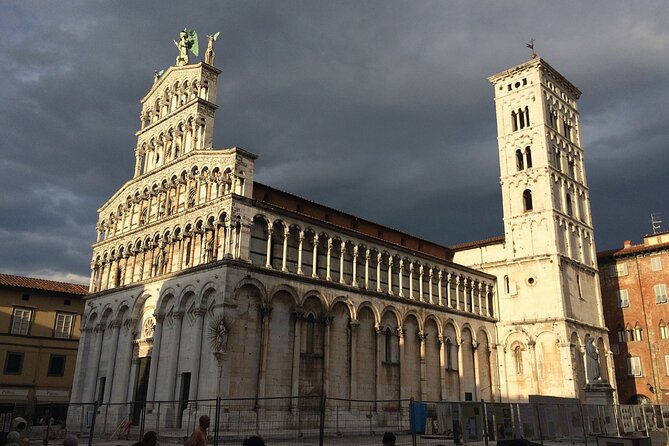
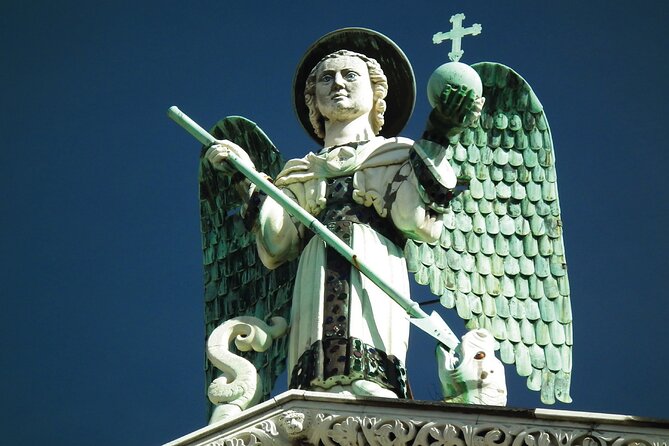
Chiesa di San Michele in Foro sits in the former Roman forum, now Piazza San Michele in Foro. The church dates to the eighth century and is dedicated to the archangel Michael.
The audio description draws your attention to the large marble statue at the top. The archangel is shown defeating a dragon, with metal foil wings, and the figure is about four meters high. According to local legend, a lost emerald once set in the statue can produce a glow on bright days.
The stop takes about 20 minutes and is free. It is a good example of what the digital guide does best: it gives you a reason to look closely at a feature that could otherwise pass overhead. Stand in the piazza, listen, and then inspect the facade and statue for yourself.
The Roman connection also makes this stop useful in the sequence. You have just considered medieval towers and cathedral art. Here, the route reminds you that Lucca’s streets and squares also follow an older Roman plan.
Torre Guinigi and 230 steps to the top

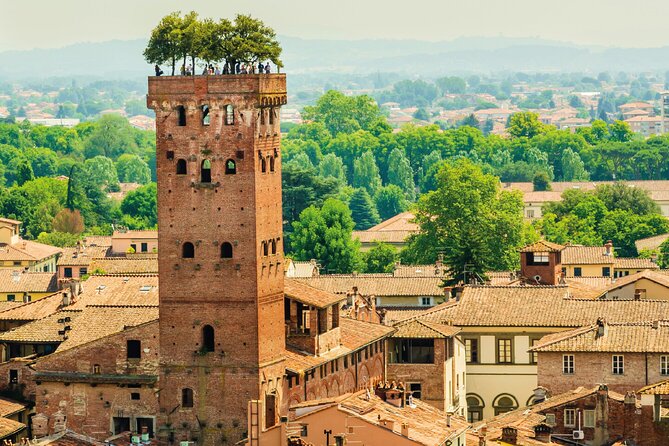
Torre Guinigi is the most demanding stop on the route and one of the most memorable. Its trees, growing from the top of the 45-meter tower, make it easy to identify from many points in the city.
The climb involves 230 steps and takes about 45 minutes in the planned schedule. Admission costs €8, which is separate from the digital guide. The route is clear about the effort, and you should take that warning seriously if stairs are difficult for you.
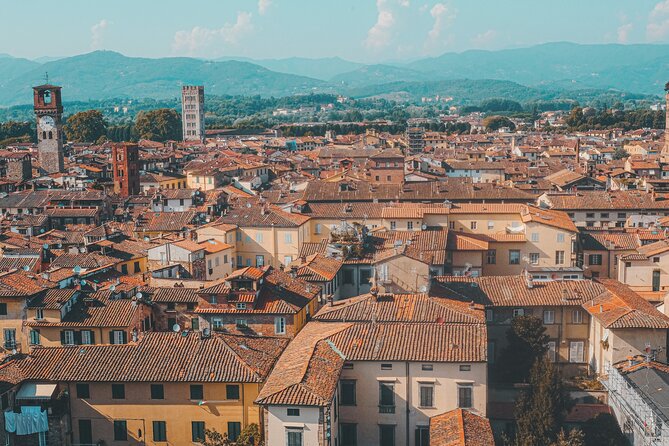
For many people, the view makes the climb worthwhile. From the top, you can look across Lucca’s historic center and see how the walls, churches, roofs, and towers fit together. The trees at the summit are also a striking sight in their own right.
This is a place where you should not rush. The audio gives you context, but the reward comes from taking a moment at the top. If you are walking with young children, decide in advance if the climb fits your group. The route has been used with two children, but the 230 steps still require patience and supervision.
Piazza Anfiteatro and the Roman city below
Piazza Anfiteatro is one of Lucca’s most recognizable spaces. Its oval shape follows the foundations of a Roman amphitheater dating to the second century AD, where gladiator fights once took place.
The original remains are not visible in the square itself, but the shape tells the story. Four vaulted entrances lead into the piazza, and the curve of the surrounding buildings traces the ancient structure beneath your feet.
The stop takes about 20 minutes and is free. It is a good place to pause the guide and enjoy the setting at your own speed. You might want a drink, a snack, or a few photographs before continuing.
This stop also shows why a planned route helps. Without some historical context, you could see Piazza Anfiteatro as simply a pleasant oval square. With the explanation, its form becomes evidence of an older city hidden inside modern Lucca.
Basilica di San Frediano, the route’s final stop
The walk ends at Basilica di San Frediano in Piazza San Frediano. The basilica is one of Lucca’s oldest places of worship, and tradition connects its foundation with San Frediano, an Irish prince who became a hermit on Mount Pisano and later served as one of the city’s early bishops.
The basilica is first mentioned in 685 as the basilica Longobardorum. The planned visit takes about 30 minutes, and entry costs €3, not included in the guide price.
Ending here gives the route a strong sense of progression. You begin at a Renaissance gate, pass through political and Roman spaces, look up at medieval towers, and finish at an early church with a long religious tradition.
The endpoint is Piazza S. Frediano. You are not required to stop your day there. The audio guide has done its job by bringing you across the center, and you can continue exploring, eat, or return to any sight that deserves more time.
Why the audio and written format works
You receive both audio and written guidance. That is useful when a street is noisy, when you want to read at your own pace, or when you need to check a detail without replaying the entire explanation.
Navigation is another strong point. The guide can be added to Google Maps, which helps you follow the route and locate the next stop. That matters in Lucca because the historic center is pleasant enough to encourage detours. You can wander into a side street, stop for gelato, and restart when ready.
You can listen through your phone speakers or use headphones. Headphones make the commentary easier to hear, but using a speaker may help if you are walking with others and want to share the information. Keep the volume sensible in churches and busy public spaces.
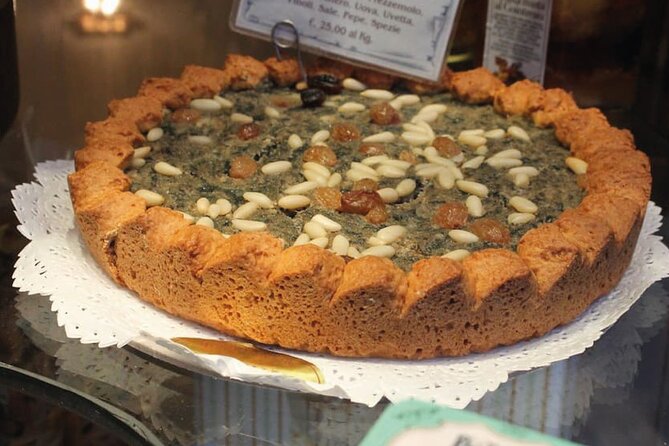
The guide also adds material beyond buildings. It includes local food information, Italian aperitivo, and suggestions for authentic local restaurants. That makes the experience more useful than a monument checklist. You get help deciding how to spend the breaks between stops.
Timing, costs, and practical limits
The base price is $6.36 per person, with group discounts available. That is strong value if you want a structured introduction to Lucca and do not need a live guide.
Your total spending can rise if you enter the paid sights. Torre Guinigi costs €8, Basilica di San Frediano costs €3, and the cathedral and Torre delle Ore also require separate admission. The itinerary views the cathedral from outside, so you can keep costs down by choosing only the monuments that matter most to you.
The experience is available daily from midnight to 11:30 p.m. according to the supplied hours, giving you broad control over when to begin. The listed booking period runs from March 9, 2024, through June 18, 2026.
Confirmation arrives at booking time. You need a smartphone with internet access, and you should read the voucher carefully for activation instructions. This is the most important practical step. A digital tour is only useful once it is loaded and working.
Service animals are allowed, and the route is near public transportation. Most people can participate, but Torre Guinigi’s 230 stairs are a clear physical consideration. The activity can accommodate up to 104 people, though the self-guided system means you are not required to move as one tight group.
Free cancellation is available up to 24 hours before the local start time. Cancelling inside that 24-hour window does not qualify for a refund, and changes then are not accepted.
Who will enjoy this Lucca walk most
I would choose this for a first look at Lucca, especially if you want a clear route without committing to a fixed group schedule. It suits independent visitors, couples, families, and anyone who likes to mix sightseeing with food stops.
It is also a good fit if you enjoy learning small details. The asymmetrical cathedral facade, the statue above San Michele, the Roman foundations below Piazza Anfiteatro, and the social meaning of medieval towers all reward close attention.
I would be more cautious if you want a live conversation or detailed answers at every stop. You can receive help with doubts or problems through the service, but the experience itself is built around your phone, not a guide walking beside you.
Should you book this Lucca audio tour?
Book it if you want an inexpensive, flexible route through Lucca’s main sights and you are comfortable using your smartphone. The strongest reasons are the low price, clear navigation, pause-and-restart control, and useful mix of monuments, legends, and food advice.
Skip it if you want all admission tickets included or if climbing towers and managing a digital guide sounds like more work than fun. For most independent visitors, though, it offers a practical way to see the city without missing its major landmarks or losing time to a rigid schedule.
FAQ
How much does the Lucca walking tour cost?
The digital guide costs $6.36 per person. Group discounts are available.
How long does the tour take?
The route takes approximately four to five hours, depending on how long you spend at each stop and whether you enter the paid attractions.
Where does the walking tour begin?
It begins at Porta San Pietro, at Sortita Porta S. Pietro in Lucca.
Where does the route finish?
The route ends at Basilica di San Frediano in Piazza S. Frediano.
Do I need a smartphone and internet connection?
Yes. You need a smartphone with an internet connection to activate and use the digital guide. Activation details are included in your voucher.
Are admission tickets included?
No. Admission is not included for the cathedral, Torre delle Ore, Torre Guinigi, or Basilica di San Frediano. Torre Guinigi costs €8, and Basilica di San Frediano costs €3. The other listed stops are free, though the cathedral and Torre delle Ore are marked as paid-entry attractions.
Can I cancel for a full refund?
Yes, if you cancel at least 24 hours before the experience start time. Cancellations or changes made less than 24 hours before the start time are not refunded or accepted.
Latest audio tours in Italy
- Pantheon Skip the Line Entry Tickets with Digital Audio Guide★ 3.5 · 52 reviews
- St. Peter’s Basilica: Dome Climb with Lift & Audioguide★ 4.5 · 13 reviews
- Audio guide in Vatican Museums and Sistine Chapel★ 4.5 · 12 reviews
- The Roman Jewish Ghetto: A Self-Guided Audio Tour★ 4.0 · 8 reviews
- Experience: The Pantheon Audio Tour★ 4.5 · 4 reviews
- Trastevere: A Self-guided Audio Tour of Rome’s Medieval Village★ 4.5 · 3 reviews
- The Colosseum’s Attic with 3rd, 4th & 5th Levels with Audio Guide★ 4.5 · 20 reviews
- Self-Guided Audio Tour – The gods of the Palatine★ 3.5 · 5 reviews
Audio Walking Tours, compared.

City Monuments Guided Walking Tour with Audio Guide
Read our review →

Self Guided Classic Freedom Trail Location Aware (GPS) Walking Audio Tour
Read our review →
Self-Guided Historical Walking Tour (Audio Guide)
Read our review →
Cape Cod & Provincetown Self-Guided Driving & Walking Audio Tour
Read our review →
Verona Walking Tour with Audio and Written Guide by a Local
Read our review →
Royal Walking Tour and Buckingham Palace Audio Tour
Read our review →
Bologna Walking Tour with Audio and Written Guide
Read our review →Browse the lists this tour appears in