
Reviewed · MADRID
Las Ventas Madrid Bullring & Bullfighting Museum with Audioguide
Las Ventas is more than a stadium. It is a working arena, a museum of Spanish bullfighting, and one of Madrid’s most striking buildings. You’ll walk into the ring, follow the route matadors once used, and hear how a noblemen’s horseback contest became the modern corrida.
I like the self-paced audio guide, which lets you pause, replay, and move at your own speed. I also like the chance to see the Puerta Grande and the matadors’ alley without buying a ticket to an actual bullfight. The main drawback is that construction, special events, or bullfighting days can close parts of the building or change the schedule.
Key points to know before you go
- Walk into the actual bullring: See the sand, seating tiers, gates, and narrow callejon used behind the ring.
- Study Goya and twentieth-century costumes: The Bullfighting Museum includes Goya’s tauromachy engravings, bullfighters’ suits, capes, and a section on Manolete.
- Use the audio guide at your own pace: The commentary explains the sport’s history, rituals, people, and architecture without requiring a live group.
- Try the virtual bullfighting activities: A 360-degree San Isidro Fair experience puts you in a simulated bullfight, with interactive photo opportunities as well.
- Admire the Neo-Moorish design: Ceramic tiles and glazed plaques representing Spanish provinces reward a slow walk around the building.
- Plan around events: The tour does not operate normally on bullfighting days, and construction or special events may restrict access.
Why Las Ventas matters in Madrid
Las Ventas is often called the Bullfighting Cathedral. That title tells you how seriously the venue is regarded within Spain’s bullfighting tradition, even though the sport remains controversial and opinions about it vary sharply.
The arena was built in 1929 on land known as Las Ventas del Espíritu Santo. It covers about 45,800 square meters and can hold 23,797 people, making it the largest bullring in Spain by capacity.
I find the visit useful because it gives you context before you decide what you think about bullfighting. You are not simply shown a pretty arena. The audio guide explains the roles of the matador, bull, judges, assistants, musicians, and audience, along with the rituals that make a corrida more than a sporting contest.
The historical outline is especially helpful. Spanish nobles once fought bulls from horseback, but King Felipe V outlawed that practice in the eighteenth century. Bullfighting then shifted toward the ground-based format associated with the modern corrida de toros.
That background helps explain why the arena has such a strong cultural role. At the same time, you should know that the visit presents bullfighting as an important Spanish tradition, not as a debate about animal welfare. If you want a detailed discussion of the sport’s ethical arguments, you will need to seek that elsewhere.
More Museum Audio Tours in Spain
- Madrid: Prado Museum Ticket with In-App Audio Guide
★ 3.6 · 1,154 reviews - Madrid: Reina Sofía Museum Ticket with In-App Audio Guide
★ 3.1 · 231 reviews - Madrid: Archaeological Museum E-Ticket and Audio Guide
★ 4.3 · 115 reviews
Entering Las Ventas and getting oriented
The visit is self-guided. You arrive during the opening hours, present your prepaid ticket, and collect or use the audio guide provided for the tour. There is no fixed departure time in the usual sense, so you can enter during the permitted hours rather than rushing to meet a guide at a street corner.
That flexibility is one of the experience’s strongest features. You can complete the main route in about an hour, but the museum and interactive displays give you reasons to stay longer.
The venue is close to public transportation, and one detailed account described the Metro stop as being right outside the arena. The exact entrance procedure can change during events, so keep your voucher ready and allow a little extra time to exchange it at the venue if required.
The audio commentary gives you a clear sequence to follow. It also lets each person listen at a different pace, which is useful for families or groups with mixed interests.
The arena, seating tiers, and callejon
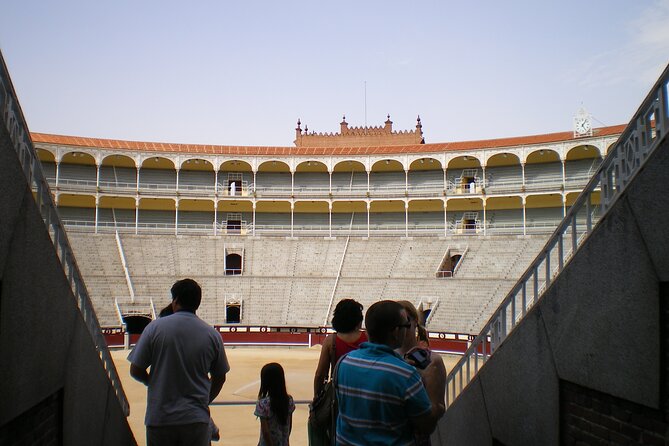
The most memorable part for many people is stepping onto the arena floor. From ground level, the space feels very different from the upper seats. You can look back at the curved rows of tendidos, the Spanish name for the seating levels, and picture the scale of a full house.
The audio guide explains how the arena functions and points out the areas that matter during a bullfight. You’ll hear about the movement between the ring and the surrounding passage, as well as the practical role of the narrow callejon.
The callejon is the alleyway behind the main ring. It gives matadors and other participants a route around the arena, including a way to move clear of an enraged bull. Seeing this close, enclosed passage adds a practical layer to a tradition that can seem theatrical from the audience seats.
I recommend taking your time here rather than treating the arena floor as a quick photo stop. Look up at the seating, note how close the first rows are to the action, and listen to the explanation of how the president of the bullfight controls the event.
The route may not always look perfect. Construction has sometimes blocked sections, and machinery or metal grinders can make it harder to hear the audio. If access is limited during your visit, ask at the ticket desk what parts remain open before you begin.
The Puerta de Madrid and the meaning of the gates
Las Ventas has several important gates, but the Puerta de Madrid is the one to watch for. It is associated with the exit used by victorious matadors.
A matador who has achieved the highest honor can leave through the main gate, known as the Puerta Grande. The tour helps you understand why this is such a powerful symbol. Leaving through that gate is not just a matter of finding the nearest exit. It represents public approval and success at one of the sport’s most demanding venues.
The audio guide also explains how the president may award trophies such as ears and a tail. These details can seem obscure if you arrive without context, but they make sense once the commentary lays out the ceremonial system.
You’ll find good photo opportunities around the gates and arena. Some of the interactive features allow you to place your face into a matador image, creating a souvenir that is playful rather than solemn.
More Museum Audio Tours in Madrid
- Skip-the-line entrance to the Prado Museum with Digital Audio Guide
★ 3.0 · 91 reviews - Madrid: Lázaro Galdiano Museum Entry Ticket with Audio Tour
★ 3.9 · 14 reviews - Madrid National Archaeological Museum with Audio Tour
★ 4.5 · 11 reviews - Madrid Las Ventas Bullring and Museum Tour with Audio Guide
★ 4.5 · 8 reviews
The Neo-Moorish façade and ceramic details
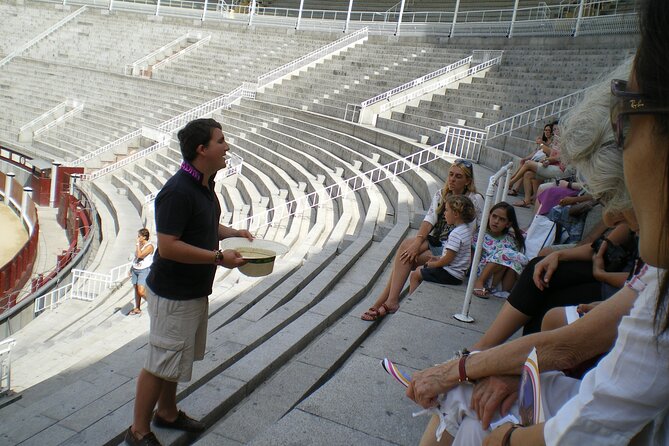
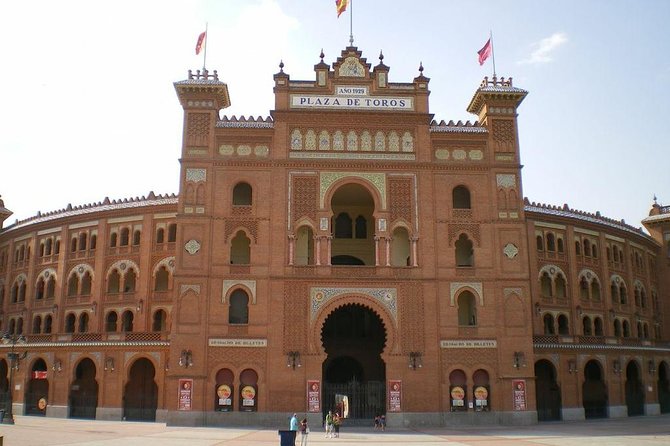
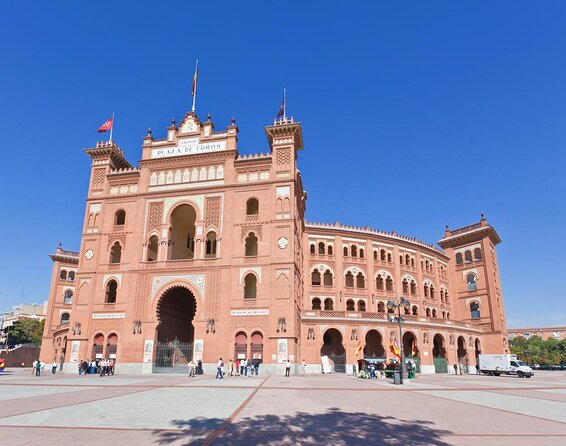
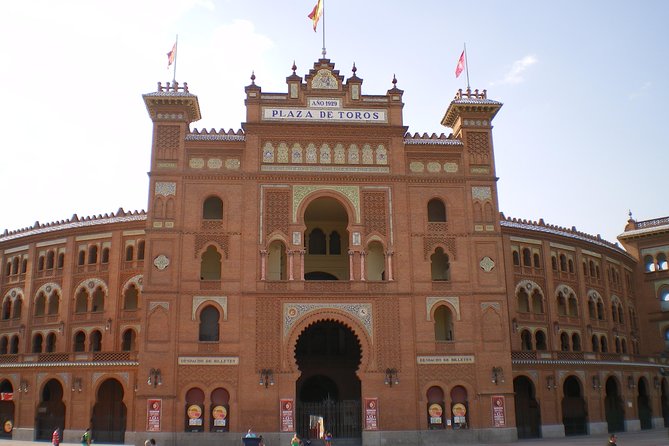
Las Ventas deserves attention even if you have little interest in bullfighting. The building was designed by José Espeliú and is a notable example of Neo-Moorish architecture.
The exterior uses exposed brick, arches, decorative tile, and glazed ceramic details. Look for the plaques showing the emblems of Spain’s provinces. These are easy to miss if you hurry toward the museum, but they help turn the building into a visual record of the country.
The design is decorative without being delicate. Las Ventas feels grand, practical, and unmistakably Spanish, with a warm brick exterior that photographs well in daylight.
I would set aside a few minutes before or after the audio route to study the façade. The architecture is one of the best reasons to recommend this visit to someone who is uncertain about bullfighting itself.
The Bullfighting Museum and its collection
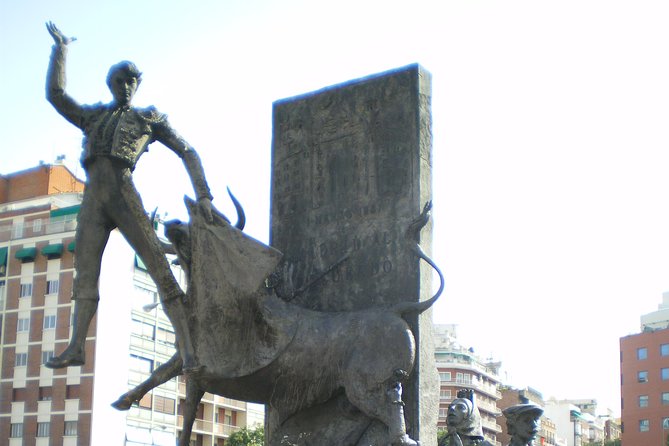
The Bullfighting Museum of Madrid sits in the Patio de Caballos, an emblematic section of the arena. It provides the historical and artistic portion of the visit, while the ring shows you the physical setting.
The collection includes engravings from Francisco de Goya’s tauromachy series. Goya’s work is valuable because it records bullfighting as both spectacle and social ritual, giving you a visual link between Spanish art and the arena.
You’ll also see bullfighters’ suits from the twentieth century. These trajes de luces, or suits of lights, are richly decorated and much more ornate than photographs suggest. Capes and related equipment show the craft and ceremony behind the performers’ public image.
A section devoted to Manolete adds a personal focus. Rather than presenting only rules and objects, the museum connects the arena with one of the important figures in twentieth-century bullfighting.
The exhibits also document the birth and development of Las Ventas itself. That makes the museum a useful final stop because you can match the objects on display with the spaces you have just walked through.
One practical point matters here: the museum has occasionally closed for restoration, and access can change. Confirm its status when you arrive, especially if the museum is the main reason you booked.
The virtual reality bullfight
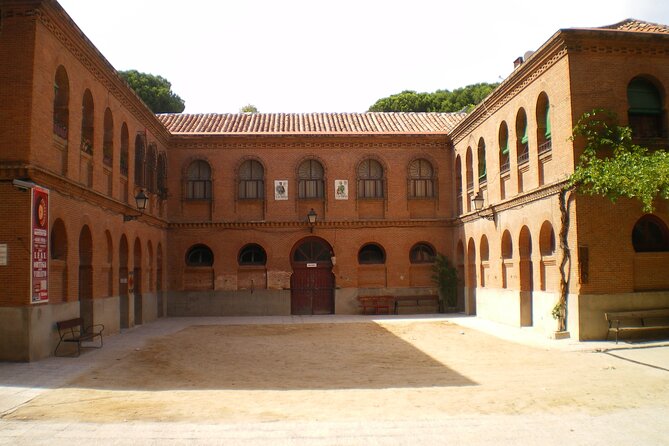
The ticket includes a virtual bullfighting activity, including a 360-degree experience linked to the San Isidro Fair. You put on a headset and enter a simulated bullfighting scene rather than watching a standard film.
This is aimed at participation. The idea is to give you a sense of what it might feel like to be in the ring as a bullfighter, with the action presented from close range.
The virtual section adds variety after the historical exhibits. It is also likely to appeal to children and visitors who find a traditional museum display too static.
The equipment is shared, so hygiene is worth keeping in mind. One visitor specifically suggested that the headset should be wiped between uses. If this concerns you, ask staff about cleaning before putting it on.
The virtual experience should not be mistaken for a full bullfight. It is a short interpretive feature, not a live performance, and the quality of access may depend on crowd levels or venue arrangements.
How long to allow and when to visit
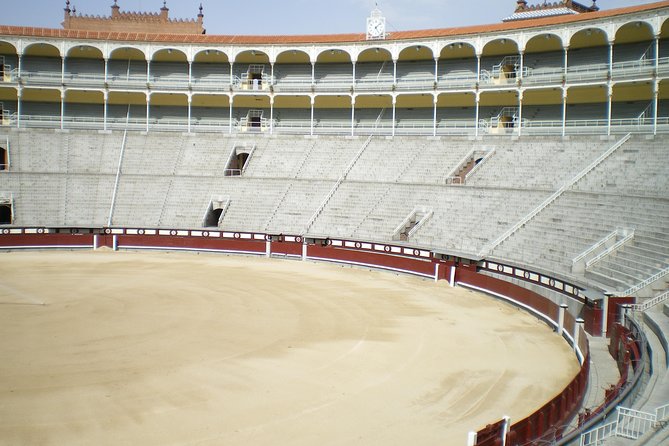
The advertised duration is about one hour. That is enough for a brisk walk through the arena and the main audio stops, but I would allow extra time if you want to read the museum displays, take photographs, and use the virtual-reality section.
Opening hours vary by season:
- From May through October, the venue generally opens from 10 a.m. to 7 p.m., with last entry at 6:15 p.m.
- From November through April, it generally opens from 10 a.m. to 6 p.m., with last entry at 5:30 p.m.
- The listed winter schedule for December 1, 2026, through March 31, 2027, is 10 a.m. to 6 p.m. daily.
These hours can change around major events. On bullfight days, the tour may end three hours before the performance. During the San Isidro Fair, the visit is listed as running from 10 a.m. to 3:30 p.m., while the Autumn Fair schedule is listed as 10 a.m. to 4 p.m.
Do not assume that a normal opening time guarantees a normal route. Special events, construction, and force majeure can alter the visit, and staff may announce changes when you exchange your voucher.
Is the $20.52 price good value?
At about $20.52 per person, this is a reasonably priced cultural stop for Madrid, particularly because the ticket combines the arena, audio guide, museum, and virtual-reality features.
The value depends on how you visit. If you rush in, take two photographs, and leave after 30 minutes, the price feels less attractive. If you spend an hour or more with the museum and audio commentary, it compares well with other paid city attractions.
The self-guided format also keeps the cost down. You are not paying for a private guide or a fixed group tour, and you can make the visit fit around lunch, the Metro, or another sight.
Food and drinks are not included, though an on-site café is available for refreshments. Hotel pickup and drop-off are not included either, but that is not a major concern for a centrally located Madrid attraction close to public transportation.
Who will enjoy this visit most?
I would recommend Las Ventas to anyone interested in Spanish art, architecture, local customs, or the history of public spectacle. You do not need to plan to attend a live bullfight to get something from the visit.
It works especially well for families because the audio route, costume displays, photo features, and virtual reality break up the history. Children may connect more quickly with the interactive elements, while adults can spend longer with Goya and the historical displays.
It also suits visitors who prefer flexibility. You can walk at your own pace, pause the audio, and leave when you have seen enough.
The experience is less suitable if you want a live guide who can answer questions as you go. One hour is enough for the main visit, but the self-guided system does not offer the personal exchange of a private tour.
You should also think about your feelings on bullfighting. The visit explains and presents the tradition in a respectful way, but it is not designed as a criticism of the sport. That does not require you to approve of bullfighting, but it helps to know what kind of cultural presentation you are entering.
Booking, cancellation, and possible disruptions
The experience offers free cancellation if you cancel at least 24 hours before the scheduled start time. Changes or cancellations made within 24 hours are not accepted for a refund, and the cut-off uses Madrid local time.
The tour provider is Julia Travel S.L. Confirmation is issued at booking, and the ticket is mobile, so you should have the voucher available when you arrive.
Because Las Ventas is still used for bullfighting and other events, check the operating schedule close to your visit. Construction has also affected access in the past, sometimes leaving parts of the arena unavailable or making the audio harder to hear.
Should you book Las Ventas?
Book it if you want an accessible introduction to bullfighting that combines architecture, art, ceremony, and a real arena floor. The audio guide is clear, the timing is flexible, and the museum gives the visit more substance than a simple stadium walk.
I would be more cautious if your visit falls during a major event or restoration period. In that case, confirm what is open before you pay, since a restricted route can reduce the value.
For most Madrid itineraries, Las Ventas is a good one-hour cultural stop. It lets you examine a significant Spanish tradition without committing to a live bullfight, while still showing you the building, symbols, costumes, and rituals that make the subject important.
FAQ
How long does the Las Ventas visit take?
The expected duration is about one hour. You can stay longer if you want to study the museum, take photos, or use the interactive displays.
Is the experience self-guided?
Yes. You explore the bullring and museum at your own pace with an audio guide.
Is an audio guide included?
Yes. The ticket includes an audio guide for the Las Ventas tour and the Bullfighting Museum of Madrid.
What can I see inside Las Ventas?
You can see the arena, seating tiers, the callejon, important gates including the Puerta de Madrid, the Neo-Moorish architecture, and the Bullfighting Museum.
What is in the Bullfighting Museum?
The museum includes Goya’s tauromachy engravings, twentieth-century bullfighters’ costumes, a section about Manolete, and material documenting the history of Las Ventas.
Is virtual reality included?
Yes. The experience includes virtual bullfighting and a San Isidro Fair virtual-reality 360-degree activity.
Is the tour available on bullfight days?
The tour does not operate normally on days of bullfighting. On some event days, the visit may end several hours before the show begins.
What are the usual opening hours?
From May to October, opening hours are generally 10 a.m. to 7 p.m., with last entry at 6:15 p.m. From November to April, hours are generally 10 a.m. to 6 p.m., with last entry at 5:30 p.m.
Is food included?
No. Food and drinks are not included, though an on-site café is available.
Can I cancel for a full refund?
Yes, if you cancel at least 24 hours before the experience start time. Cancellations or changes made less than 24 hours in advance are not refunded.
Latest audio tours in Madrid
- Self-Guided Audio Tour – Ghosts of Madrid: History and terror★ 3.5 · 9 reviews
- Royal Palace of Madrid Entry Ticket with Audioguide★ 3.0 · 68 reviews
- Self Guided Tours Madrid With 100 Captivating Audio Stories★ 5.0 · 2 reviews
- Self-Guided Audio Tour – Cervantes Literary Experience in Madrid★ 4.0 · 6 reviews
- Manzanares River’s Story: A Self-Guided Audio Tour in Madrid★ 5.0 · 8 reviews
- Skip-the-line entrance to the Prado Museum with Digital Audio Guide★ 3.0 · 91 reviews
- Madrid Las Ventas Bullring and Museum Tour with Audio Guide★ 4.5 · 8 reviews
- Madrid Self-Guided Audio Tour★ 3.0 · 11 reviews
Museum Audio Tours, compared.

Uffizi Priority Ticket & Masterpieces Audio App
Read our review →
Louvre Museum Hosted Entry and Mona Lisa Audioguide
Read our review →
St. Mark Basilica Ticket, Audioguide+History Gallery
Read our review →
Borghese Gallery Skip-the-Line Ticket & Audioguide
Read our review →
Borghese Gallery Ticket + Audioguide or Guided Tour
Read our review →
Orsay Museum Entry Ticket and Digital Audio Guide App
Read our review →
Uffizi Gallery Timed Entry Ticket & Audio Guide
Read our review →
Acropolis Museum Ticket with optional Audio Guide
Read our review →Browse the lists this tour appears in