

Reviewed · JAPAN
Fushimi Inari Shrine: Explore the 1,000 Torii Gates on an audio walking tour
Fushimi Inari is famous for its endless rows of red torii gates, but the fox statues, hand-washing ritual, and Heavy-Light Stone give the shrine much more meaning than a quick photo stop. This self-guided VoiceMap tour explains what you are seeing as you walk from the station entrance into the wooded shrine grounds.
I like the freedom to pause, repeat an explanation, or move at your own speed. I also like the low price, $5.99 for lifetime English access, offline maps, and audio. The tradeoff is that you must bring your own smartphone and headphones, download the tour before arriving, and manage the route yourself.
At a Glance: What Makes This Audio Walk Useful

- Fox statues set the theme: Learn why foxes appear throughout Fushimi Inari and how they relate to the shrine.
- A slow look at Shinto practice: The hand-washing ritual and main hall stop help explain what a shrine visit involves.
- The Senbon Torii is the visual high point: Walk beneath the famous thousand gates while the audio adds context.
- The Heavy-Light Stone gives you a personal moment: You can make a wish at this unusual shrine feature.
- Offline access matters: Download the audio, map, and route before you reach Fushimi Inari.
- The route ends near a pond: At Kumataka Shrine, you can pause or continue farther through the complex.
Why an Audio Tour Helps at Fushimi Inari
Fushimi Inari Taisha can look simple at first: a shrine entrance, red gates, forest paths, and a steady stream of people taking pictures. The visual impact is obvious. The meaning is less so.
This audio walk gives you a reason to slow down. Instead of passing every statue and ritual area as background scenery, you get short explanations tied to the places in front of you. That makes the visit feel less like a scenic hike and more like a visit to an active religious site.
The route takes about 45 minutes to one hour. That is enough time for the main approach, the shrine buildings, the Senbon Torii, and several points farther into the grounds. It is not a full exploration of every path on the mountain, so you should treat it as a focused introduction rather than an all-day route.
I especially like the self-guided format here. Fushimi Inari is not a place where you need to stay beside a group leader or wait for a set departure. You can stop for photographs, replay a section, or take a short break without holding anyone up.
More Audio Walking Tours in the world
- Sofia: City Monuments Guided Walking Tour with Audio Guide
★ 4.5 · 825 reviews - Florence: 2.5 hour Audio Guided Walking Tour led by Host
★ 4.6 · 293 reviews - Self Guided Classic Freedom Trail Location Aware (GPS) Walking Audio Tour
★ 4.5 · 258 reviews
Starting by the Fox Statue at Inari Station

The tour begins opposite Inari Station, in front of a fox statue at the entrance to Fushimi Inari Taisha. This is a practical meeting point because the station is close to the shrine and easy to identify.
Before you start walking, download the audio, map, and route data in the VoiceMap app. The tour includes offline access, which is important if your phone connection is weak or you want to avoid using mobile data. One of the clearest practical tips for this experience is simple: finish the download before you arrive.
You need your own smartphone and headphones. Those are not included, and there is no guide physically leading you from stop to stop. The app provides the narration and location information, while you choose your pace.
The opening stop uses the fox statue to introduce Fushimi Inari’s religious character. Foxes appear in many places around the shrine, and the tour points out why they matter rather than treating them as decorative figures. This gives you a useful theme to watch for during the rest of the walk.
Understanding the Shrine Before the Gates
The second stop begins to explain the importance of Fushimi Inari. That context is valuable because the torii gates can easily become the entire focus of a first visit.
The shrine has influenced people’s lives for more than 1,300 years, and the audio connects the buildings and rituals to that long tradition. You are not simply walking toward a famous photo location. You are moving through a Shinto shrine with customs that still shape how people visit and pray.
The tour also introduces wabi-sabi, an idea associated with the beauty of simplicity, age, and imperfection. At Fushimi Inari, this theme works best when you look beyond the bright red gates and notice the quieter details around the path, stonework, trees, and shrine structures.
The narration is especially useful if you have never visited a Shinto shrine before. It gives you enough background to act respectfully without turning the walk into a lecture.
Hand Water and the Main Hall

One stop covers the hand-washing ritual, sometimes called hand water. This is one of the most useful parts of the walk for a first-time shrine visitor because it explains a practice you might otherwise copy without knowing its purpose.
The ritual area is not just a decorative fountain. It prepares visitors before they approach the sacred buildings. The audio tells you what the ritual means and helps you understand why people pause there.
Next, you make a short stop at the main hall. This is a good point to take in the architecture and observe the activity around the shrine. The audio encourages you to see the building as a place of worship, not simply as a backdrop for photographs.
The main hall stop also gives the route a natural rhythm. You begin with the fox statue, learn basic shrine customs, and then reach a major building before heading into the torii gates. The sequence makes sense and keeps the walk from becoming a string of disconnected facts.
More Audio Tours in the world
- Barcelona: Sagrada Familia Entry Ticket with Audio Guide
★ 4.6 · 105,312 reviews - Rome: Pantheon Fast-Track Ticket and Official Audioguide
★ 4.5 · 27,353 reviews - Barcelona: Casa Batlló Entry with Self-Audioguide Tour
★ 4.7 · 25,359 reviews - Rome: Colosseum & Forum with Audio Guide App -Optional Arena
★ 4.2 · 24,770 reviews
Walking Through the Senbon Torii

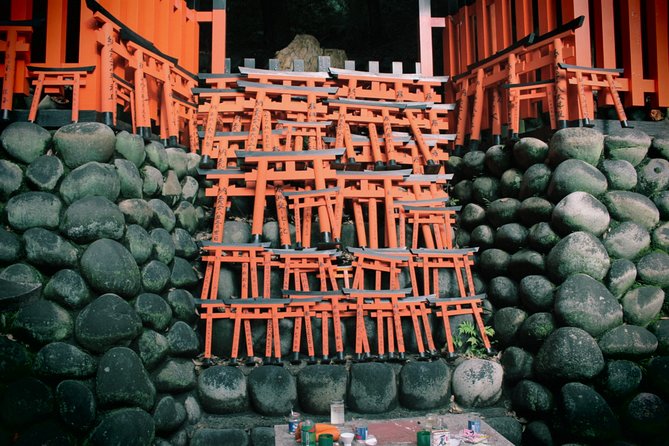
The Senbon Torii, or thousand torii gates, is the main event. The gates form long corridors of red and orange along the forest path, creating the view most people associate with Fushimi Inari.
The audio gives you more to think about as you pass through them. Torii mark the boundary between ordinary space and sacred space, and the many gates reflect the importance people place on the shrine. The tour helps turn a striking visual experience into something you can read as part of the shrine’s religious life.
You should allow extra time here if you want photographs. The stated duration is about 45 minutes to one hour, but your actual visit can stretch longer if you stop often. The self-guided format makes this easy, since you are not tied to a group schedule.
The path is described as an easy stroll, though the route does move through the shrine grounds and forest. If you prefer a very short visit, you can follow the main stops and finish near Kumataka Shrine. If you have more time, you can continue beyond the official ending.
The torii passage is also where crowd levels may matter most. The audio does not remove other people from the path, but it gives you a reason to keep walking and notice more than the first bright tunnel of gates.
Okusha Shrine and the Heavy-Light Stone
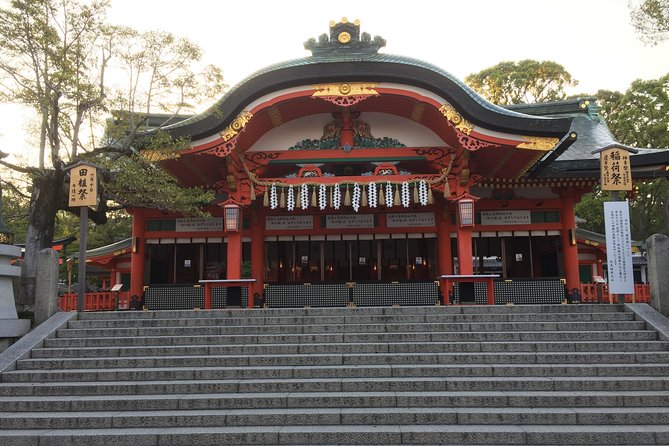
After the Senbon Torii, the tour brings you to the Okusha Shrine. This stop helps you move past the most photographed section and see another important part of the complex.
The route then introduces the Heavy-Light Stone, a distinctive feature where you can make a wish. The idea is direct and personal: you lift or test the stone, and its perceived weight is connected to whether your wish may come true.
This is one of the tour’s best stops because it adds participation to the visit. You are not only listening or looking. You have a small ritual of your own to consider.
The Heavy-Light Stone also shows why a little explanation improves Fushimi Inari. Without context, it could be just another unusual object along the path. With the audio, it becomes a place where belief, hope, and personal habit meet.
The Root up Pine Tree and the End by the Pond

The route makes a brief stop at the Root up Pine Tree, where you learn more about this particular feature. The name itself hints at a natural object with a story attached to it, and the stop adds variety after the long passage of torii gates.
The tour finishes at Kumataka Shrine, near a lovely pond deeper in the shrine complex. This is a calmer ending than simply turning around at the first gate corridor. You can take a short break here, continue exploring, or make your way back toward the start.
Because the endpoint differs from the beginning, pay attention to the map and route directions. The app includes geodata and offline maps, but you still need to watch where you are going. This is one drawback of any self-guided walk: the technology helps, but it does not replace your own attention.
The ending is also flexible. You are not required to stop exploring when the narration ends. If the shrine has made you curious about the surrounding paths, you can keep going on your own.
What You Get for $5.99
At $5.99 per person, this is an inexpensive way to add context to a major Kyoto sight. The value comes from the combination of narration, map access, and the ability to use the tour whenever you choose after purchase.
You receive lifetime access to the English tour through the VoiceMap app for Android and iOS. Audio, maps, and geodata are available offline, which is a practical benefit in Japan when you may not want to rely on a continuous signal.
The price is easiest to justify if you were already planning to visit Fushimi Inari independently. You pay a small amount for a structured route without adding a scheduled guide, group size, or meeting time beyond getting to the starting point.
It is less useful if you want a live guide who can answer questions, adjust the route in real time, or explain details based on your interests. The experience is private in the sense that only your group uses it, but it is still an app-based walk, not a personal tour with a guide.
The overall rating is 4.8 from eight ratings, which suggests strong satisfaction but is still a small sample. I would view that as encouraging rather than final proof. The strongest practical benefit is clear: you can visit at your own pace and hear explanations as you move.
Who Should Choose This Fushimi Inari Walk?
I would choose this tour if you want more than photographs but do not need a full-day guided visit. It works well for a solo visitor, a couple, or a small private group that prefers to stop and start freely.
It is also a good choice if this is your first visit to Kyoto and you want an easy introduction to Shinto customs. The stops are short, focused, and linked to visible features, so you do not need prior knowledge.
Families and mixed-interest groups may find the format convenient because nobody has to maintain a strict group pace. One person can pause for a photograph while another listens again to an explanation.
You may want a different option if you dislike using your phone while sightseeing. You must supply the device and headphones, and the experience depends on downloading the material and following the app. It also will not provide personal assistance if you lose your way or want to ask a question outside the prepared narration.
The route is open every day at all hours according to the supplied schedule, but the tour itself remains self-guided. That means you choose when to begin, rather than joining a fixed departure.
Practical Advice Before You Go
Download everything before reaching Inari Station. That includes the audio, map, and geodata. Do not wait until you are standing at the shrine entrance.
Bring headphones and make sure your phone has enough battery for the walk. Food, drinks, transportation, and any museum or attraction fees are not included, although the listed route focuses on the shrine itself.
Wear footwear suitable for an easy forest walk. The route is not presented as a demanding hike, but it does take you away from the entrance and through the shrine grounds.
Keep the tour’s one-hour estimate in mind, then add time for photographs and pauses. The Senbon Torii and the Heavy-Light Stone are the stops most likely to slow you down.
The experience is non-refundable and cannot be changed after booking. Make sure you want an English audio walk and have the app-ready equipment before paying.
Should You Book This Audio Tour?
Book it if you want an inexpensive, flexible way to understand Fushimi Inari while walking through its most important sights. The fox statues, hand-washing ritual, main hall, Senbon Torii, Okusha Shrine, Heavy-Light Stone, and Root up Pine Tree create a fuller visit than a quick walk to the red gates and back.
Skip it if you need a live guide, personal conversation, or a route tailored on the spot. For everyone else, $5.99 is a fair price for an offline audio introduction that lets you set the pace and continue exploring after the recorded route ends.
FAQ
How long does the Fushimi Inari audio tour take?
The tour takes approximately 45 minutes to one hour. You can spend longer if you pause for photographs, take a break, or continue exploring after the official endpoint.
Where does the tour begin?
It begins at the fox statue opposite Inari Station, at the entrance to Fushimi Inari Taisha Shrine in Kyoto.
Where does the tour end?
The recorded route ends at Kumataka Shrine, beside a pond deeper inside the shrine complex. You can take a break there or continue walking.
Is the audio tour available offline?
Yes. You receive offline access to the audio, maps, and geodata through the VoiceMap app. Download the material before arriving.
What do I need to bring?
You need a smartphone and headphones. Food, drinks, transportation, and any separate entrance or attraction fees are not included.
Is this a guided group tour?
No. It is a self-guided audio tour. Only your group participates, and you can move at your own pace using the VoiceMap app.
Latest audio tours in the world
- Seville Maestranza Bullring Tour with Audio Guide★ 3.5 · 6 reviews
- Seville Scavenger Hunt and Highlights Self Guided Audio Tour★ 5.0 · 5 reviews
- Seville Audio guided walking tour 3h20 and 28 audio commentaries★ 5.0 · 2 reviews
- Royal Alcazar of Seville Entry Ticket with Audio Guide★ 4.0 · 42 reviews
- Seville Cathedral and La Giralda Entry Ticket with Audio Guide★ 3.0 · 9 reviews
- Seville Cathedral and Giralda Entry Tickets with Audio Guide★ 4.0 · 56 reviews
- Essential Seville’s Ancient History: An Audio Tour★ 5.0 · 9 reviews
- Sequoia National Park Self-Guided Audio Tour★ 4.5 · 9 reviews
Audio Walking Tours, compared.

City Monuments Guided Walking Tour with Audio Guide
Read our review →

Self Guided Classic Freedom Trail Location Aware (GPS) Walking Audio Tour
Read our review →
Self-Guided Historical Walking Tour (Audio Guide)
Read our review →
Cape Cod & Provincetown Self-Guided Driving & Walking Audio Tour
Read our review →
Verona Walking Tour with Audio and Written Guide by a Local
Read our review →
Royal Walking Tour and Buckingham Palace Audio Tour
Read our review →
Bologna Walking Tour with Audio and Written Guide
Read our review →Browse the lists this tour appears in