
Reviewed · PISA
Pisa: Camposanto and Cathedral Entry Tickets and Audio Guide
Pisa’s famous square is more than a photo stop beside the Leaning Tower. This experience takes you into the Cathedral and the Camposanto, where marble, frescoes, Roman sarcophagi, and centuries of religious art give the Piazza dei Miracoli real depth.
I like the separate entrance for the Camposanto, which can save you time at the ticket office. I also like the choice of five audio guide languages and the freedom to explore at your own pace. The main catch is that the guide can be light on detail and sometimes hard to follow, especially in the Camposanto.
Key points to know
- Camposanto entry uses a separate access point: Collect your ticket at the Audioguide Desk beside the entrance to the Sinopie Museum.
- The Cathedral is included at no extra charge: You can visit its interior and exterior as part of the same route.
- The audio guide comes in five languages: Choose Italian, English, Spanish, French, or German.
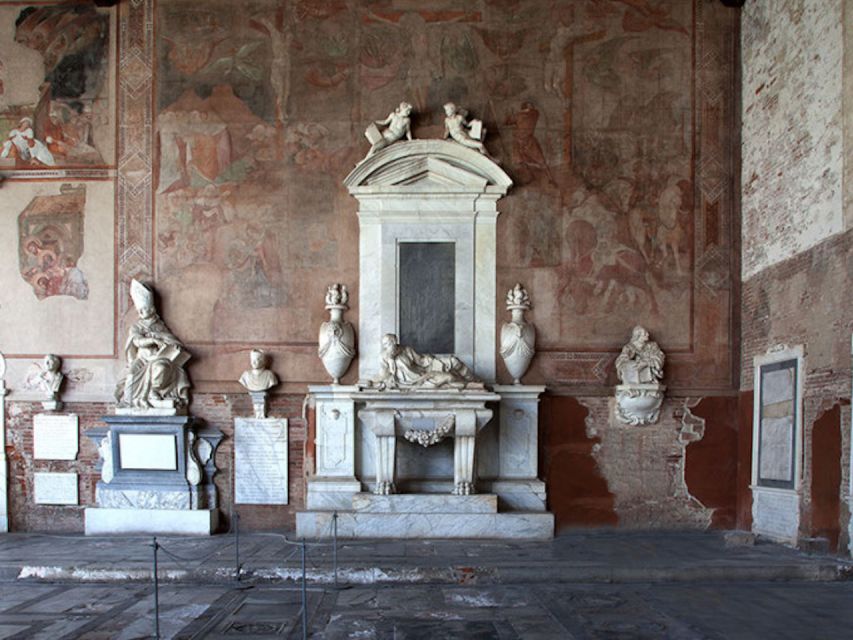
- The Camposanto is the quieter, more unusual stop: Look for Roman sarcophagi, frescoes, and works of art in its long cemetery galleries.
- Plan for about one hour: That is enough for a focused visit, but not for a slow study of every artwork.
- Dress matters: Shorts and skirts are not allowed, and you should bring a passport or ID card.
Why the Camposanto deserves your time
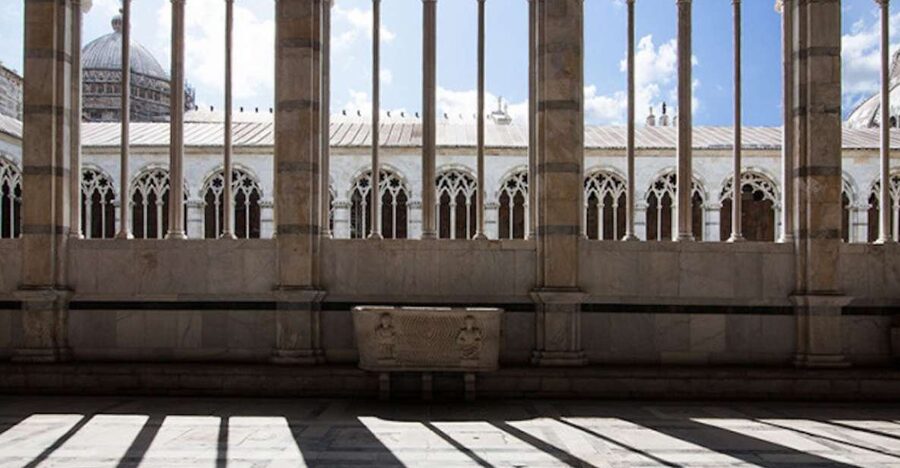
Most people arrive in Pisa with one goal: photograph the Leaning Tower. That is understandable, but the Camposanto often leaves a stronger impression once you step inside. This monumental cemetery forms one side of the Piazza dei Miracoli and gives you a calmer place to look closely at Pisa’s art and architecture.
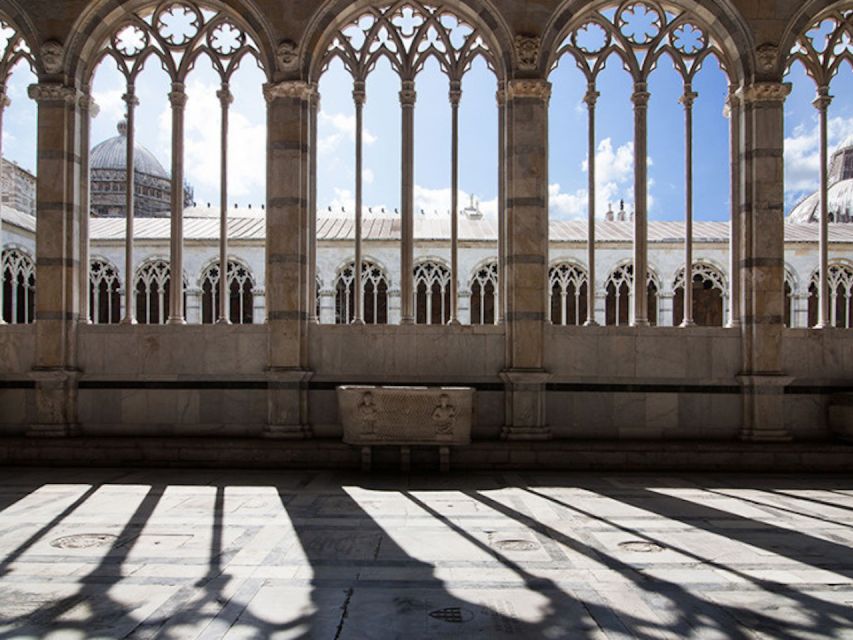
The name Camposanto means holy field. The building is linked to soil traditionally brought from the Holy Land, though the experience itself focuses on what you can see inside: arcaded galleries, old tombs, frescoes, sculpture, and Roman sarcophagi. The collection is not simply a display of attractive objects. It shows how Pisa used a sacred space to honor the dead and preserve its artistic traditions.
I especially like the Roman sarcophagi because they add a surprising classical layer to the visit. They remind you that Pisa’s medieval monuments were built in a city that also valued and reused the ancient past.
The Camposanto is also a good counterpoint to the Cathedral. The Cathedral feels active, ornate, and ceremonial. The Camposanto is more reflective. Give yourself a few minutes to slow down instead of treating it as a quick corridor between the tower and the next photo.
More Church Audio Tours in Italy
- Rome: St. Peter’s Basilica & Dome Entry Ticket & Audio Tour
★ 4.2 · 7,537 reviews - Florence: Cathedral & Brunelleschi’s Dome Ticket & Audio App
★ 4.4 · 6,973 reviews - Vatican & Sistine Chapel Ticket with Optional Audio Guide
★ 4.1 · 5,405 reviews
Entering the Cathedral of Pisa
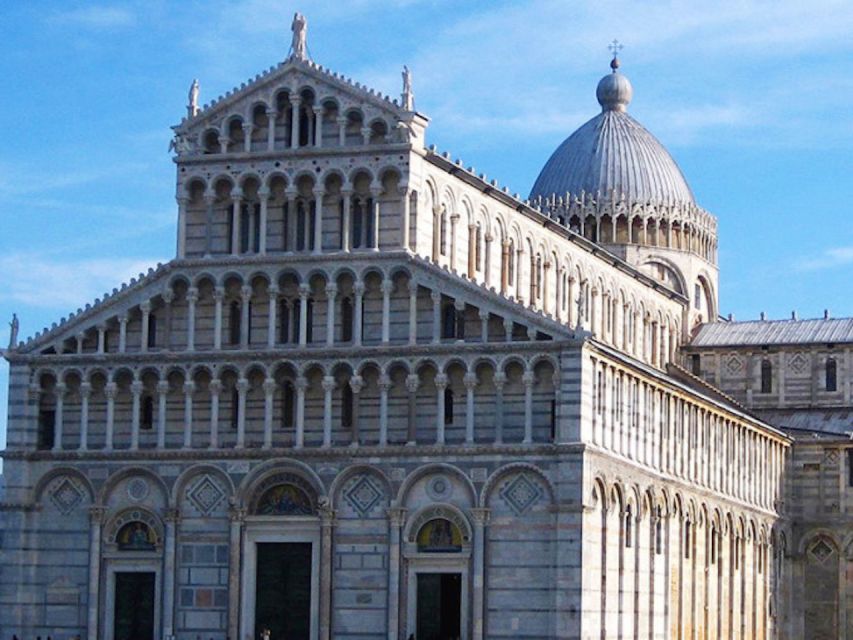
Your ticket includes free access to the Cathedral, one of the major examples of Italian Romanesque architecture in the square. From outside, the building is easy to recognize by its broad marble facade and layered decoration. Inside, you will find a very different mood, with a large sacred interior and works of art arranged for worship as well as viewing.
The audio guide provides a route through both the Cathedral and the Camposanto. That is useful if you want a basic framework instead of walking in without context. You can choose English, Italian, Spanish, French, or German, then follow the visit independently.
The Cathedral may be the more immediately rewarding stop for anyone with limited time. Its scale and decoration register quickly, while the Camposanto asks you to look more closely. If you have only one hour, I would keep the Cathedral visit focused and save enough time for the cemetery galleries.
Pay attention to the timing of your visit. One booking time was reported to coincide with a Mass, which meant that only part of the Cathedral could be reached. A religious service can change the access available inside, so do not assume every area will always be open at the exact hour you select.
How the audio guide works in practice
The audio guide is included, but it is not the same as having a person walking beside you and answering questions. You collect it at the Audioguide Desk in Piazza dei Miracoli, near the entrance to the Sinopie Museum, by presenting your reservation.
The setup has been described as easy to use and well organized. That is important at a busy monument complex, where a slow collection process can eat into a short visit. Once you have the guide, you can move independently rather than waiting for a group.
Still, you should keep your expectations sensible. The commentary may not provide much background for every work, and the route inside the Camposanto can be difficult to follow. One practical problem is knowing where you are in relation to the audio guide’s numbered stops. Before starting, take a moment to check how the route is arranged and match each explanation to the space in front of you.
I would treat the guide as a useful outline, not a full art-history course. It should help you notice the main architectural features and artworks, but you may want to read more later if you are especially interested in Pisa’s medieval art.
The one-hour route, step by step
Start by collecting your ticket and audio guide at the designated desk. Have your reservation ready, and bring your passport or identity card, which is listed as required for the activity.
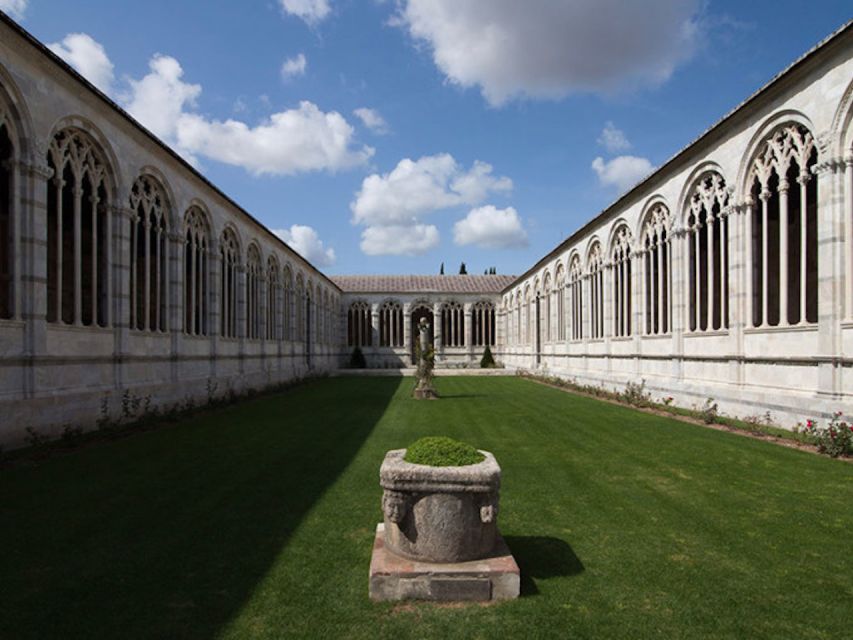
Next, visit the Camposanto. This is where the skip-the-line benefit applies, using a separate entrance rather than the ordinary ticket-office queue. The main gain is time. At a popular site such as Piazza dei Miracoli, even a modest queue can disrupt a tightly planned day.
Inside, follow the galleries and look for the Roman sarcophagi, which are among the most distinctive objects included in the visit. The frescoes and other artworks give the cemetery a sense of place that you will miss if you only view it from outside.
The audio guide then directs you through the Camposanto and onward to the Cathedral. Because the route is self-guided, you can pause at an artwork or move along when the commentary is less useful. That flexibility is a real benefit, particularly if people in your group have different levels of interest.
Finish with the Cathedral, checking the interior and exterior details that the guide points out. Allow extra time if the building is open in full. If a Mass is taking place, access may be limited to certain parts.
Another self-paced route in Italy:
- Rome: Pantheon Fast-Track Ticket and Official Audioguide
★ 4.5 · 27,353 reviews - Rome: Colosseum & Forum with Audio Guide App -Optional Arena
★ 4.2 · 24,770 reviews - Florence: Timed Entry to Michelangelo’s David + Audio App
★ 4.6 · 19,496 reviews - Rome: City Sightseeing Hop-on Hop-off Bus with Audioguide
★ 4.0 · 16,045 reviews
What makes the architecture special
The Cathedral and Camposanto are presented as two major examples of Italian Romanesque architecture. That label can sound abstract, but the buildings make it easier to understand. You will see a strong interest in proportion, repeated arcades, marble surfaces, and carefully arranged decoration.
The Cathedral is the more dramatic architectural statement. Its facade and interior show how Pisa used stone and ornament to express civic and religious importance. The Camposanto has a more enclosed, measured design. Its galleries create a frame for tombs, frescoes, and sculpture, so the building itself and the objects inside work together.
I would not approach this as a tour of isolated masterpieces. The value comes from seeing the monuments as a group. The Baptistery and Leaning Tower may draw the eye first, but the Cathedral and Camposanto explain more about how the square functions as a sacred architectural complex.
This ticket does not include an ascent of the Leaning Tower. That matters because some people expect a visit to the Cathedral area to include tower access. It does not. You are paying for the Camposanto, Cathedral access, and the audio route.
Price and value at $23
At about $23 per person, this is a reasonable choice if you want a short, structured visit to two major monuments without spending time at a ticket counter. The value comes less from the audio commentary alone and more from the combination of reserved Camposanto entry and Cathedral access.
If you are already planning to see the Piazza dei Miracoli, the ticket fits neatly into your day. It gives you somewhere meaningful to go after taking photographs of the tower. The one-hour duration also works well before lunch, after arrival in Pisa, or between other stops in Tuscany.
The value is weaker if you want detailed art interpretation. The audio guide has been found easy to operate, but some commentary can feel brief or difficult to follow. If your main reason for booking is expert explanation, you may prefer a live guided tour. This option suits you better if you want independence, a simple route, and basic historical context.
The reserve-now-and-pay-later option also helps if your Tuscany plans are still moving around. Free cancellation is available up to 24 hours before the scheduled visit for a full refund.
Practical advice for a smoother visit
Dress conservatively for the Cathedral. Shorts and skirts are not allowed under the stated rules, so choose clothing that meets the requirement before you arrive. You should also carry your passport or ID card.
Collect the ticket at the Audioguide Desk beside the Sinopie Museum entrance, not at an unrelated ticket window. The meeting point is in Piazza dei Miracoli, so allow enough time to find the desk before your chosen starting time.
Use the audio guide before you begin walking. The most common practical weakness is not the language selection or the device itself, but uncertainty about the order of stops. English, Italian, Spanish, French, and German are available, so select the language that lets you listen without translating in your head.
Check current information about the complex on the day of your visit. One booking contained outdated information about the Baptistery’s opening status, and Cathedral access can also change during a Mass. The experience described here does not include Baptistery entry, so do not book it expecting that building to be part of the route.
The activity is wheelchair accessible. The stated duration is one hour, although you can get more from the visit if you already know something about Pisa’s art and take time to inspect the sarcophagi and frescoes.
Who should book this Pisa experience?
I would recommend it to first-time visitors who want to enter the Cathedral and Camposanto without arranging a full guided tour. It also suits independent travelers who prefer to move at their own speed and families or couples who do not want to stay with a group.
It is a good match if you have a short stop in Pisa. The route is compact, the ticket collection point is in the main monument square, and the separate Camposanto entrance can help keep the visit on schedule.
Art lovers should book with a small qualification. The objects and architecture are worth seeing, but the audio guide may not provide enough detail for a specialist visit. Bring your own background notes or plan extra time with the displays if the subject interests you.
This is less suitable if your priority is the Leaning Tower. Tower access is not included, and the experience concentrates on the Cathedral and Camposanto. It is also not ideal if you dislike audio guides or want a live guide to explain exactly where to stand and what you are seeing.
Should you book the Cathedral and Camposanto ticket?
Book it if you want quick access, self-guided freedom, and two important monuments for a moderate price. The Camposanto is the strongest reason to go, with its Roman sarcophagi, frescoes, and quieter setting. The Cathedral adds the architectural centerpiece.
Skip it if you expect a long, highly detailed commentary or guaranteed full access to every part of the Cathedral during a service. For most people planning a short visit to Pisa, though, this is a practical way to move beyond the Leaning Tower photograph and see the square as a complete work of art.
FAQ
What does the Pisa Cathedral and Camposanto ticket include?
It includes skip-the-line entry to the Camposanto, free access to the Cathedral, and an audio guide covering both sites.
How long does the experience last?
The stated duration is one hour. Starting times vary, so you should check availability when booking.
Which languages are available for the audio guide?
The audio guide is available in Italian, English, Spanish, French, and German.
Where do I collect the ticket and audio guide?
Collect them at the Audioguide Desk in Piazza dei Miracoli, beside the entrance to the Sinopie Museum. Present your reservation there.
Do I need identification?
Yes. A passport or ID card is listed among the items to bring.
Is the Leaning Tower included?
No. The experience includes the Camposanto and Cathedral, but it does not include entry to the Leaning Tower.
Latest audio tours in Italy
- Pantheon Skip the Line Entry Tickets with Digital Audio Guide★ 3.5 · 52 reviews
- St. Peter’s Basilica: Dome Climb with Lift & Audioguide★ 4.5 · 13 reviews
- Audio guide in Vatican Museums and Sistine Chapel★ 4.5 · 12 reviews
- The Roman Jewish Ghetto: A Self-Guided Audio Tour★ 4.0 · 8 reviews
- Experience: The Pantheon Audio Tour★ 4.5 · 4 reviews
- Trastevere: A Self-guided Audio Tour of Rome’s Medieval Village★ 4.5 · 3 reviews
- The Colosseum’s Attic with 3rd, 4th & 5th Levels with Audio Guide★ 4.5 · 20 reviews
- Self-Guided Audio Tour – The gods of the Palatine★ 3.5 · 5 reviews
Church & Cathedral Audio Tours, compared.
St. Peter’s Basilica & Dome Entry Ticket & Audio Tour
Read our review →
Basilica Cistern Fast-Track Entry and Audio Guide
Read our review →
Cathedral & Brunelleschi’s Dome Ticket & Audio App
Read our review →
Vatican & Sistine Chapel Ticket with Optional Audio Guide
Read our review →
St. Mark Basilica Ticket, Audioguide+History Gallery
Read our review →
Skip the Line: Vatican & Sistine Chapel Ticket with Audio Guide
Read our review →
St. Peter’s Basilica with Optional Dome Ticket & Audioguide
Read our review →
Browse the lists this tour appears in