
Reviewed · SAN FRANCISCO
Food, History, and Resistance: A Self-Guided Audio Tour
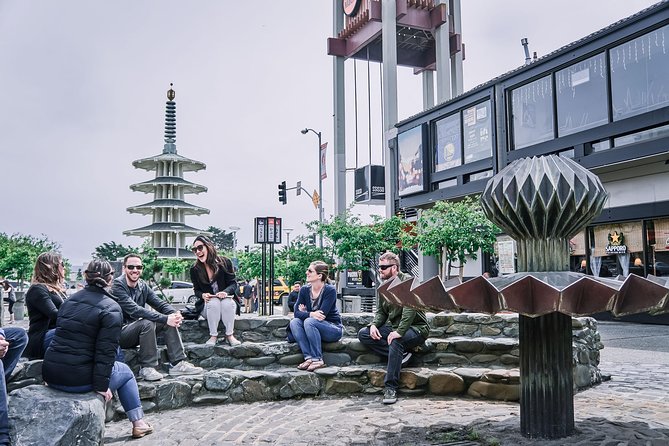
San Francisco’s Japantown is more than ramen shops and sushi counters. This self-guided audio walk connects food, Japanese American history, wartime injustice, and the old Fillmore jazz scene in one compact route. You’ll hear about traditional manju, the community’s forced removal during World War II, and musicians such as John Coltrane and Billie Holiday.
I like the way the tour lets you set the pace, stopping the audio when a place deserves a closer look. I also like the offline access, since you can download the narration, map, and location data before setting out. The main drawback is that this is an audio tour rather than a live walk, and the route does not include food, museum admission, or transportation.
Key points at a glance
- Benkyodo’s traditional manju: Learn about one of only three remaining traditional Japanese manju makers in the United States.
- A personal connection to wartime history: The route includes the Japanese Language School gate, linked to the place where Japanese residents reported for internment.
- The Fillmore’s jazz past: Hear how Bop City became an after-hours gathering place for major jazz musicians.
- A short, flexible route: Plan on about 50 minutes to one hour, with the freedom to pause and explore.
- Low-cost access: At $11.99, the tour costs less than many guided city walks and remains available for future use.
- Simple digital setup: VoiceMap provides the audio, map, and geodata, but you must bring your own smartphone.
Why this Japantown walk is worth your time
This tour works because it places ordinary city streets beside stories that are easy to miss. You may walk past a restaurant, a gate, or a familiar block without knowing what happened there. The narration gives those places meaning without requiring a full museum visit or a long scheduled tour.
The route covers two connected parts of San Francisco’s past. One is the Japanese American community, with its food traditions, language, family life, and wartime disruption. The other is the Fillmore district’s Black community and its central role in San Francisco jazz.
That combination gives the walk a wider reach than a standard food tour. You are not simply hearing where to eat. You are learning how neighborhoods change, how communities survive, and how music and food can carry memory forward.
The price is $11.99 per person, which is fair for a route lasting roughly 50 minutes to an hour. You also receive lifetime access, so you can return to the tour later instead of treating it as a one-time download. That matters if you want to split the walk into two parts or revisit the route with family.
Still, keep your expectations clear. This is not a guided tasting tour, and the fee does not cover manju, restaurant meals, drinks, museum tickets, or other admissions. The value comes from the narration and the places it helps you notice.
More History Audio Tours in the USA
- Santa Fe Historic Downtown Smart Phone Audio App Self Guided GPS Walking Tour
★ 4.5 · 112 reviews - Savannah’s Historical District: A Self-Guided Audio Tour
★ 4.5 · 69 reviews - Self-Guided Walking Audio Tour of Historic Santa Fe
★ 4.5 · 43 reviews
Starting at Osakaya Restaurant on Post Street
The walk begins at Osakaya Restaurant, at 1737 Post Street. From there, the story opens with a simple idea: Japantown cannot be understood only through its restaurants.
Food is an important doorway into the neighborhood, but the tour asks you to look beyond the menu. You begin considering the people who built the community, the customs they carried with them, and the pressure placed on Japanese Americans during World War II.
Because this is self-guided, you are not tied to a group’s pace. If the opening section gives you a useful sense of place, continue. If a storefront or nearby site catches your attention, pause the audio and take a closer look.
That flexibility was one of the strongest features for me. The full route is short enough to fit into an afternoon, yet the pauses let you make it feel less like a timed checklist. You can listen straight through in under an hour, or give the stops more breathing room.
The start is also practical for anyone already exploring Japantown. The meeting point is near public transportation, and the route ends at 1010 Geary Boulevard. Transportation between the start and end is not included, so keep the finish in mind when planning the rest of your day.
Benkyodo and the story inside a small sweet
One of the most distinctive stops is Benkyodo, known as one of only three traditional Japanese manju makers remaining in the United States. The other two are in Los Angeles and San Jose, the only other remaining Japantowns in the country.
Manju is a traditional Japanese confection. It is generally filled with sweet bean paste and wrapped with mochi, a glutinous rice mixture pounded into a soft, sticky texture. The description alone makes this stop feel more useful than a passing food reference. It explains why a small sweet can matter to a community.
For you, the key point is not simply that manju is available. It is that food can preserve a technique, a taste, and a link to earlier generations. A shop like Benkyodo helps you see Japantown as a living community rather than a collection of themed businesses.
The tour does not include food or drinks, so any purchase is your responsibility. That is a drawback if you expect a tasting experience. It is also a benefit for visitors who prefer to choose what they want, spend at their own pace, and decide how much time to give the stop.
If you pause here, listen before moving on. The audio can turn a quick snack stop into a lesson about migration, tradition, and the survival of Japanese American foodways.
The Japanese Language School gate and wartime memory
The most emotionally powerful part of the route concerns the forced removal and internment of Japanese Americans during World War II. The Japanese Language School gate is especially significant because it is connected to a location where Japanese residents reported for internment.
The physical setting can be easy to overlook. That is part of what gives this stop its force. You may be standing in a normal-looking urban area, surrounded by people going about their day, while the narration points to a moment when local families were ordered to leave their homes.
The route makes this history personal without requiring you to imagine a distant battlefield or a vanished town. The sites discussed remain in existence, which gives the story a direct quality. You are not only learning a date or policy. You are looking at places that families may have passed through during a frightening period.
One listener with family ties to San Francisco recalled wondering if their grandparents and father had stood at the same gate before being sent first to Tanforan horse track and later to Topaz, Utah. That detail shows why this portion can affect you even if you have no family connection to the story. A public place can suddenly feel connected to individual lives.
The audio format works well here because you can stop, think, and continue when ready. A live guide might need to keep the group moving. On your own, you can give this section the time it deserves.
This is not light sightseeing, and you should not expect every stop to be cheerful. The route’s appeal comes partly from its honesty. Food and music are present, but so are loss, discrimination, and resistance.
More Self-Guided Audio Tours in the USA
- Gettysburg Battlefield Self-Guided Driving Audio Tour
★ 4.5 · 910 reviews - Joshua Tree National Park Self-Guided Driving Audio Tour
★ 4.5 · 762 reviews - Ultimate Acadia National Park Self-Guided Driving Audio Tour
★ 4.0 · 521 reviews - Ultimate Lake Tahoe Self-Guided Driving Audio Tour
★ 4.5 · 435 reviews
From Japantown to the Fillmore’s Harlem of the West
The tour then broadens its focus to San Francisco’s Black community and the old Fillmore district. In the 1940s, the Black population in San Francisco grew sharply, and Fillmore Street became known as the Harlem of the West.
That phrase points to a district with its own cultural power, businesses, nightlife, and music. The tour’s Bop City stop at 1712 Fillmore Street is the centerpiece of this section.
Bop City became an after-hours place to play, attracting some of the biggest names in jazz. John Coltrane, Billie Holiday, Miles Davis, and Duke Ellington are among the musicians associated with its story.
For you, this stop adds welcome range to the walk. The experience does not treat Japantown as an isolated cultural pocket. It shows how nearby communities shaped one another and how San Francisco’s neighborhoods carried several important stories at once.
The Bop City section is also a reminder that an address can hold a past very different from its present appearance. The narration helps you picture the energy of the club and the musicians who gathered there, even though you are encountering the location as part of today’s city.
Do not expect a concert, live performance, or entrance into a jazz venue. Bop City is presented through the audio story and the location itself. The reward is context: you learn why this particular stretch of Fillmore Street mattered to American music.
Why self-guided audio works well here
VoiceMap supplies the application, audio, maps, and geodata. You need your own smartphone, and you should download the material before starting if you want the smoothest experience.
The offline function is important. It means you can listen and use the map without depending on a strong mobile connection along the route. You still need a charged phone, but you do not need to manage paper directions or search for each stop manually.
The narration is in English only. That keeps the booking simple, but it limits the tour for anyone who needs another language. There is no information provided about a written transcript or alternate audio languages, so you should choose this only if English audio works for you.
The pace is one of the tour’s best qualities. The route takes about 50 minutes to an hour, but the audio can be paused. You might listen continuously for a brisk walk, or stop at the key locations and spend extra time looking around.
That freedom is especially useful at the history stops. You are not being hurried through a sensitive subject because another ten people are waiting. The tradeoff is that no live guide is present to answer questions or adjust the route to your interests.
The activity has a maximum of 10 people, though the self-guided format means you are not dependent on a traditional group presentation. Most people can participate, and service animals are allowed.
Timing, route planning, and what to bring
The tour is listed as available every day around the clock, from Monday through Sunday. Since it uses a smartphone app rather than a fixed live departure, you have wide control over when to begin.
Bring a charged smartphone and make sure you have installed the VoiceMap application. Download the audio, maps, and geodata before you leave your accommodation or another reliable connection.
You should also plan for your own meals and snacks. The route discusses food and includes the Benkyodo stop, but food and drinks are not included. Museum visits and other attraction tickets are also separate.
The start is at Osakaya Restaurant, 1737 Post Street. The endpoint is 1010 Geary Boulevard. Transportation is not included, so check how you will reach the start and what you want to do after reaching the end.
The tour is generally suitable for most people, but the supplied information does not describe exact walking distances, hills, seating, or restroom access. If those details matter to you, contact the provider before booking rather than guessing.
Who gets the most from this $11.99 experience
I would choose this tour if you want a compact introduction to Japantown with more substance than a restaurant list. It suits solo visitors, couples, and small groups who like to control their own pace.
It is also a strong choice for anyone interested in Japanese American history, San Francisco neighborhoods, jazz, or food traditions. Families may find the stories useful, though younger children may not stay engaged with the wartime material and audio format.
The tour is less suitable if you want a guide to answer questions, a scheduled food tasting, or entry into historic buildings. It also will not satisfy someone looking for a long, highly detailed walking tour with many stops and extended commentary.
At $11.99, the decision is easy if you value flexibility and context. Lifetime access improves the deal, especially if you expect to return to San Francisco or want to listen again after learning more about the neighborhood.
The non-refundable policy deserves attention before you buy. You cannot receive a refund or change the booking for any reason, so confirm your schedule and your smartphone setup first.
Should you book the Japantown audio tour?
Book it if you want to understand what lies behind the restaurants and storefronts of Japantown. The strongest parts are the Benkyodo discussion, the Japanese Language School gate and internment story, and the account of Bop City’s jazz legacy.
You should skip it if you want included food, live guiding, or admission to museums. For everyone else, this is an inexpensive way to turn a short walk from Post Street to Geary Boulevard into a thoughtful look at food, community, injustice, and music.
FAQ
How long does the tour take?
The audio tour takes approximately 50 minutes to one hour.
What is the price?
The price is $11.99 per person.
Where does the tour begin?
It begins at Osakaya Restaurant, 1737 Post Street, San Francisco, California 94115.
Where does the tour end?
The tour ends at 1010 Geary Boulevard, San Francisco, California 94109.
What language is available?
The tour is offered in English.
What is included with the booking?
You receive lifetime access to the Food, History and Resistance in Japantown tour, the VoiceMap application, and offline access to the audio, maps, and geodata.
Do I need a smartphone?
Yes. A smartphone is not included, so you must bring your own device to use the VoiceMap application.
Are food and drinks included?
No. Food and drinks are not included in the price.
Are museum tickets included?
No. Tickets or entrance fees for museums and other attractions along the route are not included.
Can I cancel or change the booking?
No. The experience is non-refundable and cannot be changed for any reason.
Is the tour available every day?
Yes. It is listed as available Monday through Sunday, from 12:00 AM to 11:59 PM.
Are service animals allowed?
Yes. Service animals are allowed.
How many people can join?
The activity has a maximum of 10 people.
More food tours in the USA
- Bologna Food Tasting box- Audio Guided Tour with Food Tasting
★ 4.5 · 31 reviews - Old Delhi: Food Tasting Tour On Rickshaws With Audio Headsets
★ 5.0 · 11 reviews - Cool Nørrebro and Foodie Tips Self Guided Audio Walking Tour
★ 5.0 · 4 reviews
More food and drink stops in the USA
- Bruges: The Beer Experience Museum Entry with Audio Guide
★ 4.4 · 201 reviews - Bologna: Audio-Guided Archiginnasio Visit with Food Tasting
★ 3.3 · 79 reviews - Bologna: Clock Tower Audio Guide and Food Tasting
★ 4.4 · 58 reviews - Krakow: Vodka Factory Museum Ticket & Audioguide and Tasting
★ 4.3 · 38 reviews
Latest audio tours in the USA
- Sequoia National Park Self-Guided Audio Tour★ 4.5 · 9 reviews
- Sequoia and Kings Canyon Audio Tour Self Guide National Park Tour★ 5.0 · 3 reviews
- Kings Canyon National Park Self-Guided Audio Tour★ 4.0 · 4 reviews
- Sedona, Arizona Self-Guided Audio Tour★ 4.0 · 36 reviews
- Sedona & Red Rock State Park Self-Guided Driving Audio Tour★ 3.0 · 30 reviews
- Haunted Savannah Self-Guided Walking Audio Tour★ 4.5 · 3 reviews
- Downtown Seattle Self-Guided Walking Audio Tour★ 4.5 · 6 reviews
- Uncover Seattle: Self-Guided Audio Tour★ 3.5 · 7 reviews
Self-Guided Audio Tours, compared.
Acropolis Ticket & Optional Self-Guided Audio Tours
Read our review →

Ultimate Acadia National Park Self-Guided Driving Audio Tour
Read our review →
Akrotiri Ticket with Optional Self-Guided Audios
Read our review →
Browse the lists this tour appears in