
Reviewed · ITALY
Parma Walking Tour with Audio and Written Guide by a Local
Parma’s best sights fit neatly into one walk, and this self-guided audio tour gives you the freedom to linger at the cathedral, skip an interior, or stop for lunch without waiting for a group. The route begins near the ruins of the Roman bridge and ends in Parco Ducale, linking the city’s civic, religious, artistic, and musical highlights.
I like the clear Google Maps links between stops and the choice of audio or written notes. I also like the practical food advice, especially the recommendation for Osteria dei Servi, which can be a real help when you want a local meal rather than a random restaurant near the square.
The catch is that the $7.21 price covers the digital guide, not the major admission tickets. If you enter every paid site, the extras add up to €46, and you’ll need a working smartphone, internet access, and enough battery for several hours.
Key points at a glance
- A flexible four to five hour route: Walk at your own speed and decide which interiors deserve your time.
- Ten well-chosen stops: The route covers Piazza Garibaldi, the cathedral quarter, San Paolo, Pilotta Palace, and Parco Ducale.
- Audio plus written guidance: Use the recording through your phone speaker or headphones, with text available if sound fails.
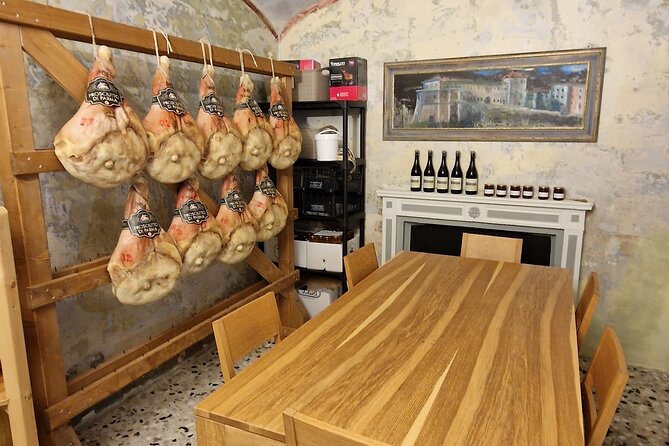
- Food advice is part of the value: The guide includes local restaurant suggestions and broader tips about Parma’s food.
- Optional tickets require planning: Teatro Regio costs €10, the Baptistery and Diocesan Museum together cost €10, San Paolo costs €8, and Pilotta costs €18.
- Helpful for a short stay: The route gives you a firm plan without locking you into a meeting time or group pace.
A good way to meet Parma on foot
This is not a conventional walking tour with a guide beside you. You receive a digital city guide with audio and written information in English, Spanish, Italian, German, and French. The material covers monuments, history, small points of interest, and food suggestions.
That format suits Parma well. The center is compact enough to explore on foot, but its attractions are spread across several different areas. A route helps you connect the dots instead of spending your limited time wondering which street leads to the next important building.
The walk takes about four to five hours if you follow the full plan and visit several interiors. You can also shorten it. Since the guide is self-led, you can pause for coffee, spend extra time inside the cathedral, or leave out a museum that does not fit your interests.
The starting point is at the ruins of the Roman bridge on Strada Giuseppe Mazzini. The finish is Parco Ducale, at Largo Luca Ganzi. That open-ended finish works nicely if you want a quiet break after the churches and museums.
More Audio Walking Tours in Italy
- Florence: 2.5 hour Audio Guided Walking Tour led by Host
★ 4.6 · 293 reviews - Verona Walking Tour with Audio and Written Guide by a Local
★ 4.5 · 157 reviews - Bologna Walking Tour with Audio and Written Guide
★ 4.5 · 132 reviews
Piazza Garibaldi and Parma’s civic heart
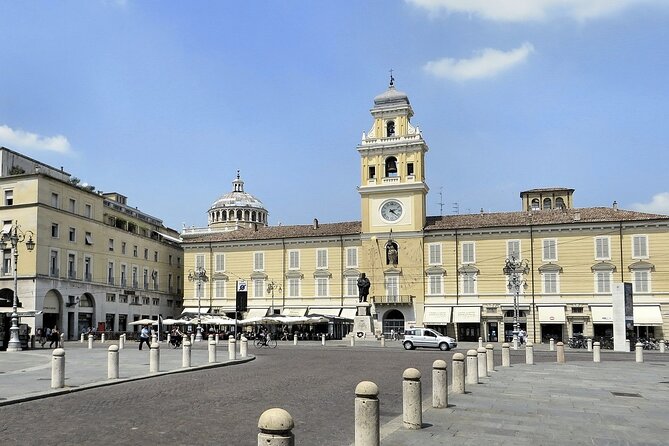
The first stop is Piazza Giuseppe Garibaldi, the city’s main civic square. It is also called Piazza del Comune or Piazza Grande, so knowing those names helps when you are checking a map or asking for directions.
This is where Parma’s public and political life gathered, while the religious center developed a few hundred meters away around Piazza Duomo. The distinction gives you a useful framework for the rest of the walk. You begin with the city’s civic face, then move toward its cathedral and medieval monuments.
The suggested visit lasts about 25 minutes and costs nothing. That makes the square a sensible place to get oriented before paying for any interiors. The guide can point out the buildings and explain why this space matters, rather than treating it as just a photo stop.
Renaissance art inside Santa Maria della Steccata
From the square, the route continues to the Basilica di Santa Maria della Steccata. This elegant Renaissance church was Parma’s first church built with a central plan, and its interior contains one of the city’s major artistic highlights.
Look for the large arch above the main altar, painted by Francesco Mazzola, better known as Parmigianino. The frescoes were created between 1533 and 1539. The visit is planned for about 15 minutes, and no admission fee is listed.
That short timing is useful if you are making a tight schedule, but you should not feel obliged to rush. The audio notes can give you enough context to understand why the church matters before you move on. If Renaissance painting is a priority for you, this is one of the places where an extra few minutes may pay off.
Teatro Regio, Parma’s opera address
Teatro Regio brings you into a different part of Parma’s identity: its opera tradition. The theater is known for its neoclassical facade, often described as Parma yellow, and for interiors decorated with gilded stuccos.
The planned visit lasts 30 minutes. Admission is not included and costs €10. That separate fee is easy to overlook when you see the low price of the walking guide, so set aside the money before you arrive.
You should enter if historic theaters and opera interest you. If not, the exterior and the guide’s explanation may be enough. The self-guided format gives you that choice without making anyone else wait while you decide.
Another self-paced route in Italy:
- Rome: Pantheon Fast-Track Ticket and Official Audioguide
★ 4.5 · 27,353 reviews - Rome: Colosseum & Forum with Audio Guide App -Optional Arena
★ 4.2 · 24,770 reviews - Florence: Timed Entry to Michelangelo’s David + Audio App
★ 4.6 · 19,496 reviews - Rome: City Sightseeing Hop-on Hop-off Bus with Audioguide
★ 4.0 · 16,045 reviews
The Baptistery, Diocesan Museum, and the cathedral
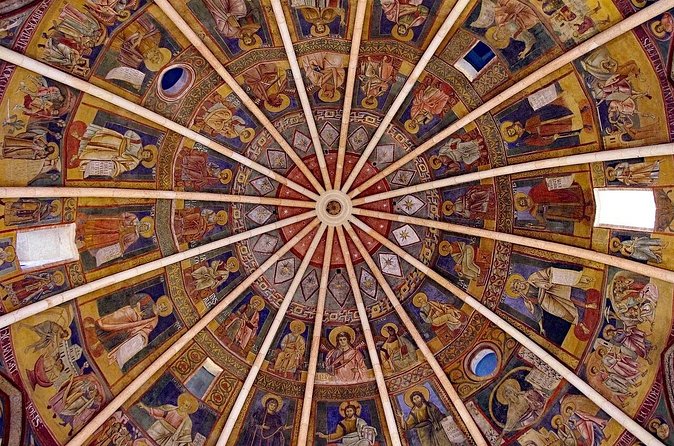
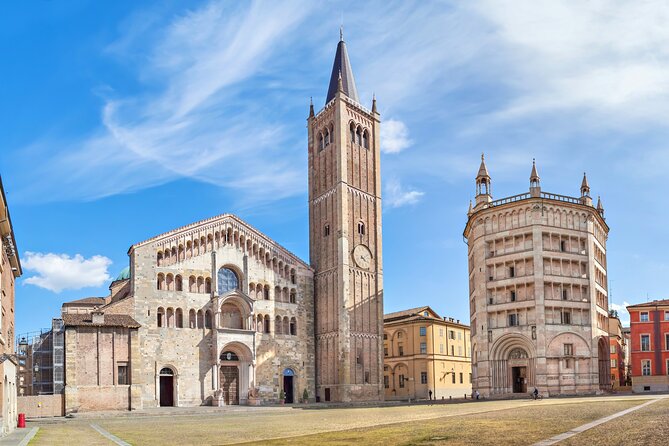
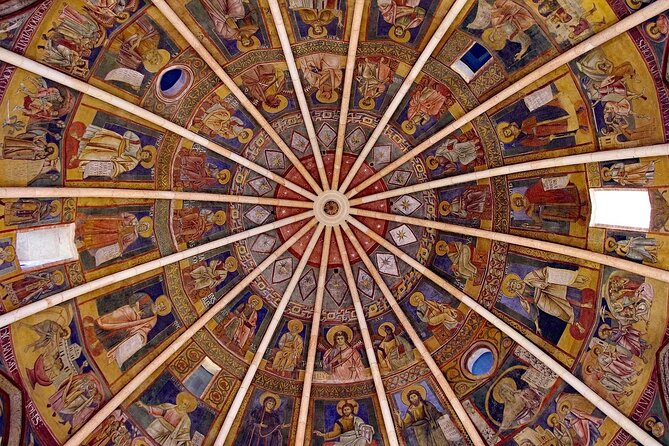
The Baptistery of San Giovanni Battista is one of Parma’s visual anchors. Its octagonal form is covered in pink Verona marble, and the building is important in the shift from Romanesque design toward early Gothic work in Italy.
The planned visit is 15 minutes, but the ticket arrangement deserves attention. Entry costs €10 and includes the Diocesan Museum. You are not required to enter, so you can simply admire the exterior if you are watching your budget or saving time.
The Diocesan Museum adds another 25 minutes to the route. It presents paintings, sacred clothing, silver objects, and stone sculpture connected with the Baptistery. This is especially useful if you want to understand the art as part of a wider religious setting, rather than viewing the Baptistery alone.
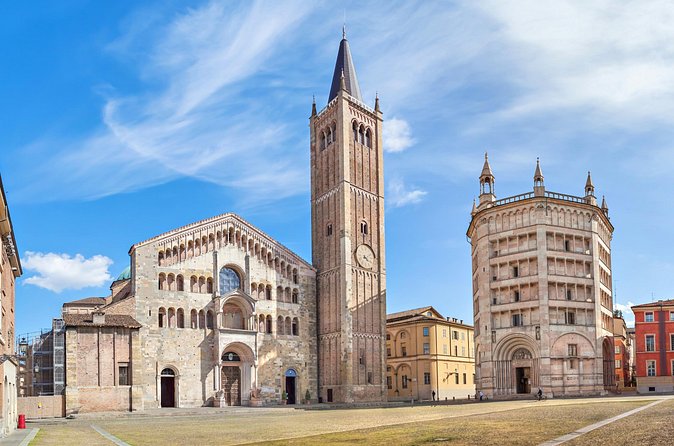
Next comes Parma Cathedral, or Cattedrale di Santa Maria Assunta. Begun in 1106, it remains one of the major medieval buildings in Italy. The Romanesque plan is still easy to recognize, but later Renaissance changes shaped the nave, dome, and transept. Some side chapels also carry later Gothic frescoes.
The cathedral visit is listed as free and takes about 15 minutes. I would treat that as a minimum, not a strict limit. The Baptistery and cathedral are close enough to make this part of the route feel like one connected visit, even though their styles and periods differ.
San Paolo’s private rooms and Saint Catherine’s cell

The Chamber of San Paolo sits inside the San Paolo museum and recreates the private apartment of Giovanna da Piacenza, an abbess who played an important role in Parma’s religious and cultural life in the early sixteenth century.
The nearby Cella di Santa Caterina contains frescoes and decorations linked to Saint Catherine and other religious subjects. Together, the two spaces give you a more intimate look at Renaissance Parma than the grand cathedral interiors do.
Admission is €8, and the suggested visit lasts 30 minutes. This is another optional stop where the added cost makes sense if you enjoy smaller museums and painted interiors. If you are moving quickly, you may prefer to reserve your time for Pilotta Palace, which offers a larger group of collections.
Pilotta Palace and the Farnese Theater
Palazzo della Pilotta is the largest paid stop on the route, with about an hour suggested for the visit. The complex was planned for the Farnese court and connected the family’s ducal residences with court service buildings.
Admission costs €18. That is the single biggest extra expense, but the ticket includes the Teatro Farnese. If you want to see Parma’s major courtly and theatrical spaces, this is likely the most important paid choice on the walk.
The Farnese Theater occupies the first floor of the palace. Built between 1617 and 1618 in the old armory, it was designed by the Ferrara architect Giovan Battista Aleotti, known as Argenta. It is considered the first modern theater in the West.
The planned theater visit is only 10 minutes, but the setting deserves careful attention. The short time estimate probably reflects the fact that you are seeing one section within a much larger palace visit. Allowing an hour for Pilotta gives you room to appreciate both the palace complex and the theater without turning the stop into a hurried checklist.
Finishing in Parco Ducale
The route ends at Parco Ducale, Parma’s best-known public garden. The park covers 208,000 square meters and offers a welcome change after the churches, galleries, and formal interiors.
The suggested walk inside the park takes about 30 minutes and is free. Its avenues and intersecting sections follow a neoclassical design, and you can look for the Palazzo Ducale del Giardino and the Trianon Fountain.
Ending here is practical as well as pleasant. You do not finish at another crowded ticket desk. You finish with room to sit, walk, or decide what to do next. Since the park is open from midnight to 11:30 p.m. every day during the stated operating period, the final stop can fit many schedules.
What the low price really includes
At $7.21 per person, the guide is priced more like a planning tool than a fully hosted tour. You are paying for the route, audio, written explanations, map links, food suggestions, and local tips.
The value improves if you are traveling with two or more people. You can share the plan while each person moves at a comfortable pace, and group discounts are available. The guide also avoids the fixed rhythm of a large walking group, which can be useful if you want to stop for photographs or lunch.
The optional tickets change the final cost:
- Baptistery and Diocesan Museum: €10
- Teatro Regio: €10
- Chamber of San Paolo and Saint Catherine’s Cell: €8
- Palazzo della Pilotta, including Teatro Farnese: €18
Entering everything adds €46 in admission fees, before considering the $7.21 guide price. You do not need to buy every ticket. For many people, the best balance would be the free cathedral and Steccata, plus one or two paid interiors chosen around personal interests.
Smartphone details that matter
You need a smartphone with an internet connection to activate and use the digital guide. The activation instructions are included in the voucher, so read them before you set out rather than waiting until you reach the first stop.
You can hear the audio through your phone’s speaker or through headphones. I would bring headphones if possible, especially if you want to listen while walking through busy public areas. Keep your battery charged, since the route lasts several hours and relies on your phone for audio and directions.
A useful backup is the written guide. If the recording fails or your battery starts running low, the text still provides the route and information. The creator is also available through email and WhatsApp for help, which is reassuring if you have trouble connecting the guide.
Who should choose this Parma walk
I would recommend it to independent visitors who want structure without a fixed group. It is particularly useful for a first visit, a short stay, or a rainy day when a well-planned indoor route makes the city easier to enjoy.
It also suits families and pairs who do not all walk at the same speed. You can follow the same route while taking breaks when needed. Most people can participate, and the route is near public transportation, though the supplied information does not give specific details about step-free access at each monument.
This is less suitable if you want a live guide explaining details in person or answering questions beside you at every stop. It also requires a little preparation. You must manage your own timing, tickets, phone, and route.
Should you book it?
Book this Parma walk if you want an affordable, flexible plan that covers the city’s main sights and gives useful food advice. The mix of audio, written text, map links, and WhatsApp or email help makes it more reliable than a simple list of addresses.
Skip it if you strongly prefer a hosted tour or do not want to use your phone during sightseeing. Also check the extra ticket costs first. For an independent visitor who wants to see the cathedral quarter, Teatro Regio, Pilotta, Farnese Theater, and Parco Ducale in one organized outing, it offers strong value at the basic price.
FAQ
How long does the Parma walking tour take?
The complete route takes approximately four to five hours. You can shorten or extend the outing because it is self-guided.
Where does the tour begin?
It begins at the ruins of the Roman bridge on Strada Giuseppe Mazzini, 43, in Parma.
Where does the tour finish?
The walk ends at Parco Ducale, at Largo Luca Ganzi, 3. The final stop is free to enter.
Is the tour led by a person in Parma?
No. This is a self-guided digital experience using audio and written material. Help is available through email and WhatsApp.
Which languages are available?
The audio guide and written guide are available in English, Spanish, Italian, German, and French.
Are entrance tickets included?
The digital guide is included, but admission fees are separate. The Baptistery and Diocesan Museum cost €10 together, San Paolo costs €8, Teatro Regio costs €10, and Palazzo della Pilotta costs €18. Teatro Farnese is included with the Pilotta ticket.
What do I need to use the guide?
You need a smartphone with an internet connection. You can listen through the phone speaker or headphones, and the written guide provides a backup if the audio does not work.
Latest audio tours in Italy
- Pantheon Skip the Line Entry Tickets with Digital Audio Guide★ 3.5 · 52 reviews
- St. Peter’s Basilica: Dome Climb with Lift & Audioguide★ 4.5 · 13 reviews
- Audio guide in Vatican Museums and Sistine Chapel★ 4.5 · 12 reviews
- The Roman Jewish Ghetto: A Self-Guided Audio Tour★ 4.0 · 8 reviews
- Experience: The Pantheon Audio Tour★ 4.5 · 4 reviews
- Trastevere: A Self-guided Audio Tour of Rome’s Medieval Village★ 4.5 · 3 reviews
- The Colosseum’s Attic with 3rd, 4th & 5th Levels with Audio Guide★ 4.5 · 20 reviews
- Self-Guided Audio Tour – The gods of the Palatine★ 3.5 · 5 reviews
Audio Walking Tours, compared.
City Monuments Guided Walking Tour with Audio Guide
Read our review →
Self Guided Classic Freedom Trail Location Aware (GPS) Walking Audio Tour
Read our review →
Self-Guided Historical Walking Tour (Audio Guide)
Read our review →
Cape Cod & Provincetown Self-Guided Driving & Walking Audio Tour
Read our review →
Verona Walking Tour with Audio and Written Guide by a Local
Read our review →
Royal Walking Tour and Buckingham Palace Audio Tour
Read our review →
Bologna Walking Tour with Audio and Written Guide
Read our review →Browse the lists this tour appears in