
Reviewed · GERMANY
Nuremberg Walking Tour with Audioguide on your Smartphone
Nuremberg’s past comes at you in layers: medieval towers beside a modern subway, Renaissance art near stark reminders of the Nazi era, and a famous marriage fountain that treats romance with comic brutality. This self-guided smartphone tour ties those pieces together over about three hours, starting and ending at the main railway station.
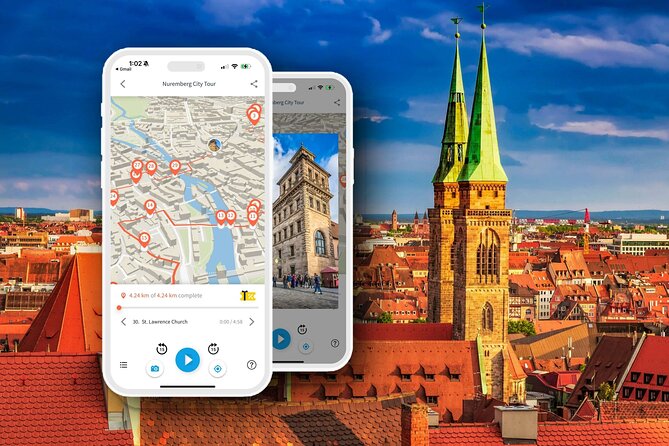
I like the offline map, which lets you keep moving without relying on mobile data, and the freedom to pause whenever you want. The 30 short recordings also keep the pace light. The catch is navigation. One user found the next stop unclear at times, so you should watch the route closely and allow extra time for wrong turns.
Key points at a glance
- Thirty audio stops: Hear professional historian narration at major sights across Nuremberg’s old town.
- A useful route from the station: Begin at Nürnberg Hauptbahnhof and finish back at the same point.
- Offline GPS map: Download the route before walking, then use it without an active data connection.
- Strong range of subjects: The route covers medieval churches, Dürer, human rights, wartime preservation, museums, and local architecture.
- Entry fees are separate: The castle, museums, Dürer House, and Historic Art Bunker require their own tickets.
- Flexible one-year access: Start at the time that suits you and pause the tour for meals, museum visits, or rest.
Starting at Nuremberg Central Station
The tour begins at Nürnberg Hauptbahnhof, a practical meeting point with easy rail connections and plenty of shops and food options inside. Give yourself ten minutes here to get oriented. The station’s stone exterior recalls 19th-century Nuremberg, while the platforms and interior serve today’s regional and international trains.
From the station, the route moves quickly toward the Handwerkerhof. This is a good opening because you shift from modern transport to a small recreation of old Nuremberg. The app should be activated and downloaded before you leave the station, especially if you want to use the offline map from the start.
The tour ends back at the station. That makes it handy for a day trip or for anyone arriving by train, since you do not need to work out a second route to your next stop.
More Audio Walking Tours in Germany
- Berlin Cathedral Ticket & Audio Tour with a City Walk
★ 4.1 · 28 reviews - Trier: City Walk with Audio Guide in 7 Languages on your Phone
★ 4.0 · 19 reviews - Cologne Walking Tour with Audioguide: City and Cathedral
★ 4.5 · 14 reviews
Handwerkerhof and the city’s craft tradition
The Handwerkerhof sits inside a restored section of the old city fortifications. Its timbered buildings, cobbled lanes, craft shops, taverns, and Franconian food give you a quick taste of the city’s guild traditions.
It is not an untouched medieval quarter. The setting was created in 1971, so you should see it as a carefully made historical scene rather than an original street frozen in time. Still, goldsmiths, glassworkers, leatherworkers, and toy makers give the area more life than a simple display.
The planned visit is only about ten minutes, which is enough for a look but not a full meal or shopping stop. If you want bratwurst or a beer here, pause the recording and add time.
Modern art beside the Street of Human Rights
The route then points you toward the Neues Museum Nürnberg and the Straße der Menschenrechte. The museum occupies a modern glass and stone building near the medieval wall. Its galleries focus on modern and contemporary art and design, with works associated with artists such as Gerhard Richter and Andy Warhol.
The museum entry fee is not included, and the brief outdoor stop does not replace a museum visit. If modern art interests you, plan a separate visit and use the app’s pause feature. The one-year access period gives you room to return to Nuremberg or split the route across more than one outing.
Next comes the Street of Human Rights, an open-air work by Israeli artist Dani Karavan. Twenty-seven white pillars carry articles from the Universal Declaration of Human Rights in German and another language. The site is especially meaningful in Nuremberg, a city heavily marked by Nazi history and the crimes planned under that regime.
This is one of the route’s most serious moments. The audio stop is short, but the installation deserves a quiet walk rather than a rushed photograph. It links the city’s past to a clear statement about human dignity.
Churches around Jakobsplatz
The route includes St. James the Less Episcopal and Anglican Church, an English-speaking church connected with the Convocation of Episcopal Churches in Europe. It serves an international community and offers a different view of Nuremberg from the usual medieval and imperial story.
Nearby, Kirche St. Elisabeth brings you back to Catholic architecture. Its large domed rotunda and restrained neoclassical design feel very different from the Gothic churches later in the walk. Construction ran from 1785 to 1903, with long delays shaped by politics and practical problems.
These stops are brief, about ten minutes each. You get the setting and the main idea, but you should not expect a full guided visit or guaranteed access to every interior. The route works best when you treat each recording as an introduction, then decide where you want to linger.
More Smartphone Audio Tours in Germany
- 800 Years of History: A Munich GPS Audio Tour
★ 4.5 · 12 reviews - Dusseldorf: City Walk Audio Guide in 7 Languages on your Phone
★ 4.5 · 11 reviews - Berlin Walking Tour with Audioguide on Your Smartphone
★ 4.0 · 11 reviews - Koblenz: City Walk with Audio Guide in 7 Languages on your Phone
★ 4.5 · 5 reviews
The White Tower and the Marriage Carousel
At Weißer Turm, old and new Nuremberg meet in a tight urban space. The medieval gate tower rises beside a modern U-Bahn station, a useful reminder that the old city is not a museum set. People still pass through it on ordinary errands.
Beside the tower is the Ehekarussell, or Marriage Carousel, one of Nuremberg’s most memorable public artworks. Jürgen Weber’s 1984 fountain shows love, routine, arguments, decline, and death in six dramatic bronze scenes inspired by poems by Hans Sachs.
I like this stop because it avoids the usual soft-focus view of romance. Some scenes are tender, others grotesque, and several are funny in a grim way. Take time to look at the figures before listening to the full commentary. The fountain makes more sense when you see how sharply the sculpture shifts from affection to conflict.
Riverside views at the Water Tower and Weinstadel
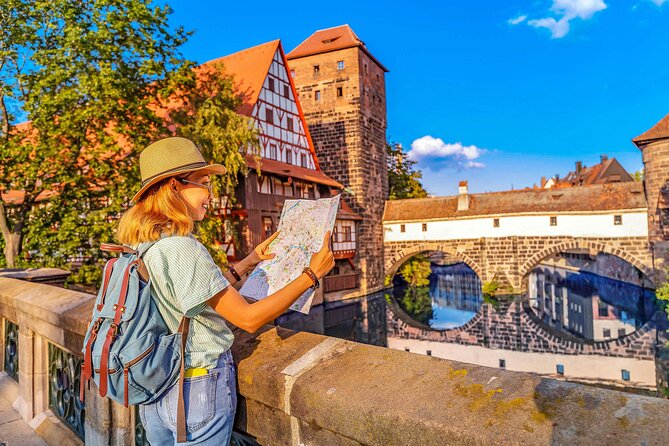
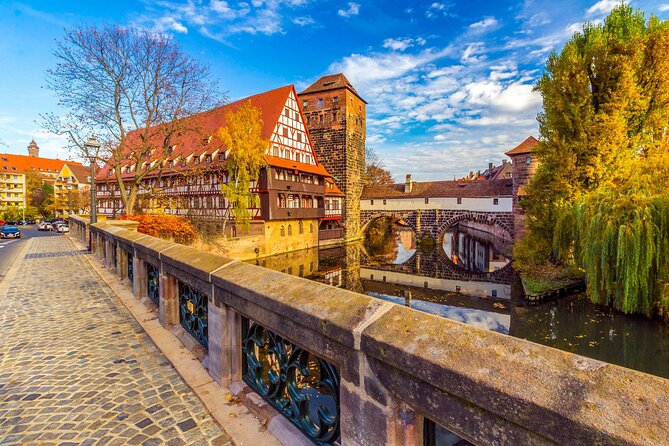
The route next follows the Pegnitz toward the Wasserturm and Weinstadel. The Water Tower is a medieval fortification with a cylindrical stone body and red-tiled roof. It was later used for civic purposes, including as a prison.
The Weinstadel is one of the city’s most photographed buildings. Built in 1446 as a wine storehouse, it later housed lepers during Holy Week and the city’s poor. Today, it serves as student housing, a practical modern use inside a very old building.
This is a good place to pause the app and look at the reflections in the river. The route gives you the historical facts, but the view is the real reward. If the path feels unclear at any point, compare the blue GPS route with the next landmark before walking on. That small check can save you from losing time among the river crossings and narrow lanes.
Toys, half-timbered houses, and the old wall
The Nuremberg Toy Museum follows. The city was once known as a major toy-making center, and this museum traces play through wooden toys, dolls, tin soldiers, board games, and LEGO. The collection links toys to technology, family life, and social change, so it is not only for children.
Admission is extra, and ten minutes gives you only a preview. Families may want to stop the tour for a longer visit. Adults who remember older toys may also find this an easy museum to enjoy without a long attention span.
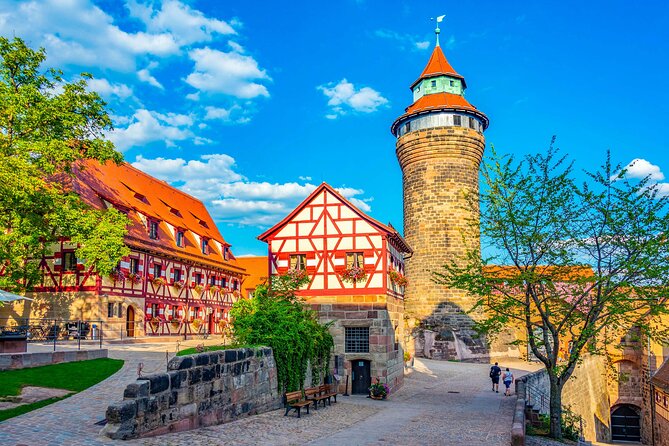
From there, the route reaches Weißgerbergasse, a narrow cobbled street lined with more than 20 preserved half-timbered houses. The street takes its name from the tanners who once worked there. Its colorful façades, flower boxes, cafés, galleries, and private homes make it one of the best places on the walk for photographs.
The city wall comes next. Nuremberg retains much of its roughly five-kilometer medieval fortification loop, with towers, gates, bastions, and sections of covered walkway. You can view parts of it from below or walk selected stretches, especially around the Moat Garden.
This portion gives you a useful sense of scale. The wall was not a single monument but a working defense system around a powerful imperial city. The audio guide helps connect scattered towers to the larger fortification.
Dürer’s home, a strange hare, and art beneath the castle
At the foot of Nuremberg Castle, you reach the Albrecht Dürer House. Dürer lived and worked here for nearly 20 years. The timber-framed house preserves period rooms, a workshop, copies of his art, and a printing press demonstration.
Dürer House entry is not part of the $8.46 tour price. If you care about Renaissance art, plan a separate visit. The audio stop gives you context, but only the museum visit lets you see the rooms and demonstrations from inside.
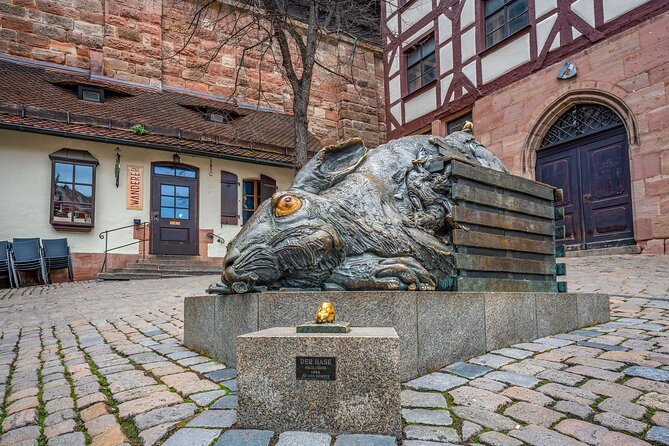
Outside is the Dürer-Hase, a large sculpture based on Dürer’s famous 1502 drawing Young Hare. The oversized rabbit and smaller surrounding hares are playful, odd, and slightly unsettling. It is a quick stop with a strong visual payoff, especially if you want something less solemn after the house.
The Historic Art Bunker is another optional paid visit. These medieval rock-cut cellars beneath the castle were reinforced during World War II to protect works by Dürer, imperial regalia, and church art from bombing. A guided visit takes you through cold, echoing tunnels and explains how the city’s treasures were stored underground.
The bunker is not simply another museum room. It shows how Nuremberg’s art survived because people moved it into a dangerous, hidden space. Check the separate admission details before you count on entering, since the walking tour itself does not include access.
Nuremberg Castle and the city’s medieval center
Nuremberg Castle crowns the old town and brings together the Imperial Castle, the former Burgraves’ Castle, fortified walls, and the Double Chapel. Its high position gives you broad city views, while the rooms and well explain how emperors and officials used the complex.
The castle needs more than the ten-minute audio stop if you want to see the interiors. I would treat the recording as a useful preview, then buy a separate ticket if the weather and your schedule allow. The route is already long, so a castle visit can turn this into a full day.
St. Sebaldus Church is one of the old town’s major Gothic landmarks. Its patron saint’s ornate bronze shrine, made by Peter Vischer, is a major work of German Renaissance sculpture. The church also carries visible wartime scars, giving the interior a quiet sense of endurance.
Nuremberg City Hall adds a sharper contrast. Its Renaissance façade and later Baroque wing express civic power, while the medieval dungeons below tell a much darker story. Dungeon entry is separate, so check ahead if you want to go underground.
Hauptmarkt, the Beautiful Fountain, and the final walk south
The Schöner Brunnen rises from the Hauptmarkt like a Gothic spire disguised as a fountain. Its 40 figures represent philosophers, evangelists, church leaders, and princes linked to the medieval order. The two golden rings on the fence are famous local luck symbols.
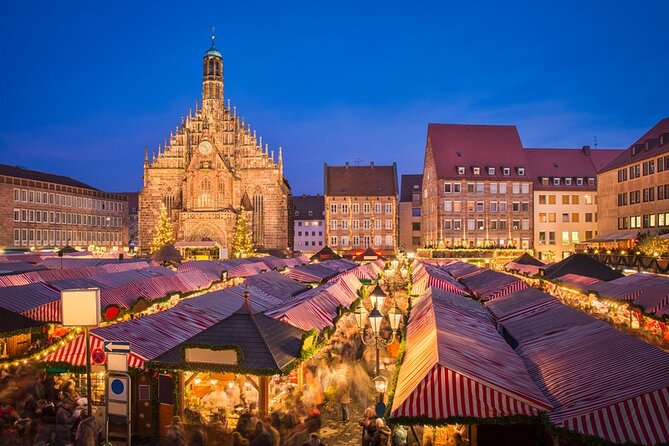
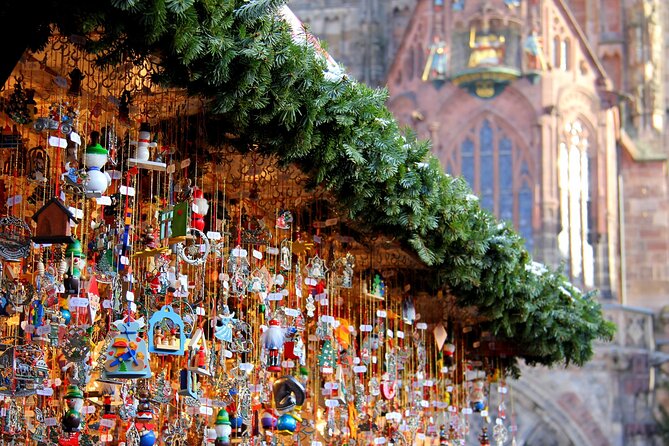
The same square hosts Nuremberg’s Christmas Market, known as the Christkindlesmarkt. At the right time of year, you will find red-and-white stalls, gingerbread, mulled wine, ornaments, and Nürnberger bratwurst. Outside the market season, the Hauptmarkt remains a working square with food, flowers, and produce.
The tour then crosses the Fleischbrücke, a stone bridge built in 1598 and 1599. Its single arch connects the market area with the Lorenz quarter. It was named for nearby butcher stalls and was inspired by Venice’s Rialto Bridge.
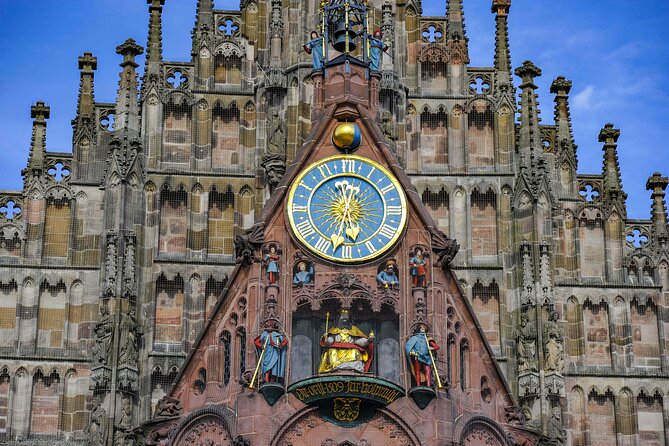
The final major stop is St. Lorenz, the city’s great Gothic church. Look for the twin towers, rose window, carved portal, stained glass, and Veit Stoß’s suspended Angelic Salutation. The church was damaged during World War II and later restored, giving the final stop both artistic force and a reminder of how much Nuremberg had to rebuild.
How the app works during three hours
You receive an app for iPhone or Android, an offline map with GPS navigation, 30 audio recordings narrated by a professional historian, and landmark illustrations to help you identify buildings. Access lasts one year, and you can use the tour at a time other than the approximate date selected at checkout.
You need your own smartphone and headphones. There is no in-person guide, transportation, food, or admission included. Download the app, activate the purchase, and save the route before setting off.
The recordings are short enough to keep your attention while walking. You can pause for a museum, meal, photograph, or rest, then continue when ready. The main weakness is that the map does not remove every navigation problem. I would keep the phone easy to reach and confirm each next point before leaving a square.
Is $8.46 a good value?
At $8.46 per person, this is a low-cost way to organize a first walk through Nuremberg. You get about three hours of structure, 30 pieces of narration, a route map, and a year of access. That is good value if you want background without paying for a private guide.
The price is less of a bargain if you expected tickets or a human guide. The castle, museums, Dürer House, and Historic Art Bunker all cost extra. You are paying for the route and interpretation, not a package of admissions.
The strongest value comes from the variety. In one walk, you cover crafts, modern art, human rights, churches, sculpture, riverside buildings, toys, Dürer, medieval defenses, imperial power, markets, bridges, and Gothic art.
Who should choose this Nuremberg walk?
I would choose it if you like exploring independently but still want historical context. It suits solo visitors, couples, families with older children, and anyone arriving by train who wants a ready-made route.
It is also a good fit if you dislike fixed tour times. You can begin when you want, stop often, and use the one-year access period to spread the route out.
I would skip it if you want conversation with a local guide, detailed answers at every stop, or a tour built around museum interiors. It is also not ideal if you dislike using your phone for navigation. Downloading the map first and checking directions often will make the experience much easier.
Should you book it?
Book this tour if you want an inexpensive, flexible introduction to Nuremberg that goes beyond the standard postcard sights. Its best moments are the mix of serious and playful stops, from the Street of Human Rights to the Marriage Carousel, and the clear route from the station and back.
Do not book it expecting entry tickets or a live guide. Bring headphones, allow more than three hours if you plan to enter museums, and keep the route open while walking. For $8.46, it is a sensible first look at Nuremberg, especially when you value freedom over a fixed schedule.
FAQ
Where does the Nuremberg audio tour begin?
It begins at Nuremberg Central Station, also called Nürnberg Hauptbahnhof, at 90402 Nuremberg, Germany.
Where does the tour finish?
The activity ends back at the starting point, Nuremberg Central Station.
How long does the walking tour take?
The estimated duration is about three hours.
Is a live guide included?
No. This is a self-guided tour using a mobile app. No in-person guide is provided.
What devices can I use?
The audio guide app is available for iPhone and Android devices.
Does the tour include an offline map?
Yes. The app includes an offline map with GPS navigation and illustrations to help you recognize landmarks.
Are museum and attraction entry tickets included?
No. Separate admission is required for the museums, Albrecht Dürer’s House, Nuremberg Castle, and the Historic Art Bunker.
Can I cancel for a full refund?
Yes. You can cancel at least 24 hours before the experience start time for a full refund. Cancellations or changes made within 24 hours are not refunded or accepted.
Latest audio tours in Germany
- Private audio book city rally around the Jahrhunderthalle in Bochum★ 5.0 · 12 reviews
- Private audio book city rally around the old town of Essen Kettwig★ 4.0 · 6 reviews
- Sanssouci Park: A Self-Guide Audio Tour of the Garden’s Landmarks★ 3.0 · 2 reviews
- Beautiful Baroque Potsdam: A Self-Guided Audio Tour★ 4.5 · 4 reviews
- Nuremberg Scavenger Hunt and Highlights Self Guided Audio Tour★ 4.5 · 7 reviews
- Discover Nuremberg: Self-Guided Audio Tour★ 3.0 · 9 reviews
- Self Guided Tours Munich With 100 Captivating Audio Stories★ 5.0 · 3 reviews
- Private audio book city rally in Munich city centre★ 4.0 · 4 reviews
Audio Walking Tours, compared.

City Monuments Guided Walking Tour with Audio Guide
Read our review →

Self Guided Classic Freedom Trail Location Aware (GPS) Walking Audio Tour
Read our review →
Self-Guided Historical Walking Tour (Audio Guide)
Read our review →
Cape Cod & Provincetown Self-Guided Driving & Walking Audio Tour
Read our review →
Verona Walking Tour with Audio and Written Guide by a Local
Read our review →
Royal Walking Tour and Buckingham Palace Audio Tour
Read our review →
Bologna Walking Tour with Audio and Written Guide
Read our review →Browse the lists this tour appears in