
Reviewed · GERMANY
Trier: City Walk with Audio Guide in 7 Languages on your Phone
Trier’s Roman gates, medieval market square, cathedral, and Marx birthplace fit into one well-planned 5.5-kilometer walking route. The audio guide gives you 27 stories as you go, so you can explore without matching a guide’s pace or keeping a group together.
I like the freedom to stop for a drink, enter a museum, or continue the next day. At $9.03 per person, it is also a sensible way to get a city orientation without paying for a private guide. The main concern is the technology: you need working GPS, an internet connection, a charged phone, and headphones, and some audio translations and waypoints may be uneven.
Key points to know before you book
- The route covers 5.5 kilometers: Allow about two to three hours of walking and listening, with plenty of time for stops.
- You get 27 audio stories: The commentary aims for legends, local tales, and fun facts, not just dates and stonework.
- Your ticket lasts beyond one outing: You have until the end of the next day to finish the route.
- The major sights are outside admissions: Entry fees for the cathedral, museums, or other attractions are not included.
- You need your own equipment: Bring a smartphone, headphones, a full battery, and ideally a power bank.
- The duo option may keep you together: The audio system can require both phones to remain near each other, so confirm the booking setup if you plan to split up.
Why this Trier walk works well for independent sightseeing

Trier is a city where ancient Roman remains sit directly beside ordinary shops, cafés, and church squares. That makes it easy to explore on foot, but it also means you can miss the larger story if you simply wander from monument to monument. This route gives you a thread to follow.
You begin at the supplied meeting point in Trier and use the app’s GPS guidance to move from stop to stop. There is no guide waiting with a flag, and no fixed departure time described beyond your selected start. Instead, the route tells you when you have reached a point and plays the related story.
That setup suits you if you like to set your own speed. You can stop to take photographs, sit with a coffee, or go inside a museum without holding up anyone else. The tour remains a private activity, meaning only your own group participates.
The audio content is designed to be more relaxed than a list of construction dates. It includes stories, legends, and lighter facts collected by a local guide. That approach can make Trier’s stones easier to remember, especially if Roman architecture is not normally your favorite subject.
Still, an audio walk is not the same as a live guide. You cannot ask a follow-up question, request a shorter route, or ask someone to explain what you are seeing in the moment. If you want personal conversation and instant answers, book a human-led walk instead.
More Audio Walking Tours in Germany
- Berlin Cathedral Ticket & Audio Tour with a City Walk
★ 4.1 · 28 reviews - Cologne Walking Tour with Audioguide: City and Cathedral
★ 4.5 · 14 reviews - Dusseldorf: City Walk Audio Guide in 7 Languages on your Phone
★ 4.5 · 11 reviews
Porta Nigra: Trier’s Roman front door
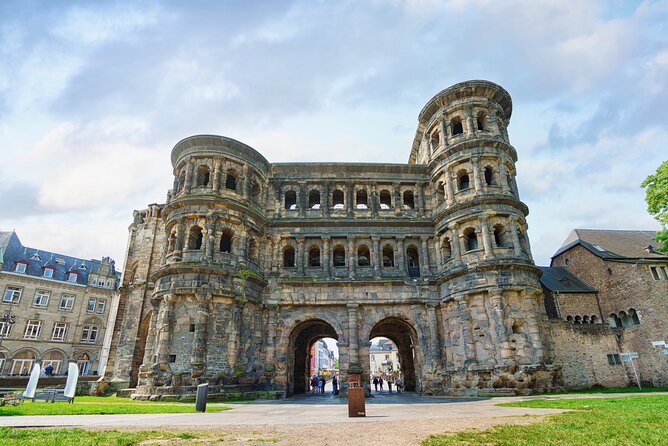
The Porta Nigra is the natural opening to Trier’s Roman story. This well-preserved city gate dates from the second century AD and was built from huge blocks of stone. Its size makes the original defensive purpose clear before you even hear the explanation.
The audio commentary can give you useful context for reading the structure. Rather than treating it as an isolated photo stop, the route presents the gate as part of Roman Trier and its system of city defenses.
You do not need to pay an admission fee simply to follow the outdoor route, but any decision to enter an attraction along the way is separate. That distinction matters when you compare the low tour price with a traditional sightseeing ticket.
Give yourself time here. The gate is one of those places that looks impressive in a quick photograph, but its scale becomes clearer when you pause near the base and look up at the stonework. The route continues for several kilometers, so comfortable shoes are a sensible choice.
Hauptmarkt: medieval Trier at street level
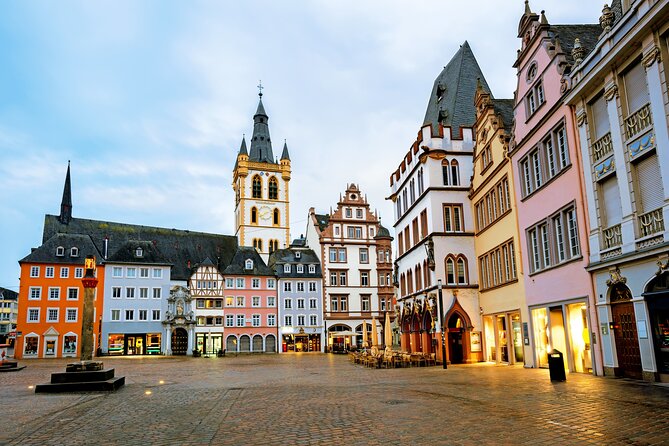
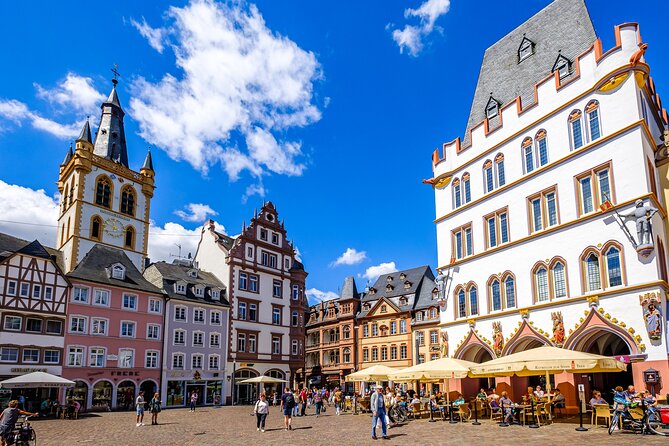
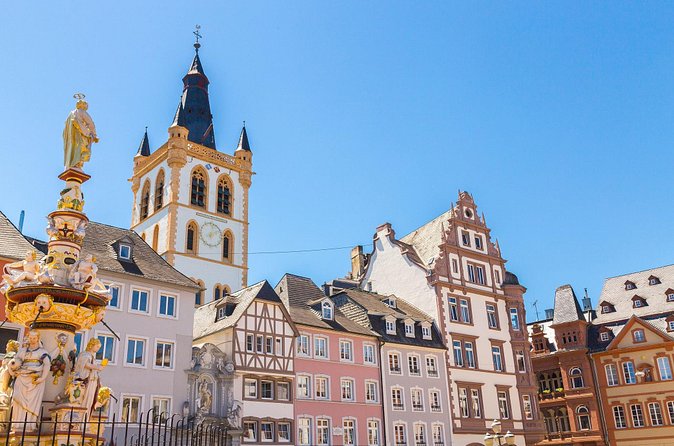
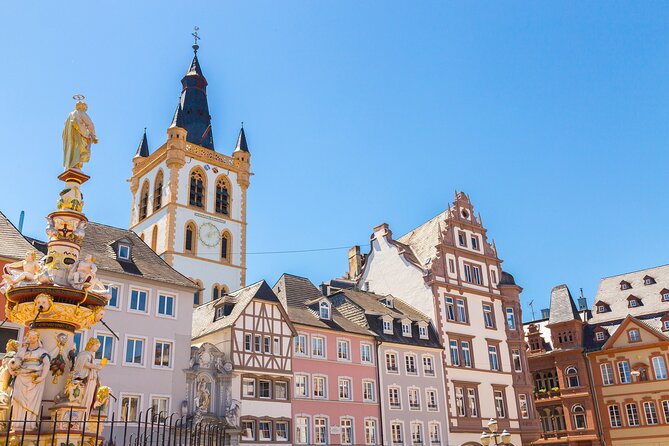
From the Roman gate, the walk takes you toward the Hauptmarkt, Trier’s central square and one of Germany’s oldest market places. This is a change of mood from military Roman architecture to a town square framed by historic buildings, colorful half-timbered houses, and cafés.
The St. Gangolf Church and Roman Fountain are two of the notable sights here. The square also hosts markets and events, so what you see may vary with the day. You can pause the audio while looking around or finding a place to sit.
This is one of the strongest parts of a self-guided route because the square rewards unhurried exploration. A scheduled group might give you a few minutes and move on. Here, you can listen, stop the narration, and take in the buildings at your own pace.
The commentary’s lighter stories are particularly useful in a place like the Hauptmarkt. Dates alone do not explain why a square feels important. Local anecdotes and small details give you a better sense of how the center functions as part of daily Trier.
Trier Cathedral and the city’s long religious story

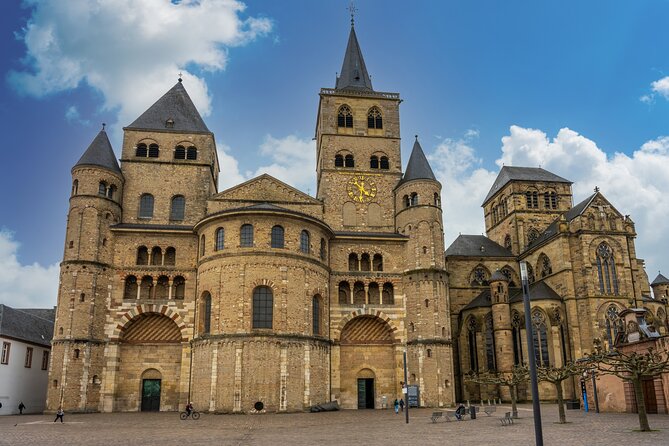
The Cathedral of Saint Peter is one of the route’s major stops. It is commonly called Trier Cathedral and is recognized as the oldest cathedral in Germany. Construction began in the fourth century under Emperor Constantine, and later changes added several architectural styles to the building.
That long building history is part of what makes the cathedral interesting. You are not looking at one perfectly uniform design. Roman beginnings, later Romanesque work, and subsequent renovations have left different marks on the structure.
The cathedral is also known for the Holy Robe, believed to be the tunic worn by Jesus. The relic makes the building an important pilgrimage destination as well as a historic monument.
The tour fee does not include admission to attractions you pass. That means you should treat the audio walk and any interior visit as separate parts of your day. If you want to enter the cathedral or another museum, leave extra time in your schedule and expect any applicable admission charge to be paid on site.
The route gives you a helpful introduction, but an audio stop cannot replace time inside the building. If religious art, architecture, or the Holy Robe is a main reason for your visit, use the flexible schedule to make a proper visit rather than listening only from outside.
More Smartphone Audio Tours in Germany
- 800 Years of History: A Munich GPS Audio Tour
★ 4.5 · 12 reviews - Berlin Walking Tour with Audioguide on Your Smartphone
★ 4.0 · 11 reviews - Koblenz: City Walk with Audio Guide in 7 Languages on your Phone
★ 4.5 · 5 reviews - Nuremberg Walking Tour with Audioguide on your Smartphone
★ 5.0 · 3 reviews
Karl Marx House: a different side of Trier
The Karl Marx House adds a modern political and social layer to the route. Marx was born in Trier and spent part of his childhood in the house, which is now a museum about his life, ideas, and historical setting.
The exhibits include original documents, photographs, and material about his influence on political theory and socialism. Even if you are not planning a full museum visit, the stop explains why Trier is connected not only with Roman emperors and church history, but also with the political debates of nineteenth-century Europe.
This is a good example of why the route works better than a simple list of Roman ruins. Trier’s identity has several chapters, and the audio commentary links them across the city. You can decide if the museum deserves a separate visit, but remember that entry is not included.
If you are sightseeing with children or with people who have different interests, the self-guided format helps. One person can spend longer at Marx House while another takes a short break, provided the app setup allows the group to stay within the required GPS range.
Basilica of Constantine and the scale of imperial power
The Basilica of Constantine, also called the Aula Palatina, is one of Trier’s clearest reminders that this was once an important Roman imperial center. Built in the early fourth century during Constantine’s reign, it served as an audience hall within a larger palace complex.
The building is known for its enormous rectangular hall, high flat wooden ceiling, and relatively simple architectural style. That plainness is part of the effect. The space communicates power through scale rather than through a crowded display of decoration.
Today the basilica is used as a Protestant church. Its continuing use gives the building a living purpose, not just a place in an archaeological timeline.
The stop also shows the benefit of audio guidance. Without context, a large hall can look empty. The narration explains what the building was for and helps you picture its role in imperial Trier. As with the other sights, any interior admission or special opening arrangements are outside the tour price.
Timing: two hours, or a full next-day outing
The stated walking distance is 5.5 kilometers, and the average duration is two to three hours. That estimate likely works for a steady walk with normal listening pauses, but your actual time depends on how often you stop and which attractions you enter.
The useful detail is that you have until the end of the next day to complete the route. That gives you much more control than a standard two-hour departure. You can start in the morning, pause for lunch, visit a museum, and continue later. If bad weather interrupts your plans, you may also be able to finish the next day.
I would plan the walk as a flexible half-day rather than rushing to finish in exactly two hours. The route itself may be manageable in that time, but Trier’s main sights deserve pauses.
The extended completion period does have limits. It is not an open-ended pass, so check the activation instructions and the expiry time before you begin. Your phone also needs to remain usable throughout the outing.
The phone and audio setup deserves attention
You receive an app with GPS guidance and audio content in seven languages. The booking information identifies English as the offered language, so check the language selection and activation details before setting out if you need another option.
You will receive instructions and a code in a separate email. Keep that message available, since the activation step is essential. A customer who had trouble locating the six-digit code was able to get help from a service representative, but it is better to find the instructions before you reach the starting point.
Bring your own smartphone and headphones. Neither is included. A full charge is important because GPS and audio can use power quickly, especially over several hours. I would carry a power bank, as the supplier specifically recommends.
You also need an internet connection and active GPS. Do not assume the walk will work as a fully offline download unless the activation instructions clearly say so. If your mobile data is limited, check the technical requirements before you leave your hotel.
The audio may be played from one phone for a pair, but the duo setup can have practical limits. If both people use separate phones, the devices may need to stay together for the route and narration to continue. That is worth knowing before one person wanders off to browse a shop or take photographs.
Where the low price delivers value
At $9.03 per person, this is priced closer to a digital orientation than a conventional guided tour. You are paying for the route, GPS directions, and recorded stories, not for a personal guide or attraction admissions.
The value is strongest if you want basic structure without committing to a fixed group schedule. A private walk at this price is also useful for couples, families, and small groups who would otherwise need to pay much more for a private human guide.
The price is less appealing if you expect polished museum-level interpretation at every point. One reported problem involved poor English-to-German translation, including incorrect place names and awkward wording. Some waypoints were also reported to contain only a number, with no useful audio or text.
That does not make the whole route unusable, but it does lower expectations. Treat the app as a helpful companion rather than the final authority on every detail. If a story sounds odd, rely on the physical landmark and any official information available at the site.
Group discounts are listed, but the supplied details do not explain the exact savings or conditions. Check the final price carefully, especially if comparing a duo booking with two single tickets. The duo option may restrict how far apart the two phones can be.
Who should choose this audio walk
I would recommend it most strongly to:
- Independent visitors who dislike fixed group departures
- Couples or small groups who want a private route
- Budget-conscious sightseers who want structure for less than a live private tour
- People who enjoy listening while walking rather than reading long panels
- Anyone with enough time to pause at museums, cafés, and major monuments
It is less suitable if you want a live guide, detailed answers to questions, or guaranteed editorial polish in every language. It may also frustrate you if your phone battery is weak or your mobile connection is unreliable.
Most people can participate, and the route returns to the starting meeting point. The supplied information does not give detailed accessibility notes, so contact the provider directly if you need specific information about surfaces, steps, or access inside the sights.
Free cancellation is available if you cancel at least 24 hours before the local start time. Within 24 hours, the amount is not refunded, and late changes are not accepted.
Should you book the Trier audio tour?
Book it if you want a low-cost way to organize a day around Trier’s biggest sights while keeping control of your time. The combination of Porta Nigra, the Hauptmarkt, Trier Cathedral, Karl Marx House, and the Basilica of Constantine gives you a broad introduction to the city, from Roman imperial power to medieval religion and modern political history.
The best feature is the freedom to pause and continue through the end of the next day. The biggest weakness is the app itself, particularly the possibility of awkward translations or thin information at a few waypoints.
My practical advice is simple: charge your phone fully, bring headphones and a power bank, locate the activation email before you start, and allow more than the minimum two hours if you plan to enter museums. For $9.03, this is a useful orientation and a flexible sightseeing tool, but not a substitute for a live historian or a complete museum visit.
FAQ
How long does the Trier audio walk take?
The average duration is two to three hours. The walking route covers about 5.5 kilometers and includes 27 audio stories.
Can I finish the tour on a different day?
Yes. You have until the end of the next day to complete the activity, giving you time to take a break, visit a museum, or continue after bad weather.
What sights are included on the route?
The route includes Trier’s Porta Nigra, Hauptmarkt, Cathedral of Saint Peter, Karl Marx House, and Basilica of Constantine, along with other points covered by the 27 stories.
Is a live guide included?
No. This is a self-guided audio tour using an app and GPS guidance on your smartphone.
How many languages are available in the audio app?
The app provides audio guidance in seven languages. The booking information identifies English as the offered language, so check the activation details for your preferred language.
Do I need my own phone and headphones?
Yes. A smartphone and headphones are not included. You should also bring a fully charged phone or a power bank.
Does the tour require internet access?
Yes. The activity requires an internet connection and the GPS function on your phone.
Are admission fees included?
No. Admission fees for attractions along the route are not included in the tour price.
Where does the tour start and finish?
It starts at the specified meeting point in Trier, Germany, and ends back at the meeting point.
Can I cancel for a refund?
You can receive a full refund if you cancel at least 24 hours before the local start time. Cancellations and changes made within 24 hours are not refunded or accepted.
More multilingual audio guides in Germany
- Cologne: City Walk with Audio Guide in 7 Languages on your Phone
★ 3.5 · 3 reviews - Heidelberg: City Walk Audio Guide in 7 Languages on your Phone
★ 3.0 · 2 reviews - Athens: Acropolis Ticket with Multilingual Audio Guide
★ 3.9 · 926 reviews - Geiranger: Bus Tour with Multilingual Audio Guide
★ 4.0 · 317 reviews
Latest audio tours in Germany
- Private audio book city rally around the Jahrhunderthalle in Bochum★ 5.0 · 12 reviews
- Private audio book city rally around the old town of Essen Kettwig★ 4.0 · 6 reviews
- Sanssouci Park: A Self-Guide Audio Tour of the Garden’s Landmarks★ 3.0 · 2 reviews
- Beautiful Baroque Potsdam: A Self-Guided Audio Tour★ 4.5 · 4 reviews
- Nuremberg Walking Tour with Audioguide on your Smartphone★ 5.0 · 3 reviews
- Nuremberg Scavenger Hunt and Highlights Self Guided Audio Tour★ 4.5 · 7 reviews
- Discover Nuremberg: Self-Guided Audio Tour★ 3.0 · 9 reviews
- Self Guided Tours Munich With 100 Captivating Audio Stories★ 5.0 · 3 reviews
Multilingual Audio Guides, compared.

Geiranger: Bus Tour with Multilingual Audio Guide
Read our review →
Sightseeing Cruise on the Danube with Audio Guide in Budapest
Read our review →

Castel Sant’Angelo E-Ticket & Multilingual Audio Guide
Read our review →
Best Of – with Tour Leader & Multilingual Audio Guide
Read our review →
Chiva Private Cultural Tour with Audio Guide in Buga
Read our review →
Acropolis Museum E-Ticket and Multilingual Audio Guide
Read our review →Browse the lists this tour appears in