
Reviewed · NEW YORK CITY
New York City’s High Line: A Self-Guided Audio Tour
The High Line is more than a pretty elevated park. It is a rescued freight railway with a grim past, a stack of wild reuse proposals, and a front-row view of New York’s changing west side. This 90-minute self-guided walk uses stories to connect the tracks, buildings, markets, and public art around you.
I like the entertaining storytelling, which turns facts into memorable scenes, and I like the freedom to pause whenever you want. The offline audio, map, and geodata are also useful underground or when your signal gets patchy. The main drawback is that the app may not always match your walking speed, so you may need to pause or adjust it as you go.
Key points to know before you go

- Follow the old railway from Gansevoort Street to Hudson Yards, covering the High Line’s past and present in about an hour and a half.
- Hear the story of Death Avenue, the former street-level rail line where frequent pedestrian deaths helped lead to the elevated structure.
- Pass major stops such as Chelsea Market, Pier 57, and the Whitney Museum of American Art without paying separate admission.
- Learn about more than 700 reuse ideas, including a mile-long swimming pool and a rollercoaster threaded between buildings.
- Use the VoiceMap app offline, with your own smartphone and headphones.
- Expect an audio tour rather than a live guide, with English commentary and private use for your own group.
Start among galleries, food, and old rail tracks

The walk begins at Friends of the High Line at 820 Washington Street, near the southern end of the park in the Meatpacking District. This is a good starting point because the neighborhood brings together old industrial buildings, fashionable shops, restaurants, galleries, and the raised rail line itself.
Before you set off, download the VoiceMap application and the tour content. Bring a charged smartphone and headphones. Your ticket includes lifetime access in English, along with offline audio, maps, and geodata, so you do not need to depend on a mobile connection once everything is ready.
The tour is self-guided, which gives you control over the pace. If you want to stop for a photo, read a plaque, enter a market, or simply watch the city for a few minutes, you can pause the audio. That flexibility is the chief advantage over a fixed group walk.
The tradeoff is that no person is there to solve a technical problem or answer a follow-up question. One practical issue is audio synchronization. If you walk faster or slower than the programmed route, the narration may not line up perfectly with your position. I would treat the app as a helpful companion rather than a strict marching order.
More Self-Guided Audio Tours in the USA
- NYC: St. Patrick’s Cathedral Official Self-Guided Audio Tour
★ 3.5 · 45 reviews - New York City’s Financial District: A Self-Guided Audio Tour
★ 4.5 · 8 reviews - West Village’s Flappers, Freaks & Punks: A Self-Guided Audio Tour
★ 5.0 · 4 reviews
Death Avenue and the reason the High Line exists
One of the strongest parts of the tour is the explanation of what came before the park. In the late 1800s, trains ran at street level along this section of Manhattan. The line crossed busy streets and killed so many pedestrians that the route became known as Death Avenue.
That detail gives the High Line a sharper meaning. You are not simply strolling on an attractive walkway. You are walking on a structure created to move dangerous freight traffic above street level and away from people below.
The audio places the park in that larger story. It explains how practical transport infrastructure later became a threatened relic, then a public space. I like this approach because it helps you notice the rails, steel, and old industrial setting instead of treating the High Line as just another urban garden.
You will still need to look around rather than stare at your phone. The best use of the app is to listen for a short segment, lift your eyes to the buildings and tracks, then stop when something catches your attention.
Whitney Museum of American Art and the southern High Line

The route includes the Whitney Museum of American Art, located at the southern end of the High Line. The museum is not included in the $14.99 price, and the audio tour does not provide admission. You can admire its place in the route without entering, or plan a separate museum visit if its exhibitions suit your schedule.
This stop helps explain why the High Line became such a powerful public project. The park is tied to art, architecture, old warehouses, and new construction, all packed into a short stretch of Manhattan.
You should not expect an inside tour of the Whitney. The museum appears as a landmark along the walk, not as a scheduled attraction with included entry. That distinction matters if you are comparing this audio tour with a guided museum and High Line package.
The southern section is also useful for getting your bearings. The tour begins near Washington Street and then leads you onto the elevated route. Because the starting point is clearly identified, you can prepare before pressing play rather than trying to begin in the middle of a crowded path.
Pier 57 and the changing waterfront
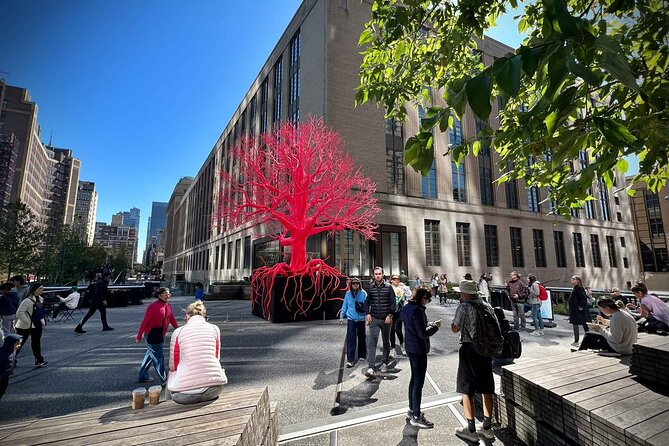
Pier 57 provides another look at how the west side has changed. The route links the High Line to the Hudson River waterfront, giving you a sense of how rail transport, shipping, food, retail, and public space now overlap in this part of the city.
The stop is not presented as a separate admission attraction. It is one of the places you pass while following the audio route. That makes it useful for context, especially if you want to understand the High Line as part of a wider redevelopment zone rather than an isolated park.
I appreciate that the walk does not focus only on the famous viewpoints. Stops such as Pier 57 broaden the story. You get a better feel for the relationship between the raised railway and the riverfront below.
At the same time, this is still an audio walk, not a full waterfront tour. The supplied route information does not promise interior visits, food tastings, or a detailed tour of every pier facility. Plan on seeing these places from the route and hearing how they fit into the area.
More Self-Guided Audio Tours in New York City
- New York’s Iconic Central Park: A Self-Guided Audio Tour
★ 4.0 · 4 reviews - Boho Greenwich Village: A Self-Guided Audio Tour
★ 5.0 · 3 reviews - The Battery: A Self-Guided Audio Tour from Bowling Green Park to Stone St
★ 5.0 · 3 reviews - Broadway: A Self-Guided Audio Tour of the World’s Iconic Theatre District
★ 4.5 · 3 reviews
Chelsea Market, food television, and industrial New York
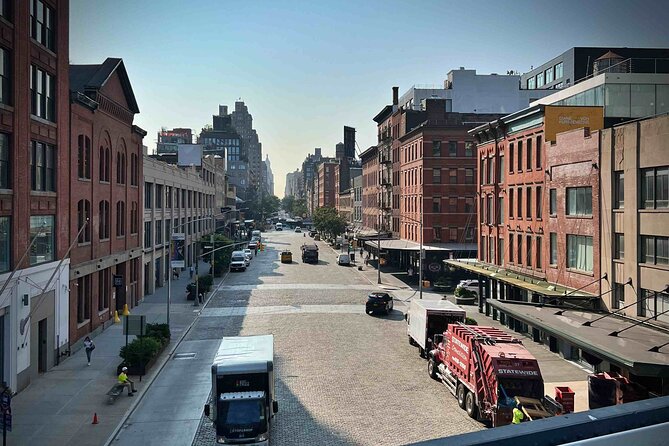
Chelsea Market is one of the most recognizable stops. The food hall occupies a former industrial setting and is known as a place where the Food Network films its shows. The tour uses it to connect the area’s working past with its current food and media identity.
You can treat Chelsea Market as a possible pause point, but food and drinks are not included. That is actually helpful for independent visitors, since you can decide if you want a quick snack, a longer meal, or no stop at all.
The market also gives the walk some welcome variety. The High Line itself can feel like one long linear park, but Chelsea Market adds a street-level indoor option and a clear reminder that this neighborhood is not only about gardens and viewpoints.
Keep your timing in mind. The advertised duration is about one hour and 30 minutes, but that is best understood as the walking and listening time. If you stop for food, photos, shopping, or nearby attractions, your visit will take longer.
The Standard Hotel and the tour’s cheekier side
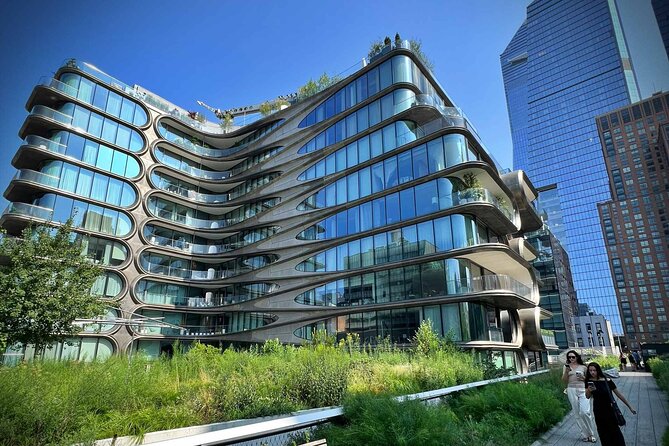
Near the High Line, the Standard Hotel is known by the nickname Eyefull Tower. The audio includes the hotel’s reputation for exposed hotel guests looking toward park visitors, along with the well-known story of Beyoncé’s sister confronting Jay-Z in an elevator.
This is a more playful part of the narration. It breaks up the infrastructure lesson and gives you the kind of local anecdote that makes a walk easier to remember. The tone is not simply a list of dates and construction details.
The story also reflects the High Line’s unusual setting. You are walking through a public park with close views into hotels, apartments, offices, and restaurants. The buildings are part of the scenery, but the proximity can create awkward or comic moments.
If you prefer strictly architectural commentary, this section may feel less essential. If you like a little celebrity and neighborhood gossip mixed into your city walking tour, it adds personality.
General Theological Seminary and the quieter details
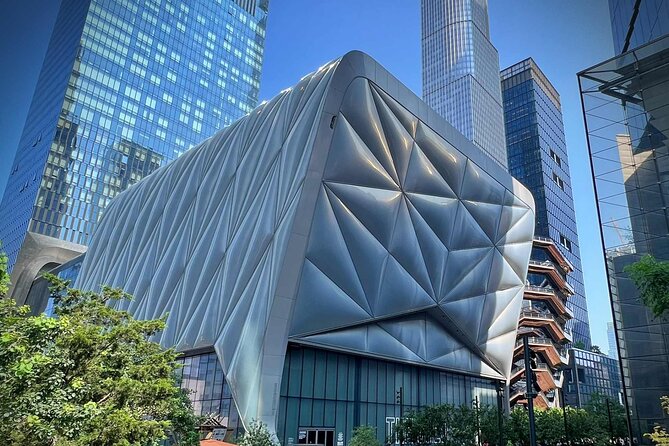
General Theological Seminary appears as another landmark along the route. Its inclusion gives the tour a pause from railways, food halls, hotels, and new towers.
This is a useful reminder that the blocks around the High Line contain older institutions as well as new development. The audio encourages you to notice the area’s different layers, not just the most photographed parts of the park.
The tour’s value comes from these connections. You are not paying for entry to each stop. You are paying for a guided narrative that tells you why the places matter and how they relate to the elevated line.
Because the tour lasts about 90 minutes, it cannot explain every building in depth. I would see the seminary as part of the broader story rather than expect a dedicated architectural lecture.
More than 700 ideas for saving the High Line

The most surprising part of the story may be what people proposed before the High Line became the park you see today. More than 700 creative ideas were submitted for reusing the structure.
Some proposals were practical. Others were wonderfully strange, including a mile-long swimming pool and a rollercoaster winding between the buildings. These ideas show that the future of the railway was not obvious. The structure could have become many different things.
This section gives the tour its imagination. It helps you compare the existing park with the possibilities that never happened. You begin to see the High Line not as an inevitable success, but as a public project shaped by competing visions.
I especially like this kind of story because it makes urban planning easier to understand. Big city spaces are often the result of choices, arguments, and compromises. The audio brings that process down to a human scale.
Hudson Yards and the final stop at Vessel
The route heads north toward Hudson Yards, where the older industrial story meets a much newer development. The change in setting is part of the point. You move from preserved railway infrastructure into a district built around modern towers and public attractions.
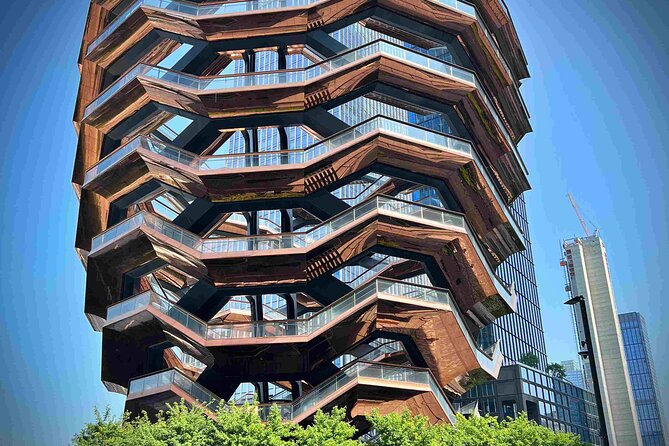
The walk ends at Vessel, a sixteen-story structure designed as a large stairway with no conventional destination. Its shape made it an immediate photo subject and an Instagram icon.
The tour also addresses Vessel’s tragic connection with suicide. That subject is serious, and the audio’s treatment means this is not simply a cheerful photo stop. I would be prepared for a change in tone near the end.
The route information names Vessel as the ending point, while the booking details also describe the activity as ending back at the meeting point. That is a point worth clarifying before you set out, especially if you have a timed reservation or need to return to the Meatpacking District. The described route itself runs from Gansevoort Street toward Hudson Yards.
Vessel access is not included. The attraction is a landmark viewed along the route, and the tour does not promise entry to museums or other attractions mentioned along the way.
What $14.99 buys you
At $14.99 per person, this is a modest-cost way to add structure to a High Line walk. You receive lifetime access to the English tour, the VoiceMap application, and offline audio, maps, and geodata. That is good value if you plan to listen at your own pace or return to the route later.
The price does not cover your phone, headphones, transportation, food, drinks, or admission fees. Those exclusions are reasonable for a self-guided walk, but they matter when you compare the total cost with a live tour.
The strongest value is the storytelling. A free walk through the park will show you the tracks, plantings, buildings, and city views, but it may not explain Death Avenue, the reuse proposals, or the local anecdotes in a connected way.
The weakest value appears if you want personal interaction. There is no live guide, no shared group conversation, and no promise of answers to questions along the way. You are buying a prepared audio narrative and the freedom to use it independently.
With an average booking lead time of five days, this is not generally something people arrange months ahead. Still, I would download the app and test the audio before reaching the starting point. That small step can prevent a frustrating beginning.
Who will enjoy this High Line walk
I would recommend the tour to you if you enjoy city walks with a strong story and prefer not to follow a guide’s fixed pace. It works well for independent visitors, couples, families with older children, and anyone who wants context without committing to a long live tour.
It is also a good match if you have already seen the High Line and want to understand it better. The railway’s past, the failed reuse concepts, and the connection to surrounding landmarks give the route more depth.
You may want something else if your main goal is a museum visit, a food tour, or a detailed architecture lecture. Those activities are not included, and the named attractions are mainly viewed from or near the walking route.
Most people can participate, and service animals are allowed. The walk is near public transportation. You provide the smartphone and headphones, and the experience is offered in English only.
Should you book this audio tour?
Book it if you want an affordable, flexible way to turn a famous park into a meaningful New York walk. The story-led commentary is the main reason to choose it, especially if details about Death Avenue, the High Line’s uncertain future, and the surrounding landmarks appeal to you.
Skip it if you want a live guide, included food, museum entry, or perfectly synchronized audio every step of the way. The app is easy to download and generally works well, but you should be ready to pause it if your pace gets out of line.
For the price, the tour offers a useful middle ground: more context than a casual stroll, less structure than a group excursion. Bring headphones, charge your phone, allow extra time for stops, and confirm the final endpoint before booking if your schedule depends on returning to Gansevoort Street.
FAQ
How long does the High Line audio tour take?
The tour lasts approximately one hour and 30 minutes.
What language is the tour offered in?
The audio tour is offered in English.
Where does the tour begin?
It begins at Friends of The High Line, 820 Washington Street, New York, New York 10014.
Where does the route go?
The route follows the High Line from Gansevoort Street in the Meatpacking District toward Hudson Yards, passing places such as the Whitney Museum of American Art, Pier 57, Chelsea Market, General Theological Seminary, and Vessel.
What is included in the price?
The price includes lifetime access to the English tour, the VoiceMap application, and offline access to the audio, maps, and geodata.
Do I need to bring anything?
You need to provide your own smartphone and headphones. Transportation, food, drinks, and entry fees are not included.
Is this a private tour?
Yes. It is a private activity for your own group, with no other group participants included.
Can I cancel or change the booking?
No. The experience is non-refundable and cannot be changed for any reason.
Latest audio tours in New York City
- Boho Greenwich Village: A Self-Guided Audio Tour★ 5.0 · 3 reviews
- The Battery: A Self-Guided Audio Tour from Bowling Green Park to Stone St★ 5.0 · 3 reviews
- West Village’s Flappers, Freaks & Punks: A Self-Guided Audio Tour★ 5.0 · 4 reviews
- New York’s Iconic Central Park: A Self-Guided Audio Tour★ 4.0 · 4 reviews
- New York City’s Financial District: A Self-Guided Audio Tour★ 4.5 · 8 reviews
- Self-Guided Audio Tour of New York City★ 4.5 · 2 reviews
- Broadway: A Self-Guided Audio Tour of the World’s Iconic Theatre District★ 4.5 · 3 reviews
- Guided Tour (with Audio) Hamilton Musical in Lower Manhattan NYC★ 5.0 · 11 reviews
Self-Guided Audio Tours, compared.

Acropolis Ticket & Optional Self-Guided Audio Tours
Read our review →


Ultimate Acadia National Park Self-Guided Driving Audio Tour
Read our review →

Akrotiri Ticket with Optional Self-Guided Audios
Read our review →
Browse the lists this tour appears in