
Reviewed · NAPLES
Herculaneum: skip the line entry ticket (art) + audioguide & map
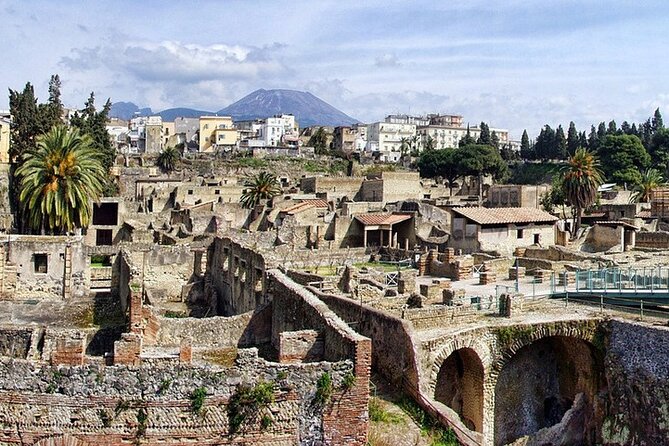
Herculaneum gives you a close look at Roman daily life, with houses, villas, mosaics, and streets preserved under volcanic material after Mount Vesuvius erupted in 79 AD. The included audioguide and map help you make sense of the ruins without joining a fixed group.
I like the freedom to linger in a room or move on when your attention fades. I also like the useful skip-the-line entrance ticket, which keeps the visit focused on the ancient town rather than the ticket queue. The main drawback is that there is no live guide, and the audio guide may not be clearly indicated when you arrive.
Key points to know before you book
- Herculaneum is best before Pompeii: Its smaller scale and unusually preserved buildings can feel less striking if you visit it after Pompeii.
- An English audioguide replaces a live guide: You explore alone, with recorded information and a map rather than personal commentary.
- Plan on about three hours: The stated duration is two to four hours, giving you room to set your own pace.
- The city wall once bordered the sea: This helps you understand how the ancient town was arranged before the eruption.
- The ticket office is both start and finish: You redeem the ticket at the Herculaneum Ticket Office in Ercolano.
- This is a private activity for your group: You do not share the arranged activity with another booking group, but the visit itself is self-guided.
Why Herculaneum feels different from Pompeii
Herculaneum is not simply a smaller Pompeii. The two sites tell related stories, but Herculaneum gives you a more concentrated look at Roman homes and household life.
The town was buried by the eruption of Mount Vesuvius in AD 79. One useful detail from the visit is that the remains were covered under marshy material rather than the lighter ash associated with much of Pompeii. That difference helped preserve many parts of the town, giving the site a strong sense of rooms, walls, and domestic spaces.
I find this especially valuable if you enjoy ancient history through ordinary details. Instead of only looking at grand public monuments, you can spend time with the layout of houses, decorative mosaics, and the spaces where people once lived. The remains help you picture a functioning Roman town rather than a collection of broken stones.
A view of the city wall also helps explain the old setting. The wall once bordered the sea, so the site gives you a clearer idea of Herculaneum’s relationship with the coast. That is one of the details worth seeking out with the map and audio commentary.
More Skip-the-Line Audio Tours in Naples
- Mount Vesuvius: Skip-the-Line Ticket and Smart Digital Guide
★ 4.2 · 2,780 reviews - Pompeii: Skip-the-Line Entry Ticket with Audio Guide or Tour
★ 4.1 · 1,364 reviews - Herculaneum: Skip-the-Line Entry Ticket with Audio Guide
★ 4.3 · 870 reviews
Starting at the Herculaneum Ticket Office
You begin at the Herculaneum Ticket Office in Ercolano, at postal code 80056 in the Metropolitan City of Naples. This is also the ticket redemption point and the place where the activity ends.
That simple arrangement matters. You do not need to find a separate tour office or walk to a second meeting location after collecting your ticket. The instructions identify the same ticket office for the start, ticket redemption, and finish.
Once your entrance is handled, you explore the archaeological park independently. The experience is listed as a private activity for your group, but do not confuse that with a private guided tour. No tourist guide is included. Your structure comes from the entrance ticket, map, and audioguide.
I would save the confirmation details on your phone and allow a little time to locate the ticket office. The activity is near public transportation, but the supplied information does not specify a particular bus, train, or walking route, so check your own route before setting out.
What the included ticket gives you
The main practical benefit is the Herculaneum entrance ticket, identified as an Artecard ticket in the inclusions. The experience is also presented as a skip-the-line visit, which can be useful when you want to spend your limited time inside the ruins rather than waiting at the entrance.
The ticket is not a guided tour. It gives you access to the archaeological park, while the map and recorded commentary provide the framework for your visit.
That distinction affects the value. If you like to read, listen, and make your own decisions, the arrangement is efficient. You can pause near a mosaic, continue through a house, or skip a section that does not hold your interest. If you want a person to answer questions or point out small details in real time, this will feel limited.
The ticket alone does not include a tourist guide. It also does not list transportation, meals, or any other extras. The value therefore depends on how much you want a self-guided visit and how useful the English audio content is to you.
Using the English audioguide and map
The experience is offered in English and includes an audioguide. The audio is meant to supply the background that a live guide would normally give, while the map helps you keep track of where you are within the site.
You may find the audio easy to use and informative, but it has been described as somewhat repetitive. That is not unusual for recorded sightseeing commentary. It can repeat key points so you do not miss them, but you may want to pause it when you are more interested in looking than listening.
One practical concern is that the audioguide is not always clearly indicated at the start. I would ask directly at the ticket office where to collect or activate it before walking into the park. The included map should also be confirmed at the same time.
No guide’s name is provided because this is not presented as a live guided tour. That makes the experience less personal, but it also means you are not tied to a guide’s speaking pace or route.
A separate account refers to a Spanish guide becoming ill and an appointment being canceled. The activity details here specify English audio and no tourist guide, so I would not book this expecting a Spanish-speaking guide or live commentary. If language support is important, confirm the exact audio language before the visit.
More Audio Tours in Naples
- From Naples: Caserta Palace Ticket and Train with Audioguide
★ 4.3 · 348 reviews - Naples: Pompeii Self Guided Audio Tour
★ 3.9 · 211 reviews - Naples: National Archaeological Museum Tour & Digital Guide
★ 4.2 · 177 reviews - Naples: National Archaeological Museum audio guide
★ 4.0 · 155 reviews
Spending three hours among houses and mosaics
The suggested stop is the Archaeological Park of Herculaneum, with about three hours allowed for the visit. The stated total duration is flexible, around two to four hours, so you can adjust the pace to your interests.
Begin by getting your bearings with the map. Then use the audio to understand the town as a whole before moving from one building to the next. This approach keeps the visit from becoming a blur of walls and pavements.
The houses and villas are the heart of the experience. Their value lies in the details of Roman domestic life: the way rooms connect, the decoration underfoot, and the difference between practical areas and more formal spaces. The mosaics are not just attractive surfaces. They help show how much care went into private interiors.
I would avoid rushing from one stop to another simply to cover the full site. Herculaneum rewards a slower look at a few well-preserved spaces. Listen to the relevant audio section, study the room, and then move on when you have a clear sense of what you are seeing.
The site is particularly useful for people who like context. The audio can explain the setting, while the physical remains show how that information worked in practice. You are not only hearing about Roman life, you are looking at the rooms where that life unfolded.
The city wall and the old coastal setting
Make time for the view of the city wall that once bordered the sea. It is a small detail, but it changes your understanding of Herculaneum.
Without that context, the site can seem like an inland collection of ruined buildings. The wall helps you picture the ancient town in relation to the coast and explains why its position mattered.
This is the sort of detail a map and audio guide can handle well. You can find the feature, listen to the explanation, and then look at the town with a better sense of its original setting. A live guide might add more local color, but the basic connection is still available through the self-guided format.
Why the order with Pompeii matters
If you plan to visit Pompeii too, consider seeing Herculaneum first. The contrast can work against Herculaneum if you visit it after Pompeii, since Pompeii is much larger and may leave you expecting another vast archaeological city.
Herculaneum works better as an introduction to Roman domestic life. Its compact scale lets you focus on preservation, interiors, mosaics, and the relationship between homes and streets.
After that, Pompeii can provide a broader sense of an entire city. The order also helps you appreciate what makes Herculaneum different instead of judging it only by size.
This is not a strict rule. If your schedule puts Pompeii first, Herculaneum can still be worthwhile. Just adjust your expectations. You are coming for a focused visit of roughly three hours, not a second full-day excavation.
Who will get the most from this format
I would recommend this experience to independent visitors who like to set their own pace. The ticket, map, and audioguide provide enough structure to keep the visit organized, while the absence of a live guide leaves you free to linger.
It also suits people with a limited schedule in Naples. The two to four hour window is long enough for a meaningful visit without requiring a full day. You can spend more time on the houses and mosaics that interest you and less time on sections that do not.
Families and mixed-interest groups may also find the flexible format useful. One person can listen while another studies the building, and the group does not have to remain behind a guide.
I would hesitate if you want detailed personal explanations, spontaneous questions, or a guide who adjusts the route to your interests. The audio may be informative, but it can also feel repetitive, and it does not replace conversation.
Most people can participate, and service animals are allowed. The activity is near public transportation. The supplied details do not give specific information about every surface, stair, or accessibility feature inside the archaeological park, so anyone with mobility concerns should confirm those conditions before booking.
How much value the experience offers
No price is provided here, so I cannot judge the exact cost against other Herculaneum tickets. I can judge what you receive for the booking: park admission, an Artecard ticket, an English audioguide, and a map.
That package is useful if the ticket access saves time and you would otherwise pay separately for audio material. It is less compelling if you already have another guide or prefer to explore without commentary.
The best value comes from using the included tools well. Start with the map, listen to the sections that match the buildings in front of you, and give yourself enough time to stop in the houses and villas rather than treating the park as a quick photo stop.
The lack of a live guide keeps the format simple and likely helps keep the experience flexible. In exchange, you accept less personal attention and the possibility of unclear audio instructions at the start. Ask about the audioguide immediately at the ticket office, and you will reduce the main practical uncertainty.
Cancellation and basic booking details
You receive confirmation at the time of booking. Free cancellation is available if you cancel at least 24 hours before the experience starts, based on local time.
Cancellations made less than 24 hours before the start are not refunded, and changes inside that period are not accepted. This matters if your Naples schedule depends on trains, weather, or a changing cruise timetable.
The provider is Pompei Tour Organizer_Tempio Travel. The activity begins and ends at the Herculaneum Ticket Office, and only your booking group participates in the arranged activity.
Should you book this Herculaneum visit?
Book it if you want a straightforward way to enter Herculaneum and explore independently for about three hours. The preserved homes, villas, mosaics, and old sea wall give you plenty to study, while the audio and map add useful direction without forcing you into a fixed route.
Visit Herculaneum before Pompeii if you can. That order lets you appreciate its close look at Roman homes instead of comparing it only with Pompeii’s much larger scale.
Skip this option if a live guide is essential. The audio may be informative but repetitive, and there is no named guide or personal commentary included. For an independent visit, though, the ticket, map, and flexible timing make this a practical choice for a half-day in Ercolano.
FAQ
Where does the experience start?
It starts at the Herculaneum Ticket Office in Ercolano, 80056, Metropolitan City of Naples, Italy.
Where do I redeem the ticket?
You redeem the ticket at the Herculaneum Ticket Office, the same location listed as the meeting point.
Where does the experience end?
The activity ends back at the meeting point, the Herculaneum Ticket Office.
How long does the visit take?
The approximate duration is two to four hours. The archaeological park portion is planned for about three hours.
What is included?
The booking includes a Herculaneum entrance ticket identified as an Artecard ticket, an audioguide, and a map.
Is a live tourist guide included?
No. A tourist guide is not included. The visit is self-guided with the included audioguide and map.
What language is offered?
The experience is offered in English. The included audio is described as an English audioguide.
Is this a private activity?
Yes. Only your group participates in the arranged activity.
Can I cancel for a full refund?
Yes, if you cancel at least 24 hours before the experience start time. Cancellations or changes made less than 24 hours before the start are not refunded or accepted.
Latest audio tours in Naples
- From Naples Explore Pompeii Freely with Your Personal Audioguide★ 3.5 · 3 reviews
- Pompeii from Naples: Smart Audio Guide with Travel Instructions★ 5.0 · 4 reviews
- Mount Vesuvius Skip the Line Ticket + Multilingual Audio Guide★ 4.0 · 32 reviews
- Naples from Above: Castel Sant’Elmo Access & Audio Guide★ 3.0 · 2 reviews
- Naples: Herculaneum Entry Ticket with Digital Audio Tour★ 3.5 · 6 reviews
- Naples: Royal Palace Entry Ticket with Digital Audio Guide★ 4.0 · 3 reviews
- Interactive audio guide for the historic center of Naples★ 5.0 · 43 reviews
- Skip the Line Ticket to Herculaneum with Audio Guide★ 4.0 · 20 reviews
Skip-the-Line Audio Tours, compared.

Topkapi Palace and Harem Skip-the-Line-Tickets & Audio Guide
Read our review →
Pantheon Reserved Entry Ticket with Audio Guide
Read our review →
Borghese Gallery Skip-the-Line Ticket & Audioguide
Read our review →
Skip the Line: Vatican & Sistine Chapel Ticket with Audio Guide
Read our review →
Skip-the-line Entry Ticket with Audio Guide & Map
Read our review →
Mount Vesuvius: Skip-the-Line Ticket and Smart Digital Guide
Read our review →
Borghese Gallery Skip-the-Line Tickets with Audioguide
Read our review →
Taormina: Ancient Theater Skip-the-Line Ticket & Audio Guide
Read our review →Browse the lists this tour appears in