
Reviewed · NETHERLANDS
Explore Groningen City with Self-Guided GPS and Audio Tour
Groningen reveals itself best on foot, and this self-guided GPS and audio walk gives you a useful route through the old center without tying you to a group. You begin at Vismarkt, follow the app through handsome squares and quiet lanes, and finish back at the same point. The most appealing details are the old guesthouse at Pelstergasthuis and the stories behind the city’s churches and towers.
I like the low price of $8.41 and the freedom to pause, look inside places, or take the route at your own pace. I also like that the walk links major sights with smaller corners, including Muurstraat and the old Jewish quarter. The main drawback is simple: you need to guide yourself, and the audio content may feel less lively than a good local guide.
Key points at a glance
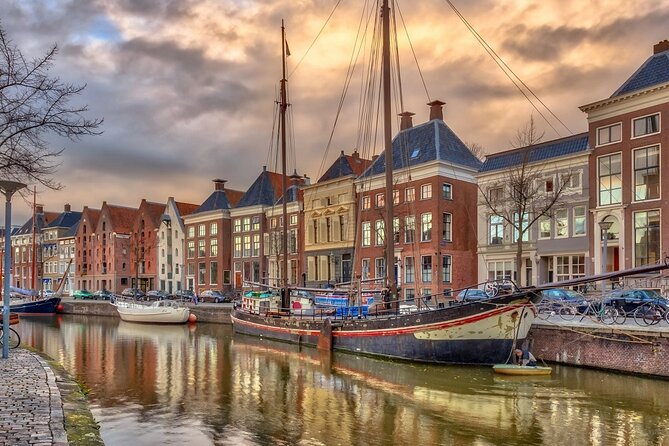
- Start at Vismarkt 56: The route begins in the former fish market, now one of central Groningen’s key squares.
- About two hours on foot: Travel time is included, so you get a compact introduction to the city center.
- Eight useful city sights: The route covers Forum Groningen, Martinikerk, Martinitoren, city hall, Goudkantoor, Pelstergasthuis, Groningen Synagogue, and Akerk.
- English audio through the Niki app: You follow GPS directions and listen as you go, without a scheduled group.
- Free access at the listed stops: The walk itself does not include paid admission, though the route does not promise entry to every interior.
- Flexible and private: Only your group participates, and the activity runs daily from 7:00 AM to 7:00 PM.
A smart first look at Groningen
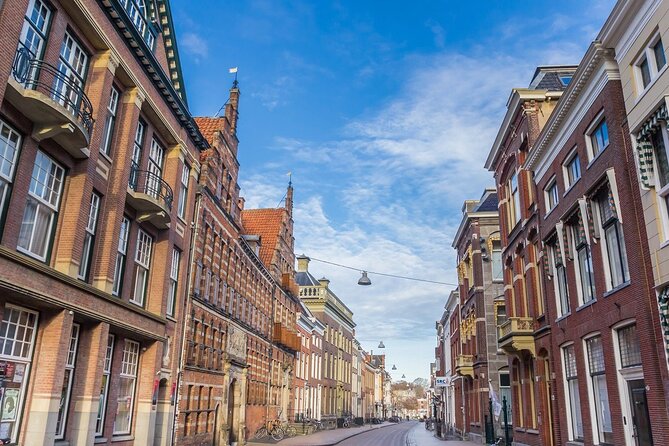
This is a city-center orientation walk, not a full museum tour or a long excursion into the surrounding province. In roughly two hours, you move between old religious buildings, civic landmarks, former charitable institutions, and modern cultural spaces.
That mix is the route’s strength. Groningen is not presented only as a university town or only as a medieval center. You get a little of both: the academic heart near the science museum, the broad Grote Markt, old churches linked to river trade, and Forum Groningen, a modern building devoted to films, exhibitions, books, games, and public events.
You start at PronkVismarkt 56, at the edge of Vismarkt. The exact meeting point matters because the route is designed around it, and the activity ends there too. You will want your phone charged and the app ready before setting off. Since this is self-guided, there is no guide to gather the group, explain a missed turn, or answer questions on the spot.
The app-based format works well for independent sightseeing. You can stop for a coffee, spend extra time in a church, or slow down when the square is busy. The trade-off is that you must pay attention to the GPS and manage your own time.
More Self-Guided Audio Tours in the Netherlands
- Lisse: Self-Guided Tulip Fields GPS Audio Tour
★ 4.6 · 83 reviews - Utrecht Scavenger Hunt and Highlights Self Guided Audio Tour
★ 4.0 · 10 reviews - Amsterdam Scavenger Hunt and Highlights Self Guided Audio Tour
★ 4.0 · 9 reviews
Vismarkt, where Groningen’s old trade center began
Vismarkt is an effective starting point because its name tells you something about its past. Fish was sold here, and the square may reflect an older Roman-style street plan, with the market intended as a central point of the town.
Today, the setting is more architectural than commercial. Look at the buildings around the square, including Vismarkt 56, before starting the audio. This first stop is brief, listed at about five minutes, so it serves mainly as an introduction to Groningen’s street pattern and trading past.
I like this opening because it immediately gives you a sense of how the city developed. You are not beginning with a generic tourist office or a distant monument. You are standing in a place shaped by everyday commerce.
The short timing also tells you something about the pace. The route expects you to keep moving, so this is not designed for a long market visit or a detailed architectural survey.
The science museum and Muurstraat
One of the early stops is Groningen’s science museum, located in the academic center of this student city since 1934. Its collection covers science, nature, and culture.
The walk does not require you to enter. If you have extra time, you can look through the collection, but the route continues calmly toward Muurstraat, one of the city’s smaller streets. That gives you a practical choice: stay with the two-hour plan, or turn the walk into a longer visit by adding the museum.
Muurstraat helps break up the larger squares. Smaller streets often make a city feel more legible, and here the transition from an academic institution to a narrow historic lane gives you a better sense of Groningen’s scale.
Forum Groningen and the view from the roof
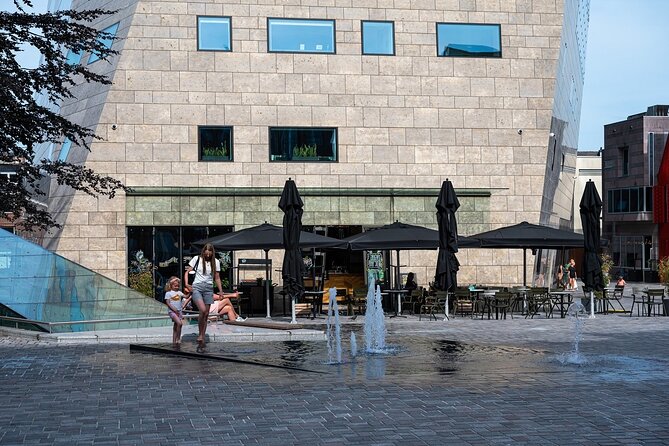
Forum Groningen is the route’s modern counterpoint. Its program covers films, exhibitions, festivals, games, books, talks, and Storyworld, so it is not simply another historic building to photograph.
Entry to the Forum is free, and you can go inside and visit the roof for a view across the city. That is one of the most useful practical suggestions in the walk. A high view can help you understand Groningen’s compact center before you continue through it.
The stop is timed at about 15 minutes, though the building can easily claim more of your day if an exhibition or event catches your attention. If your schedule is tight, use the roof as the priority. If you have time to spare, the interior gives the walk a change of pace.
I especially like this stop because it prevents the route from becoming a parade of old masonry. The Forum shows how Groningen connects its historic core with current public culture.
Another self-paced route in the Netherlands:
- Amsterdam: 75 Minute City Canal Cruise with Audio Guide
★ 4.4 · 19,938 reviews - Amsterdam: City Centre Canal Cruise including Audioguide
★ 4.3 · 16,901 reviews - Amsterdam: Royal Palace Entry Ticket + Audio guide
★ 4.6 · 7,889 reviews - Amsterdam: Heated Canal Cruise Including Audioguide
★ 4.2 · 2,773 reviews
Martinikerk and the city’s oldest church tradition
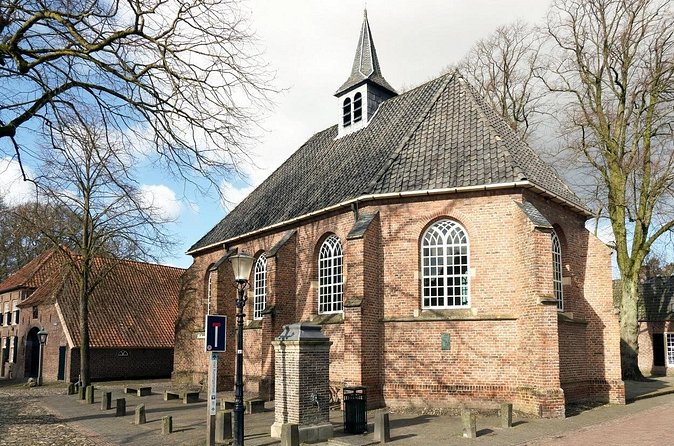
The route then turns to Martinikerk, identified as Groningen’s oldest church. Its story begins around the year 1000, when a stone church made of tuff stood at Martinikerkhof.
Around 1220, a larger Romanesque church replaced it. You can still see traces of that building in the round windows and recessed decorative brick panels on the north and south walls of the nave. These details are easy to miss if you only look for a grand facade, so the audio explanation is useful here.
The church continued to grow in the 15th century, when Groningen enjoyed a strong economic period. The earlier cruciform structure gradually developed into the church you see now.
The route allows about five minutes at several of these historic stops. That is enough for an outside look and a quick interior visit if the doors are open, but not enough for a slow examination of the building. If Martinikerk interests you, I would plan to return after the audio walk.
Martinitoren, the old grey tower
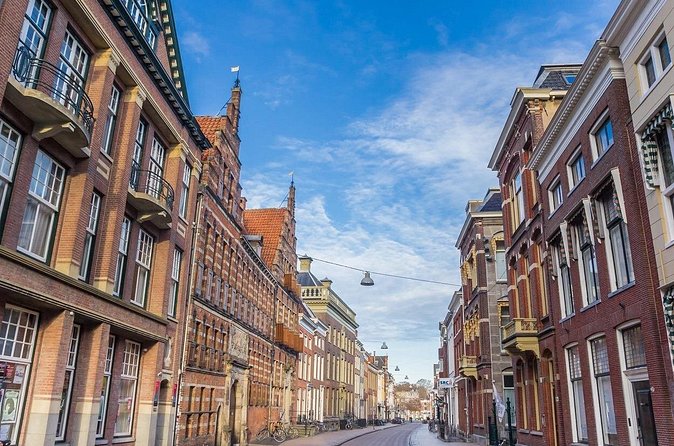
Next comes the Martinitoren, Groningen’s best-known and highest tower. Locals call it D’Olle Grieze, or the old grey one, a fitting nickname for a structure that has survived repeated trouble.
The current tower was not the first on this site. An earlier 13th-century tower rose about 30 meters before lightning destroyed it in 1408. A second tower, built after the church was expanded in Gothic style, reached about 45 meters but collapsed in 1468 after fire and lightning damage.
That history gives the tower more weight than a simple photo stop. You are looking at a city symbol shaped by rebuilding, fire, and changing styles.
The supplied experience does not state that tower admission is included, so do not assume the walk provides access to the top. The confirmed viewpoint is the roof of Forum Groningen. If you want to climb the Martinitoren, check separately before planning your day.
Grote Markt and the city hall
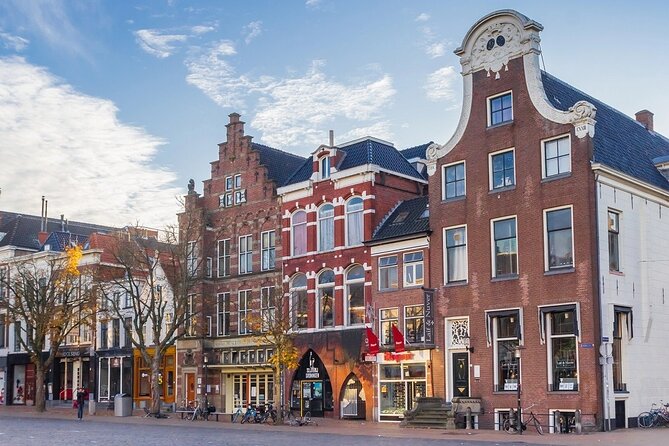
The walk continues to Groningen’s city hall in Grote Markt. The building has served as the center of local government for more than two centuries, though the original plan took time to complete.
An architectural competition in 1774 produced the winning design by Jacob Otten Husly. Money problems and the arrival of French troops delayed the work, and the town hall was not ready for use until 1810.
Its Dutch classicist, or neoclassical, design makes it an important civic building rather than just another square facade. It was fully renovated between 2020 and 2022, so the building you see reflects both its original design and recent care.
I like the way this stop shifts attention from church power to local democracy. It also places the building in the middle of Grote Markt, where you can compare the city hall with the surrounding streets and public space.
Goudkantoor and the business of collecting taxes
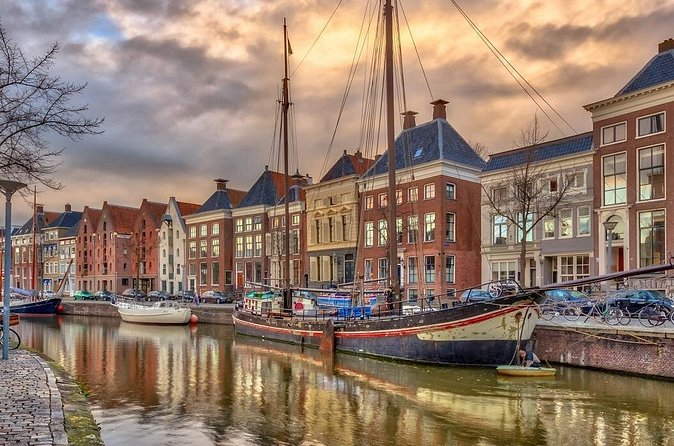
Near the central square is an especially handsome Renaissance building from 1635. It was built for the province as a tax office, a reminder that impressive architecture has often been connected to practical administration.
The Latin inscription on the facade refers to giving the emperor what belongs to the emperor. The building later became known as Goudkantoor because an office dealing with guarantees for gold and silver works occupied the upper floor from 1814 to 1887.
Ownership was disputed between the city and province after French rule ended in 1814. In 1843, the building was repaired, and the provincial coats of arms on the facade were replaced by city arms.
This is exactly the sort of detail that makes a short audio route worthwhile. Without explanation, you might admire the Renaissance facade and walk on. With the story, you see a building tied to taxes, ownership, precious metals, and changing authority.
Pelstergasthuis, a quiet piece of medieval care
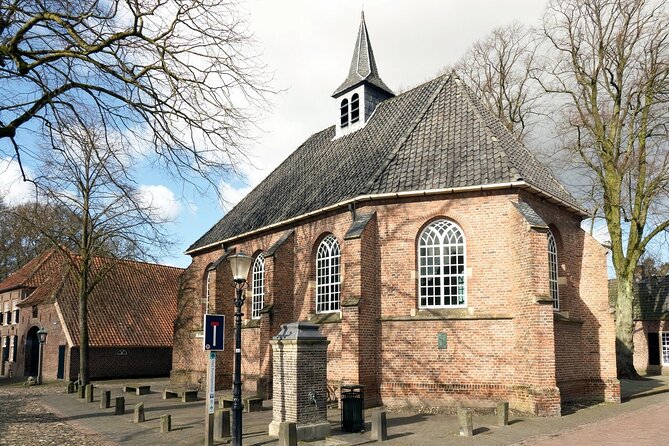
Pelstergasthuis is one of the most distinctive stops. It is Groningen’s oldest guesthouse, probably dating from the 13th century, and it was the city’s only guesthouse until 1342.
The site was first recorded in 1267, when Pope Clement IV permitted a chapel and cemetery to be built there. The buildings now visible come from several periods between the 14th and 19th centuries.
The church is the oldest surviving part of the guesthouse, and the interior contains Groningen’s oldest bell, dated 1459. You are invited to look inside, though access can depend on opening conditions at the time of your visit.
This stop gives the route a human scale. The grand church and tower explain public power, while Pelstergasthuis points to care for people who needed shelter. It is also a welcome pause from the larger central squares.
The listed visit takes about five minutes. I would not rush it. Even a short look at the courtyard or church can make this one of the more memorable parts of the walk.
Groningen Synagogue and Folkingestraat
The synagogue brings a different layer of Groningen’s past. The earlier synagogue had served the Jewish community since 1756 in Kleine Folkingestraat, also called Jodenstraatje.
The present building was designed in 1903 by architect Kuipers. Although he had designed many churches, he had limited experience with synagogues, so he traveled through Germany for ideas. The Moorish or Oriental style he saw there influenced the building’s dome and horseshoe arches.
The design reflects an era when German Jewish communities used Oriental forms to express a sense of Jewish identity in synagogue architecture. That context makes the building more than a decorative stop.
The route allows about five minutes here. You can appreciate the dome, arches, and street setting, but do not assume that a full interior visit is part of the activity. The confirmed format is an outdoor audio walk with free admission at the listed sights.
Akerk and the river A
The final major stop is Akerk, an approximately 800-year-old church linked to the river A. Around 1200, a chapel was built on the river’s eastern bank, and it grew into a large basilica dedicated to Saint Nicholas, the patron saint of sailors.
That dedication makes sense in a city where the river supported trade. The church was first recorded in writing in 1246 and was enlarged during the 15th century. By about 1495, it had largely taken the form you see today.
The Akerk began as a Catholic church but passed to Protestant use during the Reformation in 1594. Catholic decorations were removed, and Protestant services continued there until 1970.
The building remains connected to city life, which is a useful note to end on. After several stops focused on origins and past changes, Akerk shows how an old church can continue to matter within an active urban center.
What $8.41 really buys you
At $8.41 per person, this is inexpensive for a two-hour introduction to central Groningen. You are paying for a prepared route, GPS guidance, and English audio rather than a live person’s time.
That makes the value strongest for first-time visitors who want structure but dislike fixed group schedules. The price also works well if you have only a short stay and want the main sights connected into one walk.
The value is weaker if you expect detailed access to every building, personal recommendations, or conversation with a local guide. The walk gives you context, but your phone remains the guide.
The activity is private in the sense that only your group participates. That does not mean you receive a personal guide. It means you can walk without joining other groups, at your own pace, during the stated daily hours.
Practical details before you set out
The experience is offered in English and runs Monday through Sunday from 7:00 AM to 7:00 PM. The advertised duration is about two hours, with travel time already included.
You begin at PronkVismarkt 56, 9711 KV Groningen, and return to that same meeting point. The route is near public transportation, and service animals are allowed. Most people can take part, though you should remember that it is a walking activity through an active city center.
Free cancellation is available if you cancel at least 24 hours before the start time. Changes or cancellations inside that 24-hour window are not accepted for a refund.
The experience is generally booked about eight days ahead, so a little advance planning is sensible if your dates are fixed. Still, its daily operating hours and flexible format make it easier to fit around a museum visit or train arrival than a fixed morning tour.
Who should book this walk?
I would choose this for an independent visitor who wants a clear route through Groningen’s historic core without spending much. It suits couples, families with older children, and small private groups who prefer to pause when something catches their eye.
It is also a good first activity after arriving in the city. The route introduces the main squares, the Martinikerk and Martinitoren, the synagogue, two important churches, and the Forum. Afterward, you will know which buildings deserve a longer return visit.
I would hesitate if you want a highly personal history lesson or guaranteed access inside every church. The audio format cannot adjust its explanation to your questions, and the short stop times favor an overview.
Should you book it?
Book this walk if you want an affordable, flexible orientation to Groningen with enough history to make the streets meaningful. The best parts are the contrast between old and new, the story-filled Pelstergasthuis, and the chance to see the city’s churches and civic buildings in one compact route.
Skip it if you already know central Groningen well or want a live guide who can respond to your interests. For a first visit, though, $8.41 is a modest price for two hours of useful context, a practical route, and the freedom to explore at your own speed.
FAQ
How long does the Groningen audio tour take?
The tour takes approximately two hours, and travel time is already included in that estimate.
Where does the activity begin and end?
It begins at PronkVismarkt 56, 9711 KV Groningen, Netherlands, and ends back at the same meeting point.
Is the tour offered in English?
Yes. The experience is offered in English through the self-guided GPS and audio format.
Is this a private tour?
Yes. Only your group participates. It is self-guided, so no live guide is listed.
Are admission tickets included?
The listed stops show free admission, but the activity does not state that paid entry to other attractions or special exhibits is included. Forum Groningen can be visited for free, including its roof.
Can I cancel for a full refund?
Yes, if you cancel at least 24 hours before the experience start time. Cancellations or changes made less than 24 hours before the start time are not accepted for a refund.
Latest audio tours in the Netherlands
- Rotterdam Scavenger Hunt and Highlights Self Guided Audio Tour★ 4.5 · 4 reviews
- Hattem’s Windmills, Bakeries and Ghosts: A Self-Guided Audio Tour★ 3.5 · 3 reviews
- Zwolle: City Walk with Audio Guide in 7 Languages on your Phone★ 3.5 · 3 reviews
- Amersfoort City Walk with Audio Guide in 7 Languages★ 3.0 · 3 reviews
- Maastricht Scavenger Hunt and Highlights Self Guided Audio Tour★ 4.5 · 2 reviews
- Explore Highlights of Haarlem: Self-Guided GPS and Audio Tour★ 4.0 · 2 reviews
- Explore Gouda with Self-Guided GPS and Audio Tour★ 4.0 · 2 reviews
- Den Bosch: City Walk Audio Guide in 7 Languages on your Phone★ 5.0 · 2 reviews
Self-Guided Audio Tours, compared.

Acropolis Ticket & Optional Self-Guided Audio Tours
Read our review →


Ultimate Acadia National Park Self-Guided Driving Audio Tour
Read our review →

Akrotiri Ticket with Optional Self-Guided Audios
Read our review →
Browse the lists this tour appears in