
Reviewed · NETHERLANDS
Explore Gouda with Self-Guided GPS and Audio Tour
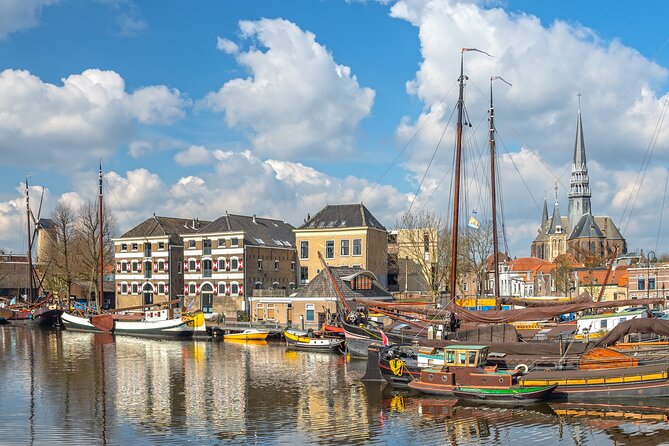
Gouda packs a lot into a small walk: a grand medieval town hall, canals winding through the old center, cheese-making stories, quiet courtyards, and one very long church. I like that this two-hour GPS audio tour gives you a clear route without tying you to a guide or group schedule. I also like the low price, $8.32 per person, which makes it an easy way to add Gouda to a Dutch rail trip.
The main caution is the technology. GPS can drift, and one recorded walk occasionally sent the user slightly off course. You can correct that easily in central Gouda, but keep your phone charged and pay attention at turns. This is best for an independent visitor who enjoys setting the pace, not for someone seeking live conversation or detailed questions answered on the spot.
Key points at a glance
- Begin at Gouda Station: The walk starts at Stationsplein 11, making it simple to reach by public transport.
- Follow the cheese story: The route connects Gouda’s famous cheese trade with the Waag and the historic market.
- Hear the city in your language: GPS triggers spoken information and directions as you reach each point.
- See more than the market square: Canals, St. John’s Church, Museum Gouda, a historic courtyard, ships, and Admiral’s House fill out the route.
- Plan on about two hours: Travel time is already included, and the walk finishes back at the starting point.
- Expect a private, self-guided outing: Only your group takes part, but there is no named live guide provided.
Starting at Gouda Station and finding your bearings

Your walk begins at Gouda Station, at Stationsplein 11. That is a useful starting point because you can arrive by train and begin without arranging a separate meeting point in the old center. The route ends back at the same meeting point, so you do not need to work out a return journey from an unfamiliar part of town.
The GPS system is meant to tell you where to go and when to listen. It also provides spoken information in your chosen language, though the available language options are not specified in the supplied details. You should check those options before booking if language choice matters to you.
I would give yourself a moment at the start to open the tour, confirm the route, and make sure your phone can receive GPS signals. The walk is about two hours, with travel time already included. That makes it a manageable morning or afternoon activity rather than an all-day commitment.
Because the tour is self-guided, you can pause when you like. You might stop for a photograph, spend more time near the market, or shorten your visit at a particular point. The trade-off is that nobody is there to fix a wrong turn immediately. A previous user found that the GPS wandered a little, but also found the route easy enough to recover.
More Self-Guided Audio Tours in the Netherlands
- Lisse: Self-Guided Tulip Fields GPS Audio Tour
★ 4.6 · 83 reviews - Utrecht Scavenger Hunt and Highlights Self Guided Audio Tour
★ 4.0 · 10 reviews - Amsterdam’s Red Light District: A Self-Guided Audio Tour
★ 4.5 · 9 reviews
Gouda’s town hall and the medieval market
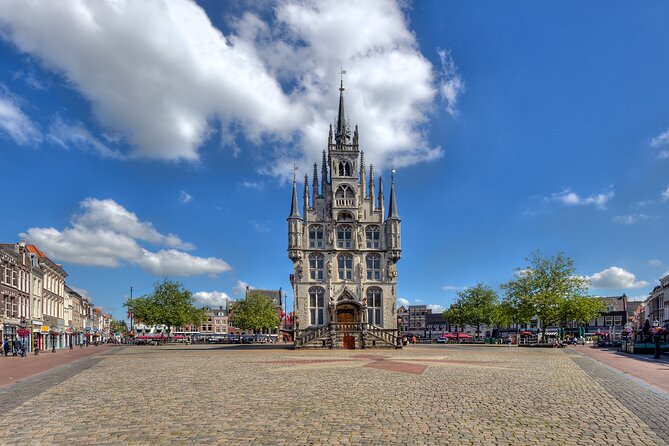
The first major sight is Gouda’s town hall, a huge fifteenth-century building dating from around 1450. It sits prominently on the Markt, the historic market square, where its size and position make it hard to miss.
This is a strong opening stop because it puts Gouda’s civic story in front of you at once. The building was created when the city council wanted a prominent home in the heart of town. Look at it as more than a pretty façade. Its location tells you how important the market was to local government, trade, and daily life.
The tour returns to the town hall later in the route. That may serve as a closing point or repeat the information as the walk loops through the center. Either way, the repeated sight helps you understand the Markt as the city’s main anchor.
The supplied details do not say that the tour includes entry inside the town hall. Plan on viewing the exterior unless the audio instructions tell you otherwise. The most useful part here is the setting: the town hall, market square, and nearby cheese buildings belong to the same civic and commercial story.
Canals and Gouda’s older street plan
From the market area, the walk takes you into Gouda’s winding streets and along the Gouwe, the waterway that runs through the city. The route presents Gouda as a settlement that grew along a riverbank during the Middle Ages.
This section should appeal to you if you prefer seeing how a city works rather than simply checking off famous buildings. The canals explain why Gouda developed where it did. Water supported movement, trade, and the growth of the town, while the narrow streets preserve the shape of an older center.
The audio format has a clear advantage here. A canal can look like a pleasant bit of scenery, but the spoken story helps connect it to Gouda’s beginnings. You can keep walking while listening instead of stopping to read a long panel.
Still, GPS is less exact among close buildings and twisting lanes. Keep the phone visible at turns, and do not assume the next sound cue means you should walk quickly. The point of this part is the street pattern itself, so take your time and check your position if the directions seem uncertain.
Gouda cheese, the Waag, and a famous name
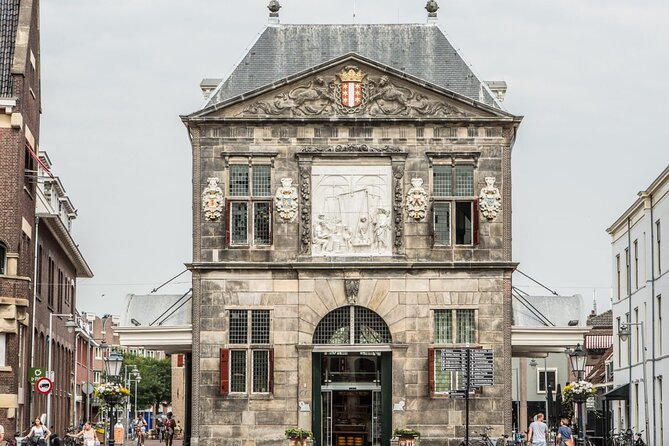
Gouda and cheese are closely linked, and this walk gives the subject several stops rather than treating it as a passing photo opportunity. You hear the story behind Gouda cheese and visit the Waag, the historic weighing house connected with the city’s cheese market.
For centuries, farmers from the surrounding area brought cheese to Gouda by horse-drawn cart. The market was held at the Waag, where the cheese was traded. That detail gives the city’s famous name some weight. Gouda cheese was not simply named after a place that happened to be nearby. The town was an important trading point for the product.
I like this part because it connects a familiar food to an actual urban setting. When you see the Waag and the market square, you can picture the commercial role these spaces once played. You also get a better sense of why Gouda became known around the world for cheese.
The tour information does not promise a tasting, a cheese-making demonstration, or entry into a cheese shop. Book this for the story and the buildings, not for a guaranteed food experience. You can always add your own cheese stop in town, but that would be separate from the recorded walk.
Another self-paced route in the Netherlands:
- Amsterdam: 75 Minute City Canal Cruise with Audio Guide
★ 4.4 · 19,938 reviews - Amsterdam: City Centre Canal Cruise including Audioguide
★ 4.3 · 16,901 reviews - Amsterdam: Royal Palace Entry Ticket + Audio guide
★ 4.6 · 7,889 reviews - Amsterdam: Heated Canal Cruise Including Audioguide
★ 4.2 · 2,773 reviews
St. John’s Church and its remarkable glass
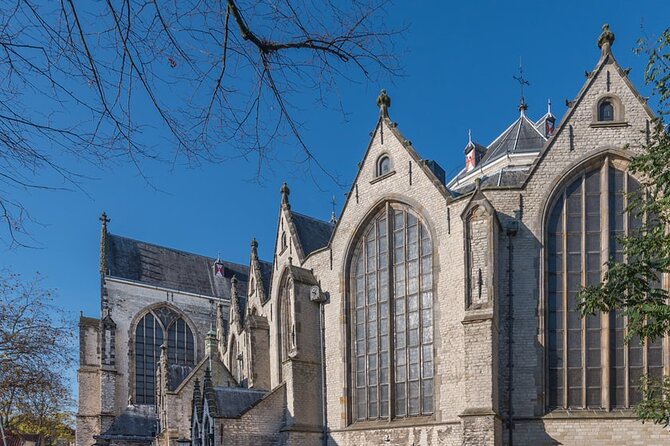
St. John’s Church is dedicated to John the Baptist, Gouda’s patron saint. Its symbolic colors are white, linked with purity and love, and red, linked with suffering. Those colors appear repeatedly in the church’s stained-glass windows.
This is one of the route’s most important cultural stops. The audio explains the meaning behind what you are seeing, which matters in a church filled with visual detail. Without context, stained glass can become a blur of color. With a little background, you can look for repeated symbols and understand why the windows were designed that way.
The supplied information does not say whether admission inside the church is included or guaranteed. Check the current opening conditions before relying on an interior visit. If the church is accessible during your walk, allow enough time to look carefully rather than treating it as a quick waypoint.
The church also gives the tour a welcome change of pace. After market activity and canals, you move into a place shaped by worship, symbolism, and craftsmanship. It is a good example of how the walk goes beyond Gouda’s cheese reputation.
Museum Gouda and the city’s changing collections
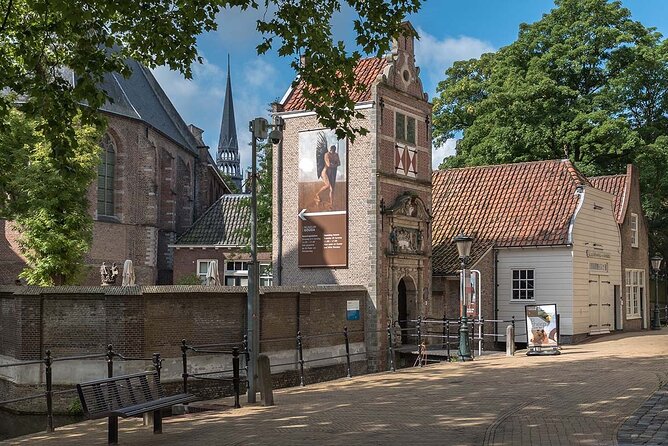
Museum Gouda began in 1874 as the Municipal Museum of Gouda. It first occupied the Arti Legi building on the Markt, and in 1947 its collection moved to the Catharina Gasthuis.
That movement tells you something useful about the city’s cultural development. The museum is not presented simply as a modern attraction. Its own locations are part of Gouda’s story, and the tour places it among the town hall, church, and market sites that shaped civic life.
The route appears to focus on the museum’s setting and background rather than promising a full museum visit. The supplied details do not include admission, opening times, or the size of the collection you can see during the walk. If you want to go inside, treat that as a separate plan and check the current schedule.
For a two-hour walk, the museum stop is valuable even if you only view the exterior. It adds a layer of art and public culture to a route that could otherwise lean heavily toward architecture and cheese.
Swanenburghshofje, a quiet courtyard stop
The Swanenburghshofje offers a look at a different side of Gouda. Its story begins in 1689, when Elisabeth Nathans Bars, the widow of timber merchant Noach Cornelisz Swanenburgh, established the courtyard.
A hofje is a group of homes arranged around a shared courtyard. The route’s details focus on the courtyard’s origins and its connection to a local benefactor. This gives you a glimpse of private charity and community life, away from the grand public buildings of the Markt.
I especially like having a stop like this in the route. A town hall tells you about government, and a market tells you about trade. A courtyard tells you about how people lived and how one person’s wealth could support a small residential community.
Please be respectful here. The information provided does not say that the courtyard is always open for unrestricted entry, and it may still function as a residential place. Follow the audio directions, observe any signs, and do not treat a quiet courtyard as a public stage.
Museum Port of Gouda and historic inland ships
The Museum Port of Gouda, located in the city center, focuses on historic transport ships. Many of the vessels date from around 1900 and were designed for sailing on inland waterways.
This stop ties neatly back to the Gouwe and Gouda’s position as a trading town. The canals were not just attractive water features. They formed part of a working transport network, and these ships help you picture the goods and people that moved through the area.
The port also broadens the route’s subject matter. You are not only seeing churches, civic buildings, and cheese markets. You are seeing the practical machinery of local commerce. For anyone interested in boats, engineering, or Dutch waterways, this may be one of the most satisfying stops.
The details do not confirm that the tour includes boarding the ships or entering a museum building. Think of it as a chance to see the historic vessels and hear their place in Gouda’s transport story. A separate admission may apply if you want more than the outdoor audio stop.
Admiral’s House and Gouda’s narrow townhouses
Admiral’s House is a high, narrow home with an unusually fine rococo interior. Its building history can be traced back as far as the fourteenth century, with later changes to both the structure and interior.
The house is a good reminder that Gouda’s story is not limited to public monuments. Private homes can show wealth, taste, and social position just as clearly as a town hall. The narrow form also fits the character of an old Dutch city, where buildings rise within compact plots along busy streets and waterways.
The route information does not say that you enter Admiral’s House. You should expect an exterior stop with audio context unless access is specifically available on the day. Even from outside, its height and decorative character make it a worthwhile pause.
This is the kind of stop that rewards close looking. Notice the proportions, the decorative details, and the way the home fits into the older street. You get more from it if you slow down instead of listening while rushing to the next point.
Is $8.32 good value for two hours?
At $8.32 per person, this is inexpensive for a private, self-guided city walk. You are paying for the GPS route and recorded commentary, not a live guide, meal, museum entry, or transport ticket. That distinction matters when comparing it with a traditional guided tour.
I see the best value here in the route design. Gouda’s center is compact, but the sights cover different subjects: government, waterways, cheese, religion, charity, shipping, and domestic architecture. Finding all of those points yourself would take extra planning.
The low price also reduces the risk of trying it. If you have a free afternoon in Gouda, this can give structure to your visit without taking over your day. The main thing you give up is live interaction. You cannot ask the audio guide to explain a detail, change the route, or suggest a nearby café.
The average booking lead time is 19 days. That may help you plan a Dutch rail itinerary, but there is no need to assume you must book far in advance based on that figure alone. Confirmation arrives at booking, and free cancellation is available until 24 hours before the start time. Inside that period, the payment is not refunded, and changes are not accepted.
Who should choose this Gouda walk?
I would choose this experience if you want a gentle introduction to Gouda and prefer walking independently. It suits solo visitors, couples, families, and private groups who want the same route without joining strangers.
It is also a good fit for anyone arriving by train. Starting and ending at Gouda Station keeps the plan simple, especially if Gouda is one stop on a larger Netherlands trip. Most people can participate, and service animals are allowed. The route is near public transportation, but the supplied details do not give specific information about surfaces, steps, or wheelchair access.
I would look elsewhere if your priority is a live local guide, a cheese tasting, guaranteed museum entry, or a detailed food-focused tour. You should also be comfortable using a smartphone and correcting a minor GPS error.
Should you book this self-guided Gouda tour?
Book it if you want a low-cost, private audio walk that covers much more than cheese. The town hall, canals, Waag, St. John’s Church, Museum Gouda, Swanenburghshofje, historic ships, and Admiral’s House give you a well-rounded view of the city in about two hours.
Skip it if you need a human guide or dislike phone-based directions. For everyone else, it is a practical way to get your bearings fast, hear the stories behind Gouda’s sights, and still have time afterward to explore the market or arrange your own cheese stop.
FAQ
Where does the tour start?
The tour starts at Gouda Station, Stationsplein 11, 2801 AK Gouda, Netherlands.
Where does the tour finish?
The activity ends back at the meeting point at Gouda Station.
How long does the experience take?
The tour lasts approximately two hours. Travel time is already included in the total duration.
Is this a guided group tour?
No. It is a private self-guided activity for your group only, using GPS directions and recorded audio.
Is a live guide provided?
No live guide is named or included in the supplied details. The experience uses GPS and spoken information.
Can I choose the audio language?
The tour provides information spoken in your own language, but the available language options are not specified.
What sights are included?
The route covers Gouda’s town hall, canals and the Gouwe, cheese-related sites, St. John’s Church, Museum Gouda, Swanenburghshofje, Museum Port of Gouda, the historic cheese market area, and Admiral’s House.
Is cheese tasting included?
No cheese tasting is specified. The tour explains Gouda’s cheese story and visits historic cheese-related locations.
Is the tour suitable for most people?
Most people can participate. The experience is near public transportation, and service animals are allowed. Specific details about wheelchair access are not provided.
Can I cancel for a full refund?
Yes. You can cancel at least 24 hours before the local start time for a full refund. Cancellations or changes made within 24 hours are not accepted for a refund.
Latest audio tours in the Netherlands
- Rotterdam Scavenger Hunt and Highlights Self Guided Audio Tour★ 4.5 · 4 reviews
- Hattem’s Windmills, Bakeries and Ghosts: A Self-Guided Audio Tour★ 3.5 · 3 reviews
- Zwolle: City Walk with Audio Guide in 7 Languages on your Phone★ 3.5 · 3 reviews
- Amersfoort City Walk with Audio Guide in 7 Languages★ 3.0 · 3 reviews
- Maastricht Scavenger Hunt and Highlights Self Guided Audio Tour★ 4.5 · 2 reviews
- Explore Highlights of Haarlem: Self-Guided GPS and Audio Tour★ 4.0 · 2 reviews
- Explore Groningen City with Self-Guided GPS and Audio Tour★ 3.0 · 2 reviews
- Den Bosch: City Walk Audio Guide in 7 Languages on your Phone★ 5.0 · 2 reviews
Self-Guided Audio Tours, compared.
Acropolis Ticket & Optional Self-Guided Audio Tours
Read our review →


Ultimate Acadia National Park Self-Guided Driving Audio Tour
Read our review →

Akrotiri Ticket with Optional Self-Guided Audios
Read our review →
Browse the lists this tour appears in