
Reviewed · USA
Gettysburg Battlefield Self-Guided Driving Audio Tour
Gettysburg makes more sense when you hear the battle unfold in sequence, and this self-guided drive does that well. The route follows the official battlefield road for more than 19 miles, with over 60 audio stories tied to places such as McPherson’s Ridge, Little Round Top, the Peach Orchard, and the High Water Mark. The battle becomes a moving story, not just a collection of monuments beside a road.
I like the freedom to stop for photos, pause the narration, or skip a site without waiting for a bus. I also like the value: one $16.99 purchase covers a whole car of up to four people. The main concern is the GPS app. Some people get it working at once, while others need to restart it or practice with the starting point and route before the audio stays in sync.
Key points to know before you go
- More than 19 miles of battlefield road: Allow two to four hours if you want time for stops, monuments, and short walks.
- The story follows all three days of battle: You move from the first fighting at McPherson’s Ridge to Pickett’s Charge and Lincoln’s Gettysburg Address.
- Over 60 GPS-triggered audio stories: Narration begins as you reach each location, so you can keep your phone out of your hands while driving.
- Excellent carload value: The price is per group, not per person, and the tour has lifetime access with no expiry.
- Offline use matters: Download the tour over strong Wi-Fi or cellular service before arriving at the battlefield.
- The app needs a little preparation: Start at the Heritage Center or National Park Visitor Center, follow the marked route, and keep to the suggested speed.
Why a self-guided drive fits Gettysburg
Gettysburg is too large for a quick walk around a single monument. The battlefield spreads across open fields, wooded hills, farms, ridges, towers, and memorial avenues. A car lets you cover the ground without wearing yourself out, while the audio gives meaning to the places passing outside your window.
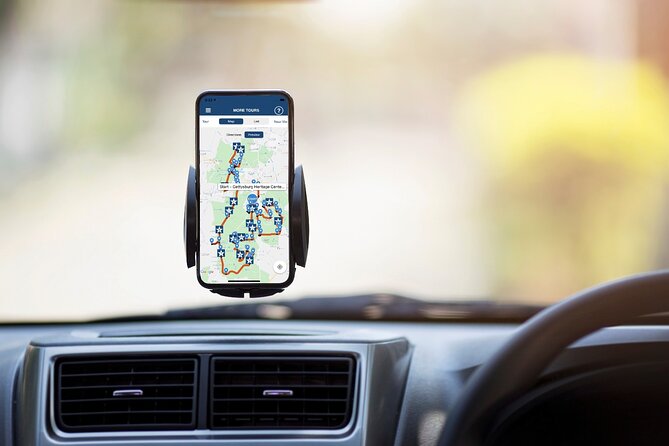
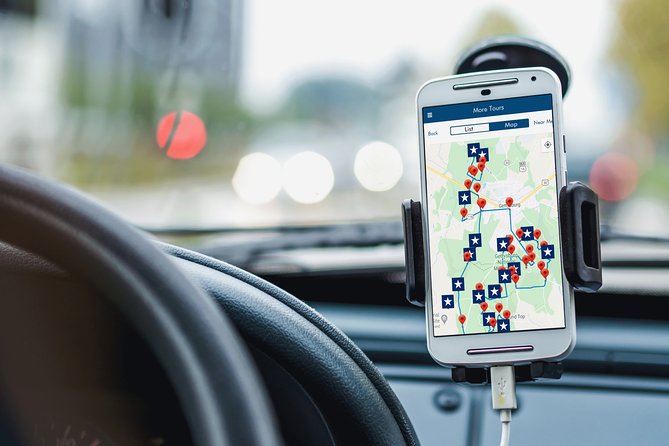
This is not a tour with a guide sitting beside you. You download Action’s Tour Guide app, enter the password sent by email and text, and start the experience at the designated point. GPS triggers each chapter as you approach it. The system is designed to let you listen while driving, then pull over when a stop deserves a closer look.
That format works especially well for families, couples, and small groups who do not want to match a bus schedule. You decide how long to spend at the Pennsylvania Memorial or whether to take the optional Eisenhower National Historic Site detour. You can also pause for lunch, return to a favorite section, or split the drive over more than one day.
The tradeoff is that you are responsible for the technology and navigation. Download the tour before you arrive. Give the app location permission. Connect your phone to the car stereo with Bluetooth, USB, or AUX if you want everyone to hear. The app supports Apple CarPlay for audio playback, but map display and Android Auto support are still listed as upcoming features.
More Self-Guided Audio Tours in the USA
- Joshua Tree National Park Self-Guided Driving Audio Tour
★ 4.5 · 762 reviews - Ultimate Acadia National Park Self-Guided Driving Audio Tour
★ 4.0 · 521 reviews - Ultimate Lake Tahoe Self-Guided Driving Audio Tour
★ 4.5 · 435 reviews
Starting at the Heritage Center and first-day fighting
The experience begins at the Gettysburg Heritage Center parking area on Steinwehr Avenue, or at the National Park Visitor Center if that better suits your plans. The Heritage Center Museum is a useful opening stop because it gives you a chance to get oriented before the battlefield route begins. Admission to the museum is not included, so treat it as an optional extra rather than part of the $16.99 tour.
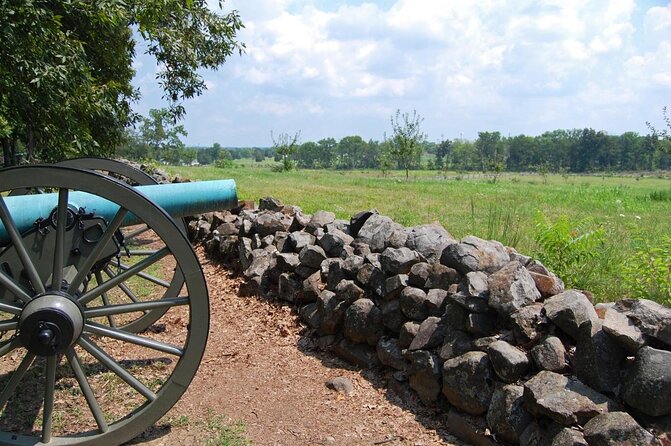
From there, the route follows the official Auto Tour road. The first chapters explain the opening morning of July 1 at McPherson’s Ridge, where Union and Confederate forces collided and commanders moved regiments into place. This is a good place to pay attention to the shape of the ground. The ridge and open views help you picture why troop positions mattered.
Next comes the Railroad Cut, the site of a major first-day clash. The narration shifts from broad troop movements to the decisions made by officers on both sides. Gettysburg can feel abstract when you only read monument names. Audio tied to the exact ground helps connect those names to action.
The Eternal Light Peace Memorial introduces the long meaning of the battle. Its Maine granite base and Alabama limestone pillar symbolize the reunification of North and South. That detail gives the memorial more weight than a quick roadside glance.
At Oak Ridge Observation Tower, you can look over the first day’s fighting from above. The tower offers one of the better panoramic views along this opening section, though the supplied tour information does not guarantee tower access at every visit. Check conditions when you arrive, and do not plan your timing around the climb alone.
The 11th Pennsylvania Volunteer Infantry Monument brings in a memorable personal detail: Battlefield Sallie, the regiment’s dog mascot, is sculpted at the base. The narration also explains the role of drummers and military music, a welcome change from a route made up only of generals and battle plans.
The first-day section closes with evening strategy and the question facing the Union after heavy losses and lost ground. That pause in the story matters. You are not simply moving from point A to point B. The route explains how one day’s result shaped the decisions made after dark.
North Carolina, Virginia, and the opening of day two
The route continues past the North Carolina Memorial and Virginia Monument, two large memorials that reflect the scale of participation in the battle. The tour does not ask you to stop at every monument, which keeps the drive moving, but you can pause whenever a site catches your eye.
At Auto Tour Stop 5, the narration turns to the second day. This location later connects to Pickett’s Charge, but the tour saves that famous story for the proper point in the sequence. That choice helps keep the chronology clear. You first learn how both armies organized and prepared before hearing about the final assault.
The Longstreet Observation Tower provides another high viewpoint over the battlefield. You will hear about the second day while looking across the ground where Confederate and Union plans collided. The value here is not just the view. It is the chance to match the spoken account with the ridges, fields, and distances in front of you.
The Eisenhower National Historic Site is an optional detour. The home overlooks the battlefield and was often used by President Eisenhower. Since it sits off the main Auto Tour road, you should allow extra time if you want to include it. The self-guided format makes that choice easy, but the stop is not necessary to complete the main route.
Little Round Top, Devil’s Den, and the hardest ground
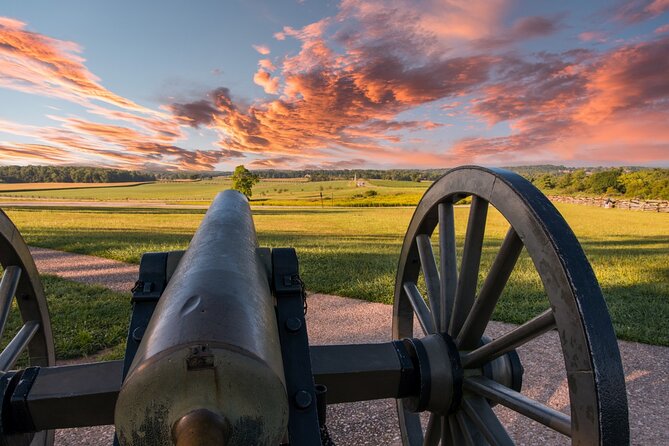
Warfield Ridge sets up one of the key struggles of the second day. Confederate troops prepared to attack a Union position defended in part by specially trained marksmen. From here, the narration leads you toward Little Round Top, where Union soldiers held a strategic hill by a narrow margin.
Little Round Top is one of the best-known places on the battlefield, but its importance can be hard to grasp from a quick photo stop. The audio explains why control of the hill mattered and how the fighting affected the wider Union line. The drive also passes through the Valley of Death, a name that gives you a blunt sense of the violence of the ground.
Nearby Devil’s Den adds another layer. Confederate sharpshooters used the volcanic rocks for cover, firing at Union soldiers from protected positions. The rocks make this stop particularly visual. You can see how natural features shaped the tactics, rather than treating the fighting as something that happened on a flat diagram.
Construction at Little Round Top is an important practical point. The supplied information says you can still experience the site through narration and photographs while work is underway, but access and views may change. If the area is restricted on your visit, do not assume the tour has failed. The audio still provides the story, and the rest of the route remains available.
The Wheat Fields and Peach Orchard continue the second-day account. The Wheat Fields saw another major clash, while the Peach Orchard became a key point in the unfolding battle. These stops reward patience. If you rush through the audio, you may hear the basic sequence but miss why each position mattered.
At the Abraham Trostle Farm, the story becomes personal. The family fled so quickly that dinner remained on the table. That small detail gives you a sharper sense of how suddenly civilians were forced out of their homes.
The route then passes Plum Run and the George Weikert Farm. The Weikert property was turned into a battlefield hospital after the family evacuated. Here the narration shifts from troop movement to military medicine and the effects of war on ordinary farms. I find these civilian and medical details important because they keep Gettysburg from becoming only a story of commanders and maneuvers.
More Driving Audio Tours in the USA
- Scenic Newport, RI Self-Guided Driving Audio Tour
★ 4.5 · 325 reviews - Arches National Park Self-Guided Driving Audio Tour
★ 4.5 · 288 reviews - Yellowstone National Park Self-Guided Driving Audio Tour
★ 4.5 · 249 reviews - Palm Springs Self-Guided Driving Audio Tour
★ 4.0 · 211 reviews
Pennsylvania’s monument and the close of day two
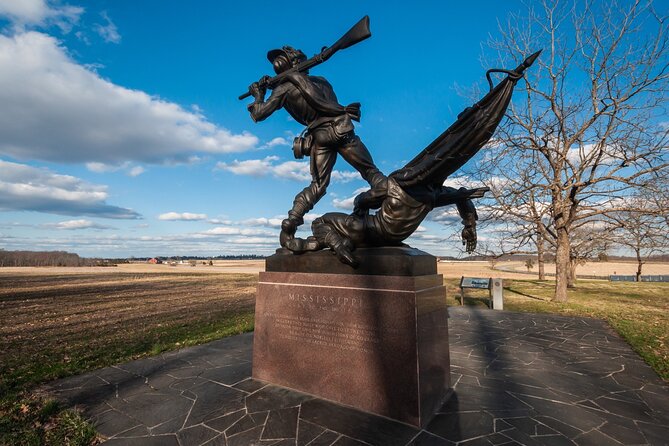
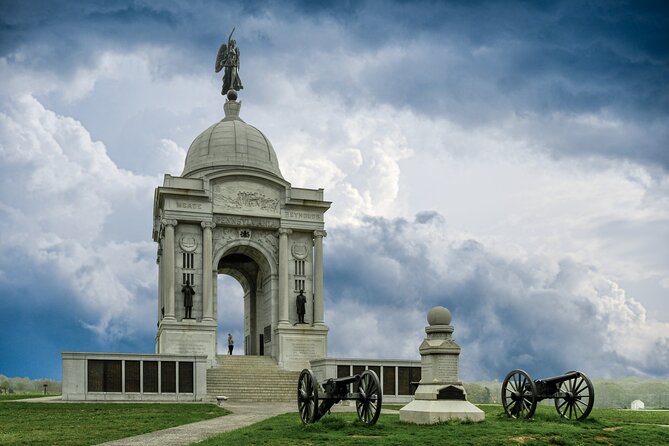
The Pennsylvania Memorial honors nearly 35,000 Pennsylvania soldiers who fought at Gettysburg. The monument carries special force because Pennsylvania was not a distant place for these men. The battle came to their state, and they were defending home ground as well as a national cause.
Spangler’s Spring is a smaller location, but the tour gives it room in the sequence. From there, you continue toward Culp’s Hill Tower, where Union and Confederate forces fought for control of another strategic position. The Union held the hill until evening, an outcome that shaped the night ahead.
East Cemetery Hill brings the second day to a tense close. The Confederate attempt to raid the hill after dark came close to breaking the Union position. The narration explains how persistence, skill, and luck helped the Union hold.
This part of the route shows why a self-guided format can be better than a rushed group schedule. You can stop at the monuments, read inscriptions, and replay a chapter if the battle movement is hard to follow. You are also free to keep driving if the children in your car have reached their limit.
Pickett’s Charge and the National Cemetery

The final day begins at Gettysburg National Military Park, where the tour frames the battle as the end of General Robert E. Lee’s second invasion of the North. Gettysburg became known as the High Water Mark of the Rebellion, and the battle later inspired Abraham Lincoln’s Gettysburg Address.
At Auto Tour Stop 15, the route explains Pickett’s Charge. From the top of the hill, you look across the open ground crossed by Confederate troops toward the Union defenses. The audio identifies the High Water Mark, the farthest point reached by the Confederate advance.
This is one of the moments when the car tour works best. You can hear the narration, look across the distance, then pull over and take in the scale of the field. A map can show the route of an assault, but standing at the edge of that open space gives you a better sense of how exposed the soldiers were.
The final stop is the National Cemetery on Taneytown Road. The tour ends among the graves of Union soldiers and at the place connected with Lincoln’s Gettysburg Address. Lincoln was expected to give a long speech, but he kept his remarks brief because he believed the soldiers’ sacrifice deserved the attention.
The ending is quiet and fitting. After hours of troop movements, monuments, farms, and fighting, the route finishes with the human cost of the battle rather than another military position.
Price, timing, and what you actually get
At $16.99 per group of up to four, this is one of the least expensive ways to add structure to a Gettysburg visit. A family of four pays less than $4.25 per person, and a couple still gets a full route for under $9 per person. The comparison is not only about price. You also avoid being locked into someone else’s departure time.
The full route takes roughly two to four hours. The drive itself is described as about one to two hours, but that shorter estimate does not allow much time for monuments, towers, photos, or the Heritage Center. I would plan on at least three hours if this is your main Gettysburg activity, and longer if you want the optional Eisenhower stop.
You receive lifetime access with no expiry, so you can use the tour again on another trip or repeat only the sections you missed. That is useful if you are staying in the area for several days. The audio is in English only.
The tour includes offline maps and automatic audio playback, but it does not include attraction admission, reservations, or museum tickets. That keeps the base price low, though you should budget separately for any paid attraction you choose to visit.
App tips that can save your morning

Set up the app before you reach the battlefield. Search your email and text messages for the audio tour instructions, download Action’s separate app, and enter the supplied password while you have a strong connection.
At the starting point, open the correct tour version if more than one appears. The first story should begin when you reach its location. Follow the route and speed limit closely, since the GPS system depends on your position and direction.
If the audio does not begin, check the starting point rather than driving far ahead. A few people have needed to restart the tour or try the opening sequence again. The most useful habit is to practice with the app before setting off, especially if you have never used a GPS-triggered audio guide.
Keep the phone where the driver will not need to handle it. Connect the sound to the car stereo, and let the passenger manage pauses or extra chapters. The tour is private, so only your own group takes part.
Who should book this Gettysburg tour?
I would choose this for independent visitors who want historical structure without a fixed group schedule. It is a strong fit for families, older adults who prefer to see the battlefield by car, couples, and anyone making a return visit who wants to focus on specific sections.
It also suits people who enjoy small details. Battlefield Sallie, the Trostle family dinner, the field hospital at the Weikert Farm, and the symbolic stones of the Peace Memorial give the route personality beyond troop names and dates.
I would think twice if you dislike phone-based tours or want a live guide who can answer questions as you go. GPS performance may require patience, and the app can feel awkward until you learn how its chapters trigger.
Should you book it?
Book it if you want an affordable, private, flexible way to cover Gettysburg’s main battlefield route. The narration follows the three days of fighting in a clear order, and the ability to pause at Little Round Top, the Peach Orchard, or the National Cemetery gives you time to look and think.
Skip it only if you need a live guide or do not want to prepare an app before arriving. Download everything in advance, start at the correct point, and allow more than two hours if you plan to stop. For most small groups, the low price and repeat access make this a practical way to put the battlefield into context.
FAQ
Where does the Gettysburg self-guided driving tour start?
You can start at the Gettysburg Heritage Center parking lot at 297 Steinwehr Avenue, or at the National Park Visitor Center. The audio begins when you reach the first story point.
Where does the tour end?
The route ends at the National Cemetery at 125 Taneytown Road, near the site associated with Lincoln’s Gettysburg Address.
How long does the driving tour take?
The route covers more than 19 miles. The drive can take about one to two hours, while the full experience usually takes two to four hours depending on stops, photos, and optional detours.
How much does the tour cost?
The price is $16.99 per group of up to four people. You purchase one tour for the car rather than paying separately for each person.
Is the tour available offline?
Yes. Download the tour while you have strong Wi-Fi or cellular service. After that, the audio and offline maps can be used without a signal.
What phone and audio equipment do I need?
The recommended devices are an iPhone running iOS 15 or later, an Android device running version 9 or later, or an iPad or tablet with GPS and cellular connectivity. You can connect the phone to your car stereo by Bluetooth, USB, or AUX.
Can I cancel for a refund?
You can receive a full refund if you cancel at least 24 hours before the experience start time. Cancellations or changes made within 24 hours are not accepted for a refund.
Latest audio tours in the USA
- Solvang City Personalized Self-Guided App Tour★ 3.0 · 6 reviews
- Essential Downtown SLO: A Self-Guided Audio Tour★ 4.5 · 27 reviews
- Silicon Valley Self-Guided Driving Audio Tour for Tech Lovers★ 4.0 · 24 reviews
- Self-Guided Audio Tour of the Golden Gate Bridge★ 3.5 · 3 reviews
- The Ghosts of San Francisco Haunted Audio App Walking Tour★ 5.0 · 2 reviews
- Point Reyes National Seashore Self Guided Driving Audio Tour★ 4.0 · 9 reviews
- San Francisco Self-Guided Audio Drive: Explore at Your Own Pace★ 4.0 · 9 reviews
- Explore Coronado Island on a Self Guided Audio Tour★ 5.0 · 2 reviews
Driving Audio Tours, compared.


Ultimate Acadia National Park Self-Guided Driving Audio Tour
Read our review →




Browse the lists this tour appears in