
Reviewed · PALM SPRINGS
Palm Springs Self-Guided Driving Audio Tour
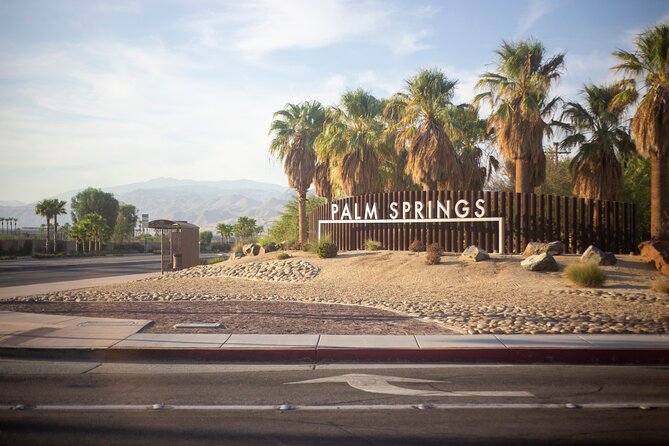
Palm Springs has a peculiar kind of sightseeing: the famous houses are everywhere, yet many sit behind tall hedges, gates, and walls. This self-guided audio drive gives you the stories behind those private homes while leading you through the Movie Colony, downtown, desert preserves, and old Hollywood sites.
I like two things right away: you pay $16.99 per group of up to four, not per person, and you control the pace. The audio plays from your phone as you approach each point, so you can pause for lunch, skip a stop, or split the route across more than one day. The main caution is navigation. GPS and audio timing worked well for many people, but others dealt with delays, app trouble, or unclear turns.
Key things to know before you start
- The route covers more than 22 miles: Plan on roughly two to three hours, with over 53 audio stories along the way.
- Celebrity homes are often private: You may see a gate, hedge, or wall instead of the house itself. Do not stop on private roads or trespass.
- The tour begins at the Palm Springs Visitor Center: You finish near Thousand Palms Canyon Road, rather than returning to the starting point.
- You get lifetime access: The tour has no expiry, so you can pause, repeat it, or use it again on another Palm Springs visit.
- A second person should handle the phone: The driver should focus on the road while a passenger watches the map and manages optional stops.
- The route mixes city and desert sights: You get celebrity lore, architecture, hiking suggestions, a memorial, an airport, and an oasis preserve in one outing.
What this Palm Springs drive actually feels like
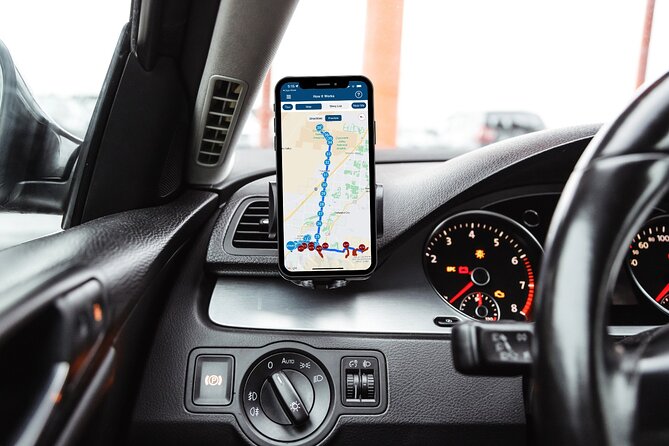
This is not a traditional guided tour with someone sitting beside you. You arrive at the Palm Springs Visitor Center, open the Action’s Tour Guide app, and let the GPS trigger each story as you reach the right spot.
The format works best when you treat it as a narrated road trip rather than a strict list of attractions. You are not hopping out at every address. Some stops take only a few minutes to view from the car, while others offer a chance to park, walk, or continue on a longer desert trail.
The narration covers more than famous residents. You hear about architects, Hollywood history, desert water, the Cahuilla people, the Coachella Valley, and the growth of Palm Springs from a quiet retreat into a celebrity playground. The balance leans toward people and stories, though, rather than a pure mid-century architecture tour.
Before leaving home or your hotel, download the tour over strong Wi-Fi or cellular service. Once downloaded, it works offline. Connect your phone to the car by Bluetooth, USB, or AUX if possible. The app can play through Apple CarPlay, but full navigation support is not yet available, and Android Auto support is still pending.
More Self-Guided Audio Tours in the USA
- Gettysburg Battlefield Self-Guided Driving Audio Tour
★ 4.5 · 910 reviews - Joshua Tree National Park Self-Guided Driving Audio Tour
★ 4.5 · 762 reviews - Ultimate Acadia National Park Self-Guided Driving Audio Tour
★ 4.0 · 521 reviews
Start at the Visitor Center and consider the five-minute detour
The official starting point is the parking lot at the Palm Springs Visitor Center, at 2901 North Palm Canyon Drive. No guide meets you there. You simply open the app, choose the tour, and drive to the first story point.
Early in the route, you get a choice. A short detour leads toward the Kaufmann Desert House and the Liberace House. It adds about five minutes, so I would take it unless you are running very late.
The Kaufmann Desert House is one of the route’s strongest architecture stops. Edgar Kaufmann, the department-store owner who commissioned Frank Lloyd Wright’s Fallingwater in Pennsylvania, hired Richard Neutra to design this Palm Springs retreat. The result helped define the clean, open style now linked with desert modernism.
You should set your expectations carefully. These are private homes. You may see only a gate, a wall, or a partial view through landscaping. The audio story is often more rewarding than the sightline itself. That is not a flaw in the tour so much as a fact of visiting private residential neighborhoods.
The Movie Colony puts the celebrity story first
The route then enters the Movie Colony, one of Palm Springs’ most famous residential districts. Frank Sinatra, Dinah Shore, Cary Grant, David O. Selznick, Jack Benny, and Tony Curtis all had homes in or around this part of town.
The neighborhood’s celebrity pull began with the El Mirador Hotel, which opened in 1928. Its Olympic-size pool, tennis courts, stables, and bell tower gave Hollywood stars a reason to come here for privacy and sunshine. Some decided not to leave, commissioning homes from architects such as Richard Neutra, Albert Frey, and Donald Wexler.
This section takes about ten minutes and costs nothing to view. I like it as an introduction because it shows how Palm Springs’ architecture and celebrity culture grew together. You are not simply looking at old houses. You are seeing the setting that made Palm Springs attractive to film stars seeking a break from Los Angeles.
Still, narrow roads and normal neighborhood traffic can make slow sightseeing awkward. Pull over only where parking is legal and safe. If your car has a passenger, let that person follow the map and watch for the next turn.
Robolights and the Walk of the Stars add local character
At the corner of East Granvia Valmonte and North Arquilla Road, the narration directs you to park and look for colorful sculptures among the trees. This is Robolights, an unusual outdoor art installation that feels quite different from the polished celebrity-home neighborhoods.
It is a brief stop, about ten minutes, and it gives the route some needed oddball character. You are not just moving from one famous address to another. You are also seeing the personal, handmade side of Palm Springs.
Next comes the Palm Springs Walk of the Stars. Its roughly 450 stars honor more than actors and singers. Architects, artists, soldiers, athletes, humanitarians, and city pioneers are included too.
That broader list matters. Palm Springs was shaped by people who designed its buildings, promoted the city, served the community, and helped create its public identity. The stop is free and takes about ten minutes, making it an easy place to stretch your legs.
More Driving Audio Tours in the USA
- Ultimate Lake Tahoe Self-Guided Driving Audio Tour
★ 4.5 · 435 reviews - Scenic Newport, RI Self-Guided Driving Audio Tour
★ 4.5 · 325 reviews - Arches National Park Self-Guided Driving Audio Tour
★ 4.5 · 288 reviews - Yellowstone National Park Self-Guided Driving Audio Tour
★ 4.5 · 249 reviews
The Coachella Valley section widens the story
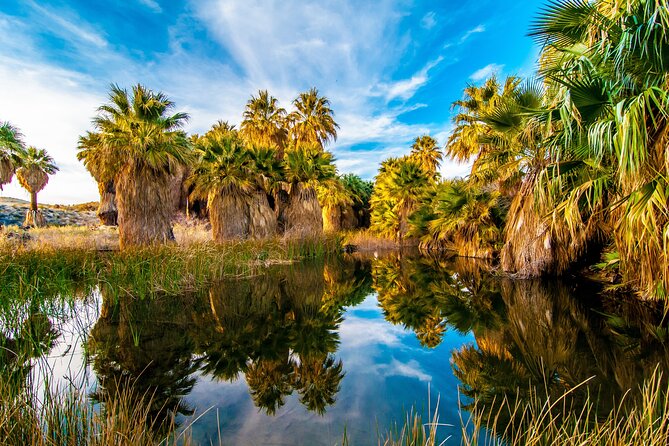
The drive eventually leaves central Palm Springs and heads into the wider Coachella Valley. The name may bring the Coachella Music Festival to mind, but the audio explains that the valley is much more than a festival destination.
This portion helps you understand the geography around Palm Springs. The city is not an isolated resort. It sits within a broad desert valley framed by mountains and connected to communities, trails, farms, airports, and natural preserves.
The Palm Springs International Airport receives its own story. In 1939, the United States Corps of Engineers chose the area for an Army Air Corps landing field because of the reliable weather and the protection offered by the mountains. After World War II, it became a civilian airport.
It is a short, free stop rather than a place where you need to enter a terminal. The value is context. You learn why this seemingly ordinary piece of infrastructure mattered to the valley’s wartime and postwar growth.
Sinatra’s gravesite is a personal choice
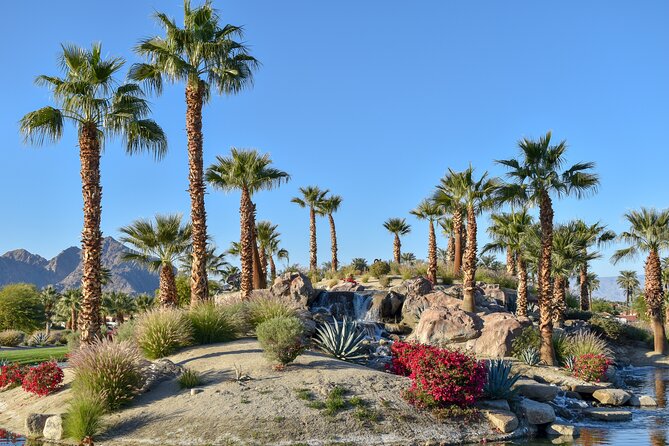
The route continues toward Frank Sinatra’s gravesite. Sinatra died in 1998 and was buried with a bottle of Jack Daniel’s whiskey, a Zippo lighter, a pack of Camel cigarettes, and ten dimes.
The dimes connect to December 1963, a detail explained in the audio. I found the story more interesting than the physical memorial itself. The grave is a long way from central Palm Springs, and the marker is modest. If you have limited time, this is an easy stop to skip.
That flexibility is one of the tour’s real strengths. You can follow every location, or treat the audio as a menu. If celebrity lore matters to you, continue. If you would rather spend the afternoon on a trail or in town, move on.
The desert trails require more time than the audio stops
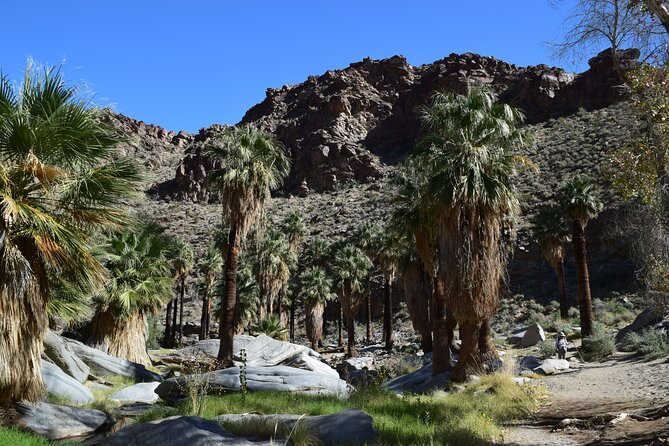
The Willis Palm Trailhead and Pushawalla Palms Trailhead introduce the hiking side of the Coachella Valley. They are not quick roadside walks.
Willis Palm Trail is a moderately strenuous four-mile hike with about 500 feet of elevation gain. The loop takes roughly three hours and may offer birds, desert wildlife, and spring wildflowers.
Pushawalla Palms Trail is a moderate four-and-a-half-mile hike with about 700 feet of elevation gain. It follows the ridge of the San Andreas Fault and reaches palm oases fed by water rising from deep underground. The route takes around three hours.
These trailheads are useful if you are planning a longer outdoor day, but do not assume they fit inside the advertised two-to-three-hour driving tour. The audio gives you a look at what is available. You need to bring your own hiking plan, time, water, and entrance information.
Thousand Palms Oasis Preserve is a worthwhile endpoint
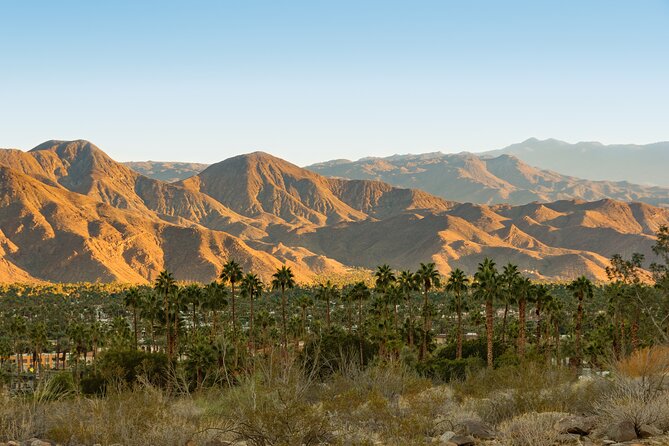
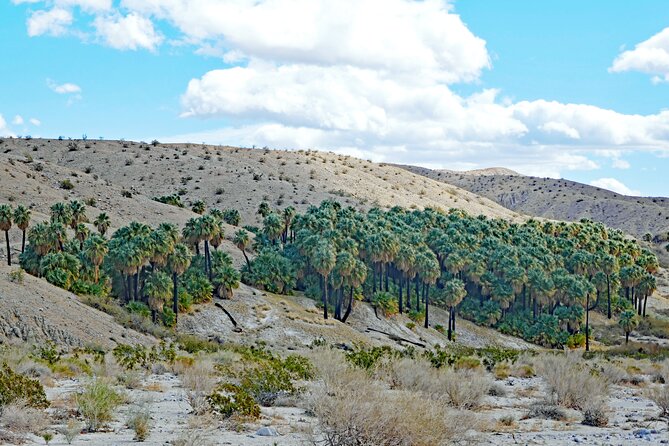
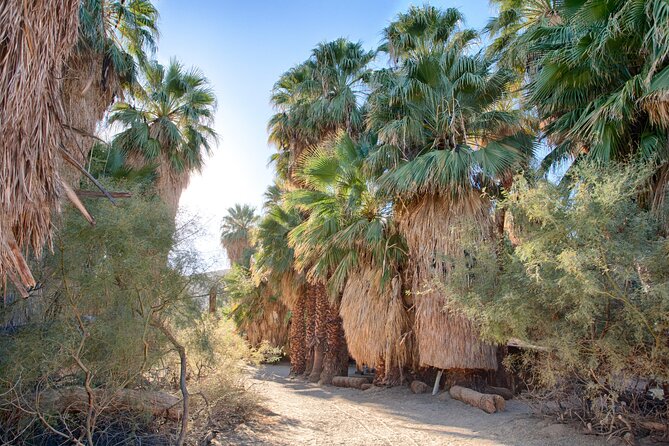
The tour reaches Thousand Palms Oasis Preserve, a striking change from the dry roads around it. Walking trails, wildlife, and clusters of palms gather around water in the desert.
The preserve has been undergoing renovation after storm damage, and the visitor center is closed until further notice. The trails remain open from sunrise to sunset. Check conditions before setting out, since the state of the facilities can change.
The tour ends near Thousand Palms Canyon Road. That matters for your car plan. You do not finish back at the Palm Springs Visitor Center, so arrange your day accordingly. If you have a rental car, the one-way route is simple enough, but you should know the endpoint before you begin.
Marilyn Monroe, disputed addresses, and desert modernism
The route includes Forever Marilyn, Seward Johnson’s 26-foot statue of Marilyn Monroe. The statue was created in 2011 and first appeared in Chicago before moving to Palm Springs, then touring internationally, including a period in Australia.
It is a big, playful photo stop. You can enjoy it as pop culture, public art, or a reminder of how strongly Palm Springs still trades on its Hollywood image.
The audio also points out a house at 1326 North Rose Avenue that has long been identified as Marilyn Monroe’s home. Local opinion disputes that claim. I appreciate the warning because it keeps the tour from treating every famous-house story as settled fact.
The Frey House II, at 686 Palisades Drive, adds a more serious architecture note. It is not open for casual public entry, though the Palm Springs Museum hosts guided tours of the property. Albert Frey, a Swiss architect who worked in Europe and New York before settling in Palm Springs, became a central figure in desert modernism.
This is one of the stops that may leave architecture fans wanting more. The tour includes major names and memorable buildings, but it is not designed as an in-depth survey of Palm Springs architecture. If that is your main interest, pair the drive with a museum visit or a dedicated architecture tour.
Palm Canyon, Andreas Canyon, and the Moorten garden
The route also points you toward Palm Canyon and Andreas Canyon, both within the Agua Caliente area.
Palm Canyon is an easy two-mile out-and-back hike with about 200 feet of elevation gain. Most people take around an hour. The Trading Post in the parking area collects the entrance fee, so this is not an included attraction.
Andreas Canyon is shorter, a one-mile loop with about 175 feet of elevation gain. It usually takes about half an hour. Along the trail, you can see more than 150 plant species within half a mile, palm trees, rock formations, Andreas Creek, and depressions in the rock where Cahuilla people once ground food.
These stops give the tour more substance than a simple celebrity circuit. They connect Palm Springs to its desert ecology and Indigenous history. You will need extra time and separate entry money if you decide to hike.
The Moorten Botanical Garden is another optional stop for anyone interested in desert plants. Chester Moorten, known as Cactus Slim, and Patricia Moorten created it in the 1940s. Chester had worked as an actor and a stand-in for Howard Hughes before tuberculosis made the dry desert air important to his health.
The garden is a good example of the personal stories threaded through this tour. Palm Springs history is not only about wealthy visitors. It is also about people who made a life here because the desert changed what was possible for them.
The aerial tram and Pioneertown are better as add-ons
The Palm Springs Aerial Tramway climbs 2.5 miles through Chino Canyon toward Mount San Jacinto State Park. Its rotating tram car turns 360 degrees as it rises, giving you changing views of the valley. At the top, you find restaurants, a gift shop, and hiking trails.
This is a major attraction, not a quick stop. Check tickets, operating times, and the amount of time you have before adding it to the drive.
Pioneertown is farther afield and has a strong old-west movie-set flavor. Dick Curtis, Roy Rogers, Dale Evans, and other entertainment figures helped create it in 1946 on 32,000 acres. The idea was to build a working western town where films could be made and show-business people could spend time away from the city.
It is an entertaining bonus for a longer Palm Springs trip, but it does not fit neatly into a quick two-hour outing. Use the tour’s lifetime access to split the experience if you want to include the more distant stops.
Price, technology, and who gets the best value
At $16.99 per group of up to four, the math is favorable. Four people can share the cost for less than five dollars each, and a couple still pays less than many traditional guided excursions. You also avoid paying for a guide, bus seat, or fixed departure time.
The value depends on how well the app behaves on your phone. The tour requires a separate Action app, a password sent by email and text, GPS, and an initial download over reliable service. Location services must be enabled.
Many people find the map, narration, and automatic audio triggers easy to follow. Clear driving instructions and stories of the right length are among the strongest parts of the experience. But you should not rely on the app alone. Keep a passenger available to watch the route, and use a second navigation app if needed.
Audio can lag behind your position, especially if GPS reception is weak or you pass a trigger point too quickly. The tour advises following the route and speed limit, and that is practical advice. Do not race between markers just to make the next story play.
Free cancellation is available up to 24 hours before the scheduled start. Inside that window, the payment is not refunded. Since access does not expire, you can also pause the tour and finish it another day.
Should you book the Palm Springs audio drive?
I would book it if you have a car, limited time, and an interest in Palm Springs’ celebrity past. It gives you a useful first look at neighborhoods you might otherwise miss, and the price is especially good for a small group.
You should also book it if you like choosing your own pace. Skip Sinatra’s gravesite, stop for a hike, repeat the route on another visit, or listen only to the sections that interest you.
I would hesitate if your main goal is to see house interiors or get close architectural views. Privacy walls are part of the experience, and several famous homes are partly or fully hidden. I would also avoid making it your only plan if you dislike phone-based navigation or have no passenger to help with the app.
For most visitors, the best approach is to treat this as a flexible introduction, not a complete Palm Springs sightseeing program. Pair it with one walk, one paid attraction, or a separate museum visit, and you will get much more from the city than a fast loop past celebrity addresses.
FAQ
Where does the Palm Springs self-guided driving tour start?
It starts in the parking lot of the Palm Springs Visitor Center at 2901 North Palm Canyon Drive, Palm Springs, California.
Where does the tour end?
The tour ends near Thousand Palms Canyon Road in California. It does not return you to the Palm Springs Visitor Center.
How long does the driving tour take?
The main experience takes approximately two to three hours. Some optional hikes and attractions along the route require additional time.
How many people can use one purchase?
One purchase covers a group of up to four people in the same car.
Does the tour work without cellular service or Wi-Fi?
Yes. You must download the tour while you have a strong Wi-Fi or cellular connection. After that, the audio and maps work offline.
Does anyone meet me at the starting point?
No. This is a private, self-guided activity. You start the app at the designated location and follow the GPS prompts.
Are entrance fees included?
No. Attraction tickets, trail entry fees, reservations, and other admission costs are not included.
Can I use the tour more than once?
Yes. The tour provides lifetime access with no expiry, so you can pause it, repeat it, or use it on another trip.
Latest audio tours in the USA
- Sequoia National Park Self-Guided Audio Tour★ 4.5 · 9 reviews
- Sequoia and Kings Canyon Audio Tour Self Guide National Park Tour★ 5.0 · 3 reviews
- Kings Canyon National Park Self-Guided Audio Tour★ 4.0 · 4 reviews
- Sedona, Arizona Self-Guided Audio Tour★ 4.0 · 36 reviews
- Sedona & Red Rock State Park Self-Guided Driving Audio Tour★ 3.0 · 30 reviews
- Haunted Savannah Self-Guided Walking Audio Tour★ 4.5 · 3 reviews
- Downtown Seattle Self-Guided Walking Audio Tour★ 4.5 · 6 reviews
- Uncover Seattle: Self-Guided Audio Tour★ 3.5 · 7 reviews
Driving Audio Tours, compared.

Ultimate Acadia National Park Self-Guided Driving Audio Tour
Read our review →


Browse the lists this tour appears in