
Reviewed · USA
Baltimore Walking & Driving Self-Guided Audio Tour
Baltimore’s story is unusually packed into a small route. In roughly nine miles, this self-guided tour takes you from the Inner Harbor and historic ships to Edgar Allan Poe, Frederick Douglass, Fort McHenry, Babe Ruth, and the city’s grand Washington Monument. The audio adds the odd details that make a place stick, from the mysterious Poe Toaster to a deadly gunfight outside City Hall.
I like the lifetime access and the price: $16.99 covers everyone in a car of up to four, so it can cost less than one conventional guided tour ticket. I also like the freedom to stop for lunch, skip an attraction, or replay the tour on another Baltimore visit. The main drawback is navigation. GPS and automatic audio triggering can be unreliable, especially in downtown streets, around tall buildings, or after a road closure.
Key points to know before you go

- More than 42 audio stories cover 27 listed sites, with a route of about nine miles.
- The $16.99 price covers up to four people, making this a strong choice for couples, families, and small groups sharing a car.
- You drive the route yourself, with optional short walks and attraction stops along the way.
- The app works offline, but you must download the tour while you have a good internet connection.
- Audio can cut off if you move too quickly, so drive slowly and pull over when you want to hear a story in full.
- The tour never expires, giving you time to split it over several days or reuse it on a later trip.
Baltimore in one self-guided route

This is not a conventional walking tour with a guide waiting at the meeting point. You begin near the Baltimore Visitor Center on Light Street, open Action’s Tour Guide app, and let the GPS-triggered stories lead you from one point to the next. The advertised duration ranges from one to three hours, with the core route generally taking about one to two hours if you keep moving.
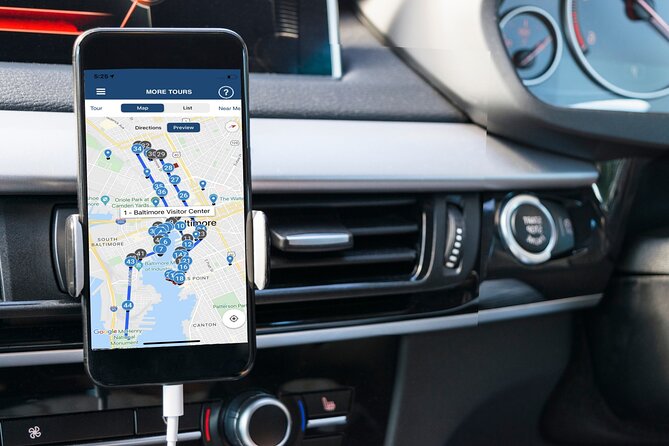
The route combines driving with optional walks. That distinction matters. You can listen from the car, but some places make more sense when you park and stretch your legs. Bring earbuds for walking portions, and connect your phone to the car stereo by Bluetooth, USB, or AUX for the driving sections.
The app is intended to play hands-free. In practice, you should treat it as an audio guide with route assistance, not as a replacement for a full navigation app. If you miss a turn, the tour may not redirect you properly. Keep Google Maps or another navigation tool available, but do not use your phone while driving.
More Audio Walking Tours in the USA
- Self Guided Classic Freedom Trail Location Aware (GPS) Walking Audio Tour
★ 4.5 · 258 reviews - Cape Cod & Provincetown Self-Guided Driving & Walking Audio Tour
★ 4.0 · 207 reviews - Santa Fe Historic Downtown Smart Phone Audio App Self Guided GPS Walking Tour
★ 4.5 · 112 reviews
Starting at the Visitor Center and Inner Harbor
The tour begins at the Baltimore Visitor Center, a sensible place to get your bearings before entering the city’s best-known waterfront district. The opening story introduces Baltimore’s culture and major figures, including Frederick Douglass and Edgar Allan Poe.
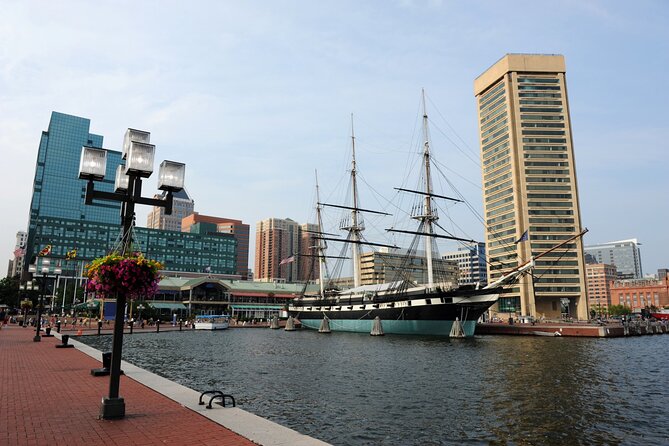
From there, you reach the Inner Harbor, the city’s main tourist area. The waterfront is an easy first stop because it gathers several important attractions close together. You can pause here for photos, food, or a longer visit before continuing.
The audio then points you toward the USS Constellation. This three-masted ship predates the Civil War and has a complicated place in American maritime history. The tour explains its role in intercepting vessels involved in the illegal transport of enslaved people. Admission is not included, so you can decide if boarding the ship fits your schedule.
The National Aquarium follows. Its collection includes more than 20,000 sea and land creatures, making it one of the route’s strongest family stops. The tour only provides outside context, so you should allow extra time and buy admission separately if the aquarium is a priority.
Near the waterfront, you also hear about the Seven Foot Knoll Lighthouse and Mr. Trash Wheel. The lighthouse is one of the harbor’s unusual historic sights, while Mr. Trash Wheel is a practical, highly visible machine that collects floating rubbish. This is a good example of the tour’s mix of old Baltimore and present-day city life.
Frederick Douglass, Isaac Myers, and Fells Point

The Frederick Douglass and Isaac Myers Maritime Park gives the tour some of its strongest historical substance. Douglass and Myers both worked at the shipyard once located here, at different times. The site connects African-American maritime work with the larger story of labor, civil rights, and Baltimore’s port.
The audio also presents Douglass as a campaigner for women’s rights, not only as an abolitionist. His support for voting rights across race and sex broadens the story beyond the usual short biography. If you want Baltimore’s history to feel connected rather than scattered, this section earns your attention.
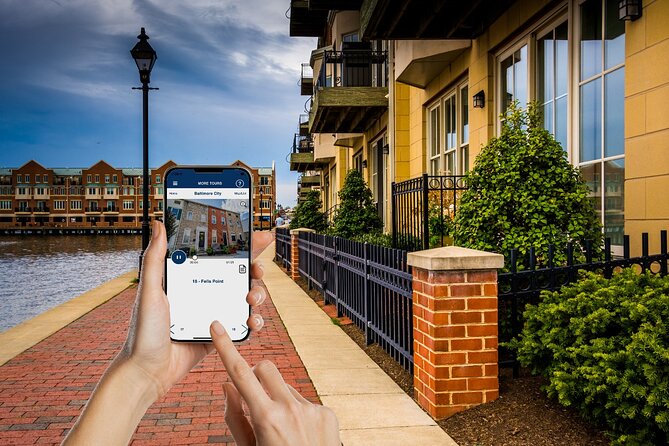
Fells Point is one of the most atmospheric parts of the route. Founded as an independent town in 1763, it still has much of its historic shape. The audio explains how free and enslaved African Americans lived and worked here, particularly around the port, and how the neighborhood’s modest homes reflected what working people could afford.
The Horse You Came In On Saloon adds a lighter, slightly spooky note. It is described as the oldest saloon in the United States and was associated with Edgar Allan Poe. The audio also mentions the claim that Poe’s ghost still appears there. You can stop for a drink, pub food, or live music, but these costs are separate from the tour.
Fells Point is also where you need to pay close attention to road conditions. A closure can throw off the automatic sequence, and the route may not quickly recover. If the app loses your position, use the map and navigation instructions rather than guessing at the next stop.
City Hall, Mount Vernon, and Poe’s Baltimore
Baltimore City Hall is one of the route’s most striking buildings, with a grand, formal design that is hard to miss. The audio adds a grim political story from 1883, when an argument between two Democratic politicians outside the building turned into a gunfight. James Busey was killed, and William Harig was arrested for murder.
At Mount Vernon Place, you see Baltimore’s Washington Monument. It was designed by Robert Mills, the same architect who later designed the better-known monument in Washington, D.C. Baltimore’s version came first, which gives the stop a useful correction to the usual assumption that it is a copy.
The Edgar Allan Poe section is one of the tour’s best narrative moments. At Poe’s grave, you hear about the Poe Toaster, a mysterious visitor who appeared around Poe’s birthday beginning in the 1930s. Dressed in black, the visitor left three roses and a bottle of cognac before disappearing. The identity of the person remained unknown.
The route continues to the site of Poe’s death, at the former Church Home and Hospital. His final days remain unclear. The account explains that Poe left Richmond for Philadelphia in September 1849, never reached his destination, and was missing for about a week before he was found in Baltimore.
The H. L. Mencken House adds another literary stop, although the supplied route information gives less detail here than it does for Poe. I would treat it as a passing point unless Mencken is a particular interest.
More Self-Guided Audio Tours in the USA
- Gettysburg Battlefield Self-Guided Driving Audio Tour
★ 4.5 · 910 reviews - Joshua Tree National Park Self-Guided Driving Audio Tour
★ 4.5 · 762 reviews - Ultimate Acadia National Park Self-Guided Driving Audio Tour
★ 4.0 · 521 reviews - Ultimate Lake Tahoe Self-Guided Driving Audio Tour
★ 4.5 · 435 reviews
Fort McHenry and the Star-Spangled Banner
Fort McHenry is the route’s most important historic attraction, and it deserves more time than the five-minute audio marker suggests. The fort defended Baltimore Harbor during the War of 1812. In 1814, nineteen British warships approached, and about 1,000 defenders prepared for an attack.
The bombardment was fierce, but recent reinforcement helped the fort withstand the cannon fire. The audio connects this defense to Francis Scott Key, who saw the American flag flying over Fort McHenry and wrote the poem that later became the national anthem.
The Star-Spangled Banner Flag House adds another layer to that story. These stops work best if you visit the fort itself rather than simply passing nearby. Admission is not included, and opening hours or access can change, so check before building your day around the interior visit.
The route ends at the Star-Spangled Banner National Historic Trail near Fort McHenry. That ending gives the tour a clear historical finish, although the overall route also includes sites beyond the harbor and may feel less linear if you stop often.
Babe Ruth, railroads, museums, and family stops

The Babe Ruth Birthplace and Museum brings the tour into Baltimore’s sporting identity. Even without attending a baseball game, you can pass Oriole Park at Camden Yards and hear about the baseball greats associated with the city.
The B&O Railroad Museum offers a different kind of local story. Baltimore’s development is closely linked with rail transportation, and this stop gives you a chance to explore that side of the city. Like the aquarium, fort, and other museums, it requires separate admission.
The Walters Art Museum and Maryland Science Center broaden the route beyond monuments and famous names. The Walters is useful for an art-focused stop, while the science center offers family-friendly exhibits and is described as one of the oldest scientific institutions in the country.
Port Discovery Children’s Museum is another clear choice for families. The audio points it out as an educational activity, but you should plan extra time if children want to visit. The self-guided format helps here because you are not tied to a group schedule.
The Mother Seton House tells the story of Elizabeth Ann Seton, the first American-born person canonized as a saint. She lived at the house temporarily after discovering Catholicism in Italy following her husband’s illness and death. It is a quieter stop than the harbor attractions, but it adds religious and social history to the route.
Mount Clare Museum House and Douglass Place round out the itinerary. Douglass Place is connected to homes built by Frederick Douglass, and the audio uses the site to continue his story from enslaved shipwright to national political figure.
The app, GPS, and real-world ease of use

The tour’s strongest practical feature is its offline operation. Download the route, maps, and audio before leaving strong Wi-Fi or cellular service, then use the app without relying on a signal. This is especially useful if your connection drops in a difficult part of the city.
The weak point is automatic location triggering. Stories can be interrupted if you pass a checkpoint too quickly, even when traffic forces you to move only slowly. The safest approach is to follow the suggested speed, leave extra time, and pull over legally when a story matters to you.
The app is recommended for iOS 15 or later, Android 9 or later, or an iPad or tablet with GPS and cellular capability. Apple CarPlay works for audio playback. Android Auto support is listed as forthcoming, so Android users should plan to connect by Bluetooth, USB, or AUX instead.
A solo driver faces the greatest challenge. You cannot safely study the map, troubleshoot GPS, and drive through busy city streets at the same time. This tour is easier with a passenger who can handle the phone and watch for turns.
What the $16.99 price really buys

At $16.99 per group of up to four, the cost is excellent if several people share one car. A couple pays less per person than a standard guided outing, and a family of four gets particularly good value.
The price does not include attraction tickets, food, parking, or reservations. That is important because the route passes several places where you may want to spend much more time than the audio stop allows. Think of the purchase as a narrated route and city introduction, not an all-inclusive sightseeing pass.
Lifetime access improves the value. You can pause the tour, split it over several days, replay it from home, or use it on a later Baltimore visit. If your first attempt is disrupted by rain, traffic, or a road closure, you do not lose the entire purchase.
Free cancellation is available when you cancel at least 24 hours before the scheduled start time. Changes or cancellations within 24 hours are not refundable.
Who should book this Baltimore tour
I would choose this tour if you want an affordable orientation to Baltimore and prefer setting your own timetable. It suits a small group with a car, families who need flexible breaks, and history-minded visitors who want context while moving between neighborhoods.
It is also useful on a rainy day because much of the experience takes place from the car. You can make short walks optional and decide which museums or historic sites deserve an indoor visit.
I would be cautious if you are driving alone, dislike phone-based navigation, or need perfectly reliable directions. The historical stories are the most dependable part of the experience. The route-following system requires patience and a backup map.
Should you book it?
Book it if the idea of a low-cost Baltimore introduction appeals to you and you are willing to manage the route yourself. Download everything before you leave, bring earbuds, connect the phone to the car stereo, and plan to stop rather than rush through the audio.
Skip it if you expect a live guide, precise turn-by-turn navigation, or included admission to the aquarium, Fort McHenry, museums, and other attractions. For the right user, the lifetime access and per-car price make this a smart way to get oriented. Just let the stories lead, and do not let the GPS become the boss of your day.
FAQ
Where does the Baltimore audio tour start?
It starts at the Baltimore Visitor Center on Light Street in Baltimore, Maryland.
Where does the tour end?
The listed endpoint is the Star-Spangled Banner National Historic Trail near Fort McHenry, at 2400 East Fort Avenue.
How long does the tour take?
The route is about nine miles long and usually takes about one to two hours to complete, though the full experience can take one to three hours depending on stops and breaks.
How many audio stories are included?
The tour includes more than 42 audio stories and covers 27 listed sites.
Is this a walking tour or a driving tour?
It is mainly a self-guided driving tour with optional walking sections. You can connect the phone to your car stereo and use headphones or earbuds when walking.
How much does the tour cost?
The price is $16.99 per group of up to four people.
Are attraction tickets included?
No. Admission tickets, attraction passes, reservations, food, and other personal expenses are not included.
Does the tour require mobile service?
You need strong Wi-Fi or cellular service to download the tour. After downloading, the app is designed to work offline.
Does the tour expire?
No. The tour offers lifetime access and can be used at any time, on multiple days, or on a later trip.
What phone or tablet can I use?
The recommended devices are an iPhone with iOS 15 or later, an Android device with version 9 or later, or an iPad or tablet with GPS and cellular connectivity.
More Driving Audio Tours in the USA
- Scenic Newport, RI Self-Guided Driving Audio Tour
★ 4.5 · 325 reviews - Arches National Park Self-Guided Driving Audio Tour
★ 4.5 · 288 reviews - Yellowstone National Park Self-Guided Driving Audio Tour
★ 4.5 · 249 reviews - Palm Springs Self-Guided Driving Audio Tour
★ 4.0 · 211 reviews
Latest audio tours in the USA
- Sequoia National Park Self-Guided Audio Tour★ 4.5 · 9 reviews
- Sequoia and Kings Canyon Audio Tour Self Guide National Park Tour★ 5.0 · 3 reviews
- Kings Canyon National Park Self-Guided Audio Tour★ 4.0 · 4 reviews
- Sedona, Arizona Self-Guided Audio Tour★ 4.0 · 36 reviews
- Sedona & Red Rock State Park Self-Guided Driving Audio Tour★ 3.0 · 30 reviews
- Haunted Savannah Self-Guided Walking Audio Tour★ 4.5 · 3 reviews
- Downtown Seattle Self-Guided Walking Audio Tour★ 4.5 · 6 reviews
- Uncover Seattle: Self-Guided Audio Tour★ 3.5 · 7 reviews
Driving Audio Tours, compared.


Ultimate Acadia National Park Self-Guided Driving Audio Tour
Read our review →



Browse the lists this tour appears in