

Reviewed · CANADA
The Sights of Banff: a Smartphone Audio Walking Tour
Banff’s story is spread across its streets, gardens, riverbanks, old cabins, and shopfronts. This self-guided audio walk ties those pieces together over roughly 5 km, from the Buffalo Nations Museum area through Cascade Gardens, along the Bow River, and back into the town center.
I like the freedom to start whenever you wish and keep the tour after booking. I also like the price: at $8.22 per person, it costs less than a typical guided outing and gives you a useful introduction to Banff’s buildings and local stories. The catch is the app. A few parts have been hard to follow, and some commentary has felt too long or outdated, so you should download it before setting out and allow time to get used to the controls.
Why this Banff walk is worth considering

- A 5 km return route connects 27 named stops, including Cascade Gardens, the Bow River pedestrian bridge, Central Park, Banff Avenue, and several historic buildings.
- GPS-triggered audio plays near each point of interest, so you can keep your phone in your pocket for much of the walk.
- Offline use is a real advantage, especially in a mountain town where you do not want the tour depending on mobile data.
- The route mixes famous sights with small details, such as a sidewalk elevation marker, an old power station, an inukshuk, and a stone fire monument.
- A built-in trivia game adds some fun, asking you to tap an answer after the commentary plays.
- You get private, flexible sightseeing for a low price, but the experience depends on your phone, battery, map reading, and comfort with the app.
What you get for $8.22 in Banff
At $8.22 per person, this is priced as an inexpensive introduction rather than a full guided history tour. You are paying for the audio content, route, GPS map, and trivia feature. There is no live guide walking beside you, and admission to the Luxton Home Museum, Whyte Museum, Banff Park Museum, and Buffalo Nations Museum is not included.
That distinction matters. You can pause outside each museum, hear the related commentary, and decide later if you want to pay for entry. If you want a guide to answer questions, adjust the pace, or steer you around a closed attraction, this is not the right format.
The strongest value comes from orientation. You get a broad look at Banff’s civic buildings, early homes, public art, religious buildings, parks, and commercial blocks in one outing. I would use it early in a Banff stay, then return to the places that catch your eye.
The booking also gives you flexible use. You can start at another time, stop and restart along the route, and keep the tour for later use through Tripvia Tours. That makes the low price more useful than a fixed departure. You can split the walk across two outings if the weather turns sour or you want to spend extra time inside a museum.
More Audio Walking Tours in Canada
- Halifax Churches, Gardens & Graveyards: a Smartphone Audio Walking Tour
★ 4.5 · 25 reviews - Halifax Boardwalk & Seaport: a Smartphone Audio Walking Tour
★ 4.0 · 19 reviews - Explore Halifax with 3 Unique Smartphone Audio Walking Tours
★ 4.0 · 16 reviews
Starting at Buffalo Nations Museum and Cascade Gardens
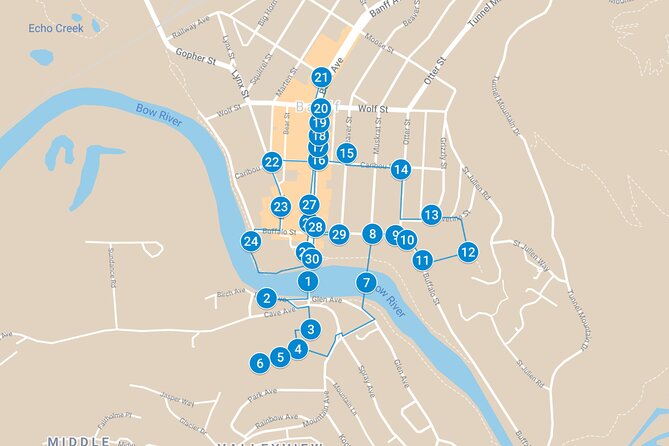
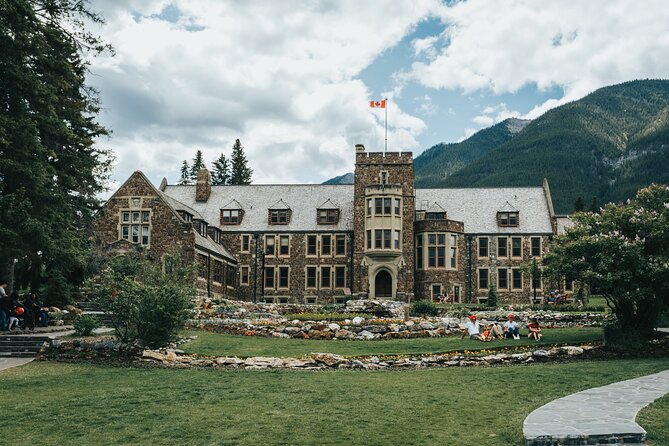
The route begins at 12 Banff Avenue, near the Buffalo Nations Museum. The museum itself requires a separate ticket, but the tour uses the area to introduce Banff and its past before sending you toward the Banff National Park Administration Building.
The administration building is one of those places you might walk past without knowing why it matters. The audio gives it a proper pause, then leads you to Cascade Gardens, the visual centerpiece of the first part of the walk.
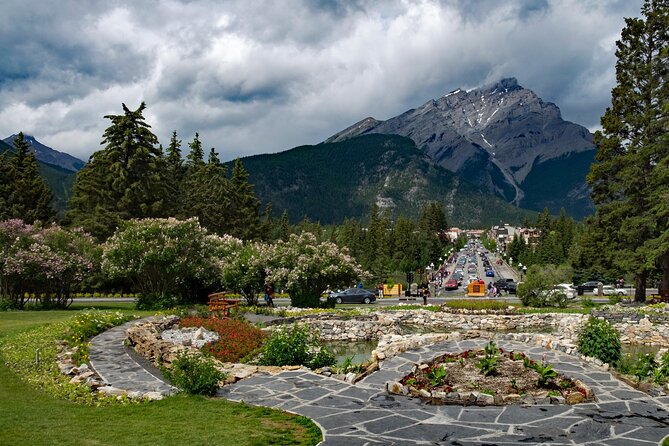
Cascade Gardens covers four acres and was built in the 1930s, with planted terraces rising up the hillside. The route includes the Cambrian and Devonian pavilions. Allow more than the suggested five minutes if you want to look carefully, take photographs, or simply enjoy a quiet break.
One useful point: the first section has been easier to follow than the later town streets. If you are testing the app for the first time, Cascade Gardens is a good place to learn how the GPS triggers work. Stop when the commentary begins, listen, then check the map before continuing.
Crossing the Bow River and finding Banff’s small clues
From the gardens, the walk reaches the Banff pedestrian bridge. Here, the commentary turns toward the person known as Mr. Banff, adding a human story to the broad Bow River view. This is a short stop, but the setting gives it more weight than a simple roadside explanation.
The route then heads to Buffalo Street and Muskrat Street, where you are asked to find an elevation marker set into the sidewalk. It looks like a coin. This is exactly the kind of small detail that makes a walking tour useful: you have a reason to look down and notice something you might otherwise miss.
At 514 Buffalo Street, you see the Crandell Peck Cabin, built in 1907 by Edward Henry Crandell. The building used almost entirely local materials. The stop is brief, but it helps you picture Banff before modern shops and large hotels filled the central streets.
Nearby, at Buffalo and Otter streets, the audio explains the meaning of an inukshuk. At 525 Buffalo Street, you pass the Banff Powerstation, which helped supply streetlights and homes in 1905. These stops are not grand attractions, and that is their value. The walk keeps pointing out the working structures and everyday objects that helped the town grow.
Ken Madsen Path and the homes of Banff’s early residents

The Ken Madsen Path brings a change of pace. You leave the more built-up streets for a scenic route while the narration gives more background about Banff. The supplied timing lists each stop at about five minutes, but you should not feel pushed. The tour has no fixed end time.
At 117 Grizzly Street, the audio points out Tarry-a-while, a historic residence associated with Mary Schaffer Warren. Her early explorations, writing, and paintings helped record the Canadian Rockies. The stop offers a useful reminder that Banff’s story includes people who documented the region as well as those who built businesses and public institutions.
The walk then turns toward the Luxton Home Museum. The historic house offers a look at one pioneer family and Banff life over nine decades. Admission is separate, so the audio stop works in two ways. You can simply view the exterior and continue, or pause the walk and visit the museum if it is open and fits your plans.
I would check opening conditions before relying on any recommended attraction. The tour notes that sites can be closed or inaccessible because of the season or other causes. That is less serious for outdoor sights, but it matters for museums.
More Smartphone Audio Tours in Canada
- Cabot Trail: a Smartphone Audio Driving Tour
★ 4.5 · 118 reviews - Icefields Parkway: a Smartphone Audio Driving Tour
★ 4.0 · 118 reviews - Smartphone Audio Driving Tour between Banff and Calgary
★ 4.0 · 25 reviews - Smartphone Audio Driving Tour between Lake Louise and Calgary
★ 4.0 · 15 reviews
Banff Avenue, Brewster history, and public art
Caribou Corner introduces the Brewster family, who came to Banff in 1886 and set up shop in the area. The walk then reaches the Four Sentries sculpture on Banff Avenue. These short stops help you read the main street instead of treating it as a simple shopping strip.
A mural near Box 3100 depicts the Cave and Basin site. The mural becomes a prompt for the audio to explain that important Banff location. The route does not turn this walk into a full Cave and Basin visit, so consider it an introduction rather than a replacement for seeing the site itself.
The Banff Visitor Information Centre appears next. This is a practical stop, not just a landmark. You can use it to gather current information about area activities, especially if weather, seasonal closures, or transportation have changed your plans.
St. Paul’s Presbyterian Church follows. The building dates to 1930, while the church itself was established in 1887. The audio uses that gap to give you a little more context than the date on the front of a building would provide.
At Banff Avenue and Elk Street, you see a stone monument shaped around a fire. The commentary explains the monument rather than inviting you to sit at an actual fire. At Caribou and Bear streets, the old Cascade Lodge appears, now associated with the Banff Freemasons.
Museums, Central Park, and Banff’s commercial past

The Whyte Museum of the Canadian Rockies is one of the more important cultural stops. Its purpose is to preserve and make accessible the history and culture of the Rocky Mountains. The tour does not include admission, but the exterior stop can help you decide if the museum belongs on your schedule.
Central Park provides another break from the street grid. The audio points out a large pile of rocks in the middle of the park. That may sound like a small matter, but this is part of the tour’s character: it treats a modest feature as a doorway into a local story.
The Banff Park Museum dates to 1895 and was created to house mounted specimens of animals, plants, and minerals connected with the park. Again, entry costs extra. I like the way this stop adds an early institution to the route, but I would not confuse the brief audio explanation with time inside the museum.
Near Banff Avenue and Buffalo Street, the route points out the Dave Whyte Block, one of the oldest largely intact commercial buildings in Banff. At 107 Banff Avenue, you see Harmony Lane, a commercial building with river-stone pillars and a rustic National Park design.
These stops are especially useful if you enjoy architecture. The walk gives you a way to compare buildings rather than seeing each one as an isolated façade. The drawback is that Banff Avenue can be busy, and the app may not always make the next street turn as clear as you want.
Churches, residences, and the final Legion stop

Rundle United, also called Ralph Connor Memorial United Church, provides a story about the man behind the church’s name. The commentary is delivered by Don, who does his best Mr. Rundle impersonation. That touch gives the audio a little personality without turning the walk into a theatrical show.
At Beaver and Buffalo streets, you see the Superintendent’s Residence. The narration explains the role and responsibilities of the park superintendent who lived there. It is another example of the tour’s effort to connect a building with the job once carried out inside it.
The final named stop is the Royal Canadian Legion Col. Moore Branch 26, along with the cenotaph built in 1920. It is a fitting ending for a route concerned with Banff’s public life, local memory, and the people who shaped the town.
The walk finishes back at the starting point. Because it is a return route, you do not need to solve a transportation problem at the end. You can also pause before the final section if you want to shop, eat, or visit one of the nearby museums, then resume when ready.
How the smartphone app works in real life
Download the tour on Wi-Fi before you leave. Once it is on your phone, no signal or mobile data is required during the walk. That is one of the most practical features, particularly for anyone trying to avoid roaming charges or weak service.
The live GPS map shows your position and the next part of the route. As you approach a point of interest, the guide commentary should play automatically. You can also use the map to check your direction and start again after a pause.
The experience requires patience at first. One user found the controls difficult to learn before getting comfortable, and another reported that the app sometimes jumped away from the map to a slogan page. The provider identified an app bug and said it had been fixed, but I would still open the tour before walking and make sure the map, audio, and route work properly.
A phone speaker is enough, so headphones are optional. Headphones may make the narration easier to hear near traffic, but a small group might prefer the speaker. The number of people selected at booking equals the number of devices that can download the tour, so keep that in mind if everyone wants separate audio.
The trivia game plays after the commentary at selected points. You tap your answer on the phone. It will appeal most to families and people who like a little structure, though it is not the main reason to book.
Timing, weather, and who should take it
The advertised duration is about one to one and a half hours, with a route of roughly 5 km return. That timing appears brisk once you account for 27 stops, photos, map checks, museum visits, and time in Cascade Gardens. Treat the estimate as walking time rather than a strict appointment.
Weather is a serious consideration. A walk in Banff at minus 19 degrees was too cold for one outing, with the group trying to drive between sights and missing sections. I would choose a milder day, wear shoes suited to walking, and split the route if needed.
This tour suits you best if you:
- Want a low-cost first look at Banff
- Prefer to avoid a scheduled group
- Like local architecture, public art, and small historic details
- Want to choose your own start time
- Are comfortable using a GPS app
- Plan to visit museums separately
It is less suitable if you want a live guide, detailed answers to spontaneous questions, or a completely hands-off route. The directions have not always felt clear, particularly in the second half, and some audio can feel repetitive. Give yourself time to confirm each location instead of walking on while listening.
The tour is private in the simple sense that only your group participates. It is not a private guide service. You bring the phone or tablet, manage the battery, and decide how long to stay.
Should you book the Sights of Banff audio walk?
I would book it if you want an affordable introduction to Banff and like exploring at your own speed. The strongest parts are the flexible timing, offline access, Cascade Gardens, Bow River crossing, and the steady stream of small details about cabins, power, churches, sculptures, and old businesses.
I would skip it if you need polished turn-by-turn directions or expect every stop to feel equally engaging. Start by testing the app near the meeting point, download it on Wi-Fi, and plan the walk for decent weather. At $8.22, the risk is modest, and you can use the route as a framework for a fuller Banff visit.
FAQ
How long is the Sights of Banff audio walk?
The advertised duration is approximately one hour to one and a half hours. The route covers about 5 km return, and you can take longer because there is no time limit.
Where does the tour start and finish?
It starts at 12 Banff Avenue, Banff, Alberta, and ends back at the same meeting point.
Does the tour require mobile data or a signal?
No. You should download the tour using Wi-Fi before setting out. The audio and route can then be used offline without a signal or mobile data.
Is a live guide included?
No. The tour uses smartphone audio commentary that plays near points of interest. The guide voice is associated with Don, who also provides a Mr. Rundle impersonation during one stop.
Are museum admissions included?
No. Admission is not included for the Buffalo Nations Museum, Luxton Home Museum, Whyte Museum of the Canadian Rockies, or Banff Park Museum.
Do I need headphones?
No. Headphones are optional because the audio can play through your device speaker.
Can I cancel the tour for a full refund?
Yes, if you cancel at least 24 hours before the experience start time. Cancellations made within 24 hours are not refundable, and changes within that period are not accepted.
Latest audio tours in Canada
- Fruit alcohol tasting + Velvet Orchards audio tour★ 5.0 · 2 reviews
- APP Self-Guided Tours Quebec with Audioguide★ 3.0 · 2 reviews
- Quebec City Self-Guided Driving Audio Tour★ 4.0 · 7 reviews
- Layers of Natural History: Picton Nature Self-Guided Audio Tour★ 5.0 · 4 reviews
- Smartphone Audio Driving Tour between Wasaga Beach and Toronto★ 4.5 · 3 reviews
- Niagara: Behind The Falls, Skylon Tower Ticket & Tesla Audio Tour★ 3.5 · 69 reviews
- Niagara Falls Pass: 5 Iconic Attractions, WEGO Bus & Audio Guide★ 5.0 · 7 reviews
- Niagara Peninsula: a Smartphone Audio Driving Tour★ 4.0 · 10 reviews
Audio Walking Tours, compared.

City Monuments Guided Walking Tour with Audio Guide
Read our review →
Self Guided Classic Freedom Trail Location Aware (GPS) Walking Audio Tour
Read our review →
Self-Guided Historical Walking Tour (Audio Guide)
Read our review →
Cape Cod & Provincetown Self-Guided Driving & Walking Audio Tour
Read our review →
Verona Walking Tour with Audio and Written Guide by a Local
Read our review →
Royal Walking Tour and Buckingham Palace Audio Tour
Read our review →
Bologna Walking Tour with Audio and Written Guide
Read our review →Browse the lists this tour appears in