

Reviewed · SWITZERLAND
The Many Faces of Geneva: Self-Guided Audio City Tour
Geneva’s famous sights take on a sharper edge in this self-guided audio tour. You follow stories of assassins, judges, reformers, philosophers, and saints while walking from the monument to Empress Sissi to the Reformation Wall. The theme is human nature: courage beside fear, justice beside anger, and virtue beside plain old bad behavior.
I like the flexible timing and the way the route links places that can otherwise feel like separate postcard stops. I also like the unusual connections, such as the Jet d’Eau’s public purpose, Rousseau’s personal contradictions, and the long bench where Geneva’s judges once pronounced death sentences.
The main drawback is that the experience depends entirely on your phone, internet connection, and willingness to listen as you walk. The audio is not for children under 16, wheelchair users cannot take the tour, and the broad moral theme may feel repetitive if you prefer a simple sightseeing walk.
Key points to know before you book
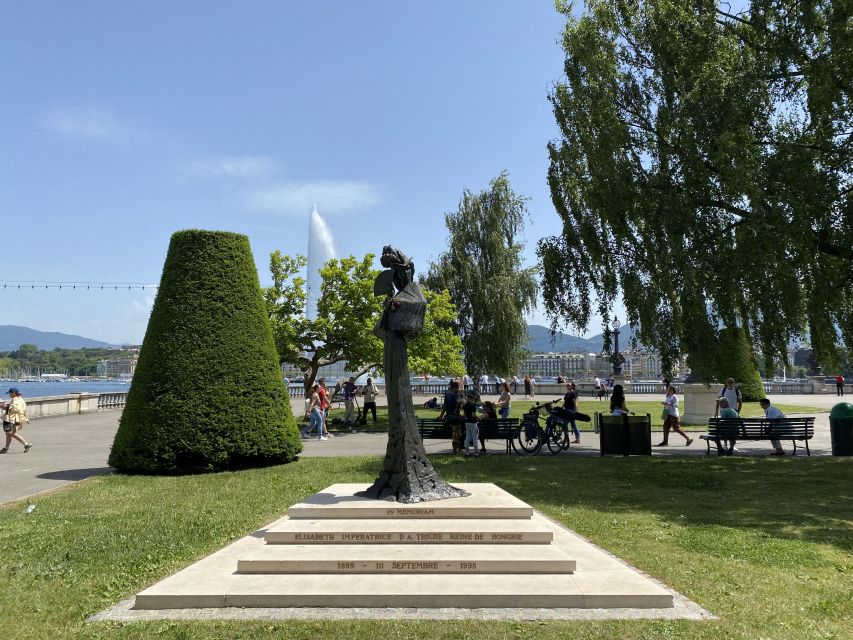
- A 1.5 to 2-hour route through central Geneva: The walk covers the city’s best-known monuments, fountains, churches, squares, and Old Town sights.
- A human story at every stop: Expect tales connected with anger, justice, courage, pride, envy, love, mercy, and moderation.
- No live guide or fixed group: You start at the Sissi monument and follow audio, photos, and directions on your own.
- English or French audio: A professional speaker provides the narration, with a route link supplied after booking.
- Good value for independent sightseers: At $13 per person, it costs less than many live walking tours, though you give up conversation and personal questions.
- Plan for phone use: Bring a charged smartphone, internet access, and headphones. The route is not suitable for children under 16 or wheelchair users.
Why Geneva works well for a tour about human behavior
Geneva is often presented through its international organizations, lake views, watchmaking, and polished streets. This tour takes a different route through the city. Instead of treating each sight as an isolated monument, it asks you to consider the people and decisions behind it.
That makes the walk more thoughtful than a standard checklist. You still see the major sights, but the audio gives you a question to carry from one stop to the next: how close is courage to violence, or justice to cruelty? Geneva’s public monuments and religious buildings provide plenty of material.
I find this approach most useful if you already know a little about the city and want more meaning from a short walk. It is also handy on a first visit because the route gathers many central sights into one outing.
The tone is not simply flattering. You hear about good deeds, social equality, and humanitarian action, but also about prostitution, confinement, rigid theology, personal affairs, and executions. That balance keeps the walk from turning into a polished civic speech.
More Self-Guided Audio Tours in Switzerland
- The Best of Basel’s Hidden Treasures: A Self-Guided Audio Tour
★ 4.5 · 32 reviews - Revealing Lucerne: Self-Guided Audio City Tour
★ 4.0 · 20 reviews - Basel’s Portrait: Self-Guided Audio City Tour
★ 4.5 · 19 reviews
Starting at the Sissi monument
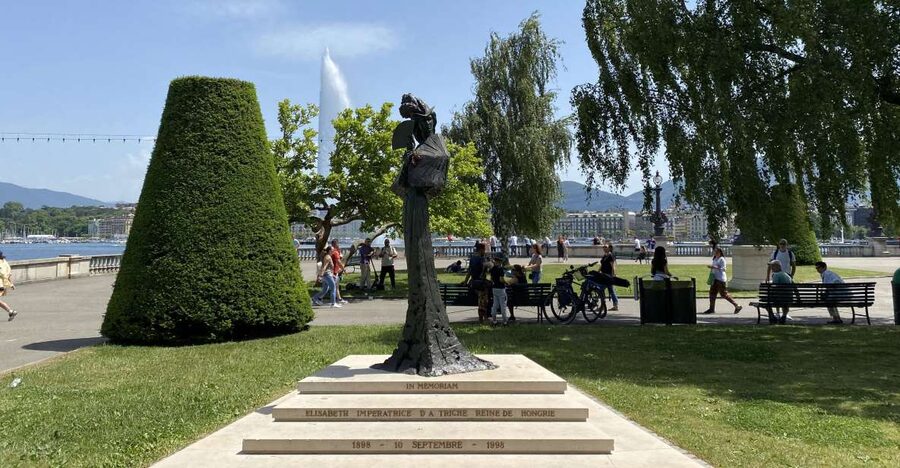
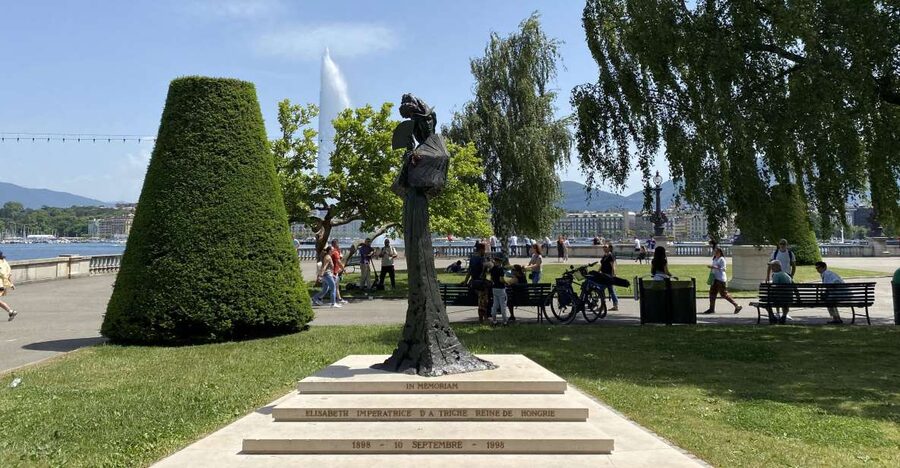
The tour begins at the monument to Empress Elisabeth, known as Sissi. This is a memorable starting point because her death was sudden and violent. An anarchist stabbed her, and the audio explains how and why the attack happened.
The story gives the tour an immediate sense of danger. Sissi was not simply a decorative royal figure in this telling. Her monument opens a discussion about anger, political violence, and the vulnerability of public people.
You plug in your headphones, open the link on your smartphone, and begin listening. There is no guide waiting at the meeting point, so you should arrive with the phone charged and the route ready to use.
Starting here also puts you near the lakefront and the Jet d’Eau, making the first part of the walk easy to recognize. If you want a calm start, check your phone and audio before pressing play. A self-guided walk is forgiving about timing, but less forgiving if your battery is low.
The Jet d’Eau and the idea of doing good
The Jet d’Eau is one of Geneva’s most recognizable sights and one of the largest fountains in the world. On a typical city tour, you see the plume, take a picture, and move on. Here, the fountain becomes a way to discuss public benefit and the idea of doing a good deed.
The audio explains how the fountain can be understood as making the world better. That may sound grand for a water feature, but it fits the tour’s larger method: ordinary civic features become prompts for questions about public life.
This stop is also a practical early landmark. You can use it to confirm that you are following the route correctly before moving farther into the city. The walk is not built around long museum visits or entry lines, so the fountain is viewed from the route rather than treated as an indoor attraction.
The Brunswick monument and Jean-Jacques Rousseau
Next comes the Brunswick monument, where the audio points out images of virtues. Look closely at the monument as you listen. Its carved details matter here, and this is one place where stopping rather than simply walking past will improve the experience.
The tour then turns to Jean-Jacques Rousseau. Rousseau promoted ideas tied to social equality, but he also confessed to affairs with married women. That contrast is exactly the sort of moral tension this walk favors.
I like this stop because it avoids presenting a famous thinker as either hero or villain. You get the public ideas and the private conduct together. For you, the value is less about memorizing another biographical fact and more about seeing how a city can honor a complicated person.
The Rousseau monument also helps break up the walk’s grander themes. After stories of royalty and public fountains, you encounter an individual whose influence came from writing and political thought, along with personal choices that sit uneasily beside his ideals.
More City Audio Tours in Switzerland
- Zurich City Tour with Audio Commentary
★ 4.0 · 372 reviews - Zurich: Audio Guided City Tour and Train to “Top of Zurich”
★ 4.2 · 65 reviews - Revealing Lucerne: Self-Guided Audio City Tour
★ 3.8 · 18 reviews - Self-Guided Audio City Tour in Bern
★ 4.3 · 18 reviews
The National Monument and Geneva’s Flower Clock
The National Monument is another stop where the tour asks you to look past the obvious. You learn why this monument won its competition, which gives the structure a civic and competitive background rather than treating it as scenery.
That detail suits the tour’s interest in ambition and pride. Public monuments are not accidental. They are designed, selected, and placed to express a city’s view of itself.
The Flower Clock brings the theme of pride into a more polished setting. Geneva’s clock is attractive and famous, but the audio connects it with human vanity and civic display. You can consider both sides at once: the clock is a useful symbol of Swiss precision, and it is also a carefully presented object meant to attract attention.
This section should appeal to people who enjoy small details about how monuments were chosen and what they communicate. If you want every stop to deliver a dramatic historical event, these sections may feel quieter.
The Palace of Justice and the Lutheran church

At the Palace of Justice, the focus shifts to justice and mercy. The audio asks you to consider how law can protect people, punish wrongdoing, or become harsh when compassion disappears.
That is a useful pause in the walk because Geneva’s grand public buildings can seem formal and distant. The tour brings the question back to human choices: who judges, who receives mercy, and what happens when anger enters the legal system?
The Lutheran church introduces a religious view of sin and good deeds. You learn how different religions understand the influence of wrongdoing and virtue on salvation. This is not presented as a long theological lecture, but it adds a second way of thinking about the same moral questions.
You should expect interpretation rather than a detailed architectural tour at this point. The church matters mainly for the ideas attached to it. If religious themes interest you, this will add depth. If you prefer architecture, you may wish the audio spent more time on the building itself.
Justice, prostitution, and the weeping prophet
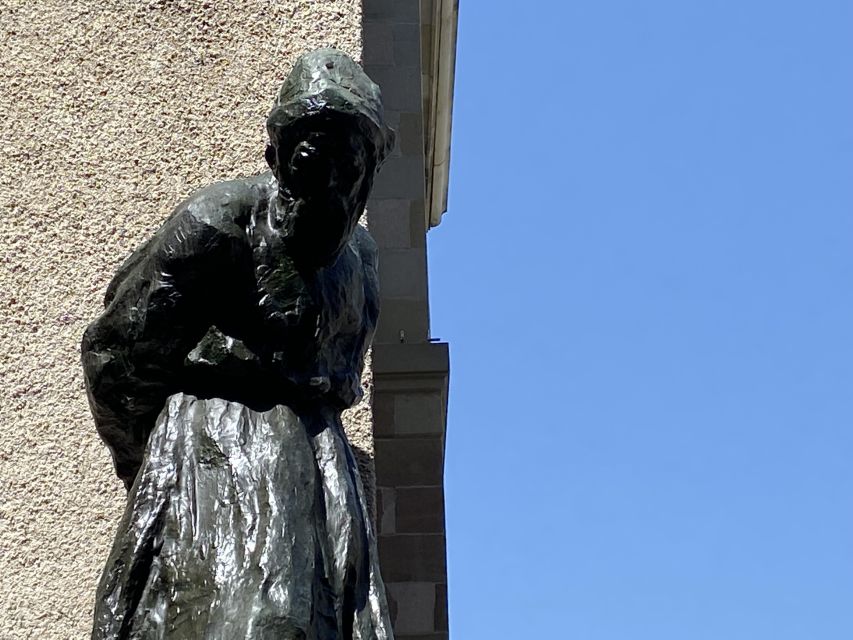
The route then leads to a monument regarded as representing a Genevan fighter for justice. The exact interest here is not only the monument itself, but the way it fits the larger story of people challenging unfairness.
The audio also identifies the former red light district and discusses the history of prostitution in Geneva. This is one of the more grounded parts of the walk. It moves away from famous names and monumental symbolism to a social subject that shaped city life.
You then reach the Statue of the Prophet Jeremiah, often called the weeping prophet. The nickname gives the stop an emotional quality. Jeremiah is associated with grief, and the tour uses him to explore sorrow rather than presenting every virtue as cheerful or heroic.
This section may appeal to you if you like a city tour that includes uncomfortable subjects. It is not a family outing for younger children, and the age restriction of 16 makes sense given the material covered.
St. Pierre Cathedral and the virtue of temperance
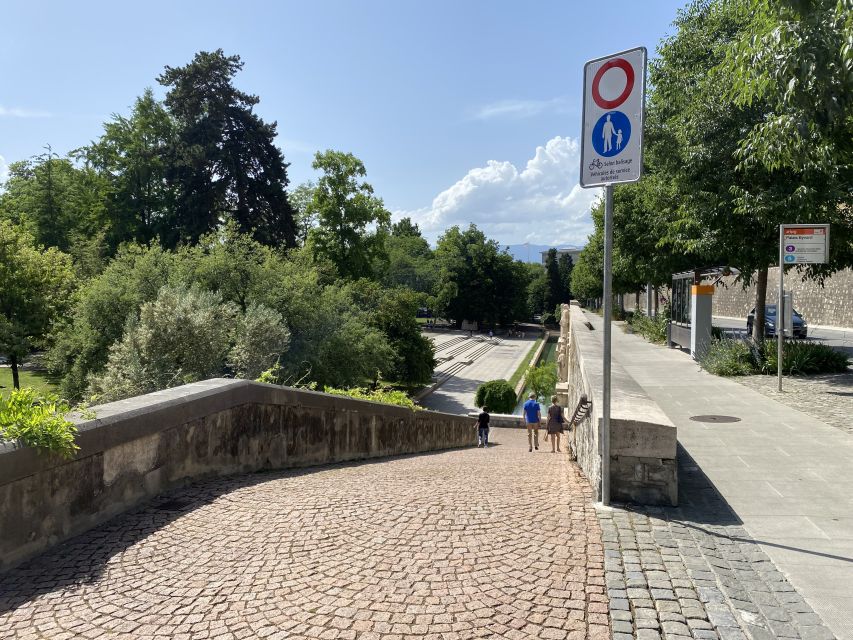
St. Pierre Cathedral is one of Geneva’s essential sights, and the tour connects it with temperance, or moderation. That is a fitting theme for a city walk that repeatedly places extremes beside restraint.
You learn why the cathedral is associated with this virtue. The audio gives you a reason to pause at a building you might otherwise enter only for its size or appearance.
The cathedral stop also provides a strong sense of place. By this point, the route has moved through public monuments, civic buildings, religious sites, and social history. St. Pierre brings those threads together in one of Geneva’s major landmarks.
Do not expect the tour to function as a full cathedral guide. Its purpose is to explain the moral connection, not to cover every architectural feature or every period of the building’s past. That focused approach helps keep the full route within two hours.
Geneva’s Town Hall and the death sentence bench

The Town Hall offers one of the walk’s most striking details: a long stone bench where Geneva’s judges pronounced death sentences. The bench is easy to overlook if you do not know what you are seeing.
Here the audio describes some of those sentences in more detail. The stop gives the theme of justice a darker and more physical setting. Law is no longer an abstract idea connected with a grand building. It becomes a decision made by people, with final consequences for other people.
I find this kind of detail especially valuable because it changes how you see an ordinary piece of stone. It also keeps the tour from becoming too cheerful or symbolic. The city’s civic history included mercy and public good, but it also included punishment and fear.
Take a moment at this stop. The story works best when you give yourself time to look at the bench and imagine the public scene that once took place there.
The Reformation Wall and the cost of certainty
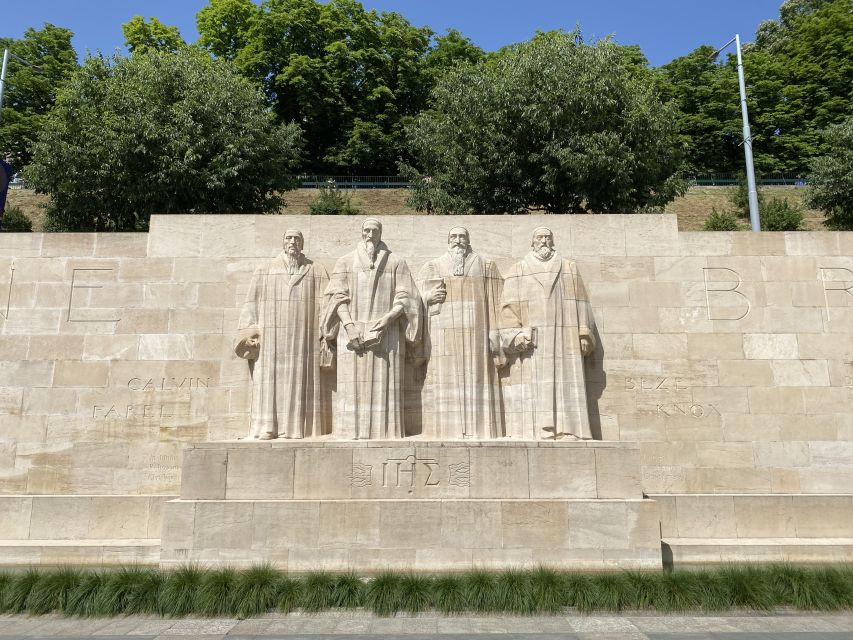
The Reformation Wall is a major closing section of the route. The audio introduces the theologians shown there and asks which of them were criticized for inflexibility, mercilessness, and heartlessness.
That question is central to the whole tour. The wall celebrates religious reform, but the people connected with reform were still human and capable of harsh judgments. You get a more balanced view of religious leadership than a simple list of names and dates would provide.
This is also one of the most visually important stops. The wall is large and easy to recognize, so it works well as a late point in a self-guided route. The audio gives you the context needed to read the monument as an argument, not just as a row of statues.
If you enjoy history presented through moral questions, this may be one of the strongest parts of the tour. If you want a strictly neutral chronology, the emphasis on virtues and sins may feel too interpretive.
Dufour, Dunant, and courage in Geneva
Near the end, you see the statue of Guillaume-Henri Dufour and the bust of Henri Dunant. The audio explains how both men struggled with evil.
These names bring the tour back toward courage and action. You are no longer considering only abstract virtues or the failures of public figures. You are asked to think about how individuals respond when confronted with violence, suffering, or injustice.
The final fountain provides evidence of the courage of the Genevans. It is a fitting ending because the tour began with a violent death and moves toward the idea that a city can respond to hardship with public action.
The route does not pretend that Geneva is free from contradiction. Instead, it presents courage beside fear, public good beside private failure, and justice beside cruelty. That honest balance is the reason this walk feels different from a standard highlights tour.
How the audio format affects the experience
The audio is recorded by a professional speaker and comes with clear route instructions, photos, and detailed directions. Those extras matter because a self-guided tour can become frustrating when you are unsure where to turn or which monument you are looking at.
You control the pace. Stop for photographs, pause the narration, or take a break when you want. Since the access is valid for 365 days, you can also choose a suitable day rather than fitting the route into one fixed departure time.
The tradeoff is the lack of a live guide. You cannot ask a question, request a shorter explanation, or have someone point out a detail in person. The audio is designed to deliver the same route and themes to everyone, so you need to be comfortable learning at your own pace.
I would download or open the route before setting out, confirm that your internet connection works, and use headphones that let you remain aware of your surroundings. You are walking through a city, not sitting in a quiet theater.
Price, timing, and who gets good value
At $13 per person, the tour is inexpensive compared with many guided city walks. I consider it good value if you want a structured introduction to Geneva and do not need live conversation.
The price is less attractive if you only want landmark names and quick facts. You are paying for the connecting idea, the narration, and the route design. The moral themes are the main product, not a collection of exhaustive historical details.
The advertised walking time is 1.5 to 2 hours. That is long enough to see the main stops without taking up an entire day. Build in extra time if you pause often, take photographs, or stop to look closely at the monuments.
You can cancel up to 24 hours in advance for a full refund, and you can reserve now while paying later. The access remains valid for 365 days, although you still need to check availability for starting times.
Who should take this Geneva audio walk
I would choose this for an independent adult who likes history, public monuments, religion, and stories about flawed people. It is especially useful if you want to see many central sights in one organized route without joining a group.
It suits solo visitors and couples who prefer to walk at their own speed. It can also work well for a return visit, when the main landmarks are familiar but you want a new way to think about them.
I would skip it if you want a child-friendly outing, a live historian, or a tour focused mainly on architecture. It is not suitable for children under 16 or wheelchair users. The route also requires your own smartphone, internet access, headphones, and a good charge.
Should you book The Many Faces of Geneva?
Book it if the idea of linking Geneva’s sights with virtues, sins, and real human contradictions appeals to you. The route covers a lot in two hours, the audio gives clear directions, and the $13 price is fair for a flexible city introduction.
Skip it if you prefer spontaneous wandering or need a guide who can answer questions. The tour’s strongest feature, its moral angle, can also become its limitation if you want simple facts without interpretation.
My practical advice is to take it early in your Geneva stay. You will see the main central sights, learn how they connect, and then have time to revisit the places that interest you most.
FAQ
Where does the tour begin?
The tour begins at the Monument to Empress Sissi in Geneva.
How long does the tour take?
The walking route takes about 1.5 to 2 hours.
Is there a live guide?
No. This is a self-guided audio tour. You follow the route using the link provided after booking.
Which languages are available?
The audio guide is available in English or French.
What equipment do I need?
Bring a charged smartphone, internet access, and headphones.
How long is the booking valid?
The activity is valid for 365 days. You should check availability for starting times.
Is the tour suitable for children?
No. It is not suitable for children under 16.
Is the tour wheelchair accessible?
No. The activity is not suitable for wheelchair users.
Can I cancel the booking?
Yes. You can cancel up to 24 hours in advance for a full refund. You can also reserve now and pay later.
Latest audio tours in Switzerland
- Lucerne Scavenger Hunt and Highlights Self Guided Audio Tour★ 4.5 · 3 reviews
- Revealing Lucerne: Self-Guided Audio City Tour★ 4.0 · 20 reviews
- The Lives and Legends of Lucerne: A Self-Guided Audio Tour★ 5.0 · 6 reviews
- Medieval Lausanne: A Self-Guided Audio Tour★ 3.5 · 3 reviews
- Self-Guided Audio Tour to the Many Faces of Geneva★ 4.5 · 10 reviews
- Geneva Scavenger Hunt and Highlights Self Guided Audio Tour★ 5.0 · 5 reviews
- Unusual Audio Tour of Geneva★ 5.0 · 8 reviews
- A Self-Guided Audio Tour of Geneva’s Old Town★ 4.5 · 7 reviews
Self-Guided Audio Tours, compared.
Acropolis Ticket & Optional Self-Guided Audio Tours
Read our review →

Ultimate Acadia National Park Self-Guided Driving Audio Tour
Read our review →

Akrotiri Ticket with Optional Self-Guided Audios
Read our review →
Browse the lists this tour appears in