
Reviewed · POLAND
The Birthplace of Poland: A Self-Guided Audio Tour of Poznań
Poznań’s Cathedral Island is where Poland’s early story feels most tangible, and this self-guided audio walk gives you a neat way to connect its churches, bridges, and old defenses. You start by a scale model of Ostrów Tumski, then follow GPS-triggered narration toward Śródka and the Archdiocese Museum.
I like the low price and the freedom to stop, restart, or linger without holding up a group. I also like the route’s mix of major sights and small details, from the remains beneath the Church of Our Lady in Summo to the old Cathedral Lock. The main drawback is simple: you must bring a charged smartphone and headphones, and GPS or download trouble could spoil the experience if you do not prepare first.
Key points to know before you go
- Mieszko’s palace lies beneath the Church of Our Lady in Summo, adding an archaeological layer to an otherwise quiet church stop.
- The route crosses the Jordan Bridge and links Cathedral Island with the historic Śródka District.
- The VoiceMap app plays automatically by location, so you can listen while walking rather than constantly reading a map.
- Offline audio, maps, and geodata are included, which is useful if you want to avoid relying on mobile service.
- The tour costs $8.99 per person and takes roughly 45 minutes to 1 hour 15 minutes, depending on your pace and stops.
- Museum admission is not included, so treat the route as an outdoor introduction rather than a full indoor sightseeing pass.
Why Cathedral Island is the right place to begin
Poznań’s Cathedral Island, known in Polish as Ostrów Tumski, is the setting for this short walk. The island is not just a collection of old buildings. It is the place where the tour explains the early political and religious center connected with the beginnings of Poland.
You begin in front of the scale model at Ostrów Tumski 9. That is a useful starting point because it gives you a physical sense of the area before you walk through it. The opening also explains how VoiceMap works, so you can test the app before the route gets going.
This is an outdoor tour, not a guided group with a person waiting at every stop. The narration is in English and is triggered by your phone’s location. That makes the walk flexible, but it also means your phone needs to be working properly. Download the audio, map, and geodata before setting off, and bring headphones.
The route is listed at 45 minutes to 1 hour 15 minutes. The shorter time suits someone who walks directly between points. The longer estimate gives you room to look around, pause the narration, or spend a little time taking in the buildings.
More Self-Guided Audio Tours in Poland
- Gdansk Scavenger Hunt and Highlights Self Guided Audio Tour
★ 5.0 · 6 reviews - Athens: Acropolis Ticket & Optional Self-Guided Audio Tours
★ 4.1 · 2,542 reviews - Gettysburg Battlefield Self-Guided Driving Audio Tour
★ 4.5 · 910 reviews
The Church of Our Lady in Summo and the world below
One of the most interesting early stops is the Church of Our Lady in Summo. The audio points out that a large relic of Mieszko’s palace and palace chapel lies below the church.
That detail changes how you see the building. From the outside, you are looking at a church. Underneath, you are being asked to picture one of the earliest layers of the island’s political and religious center. The tour does not require you to enter an excavation or museum to make the point, which keeps the route moving.
Still, you should understand the limit here. Entrance tickets to museums and other attractions are not included, and the audio walk does not turn every stop into an indoor visit. If seeing archaeological remains up close is important to you, check the opening arrangements for the relevant attraction separately.
Poznań Cathedral and the archbishops’ long presence
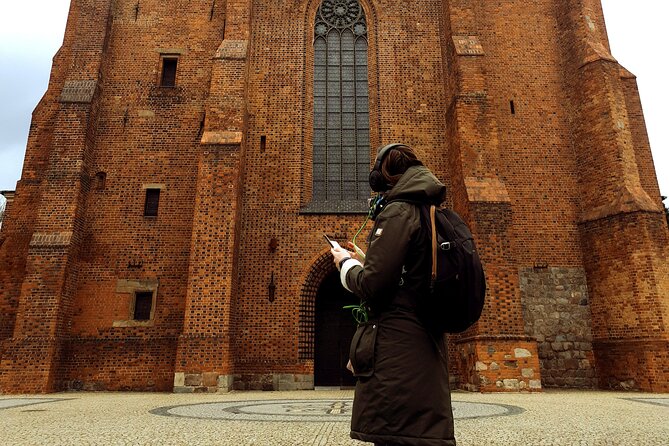
The walk continues past Poznań Cathedral, described as the oldest Polish cathedral. This is one of the route’s major landmarks, and the audio gives you context as you approach and pass it.
The value of this stop is not only the building itself. The cathedral helps explain why Cathedral Island mattered for so long. It links the religious center with the political story introduced earlier at Mieszko’s palace site.
You also pass the Archbishop’s Palace. The narration covers the building’s many changes and versions, which is a useful reminder that historic buildings rarely arrive in the present exactly as they began. Rebuilding, alteration, and changing needs are part of the story.
I like this section because it avoids making the walk only about one grand church. You get a cluster of sites that show how authority was organized around the island. Give yourself time to look up and around, since the audio is doing much of the explanatory work.
Crossing the Jordan Bridge into Śródka
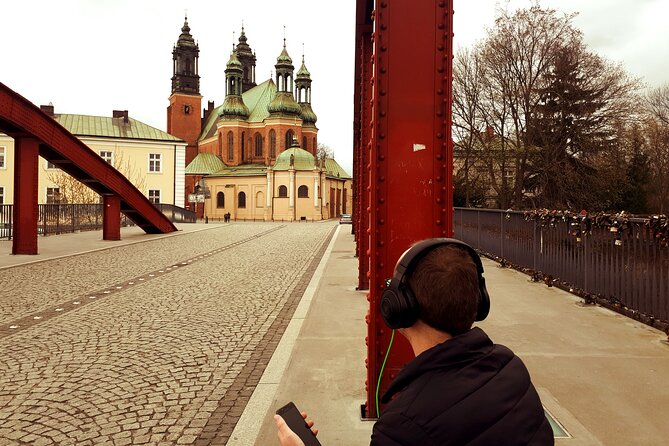
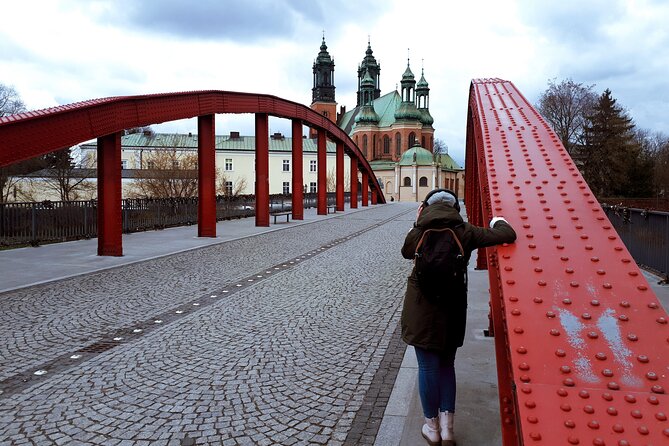
The Jordan Bridge provides the route’s clearest physical transition. You cross from Cathedral Island toward the Śródka District while hearing how the bridge was built, destroyed, and rebuilt.
That story gives the crossing more meaning than a simple walk over water. The bridge finally reconnected two parts of Poznań that had been separated, and the route lets you experience that connection with your own feet.
Śródka adds a different mood from the cathedral area. At one point, the district was independent from the rest of Poland. The audio uses that fact to show that Poznań was not always one unified urban space in the way it appears today.
This is also where the self-guided format works well. You can cross at your own pace, listen to the explanation, and stop briefly without worrying about losing a group. If road noise or other outdoor sounds interfere, headphones will help, though no audio tour can fully remove the sounds of the street.
More Audio Tours in Poland
- Wroclaw: E-Car Tour and Audio Guide
★ 4.6 · 1,738 reviews - Krakow: Day or Night Vistula River Cruise with Audio Guide
★ 4.5 · 1,303 reviews - Krakow: Hop-On Hop-Off Bus Tour with Audio Guide
★ 3.6 · 703 reviews - Krakow: Wawel Hill Audioguide Tour
★ 4.3 · 582 reviews
The Śródka mural and Saint Margaret Church
The route passes the Śródka mural, one of the first wall paintings of its type in Poland. This gives the walk a more modern visual point after the medieval and ecclesiastical sights.
The mural matters because it shows how an older district can tell its story through public art, not only through stone buildings and museum displays. It also gives you a clear visual landmark along the route.
Next comes Saint Margaret Church. The tour explains the church as you walk past. It is another chance to see how religious buildings shaped the district and how closely the area’s identity is tied to its churches.
Do not expect a long stop at every place. The format is designed for a moving walk, with short sections of narration rather than a full lecture at each building. I would pause the audio if you want extra time for photographs or a closer look, then resume when ready.
Brama Poznania and the choice of an indoor visit
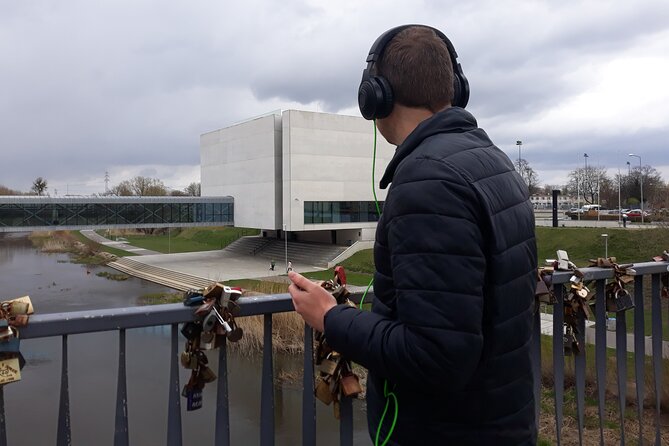
The walk passes Brama Poznania, also called the Porta Posnania Heritage Center. This modern museum was created in 2014 to present the story of Cathedral Island and Śródka.
Its presence makes the route more useful for planning the rest of your visit. The audio introduces the museum from outside, while you decide if you want to buy a ticket and spend more time indoors. Admission is not part of the $8.99 tour price.
That separation is worth keeping in mind when judging value. The audio tour is inexpensive because it gives you the route and narration, not a package of entrance tickets. If you want a low-cost orientation walk, the price works well. If you expect full access to every museum mentioned, you will need to budget extra.
Brama Poznania also marks the point where the route’s outdoor explanations can lead naturally into a longer visit. You could use the audio walk first, then return to the museum later, though the tour itself does not include transportation or admission.
Prussian fortifications at the Cathedral Lock
The Cathedral Lock is a 19th-century part of the Prussian fortification system. It is a useful reminder that Poznań’s story did not stop with the medieval cathedral and palace remains.
This stop broadens the tour’s time frame. You move from Poland’s early rulers and church foundations to a later period of military planning and imperial control. The old defensive structure may not have the immediate visual impact of the cathedral, but it helps explain why the island and surrounding districts mattered in different eras.
I appreciate stops like this on a short route. They keep the walk from becoming a string of religious buildings. You get a more layered look at the place, even though the tour remains compact.
Genius Loci and the city walls beneath your feet
The route also passes Genius Loci, a modern museum focused on the remains of the borough’s walls, which are about one thousand years old. The museum uses 3D films as part of its presentation.
This is another optional indoor extension. The audio tells you what the museum represents, but entrance is not included. If you are interested in archaeology, this may be one of the most useful places to add to your day because it connects the visible streets with the older walls below them.
The combination of relics and 3D films suggests a different experience from simply reading a plaque. Still, you should check the museum directly for current access details, since the tour information only establishes what the museum presents, not the exact admission arrangements.
Ending at the Archdiocese Museum
The walk ends in front of the Archdiocese Museum in Poznań, beside the Lubrański Academy at Jana Lubrańskiego 1. The museum occupies an important final position because the site played a major role in Poznań and Poland from the 1500s through the 1700s.
Ending here gives the tour a clean historical arc. You begin with the early center of power around Mieszko’s palace and the cathedral, cross into a district with its own past, then finish near an institution tied to later religious and national life.
The ending point is also practical. You are not returned to the starting point, so plan your next move from the museum area. The tour does not include transport, food, drinks, or entry fees. It is best viewed as a one-way walking route.
How the GPS audio format works in real use
VoiceMap’s main advantage is that the narration plays according to your location. You do not have to keep checking a printed route or tap a new track at every corner. That lets you look at the buildings instead of staring at your phone.
You can also pause and continue at your own pace. This is useful if you want coffee, photographs, a museum visit, or a quiet moment by the river. The tour remains available for lifetime use in English, so you can replay sections later rather than trying to remember everything during one walk.
The tradeoff is that an app cannot answer questions in the moment. A live guide can adjust an explanation, react to your interests, or help if you lose your way. Here, the route depends on your phone’s GPS and your ability to follow the instructions.
Technical preparation matters. The experience includes offline access to the audio, map, and geodata, so download everything before you begin. A support issue has been resolved quickly for at least one user in the past, but you should not rely on having a fast fix while standing at the starting point.
Is $8.99 good value?
At $8.99 per person, this is one of the cheaper ways to get structured information while walking through central sights. You are paying for an English audio route, a map, GPS guidance, and lifetime access rather than a fixed-time group departure.
I see the strongest value in the flexibility. You can start during the stated all-day operating period, walk alone or with your own group, and stop when something catches your eye. The route also covers several connected areas without requiring a separate transport ticket.
The value is lower if you want personal interaction or extensive indoor access. Museum tickets cost extra, and the audio cannot replace a live guide who can answer questions. The tour is also non-refundable and cannot be changed after booking, so test your phone, download the content, and make sure an audio walk suits your plans before paying.
Who will enjoy this Poznań walk?
I would choose this for an independent visitor who wants a short introduction to Cathedral Island and Śródka without committing to a group schedule. It also suits anyone who likes to pause often, take photographs, or split a walk around other plans.
It is a good fit for:
- People interested in Poland’s early rulers, church history, and old fortifications
- Visitors who want an English tour at a low price
- Independent walkers who dislike fixed departure times
- Couples or small groups who want to move at their own speed
- Anyone planning to visit Brama Poznania or Genius Loci and wanting context first
I would think twice if you need a live guide, have an unreliable smartphone, or prefer a tour that includes entry to museums. Most participants can take part, and the route is near public transport, but the supplied information does not promise a fully step-free route or describe specific surfaces.
Should you book The Birthplace of Poland?
Book it if you want a flexible, inexpensive walk through the part of Poznań where the country’s early story is tied to real places: a palace site beneath a church, the oldest Polish cathedral, a rebuilt bridge, old walls, and later fortifications.
The best reason to choose it is the mix of freedom and structure. You get a clear route without being rushed, plus enough historical detail to make the buildings and districts easier to understand. Just treat it as an outdoor audio introduction, not a guided museum tour. Download the content in advance, bring headphones, and budget separately for any museum you decide to enter.
FAQ
Where does the audio tour start?
It starts in front of the scale model of Cathedral Island at Makieta Ostrowa Tumskiego, Ostrów Tumski 9, 61-109 Poznań, Poland.
Where does the tour end?
The route ends in front of the Archdiocese Museum in Poznań, near the Lubrański Academy at Jana Lubrańskiego 1, 61-003 Poznań, Poland.
How long does the tour take?
The estimated duration is about 45 minutes to 1 hour 15 minutes.
What language is available?
The tour is offered in English.
Is a live guide included?
No. This is a private, self-guided audio activity using the VoiceMap app. Only your group participates.
What does the price include?
The $8.99 price includes lifetime access to the English tour, the VoiceMap app for Android and iOS, and offline access to the audio, maps, and geodata.
Are museum tickets included?
No. Tickets and entrance fees for museums or other attractions along the route are not included.
Do I need a smartphone and headphones?
Yes. A smartphone and headphones are not included, so you need to bring your own.
Can I cancel or change the booking?
No. The experience is non-refundable and cannot be changed for any reason.
Latest audio tours in Poland
- Wawel Hill Audio-Guided Tour★ 3.5 · 19 reviews
- Krakow Walking Tour with Audioguide on Your Smartphone★ 4.0 · 5 reviews
- Krakow: Vodka Factory Museum – Entrance Ticket and Audioguide★ 5.0 · 3 reviews
- Wawel Hill Audio Guided Tour★ 3.0 · 2 reviews
- Krakow Jewish Ghetto and Quarter Audio Guided Walking Tour★ 4.5 · 9 reviews
- Gdansk Scavenger Hunt and Highlights Self Guided Audio Tour★ 5.0 · 6 reviews
- Malbork Castle Regular Audioguided Tour★ 4.5 · 15 reviews
- Krakow: Old Town Audio-Guided Walking Tour with Headset★ 4.5 · 12 reviews
Self-Guided Audio Tours, compared.
Acropolis Ticket & Optional Self-Guided Audio Tours
Read our review →


Ultimate Acadia National Park Self-Guided Driving Audio Tour
Read our review →

Akrotiri Ticket with Optional Self-Guided Audios
Read our review →
Browse the lists this tour appears in