
Reviewed · CANADA
Sights of Moose Jaw Smartphone Audio Walking Tour
Moose Jaw’s most entertaining stories are tucked into ordinary streets: railway tracks once linked to bootleg liquor, Al Capone lore runs beneath downtown, and a mineral spa grew from an accidental discovery. This self-guided audio tour connects those stories with more than 30 stops, using your phone as both map and guide.
I like the freedom to start, stop, and pause anywhere, and I like the way the GPS map keeps the walk easy to follow. You can explore alone or with your own group, skip a stop, linger at a mural, or pause for lunch without holding up anyone else.
The main drawback is practical: your phone battery matters. One person found the battery ran out before the final stop, so download the tour on Wi-Fi, start with a full charge, and bring a power bank if you have one. The audio also works best when you are ready to pay attention to your device as you walk.
Key points at a glance
- More than 30 downtown stops: See churches, murals, historic buildings, parks, the railway yard, and the Tunnels of Moose Jaw.
- GPS-triggered audio: Commentary plays as you approach each location, with a live map showing your position and next stop.
- A flexible one to two hour walk: The tour is yours to use anytime, and you can pause or restart along the route.
- Optional location trivia: Answer a question after each commentary segment for a light game-like touch.
- A very low price: At $6.71 per person, it costs far less than most hosted sightseeing walks, though admission to attractions is separate.
- Private by design: Only your group takes part, with no crowd, fixed departure time, or guide to keep pace.
Moose Jaw stories, told one street corner at a time

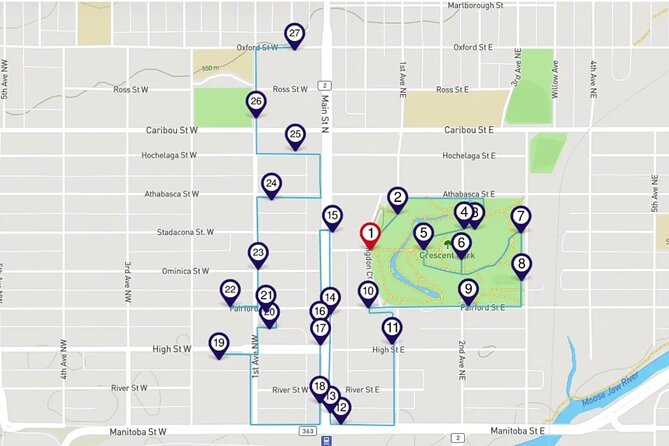
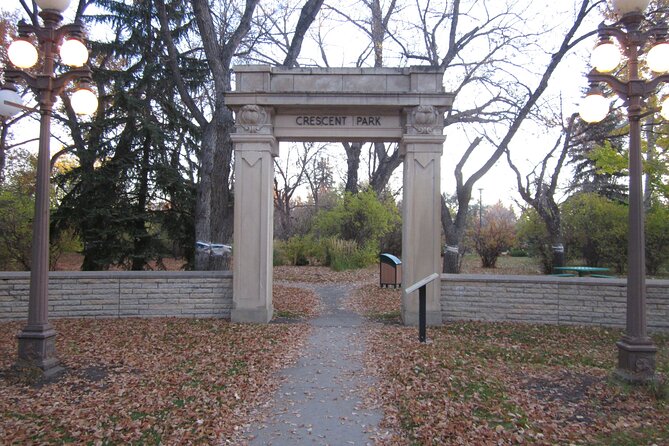
The tour begins at Crescent Park and ends at the Latimer Residence at 37 Oxford Street West. That route gives you a useful introduction to central Moose Jaw without asking you to sit through a long presentation or follow a flag-waving guide.
You listen through your smartphone as you walk. The GPS map shows where you are, and the next piece of commentary is designed to play when you reach the right area. This is a good setup for anyone who likes a clear route but dislikes being tied to a group.
The commentary is divided into short sections, generally around five minutes at a stop. That makes the experience easy to fit around your day. You can finish in roughly one to two hours, but the tour has no strict time limit, so you can stop for photographs, food, shopping, or a closer look at a building.
The optional trivia is a nice extra rather than the main reason to book. After the audio plays, you tap your answer on the phone. It gives children and competitive adults something to do, while everyone else can simply listen and keep walking.
More Audio Walking Tours in Canada
- Halifax Churches, Gardens & Graveyards: a Smartphone Audio Walking Tour
★ 4.5 · 25 reviews - Halifax Boardwalk & Seaport: a Smartphone Audio Walking Tour
★ 4.0 · 19 reviews - Explore Halifax with 3 Unique Smartphone Audio Walking Tours
★ 4.0 · 16 reviews
Crescent Park: fountains, memorials, and local character
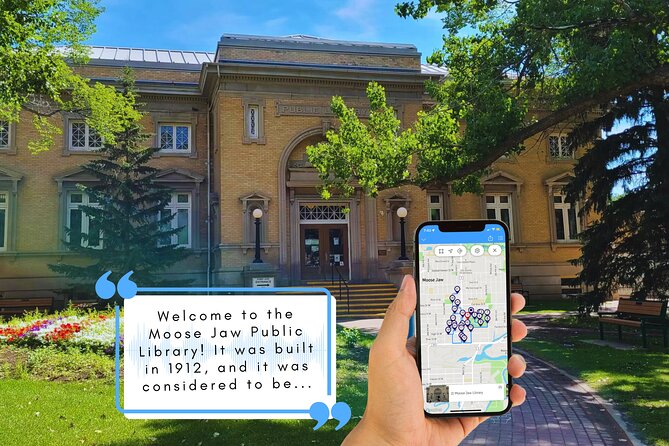
Crescent Park is a sensible place to begin because several early stops sit close together. The first commentary introduces the walk at the Moose Jaw Public Library, then leads you through the park and its nearby landmarks.
At the Crescent Park Amphitheatre, you hear how the venue came together in 1972 and learn about the painted murals around it. The stop is short, but it helps you notice how public art and performance spaces shape the city center.
The Crescent Park Cenotaph, also called the Cross of Sacrifice, gives the route a more solemn pause. Designed by Reginald Bloomfield and built by the Moose Jaw Marble and Granite Company in 1923, it was unveiled during the first Armistice Day ceremony. You do not need to enter a building or buy a ticket here, so it is an easy stop to take at your own pace.
The park’s fountain and waterfalls follow. This is the kind of location that can be easy to pass without context, but the audio gives you a reason to look more closely. The route then points you toward the Canadian National Railway Station, where you hear about the old station’s design and past.
A stop at the Crescent Park Tennis Club adds a lighter local detail, including the courts’ claim to fame. At the Moose Jaw Natatorium, the story turns to the famous Moose Jaw Mermaid. These small subjects keep the walk from becoming a parade of dates and architectural labels.
Mineral water and unusual church stories

Temple Gardens Hotel and Spa is one of the most distinctive stops. The audio explains how Moose Jaw’s natural geothermal mineral waters were accidentally discovered in 1910. You should think of this as an exterior sightseeing stop unless you separately arrange access to the spa or hotel.
Next comes St. Mark’s Presbyterian Church, described through its unusual history and changing occupants. St. Aidan Anglican Church offers a different architectural note, with its Gothic Revival design dating from 1909. If church architecture interests you, these stops give the route useful variety. If it does not, the commentary is short enough that you can keep moving.
The route also passes a building now used as a political office. Its changing purpose gives you a quick look at how downtown buildings can outlast their original roles. These stops are not major attractions with ticketed interiors, but they help you read the town as a working place rather than a collection of preserved façades.
Railways, Prohibition, and the Tunnels of Moose Jaw
The railway material becomes more colorful at the CPKC Rail Moose Jaw Yard. You hear how the station served as a funnel for bootleg liquor during Prohibition and about the ironic turn its later story took. This is one of the stronger history sections because it connects Moose Jaw’s rail location with the city’s reputation for secrecy and illicit trade.
The Tunnels of Moose Jaw is the route’s biggest named attraction. The audio covers the Al Capone connection and the local stories about organized crime and hidden liquor traffic. The stop itself is included in the walk, but admission to the Tunnels is not included. If you want the full underground attraction, plan and pay for that separately.
That distinction matters. The audio tour gives you context from outside, but it does not replace the ticketed Tunnels experience. You can still complete the walking route without going inside.
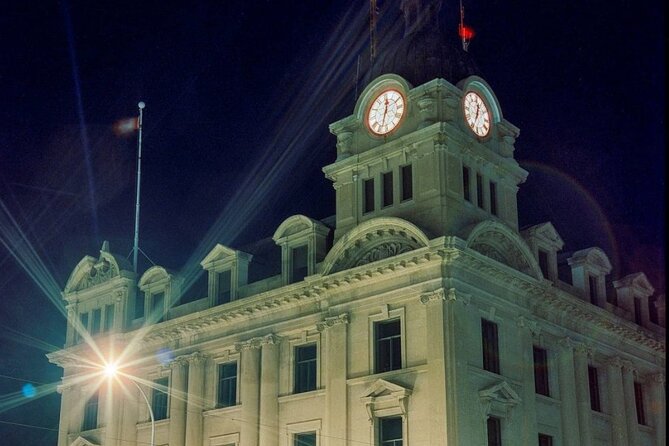
The tour then moves to Moose Jaw City Hall, where the commentary links the stone-colored building with fossils. It is an unexpected pairing and a good example of the tour’s approach: short stories that encourage you to look twice at places you might otherwise photograph and leave.
More Smartphone Audio Tours in Canada
- Cabot Trail: a Smartphone Audio Driving Tour
★ 4.5 · 118 reviews - Icefields Parkway: a Smartphone Audio Driving Tour
★ 4.0 · 118 reviews - Smartphone Audio Driving Tour between Banff and Calgary
★ 4.0 · 25 reviews - Smartphone Audio Driving Tour between Lake Louise and Calgary
★ 4.0 · 15 reviews
Churches, department stores, theatres, and civic buildings
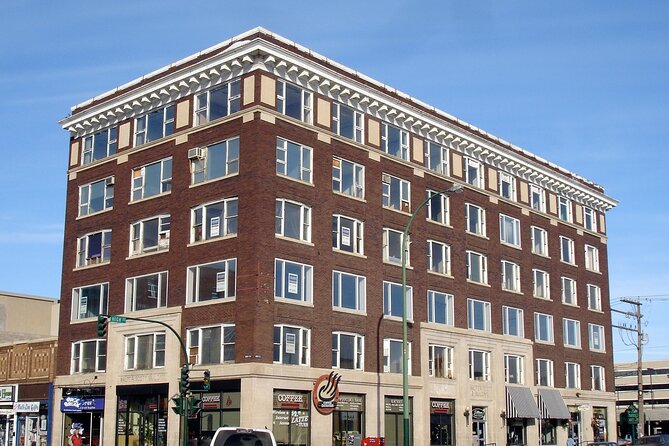
Moose Jaw Zion United Church is described as a large, imposing building with an interesting historical detail. From there, the route points to the Eaton’s Building, a heritage property connected with one of Canada’s best-known department store chains.
These stops help explain the commercial side of downtown. Eaton’s was not just a shop name. Department stores shaped how people bought clothing, household goods, and other everyday items, and their old buildings still help define historic main streets.
At the Capital Theatre, also called the Mae Wilson Theatre, you hear about the building’s theatre and performing arts past. This is a useful stop for anyone interested in old cinemas, live shows, or the way entertainment venues anchor a downtown district.
The Army and Navy Store, now connected with the Moose Jaw Cultural Centre, adds another piece of the streetscape. The commentary focuses on how the building contributes to the look and feel of the street. The Walter Scott Building follows, with a story about the building’s purpose and what Walter Scott himself might have said about it.
At Mosaic Place, the subject shifts to sports, music, and performances. This stop shows that Moose Jaw’s public life is not limited to old buildings. The city continues to use its central venues for events, games, and concerts.
Murals and the story of land ownership

Murals appear throughout the walk, and the route points out several of the more prominent examples. The Breaking New Ground mural is especially useful because it illustrates the process of gaining land ownership in Saskatchewan.
That gives the public art a clear purpose. You are not just looking at a painted wall. You are seeing a visual explanation of settlement, land, and ownership, with the audio supplying the background that may not be obvious from the image alone.
The Tribute to the Métis mural adds another important historical perspective. It features Louis Riel, a Métis leader associated with the North West Rebellion. This stop broadens the route beyond architecture and local folklore, placing Moose Jaw within larger Saskatchewan and Canadian events.
The mural stops are also good places to slow down. Since the audio is yours to pause, you can take time with the artwork instead of trying to listen while crossing the street or keeping up with a group.
Land Titles, the courthouse, and old public services
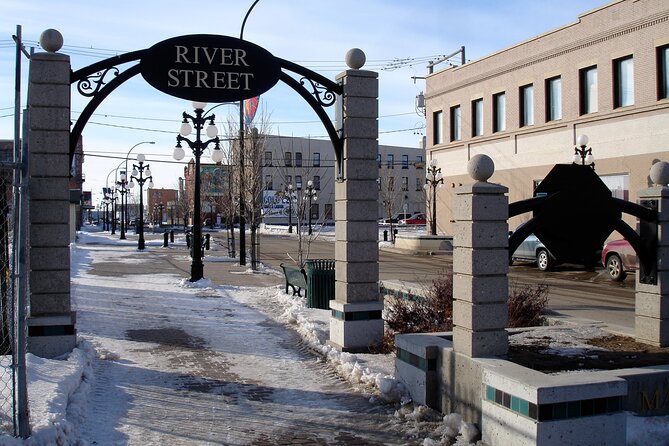
The Land Titles Building, completed in 1910, offers a look at how land records were handled during a period of major change in the region. The commentary explains its role in transferring land titles around the turn of the century.
The Old Fire Hall brings the story back to municipal services. It is a compact stop, but it helps you see how a city’s needs shaped its public buildings. The Moose Jaw Courthouse adds another civic landmark and is identified as a National Historic Site with a particular distinction.
At Hopkins Dining Parlour, the tone turns spooky. The restaurant is known as one of Saskatchewan’s most haunted places, and the audio tells you who is said to haunt it. Treat this as local folklore rather than a promise of anything supernatural, but it is a welcome change after the legal and administrative buildings.
Central Collegiate Institute is another notable stop. More than 110 years old, it remains one of Saskatchewan’s oldest operating public schools. The commentary also covers famous people the school has hosted, giving the building a connection to the wider community.
Finishing at the Latimer Residence
The final named stop is the Latimer Residence at 37 Oxford Street West. This two-and-a-half-story, brick-clad house was completed in 1905 and sits on a tree-lined street beside houses of a similar age and scale.
It is a fitting finish because the route ends with residential architecture rather than another civic or commercial building. You get a sense of how Moose Jaw’s older neighborhoods relate to the downtown core and how original features can survive in a lived-in setting.
The tour also passes nearby points of interest that are not formal audio stops. You can spend as much time as you like at those places, and the route includes a walk through the park as you visit several of its points of interest.
What the $6.71 price really gives you
At $6.71 per person, this is one of the least expensive ways to get a structured introduction to Moose Jaw. For the price, you receive the audio content, GPS route, optional trivia, flexible use, and customer support by phone and email.
The key value is not simply the low price. It is the combination of private use and no time pressure. A conventional guided walk may offer live interaction, but it also has a set departure, a fixed pace, and a group. Here, you pay for a digital guide that can fit around your own schedule.
The price does not cover your smartphone, headphones, or attraction tickets. Audio plays through the phone speaker, so headphones are optional. The tour should be downloaded on Wi-Fi before you go, and once downloaded, it does not require a signal or mobile data during the walk.
You also pay per device, not just per person in an abstract sense. The number of people selected determines how many devices can download the tour. If several people want to follow along separately, check that you have selected enough devices.
Practical details that affect your walk
The starting point is Crescent Park on Langdon Crescent. The route ends at the Latimer Residence, 37 Oxford Street West. Since the attraction is open for use from midnight through 11:30 p.m. daily during the stated operating period, you have plenty of scheduling freedom, though some recommended places may be closed or inaccessible depending on the season or other conditions.
Most people can take part, service animals are allowed, and the route is near public transportation. It is a private activity for your own group, not a shared tour.
I would download everything before leaving and bring a fully charged phone. The audio is the heart of the experience, and losing power before the last stop would cut short the walk. If you use headphones, keep the volume low enough to stay aware of traffic and other people around you.
The cancellation policy is generous if your plans change early: cancel at least 24 hours before the start time for a full refund. Changes or cancellations made inside that 24-hour window are not accepted and are not refunded.
Who will enjoy this audio walk most?
I would recommend it to independent sightseers who want a route but not a group. It also suits couples, families, and small groups who like mixing local history with exercise and outdoor time.
It is particularly useful on a first visit, when you want help finding the main sights without spending much money. The map removes much of the guesswork, while the short audio sections let you control the pace.
You may want something else if you prefer a live guide who can answer questions in real time, tell longer stories, or take you inside every attraction. The audio format is efficient, but it cannot respond to your interests or adjust its commentary on the spot.
The tour earns a 4.7 rating from six ratings, with the strongest praise focused on easy navigation, the way the background brings buildings to life, and the chance to combine walking, sightseeing, and fresh air. The battery warning is the practical lesson to take seriously.
Should you book the Sights of Moose Jaw tour?
Book it if you want a low-cost, flexible introduction to central Moose Jaw, especially if Prohibition stories, railway history, murals, old churches, and civic buildings appeal to you. At $6.71, the route gives you a lot of context for very little money.
Skip it if you want a fully hosted experience or expect attraction admission to be included. The best plan is to use this as your orientation walk, then choose one or two places, especially the Tunnels of Moose Jaw, to explore more deeply on your own.
FAQ
How long does the Sights of Moose Jaw Smartphone Audio Walking Tour take?
The tour takes approximately one to two hours, but there is no time limit. You can stop, pause, and restart anywhere along the route.
Where does the tour start?
It starts at Crescent Park on Langdon Crescent in Moose Jaw, Saskatchewan.
Where does the tour end?
The tour ends at the Latimer Residence at 37 Oxford Street West. The house is a two-and-a-half-story brick-clad residence completed in 1905.
Is the tour guided by a live person?
No. You listen to audio commentary through your smartphone. GPS triggers the commentary as you approach each location.
Do I need mobile data or a signal during the walk?
No. You should download the tour on Wi-Fi before starting. After downloading, no signal or mobile data is required during the tour.
Are attraction tickets included?
No. Admission tickets are not included. This applies to recommended attractions such as the Tunnels of Moose Jaw.
Can I use the tour on a different date?
Yes. The tour is flexible and can be used anytime after booking, not only on the original booking date.
What happens if I need to cancel?
You receive a full refund if you cancel at least 24 hours before the experience start time. Cancellations or changes made less than 24 hours in advance are not accepted or refunded.
Latest audio tours in Canada
- Fruit alcohol tasting + Velvet Orchards audio tour★ 5.0 · 2 reviews
- APP Self-Guided Tours Quebec with Audioguide★ 3.0 · 2 reviews
- Quebec City Self-Guided Driving Audio Tour★ 4.0 · 7 reviews
- Layers of Natural History: Picton Nature Self-Guided Audio Tour★ 5.0 · 4 reviews
- Smartphone Audio Driving Tour between Wasaga Beach and Toronto★ 4.5 · 3 reviews
- Niagara: Behind The Falls, Skylon Tower Ticket & Tesla Audio Tour★ 3.5 · 69 reviews
- Niagara Falls Pass: 5 Iconic Attractions, WEGO Bus & Audio Guide★ 5.0 · 7 reviews
- Niagara Peninsula: a Smartphone Audio Driving Tour★ 4.0 · 10 reviews
Audio Walking Tours, compared.

City Monuments Guided Walking Tour with Audio Guide
Read our review →
Self Guided Classic Freedom Trail Location Aware (GPS) Walking Audio Tour
Read our review →
Self-Guided Historical Walking Tour (Audio Guide)
Read our review →
Cape Cod & Provincetown Self-Guided Driving & Walking Audio Tour
Read our review →
Verona Walking Tour with Audio and Written Guide by a Local
Read our review →
Royal Walking Tour and Buckingham Palace Audio Tour
Read our review →
Bologna Walking Tour with Audio and Written Guide
Read our review →Browse the lists this tour appears in