

Reviewed · USA
Sights of Downtown Houston Smartphone Audio Walking Tour
Houston’s story unfolds block by block on this self-guided downtown walk, beginning at the 1847 Kellum-Noble House and ending at the grand Cotton Exchange. Along the way, Davis introduces you to old homes, public buildings, theaters, churches, skyscrapers, Buffalo Bayou, and the people who shaped the city.
I like two things right away: the route is flat and flexible, and the $10.99 price gives you a private experience you can take at your own pace. You can pause for photos, stop for food, or spread the walk out without waiting for a group. The main drawback is the app. GPS autoplay may fail, and you may need to start recordings manually.
Key points to know before you go
- Start at an 1847 Houston home: The Kellum-Noble House gives the walk an unusually old-fashioned opening in a modern city.
- See about four miles of downtown: The route is flat, but the distance means plenty of walking and standing.
- Davis provides the narration: Commentary covers Houston’s history, architecture, arts, churches, theaters, and public spaces.
- Download before leaving Wi-Fi: Once saved, the tour uses no mobile data and does not require a signal.
- Expect some app management: The GPS map and automatic playback may work imperfectly on some phones.
- Finish at the Cotton Exchange: The route ends at the 1884 trading center for Houston’s cotton industry.
A 1847 house is the right place to meet Houston

The tour begins at the Kellum-Noble House, at 212 Dallas Street. Built in 1847, it is one of the city’s oldest homes, and it gives you a useful starting point for understanding how quickly Houston grew from a small settlement into a major American city.
Davis, the recorded guide, introduces the tour here before leading you through downtown. The opening stop is more than a place to press play. It sets up the contrast that defines the walk: modest early buildings beside grand civic halls, Art Deco towers, theaters, hotels, and newer city institutions.
From the first stop, the route heads toward a museum complex devoted to preserving and explaining Houston and the surrounding area. Several historic buildings are gathered there, so you get more than one look at the city’s early domestic architecture.
The next stop is a cabin believed to be one of Houston’s oldest surviving structures. Its importance is not based on size or decoration. It represents the practical beginnings of the city, when a small cabin could tell you more about daily life than a tall office tower.
You’ll also hear the story of a house known by three names. The reason for that unusual title is part of the narration, so this is one place where listening closely matters. The tour is at its best when it connects a building’s name with the people and changes behind it.
More Audio Walking Tours in the USA
- Self Guided Classic Freedom Trail Location Aware (GPS) Walking Audio Tour
★ 4.5 · 258 reviews - Cape Cod & Provincetown Self-Guided Driving & Walking Audio Tour
★ 4.0 · 207 reviews - Santa Fe Historic Downtown Smart Phone Audio App Self Guided GPS Walking Tour
★ 4.5 · 112 reviews
Sam Houston Park brings the early city into the present
Sam Houston Park was established in 1900 as Houston’s first public park. It is a useful pause in the route because it gives you open space between the historic structures and the heavier downtown streets.
The park helps explain how Houston has tried to preserve pieces of its past. The city grew rapidly, yet historic homes and buildings were gathered here rather than lost entirely to redevelopment. You can take your time at this point, especially if you want photographs or need a short rest.
From the park, the walk turns toward Houston’s civic center. The narration covers Houston City Hall and its place on the city skyline. City Hall is a good example of how public architecture can express a city’s confidence, ambition, and idea of itself.
The route then reaches the Julia Ideson Building, named for the first librarian of the Houston Public Library. This stop adds a civic and educational layer to the tour. You are not simply moving from one old building to the next. The story shifts from private homes to public institutions built to serve a growing population.
Downtown architecture changes from Art Deco to modern Houston

Architecture is one of the strongest parts of this experience. The route includes an Art Deco commercial building added to the National Register of Historic Places in 1983. It is considered an important example of early 20th-century commercial architecture in Houston.
You’ll also see its Art Deco neighbor, described as downtown Houston’s only complete example of a particular architectural type. The narration supplies the missing detail, and the pairing makes the point clearly: two nearby buildings can reveal different design choices from the same period.
Another stop covers a historic skyscraper completed in 1929 and designed by Crain & Coe in the Art Deco style. This is the kind of stop that works best when you look up. Houston’s downtown towers can blur together at street level, but details in the upper floors, entrances, and decorative lines help show what made early skyscrapers special.
The tour also points out an eye-catching structure built in 1911. The supplied route details do not identify it by name, so you’ll rely on the audio and map when you reach it. That uncertainty is not a problem on the walk itself, but it is another reason to keep your phone ready rather than treating the tour as a simple checklist.
Churches, hotels, and performance halls show another Houston
The route visits an Episcopal cathedral founded in 1839. It is the oldest continuously operating church in Houston, giving you a direct link to the city’s early religious and civic life.
The narration then covers a historic hotel built in 1913 and named for William Marsh Rice. That name connects the building to one of Houston’s most important figures and to the broader story of wealth, education, and institution-building in the city.
The next stops shift toward the performing arts. You’ll hear about a venue, the people who use it, and the gentleman whose name it carries. The route also includes one of the oldest and most respected theater companies in the United States.
Another performance venue hosts a wide range of arts events and plays an important role in Houston’s cultural life. These stops help keep the walk from becoming an architecture lesson alone. You get a sense of the city as a place where buildings remain active parts of public life.
I like this stretch because you can connect the physical city with what happens inside it. A theater is not only a façade, and a historic hotel is not only a preserved address. The audio explains why these places mattered and how they fit into Houston’s development.
More Smartphone Audio Tours in the USA
- Self-Guided GPS Audio E-Bike Tour Hawaii Volcanoes National Park
★ 4.5 · 131 reviews - Ultimate Portland Self-Guided Driving GPS Audio Tour
★ 4.0 · 56 reviews - Birmingham Civil Rights Walk of Freedom Smartphone Audio App Tour
★ 5.0 · 40 reviews - Self Guided GPS Audio Driving Tour Acadia NP From Hulls Cove VC
★ 4.0 · 25 reviews
The aquarium and Buffalo Bayou widen the story

The Downtown Aquarium is another stop. Established in 2003, it houses more than 200 species of marine animals. Compared with the older buildings on the route, it represents a newer kind of downtown attraction, one designed around entertainment and family visits.
The audio also introduces Buffalo Bayou, a key feature of the Houston area. This is an important change of subject. Houston is not only a collection of streets and buildings. Waterways helped shape the city’s location, movement, and growth.
The route continues into the Old Town area, known for its mix of restaurants, bars, shops, and entertainment venues. You’ll hear how this district came to be, which adds a neighborhood story to the larger account of downtown.
This portion may tempt you to pause for a meal or drink. The tour has no fixed time limit, so you can do that without falling behind a live group. Just remember that the stated walking time is about two to three hours, and stopping along the way will make the outing longer.
The theater district and courthouse close the historical loop

The walk includes a grand theater designed in the Art Deco style. The supplied description leaves its defining feature for the audio, so listen at the stop rather than expecting all the details in advance.
You’ll also reach the Harris County Courthouse, an important example of early 20th-century public architecture in Texas. Courthouses often tell a useful story about how a region organized itself, and this one gives the tour another look at the formal side of Houston’s growth.
One especially playful stop uses a recording of Augustus Chapman Allen, one of Houston’s founders, to describe the history of his namesake landing. Hearing a historical figure presented in character gives the audio a little personality without requiring a live performer to lead the walk.
These stops bring together the city’s theater, government, and founding stories. The route is strongest when it moves between grand subjects and concrete places you can inspect from the sidewalk.
The Cotton Exchange provides a fitting finish
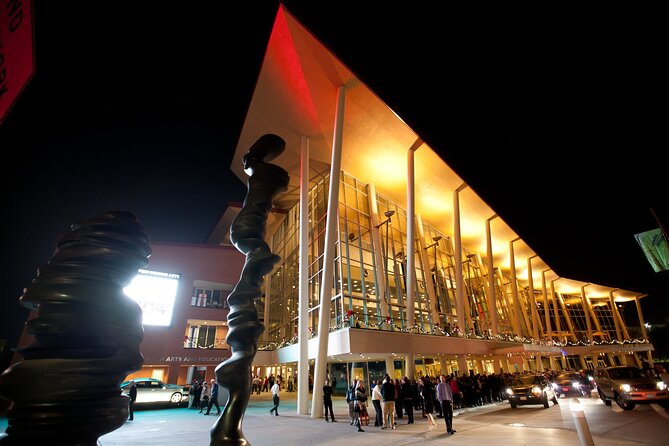
The final stop is the Houston Cotton Exchange and Board of Trade at 202 Travis Street. Built in 1884, this impressive structure was the trading center for Houston’s cotton industry.
That makes the ending especially useful. Cotton helped drive Houston’s commercial growth, and the exchange connects the city’s economic history to the buildings and institutions you have seen earlier.
The tour ends at the Cotton Exchange, and the instructions provide directions back to the first stop. That matters if you left a car nearby or want to return to your starting point. The route is not simply a loop that leaves you guessing where to go next.
By the end, you have moved from an early home and cabin through parks, libraries, churches, hotels, theaters, public offices, commercial buildings, and the waterway that helped shape the area. It is a broad introduction to downtown Houston rather than a close study of one subject.
How the audio app works in real use

The tour is designed to play commentary automatically as you reach each point of interest. A live GPS map shows the route and your location, and the audio can be downloaded over Wi-Fi before you leave.
You do not need a signal or mobile data once the tour is downloaded. That is a real advantage in a city walk, since you can conserve data and avoid depending on a strong connection in every block.
The software is not perfectly dependable on every device. GPS recognition may fail, which means the narration might not start by itself. One practical solution is to keep the app open, check the map at each stop, and be prepared to tap the next recording manually.
The app may also return to its main screen after you switch away to take a photograph. If you use your phone heavily for photos, expect to reopen the tour or navigate back into the route from time to time.
Headphones are optional. Audio plays through your phone or tablet speaker, although headphones may make the narration easier to hear around downtown traffic. You need to provide the smartphone or tablet yourself.
The walking demands are simple but not slight
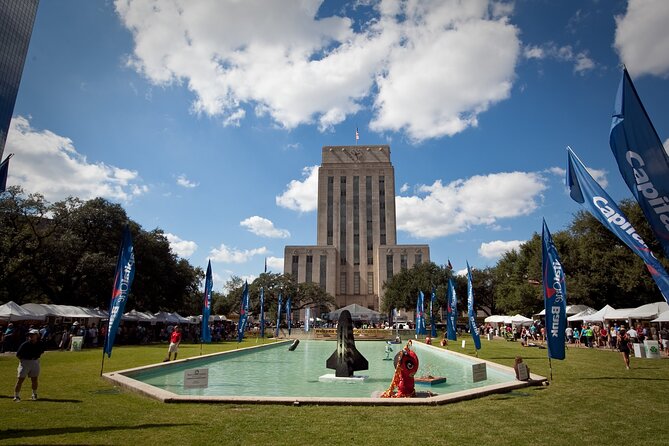
The route is flat and suitable for anyone comfortable walking several miles. One account places the total at about four miles, so do not mistake the easy terrain for a short stroll.
You’ll spend time walking and standing at each stop. Wear comfortable shoes, carry water, and allow more than the minimum two hours if you want to read plaques, take photographs, or pause in the park.
The experience is private, meaning only your own group participates. There is no live guide setting the pace, and that can be a major benefit for couples, families, or friends who prefer to stop when they wish.
The tour is offered in English. Service animals are allowed, and the route is near public transportation. A moderate level of physical fitness is recommended.
Is $10.99 good value for downtown Houston?
At $10.99 per person, this is an inexpensive way to get structure and context for a downtown walk. You receive recorded narration, a route map, GPS points, offline access, and the freedom to use the tour on a flexible schedule.
The value is strongest for a first visit to downtown Houston or for anyone who likes exploring independently but wants more than a map. You can cover many different subjects without paying for a private live guide.
The price is less compelling if you expect perfect hands-free operation. You are paying for a self-guided tool, not a person who watches the route, answers questions, and adjusts the pace. If the GPS fails on your device, you may need to manage the walk yourself.
You can also keep the tour and use it at any time through Tripvia Tours, with no fixed time limit to complete it. That flexibility makes it easier to fit around a larger Houston itinerary.
Who should book this walk?
I would choose this tour if you want a broad introduction to Houston’s downtown history, enjoy walking at your own speed, and are comfortable using a phone app.
It suits:
- Independent visitors who do not want to join a scheduled group
- Architecture fans interested in Art Deco, civic buildings, churches, and early skyscrapers
- Families or friends who want a private route with the option to stop
- Budget-conscious visitors who want narration without hiring a live guide
- People with a half-day available for a flat downtown walk
I would think twice if you dislike phone-based tours, cannot comfortably walk about four miles, or want reliable automatic playback at every stop. In that case, a live guide may be easier.
You can cancel up to 24 hours before the experience for a full refund. Confirmation arrives at booking, and the tour is available daily according to the listed hours.
Should you book the Sights of Downtown Houston walk?
Book it if you want a low-cost, flexible way to connect Houston’s oldest homes with its public buildings, Art Deco architecture, arts venues, Buffalo Bayou, and cotton-trading past.
The best parts are the range of sights, the flat route, Davis’s narration, and the freedom to pause whenever you like. Download everything before leaving Wi-Fi, start at the Kellum-Noble House, and expect to control the audio manually if the GPS does not cooperate.
This is not a polished substitute for a live guide, but it is a useful walking framework. At $10.99, it offers solid value for a curious walker who wants Houston to explain itself one downtown block at a time.
FAQ
Where does the tour begin?
The tour begins at the Kellum-Noble House, 212 Dallas Street, Houston, Texas 77002.
Where does the tour end?
It ends at the Houston Cotton Exchange and Board of Trade, 202 Travis Street, Houston, Texas 77002. Directions are provided to return to the first stop.
How long does the walk take?
The tour takes about two to three hours, although stops for photos, food, or rest can make it longer.
Is the route difficult?
The route is flat, but it involves substantial walking and standing. One account estimates about four miles, and a moderate level of physical fitness is recommended.
Do I need mobile data during the tour?
No. Download the tour over Wi-Fi before you begin. The saved tour does not require a signal or mobile data.
Does the tour include a live guide?
No. Davis provides recorded audio commentary, while the GPS map shows the route and your location. Only your own group participates.
What do I need to bring?
You need your own smartphone or tablet. Headphones are optional because the audio can play through the device speaker.
Latest audio tours in the USA
- Sequoia National Park Self-Guided Audio Tour★ 4.5 · 9 reviews
- Sequoia and Kings Canyon Audio Tour Self Guide National Park Tour★ 5.0 · 3 reviews
- Kings Canyon National Park Self-Guided Audio Tour★ 4.0 · 4 reviews
- Sedona, Arizona Self-Guided Audio Tour★ 4.0 · 36 reviews
- Sedona & Red Rock State Park Self-Guided Driving Audio Tour★ 3.0 · 30 reviews
- Haunted Savannah Self-Guided Walking Audio Tour★ 4.5 · 3 reviews
- Downtown Seattle Self-Guided Walking Audio Tour★ 4.5 · 6 reviews
- Uncover Seattle: Self-Guided Audio Tour★ 3.5 · 7 reviews
Audio Walking Tours, compared.

City Monuments Guided Walking Tour with Audio Guide
Read our review →

Self Guided Classic Freedom Trail Location Aware (GPS) Walking Audio Tour
Read our review →
Self-Guided Historical Walking Tour (Audio Guide)
Read our review →
Cape Cod & Provincetown Self-Guided Driving & Walking Audio Tour
Read our review →
Verona Walking Tour with Audio and Written Guide by a Local
Read our review →
Royal Walking Tour and Buckingham Palace Audio Tour
Read our review →
Bologna Walking Tour with Audio and Written Guide
Read our review →Browse the lists this tour appears in