

Reviewed · USA
Scenic A1A Byway Self Guided Driving Audio Tour
A 44-mile coastal drive links Jacksonville Beach and St. Augustine, with the Atlantic on one side and stories about forts, pirates, beaches, wildlife, and Timucuan culture in your ears. The route includes more than 38 audio stories, though the listed highlights focus on 17 major stops.
I love the freedom to stop for lunch, beach time, or photos without holding up a group. I also like the price: $16.99 covers the whole car, up to four people, making it a strong value for a family or small group.
The main catch is that this is an app, not a person waiting at the starting point. You need to download the tour over strong Wi-Fi or cellular service, get oriented with the opening route, and keep your phone connected to your car stereo.
Key points to know before you drive

- The route runs from Jacksonville Beach to St. Augustine, covering about 44 miles and taking roughly two to three hours without long side trips.
- The audio starts by location, so stories play as you reach the right points along A1A.
- One $16.99 purchase covers up to four people, not one person at a time.
- You get lifetime access with no expiry, so you can pause, return to the route, or use it again on another trip.
- The strongest stops mix beaches and history, from Mickler’s Landing and Guana Reserve to Castillo de San Marcos and Fort Matanzas.
- You must set up the Action Tour Guide app yourself, since no guide meets you at the start.
What this A1A drive actually feels like

This is best understood as a scenic road trip with an audio guide, not a tightly scheduled sightseeing tour. You begin near Jacksonville Beach and follow A1A south toward St. Augustine, letting the app provide background as you pass beaches, preserves, old buildings, and historic landmarks.
The route is designed for a relaxed pace. The stated driving time is two to three hours, but that assumes you are not spending much time at the parks, museums, beaches, or forts. Add a meal, a walk, or a long stop at the coast, and this can easily become a half-day outing.
I like that arrangement. You can pause the stories, pull over, and continue later. You are not paying for a bus seat that leaves at a fixed hour. You are also not tied to a guide’s pace or a full group’s interests.
The audio is hands-free and location-based. Once you reach the starting point for a story, it should begin automatically, then guide you toward the next point. Keep the app open, follow the route, and drive at the posted speed limit for the smoothest experience.
More Self-Guided Audio Tours in the USA
- Gettysburg Battlefield Self-Guided Driving Audio Tour
★ 4.5 · 910 reviews - Joshua Tree National Park Self-Guided Driving Audio Tour
★ 4.5 · 762 reviews - Ultimate Acadia National Park Self-Guided Driving Audio Tour
★ 4.0 · 521 reviews
Starting at Jacksonville Beach and Mickler’s Landing
The opening section introduces the coast around Jacksonville Beach before leading you toward Mickler’s Landing. This is a useful first stop because it gives you an immediate taste of what the drive does best: pair a simple coastal stop with a short piece of local information.
Mickler’s Landing is known for surfing, seashells, and shark teeth. You do not need to make it a long beach visit. Even a brief stop lets you stretch your legs and see why A1A is more than a point-to-point road.
The route includes Mickler’s Landing twice in the supplied stop information, so do not be surprised if the audio revisits the area or presents separate story points. The tour has more than 38 stories overall, and not every audio point is a major attraction requiring a separate visit.
Guana Reserve and the Timucuan story
Guana Reserve Middle Beach brings a change of pace. The area is part of a broad estuary where scientists study plants and animals. For you, the value is not only the scenery. The stop gives the drive a natural-history layer that you will not get from a simple beach transfer.
The Timucuan Ecological and Historical Preserve adds an important cultural story. The audio explains how water shaped Timucuan life and how the moon was linked with water and motherhood. It also discusses the Timucuan practice of tracing family lines through mothers.
That detail is one of the better reasons to use an audio tour here. You could drive past the preserve, see marshes and coastal vegetation, and miss the human story connected to the place. The narration gives you something specific to listen for instead of offering only general directions.
Reaching St. Augustine, America’s oldest city

As you approach St. Augustine, the tour shifts from coastal nature to colonial history. The city was founded in 1565 by Spanish admiral Pedro Menendez de Aviles, making it older than Jamestown.
The audio also brings in the city’s pirate associations. That touch keeps the history from becoming a string of dates. St. Augustine has layers of Spanish settlement, military defense, maritime traffic, and local legend, and the tour uses those themes to prepare you for the historic center.
You should allow extra time here if you want to stop properly. St. Augustine is not just another roadside point. The route can introduce the city, but it cannot replace time walking around its historic streets or entering its paid attractions.
More Driving Audio Tours in the USA
- Ultimate Lake Tahoe Self-Guided Driving Audio Tour
★ 4.5 · 435 reviews - Scenic Newport, RI Self-Guided Driving Audio Tour
★ 4.5 · 325 reviews - Arches National Park Self-Guided Driving Audio Tour
★ 4.5 · 288 reviews - Yellowstone National Park Self-Guided Driving Audio Tour
★ 4.5 · 249 reviews
North Beach Park and Vilano Beach’s Bluebird
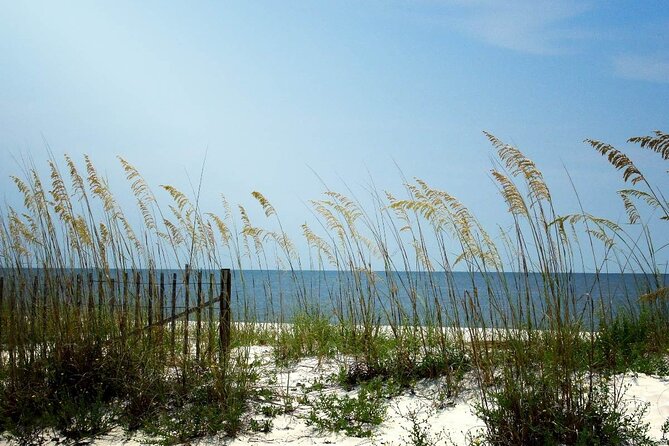
North Beach Park offers another easy roadside pause. The directions point out a large stone house and the parking lot just beyond it. That kind of detail matters in a self-guided drive because you are watching traffic, reading signs, and deciding quickly whether a stop suits you.
In Vilano Beach, the Bluebird of Happiness Statue adds a small, unusual landmark to the route. It is not a grand monument, and that is part of its appeal. A good road trip needs a few odd local details between the famous sights.
These stops work best for people who like collecting small moments along a drive. If you want only major attractions, you may prefer to keep moving toward the fort, lighthouse, and state park.
The Old Jail: pretty outside, grim inside
The Old Jail Museum appears more than once in the route details, with two different stories attached to it. The first explains why the building looks like a Victorian manor. Financier Henry Flagler wanted attractive architecture in St. Augustine, so even a jail was given a polished exterior.
That contrast is the point. The building’s appearance does not tell you much about its original purpose. The audio uses the architecture to introduce Flagler’s influence and the city’s preference for grand, decorative buildings.
The second story turns darker. Local tales describe the jail as haunted, with reports of cold hands, sewage smells, and an uneasy atmosphere. Treat that as folklore rather than proven fact, but it adds a bit of fun if you enjoy spooky history.
Admission to the Old Jail is not included as a separate paid visit because the audio tour itself does not charge admission for its stops. If you want to go inside the museum, check its entry arrangements separately. The tour gives you the background, but it does not provide a museum ticket or a guided interior visit.
Castillo de San Marcos and the coquina walls
Castillo de San Marcos is the historical centerpiece of the drive. Construction began in 1672 and took 23 years. The audio explains the practical problem faced by Spanish builders: the local coquina stone was porous, and they were unsure how it would respond to cannon fire.
Their answer was serious thickness. The fort walls reached almost 20 feet wide, giving you a clear reason for the massive appearance when you see the monument.
This is a place where the audio helps even if you already know the basic story. Instead of only telling you that the fort is old, it explains the building material and the military concern behind the design.
Admission to Castillo de San Marcos is not included. The audio tour can direct your attention to the monument and explain what you are seeing, but you need to handle any entry fee separately. If your schedule is tight, you can listen from the route and save an interior visit for another time.
Bridge of Lions and St. Augustine Lighthouse

The Bridge of Lions adds a quick architectural and civic detail. The two lions are named Fiel and Firme, meaning Faithful and Firm. Former mayor Andrew Anderson donated them as a tribute to city founder Pedro Menendez de Aviles, whose coat of arms included two lions.
This is a small story, but it helps you notice details that are easy to pass without thought. On a self-guided drive, those details can make a bridge feel connected to the city rather than just part of the road.
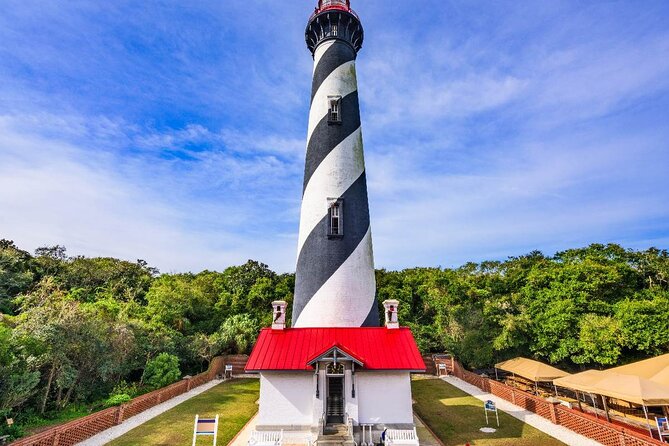
The St. Augustine Lighthouse offers a longer historical thread. The current tower dates from 1871, while earlier lighthouses occupied the site as far back as 1589. The audio also touches on lighthouse keepers who, according to local tales, never truly left.
The lighthouse is another stop where you should decide how much time you have. You can appreciate the story from the car, or plan a separate visit if you want to explore the site more fully. The tour does not promise a lighthouse entry ticket.
Anastasia State Park, Crescent Beach, and Fort Matanzas
Anastasia State Park is one of the best nature stops on the route. The park is home to 195 bird species, including familiar birds such as robins and herons and less common species found nowhere else in the country. You do not need to be a serious bird watcher to appreciate the change from city streets and historic buildings to open coastal habitat.
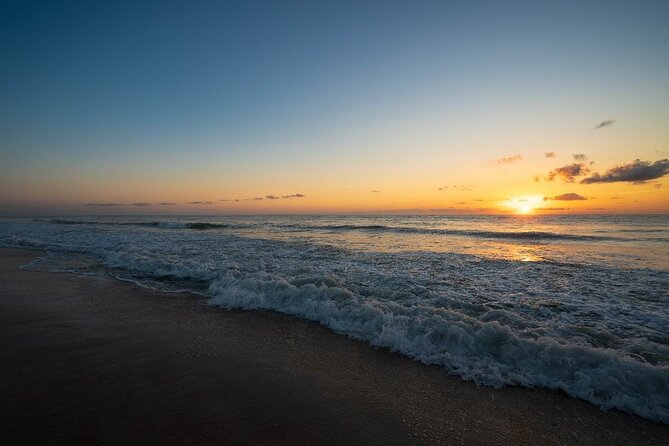
Crescent Beach brings you back to the shore. Its name comes from the curve of its coastline, and the audio points out its old Florida feel. From May through October, you might see areas connected with nesting sea turtles. Keep your expectations sensible: the tour can tell you when the season occurs, but it cannot promise a sighting.
Fort Matanzas National Monument gives the final section a military edge. The story reaches back to 1740, when the British governor of Georgia tried to challenge Spanish control of St. Augustine. The city’s mayor suspected trouble and sent a courier to Havana for supplies.
That story shows how exposed St. Augustine once was. The city’s position made it valuable, but it also left it open to attack by sea and along the waterways. The route does not simply point out a fort. It explains the pressure that made small defensive posts necessary.
The Matanzas River and its grim name
The Matanzas River looks peaceful, but its name means killings or slaughter in Spanish. The audio connects the name to events in 1565, when the river reportedly ran red with blood.
This is one of the tour’s more dramatic moments. It also shows the range of the narration. You move from beaches and bird habitat to warfare, colonial rivalry, and violence tied to the earliest period of Spanish settlement.
The story may feel heavy beside the calm water, but that contrast is useful. Coastal Florida is not only a place of beaches and leisure. The same waterways that make the area beautiful also shaped conflict, trade, settlement, and defense.
Price, app setup, and practical value
At $16.99 per group of up to four, the tour is inexpensive if you are sharing one car. A couple pays less than $9 each, and a full group of four pays about $4.25 per person. That is a better deal than a per-person bus tour if you already have a vehicle.
The value comes from flexibility more than luxury. You receive location-triggered narration, offline maps, route guidance, and lifetime access with no expiry. You can use it on another trip, pause for lunch, or split the drive across multiple days.
You do not receive food, drinks, attraction admission, or an in-person guide. You also need your own car and a phone with GPS and cellular capability. The recommended devices are an iPhone with iOS 15 or later, an Android phone running version 9 or later, or an iPad or tablet with GPS and cellular service.
Download the Action Tour Guide app before you leave. After booking, setup instructions and a password arrive by email and text. Search for audio tour if you do not see them quickly. Download the route while you have strong Wi-Fi or cellular service, then connect your phone to the car through Bluetooth, USB, or AUX.
Apple CarPlay is supported. Android Auto support is noted as forthcoming, so do not count on that connection if you use Android. If the audio misbehaves, contact support rather than trying to solve a technical problem while driving.
Who will enjoy this drive most
I would choose this tour for a couple, family, or small group that wants structure without a fixed schedule. It also suits you if beach stops, local stories, and short historical explanations sound better than a full-day museum program.
The audio format can be especially useful if someone in your group has limited mobility. One person using the beach or fort is not required for everyone to enjoy the route. You can remain in the car, view the coast, and follow the stories at your own pace.
It is less suitable if you want a live historian, detailed answers to spontaneous questions, or a carefully timed itinerary with guaranteed entry to attractions. The beginning may take a few minutes to figure out, so give yourself time to locate the first story point before pulling into the main flow of the route.
Should you book the Scenic A1A Byway tour?
Book it if you want an affordable coastal drive with enough history to make the scenery meaningful. The best parts are the freedom to stop anywhere, the excellent per-car price, the offline access, and the mix of beaches, wildlife, Timucuan culture, Spanish defense, and St. Augustine legends.
Skip it if you dislike app setup or want someone physically guiding you from start to finish. For most independent drivers, though, the low price and lifetime access make this a useful introduction to the Jacksonville to St. Augustine coast. Download it before you go, connect it to your stereo, and treat the two to three hours as the driving portion of a longer day.
FAQ
Where does the Scenic A1A Byway tour begin and end?
The tour begins at 7JQ5+67R in Jacksonville Beach and ends at 8635 A1A South in St. Augustine.
How long does the driving tour take?
The route is about 44 miles and takes approximately two to three hours to complete. Longer beach, park, meal, or museum stops will add time.
How much does the tour cost?
The price is $16.99 per group, covering up to four people in one car.
Does the price include attraction admission?
No. The audio tour does not include admission to places such as Castillo de San Marcos. Food and drinks are also not included.
Do I need cellular service during the drive?
You need strong Wi-Fi or cellular service to download the tour before starting. After the download, the tour works offline.
Is a guide present at the starting point?
No. This is a private, self-guided activity. You go to the starting point, open the Action Tour Guide app, and follow the location-triggered stories.
Can I use the tour more than once?
Yes. The tour provides lifetime access with no expiry. You can use it on another trip, pause it, continue over several days, or repeat the drive.
Latest audio tours in the USA
- Sequoia National Park Self-Guided Audio Tour★ 4.5 · 9 reviews
- Sequoia and Kings Canyon Audio Tour Self Guide National Park Tour★ 5.0 · 3 reviews
- Kings Canyon National Park Self-Guided Audio Tour★ 4.0 · 4 reviews
- Sedona, Arizona Self-Guided Audio Tour★ 4.0 · 36 reviews
- Sedona & Red Rock State Park Self-Guided Driving Audio Tour★ 3.0 · 30 reviews
- Haunted Savannah Self-Guided Walking Audio Tour★ 4.5 · 3 reviews
- Downtown Seattle Self-Guided Walking Audio Tour★ 4.5 · 6 reviews
- Uncover Seattle: Self-Guided Audio Tour★ 3.5 · 7 reviews
Driving Audio Tours, compared.



Ultimate Acadia National Park Self-Guided Driving Audio Tour
Read our review →



Browse the lists this tour appears in